💡 Direct Answer & Executive Summary (Dog Age to Human Years Calculator)
Definition: Convert canine calendar years into human age equivalents based on American Veterinary Medical Association (AVMA) breed weight class curves.
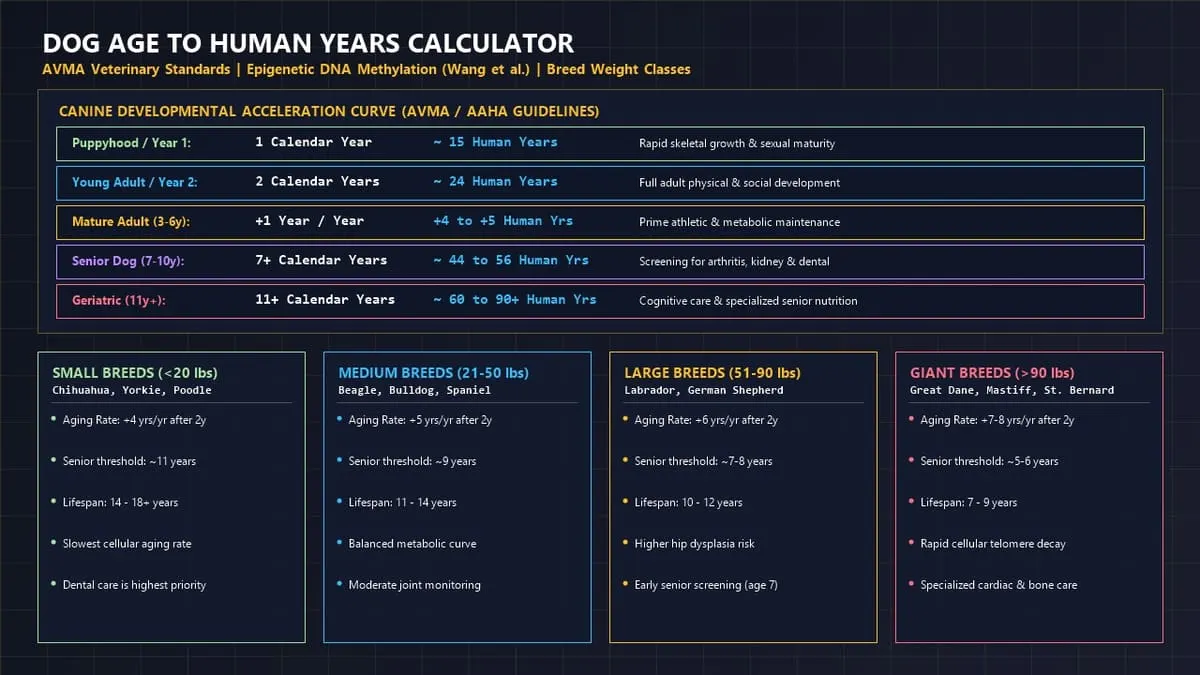
Governing Math Formula: Year 1 = 15 Human Yrs. Year 2 = +9 Yrs (24 Human Yrs). Years 3+ add +4 (Small <20lbs), +5 (Medium 21-50lbs), +6 (Large 51-90lbs), or +7-8 (Giant >90lbs) per calendar year.
Target Applications: Provides real-time quantitative solutions in Everyday Tools for students, engineers, researchers, and finance professionals.
Dog Age to Human Years Calculator: AVMA Guidelines, Epigenetics & Breed Weight Class Guide
1. Introduction
Is 1 dog year really equal to 7 human years?
For decades, the popular "Rule of 7" was the standard rule of thumb for pet owners. However, modern veterinary science, led by the American Veterinary Medical Association (AVMA), the American Animal Hospital Association (AAHA), and groundbreaking epigenetic DNA methylation research (Wang et al., UC San Diego), has completely debunked the simplistic $1:7$ ratio.
Canine biological development does not proceed in a flat linear line. Dogs mature at an astonishingly rapid rate during their first two years of life—reaching the biological equivalent of a 15-year-old human by age 1, and a 24-year-old human by age 2. Furthermore, unlike humans, a dog's breed size and adult weight dramatically dictate their cellular aging velocity. A 10-year-old Great Dane is a geriatric senior, whereas a 10-year-old Chihuahua is still in healthy middle age.
graph LR
    AGE_IN["🐕 Dog Calendar Age (Years)
e.g. 5 Years"] --> CURVE_ENG["🧬 Canine Epigenetic Aging Engine
Year 1 = 15 Human Yrs
Year 2 = +9 Yrs (24 Human Yrs)"]
    BREED_IN["⚖️ Breed Weight Class
Small (<20 lbs) | Medium (21-50) | Large (51-90) | Giant (>90)"] --> CURVE_ENG
    CURVE_ENG --> HUMAN_OUT["🧑 Equivalent Human Age: ≈ 39 Human Years"]
    CURVE_ENG --> STAGE_OUT["🩺 Canine Life Stage: Mature Adult"]
    CURVE_ENG --> VET_OUT["📋 Recommended Wellness Screening Frequency"]
Mastering canine age conversion enables dog owners, veterinarians, canine nutritionists, and animal shelters to:
- Translate calendar birthdays into true biological physiological maturity.
- Schedule timely geriatric and senior health screenings (monitoring for canine osteoarthritis, renal insufficiency, and cardiac disease).
- Adjust dietary caloric intake and protein balance as dogs transition from high-energy adulthood to senior metabolism.
- Recognize age-related cognitive dysfunction syndrome (CDS) in senior dogs.
- Understand the cellular biology behind why giant breeds age nearly twice as fast as toy breeds.
2. Definitions & Mathematical Formulations
2.1 The Simple Definition
- Canine Life Stage: The biological developmental phase of a dog (Puppy, Young Adult, Mature Adult, Senior, Geriatric).
- Epigenetic Aging (DNA Methylation): Chemical modifications to canine DNA that accumulate at predictable rates, measuring biological age at the molecular level.
- Weight Class Variance: The biological principle where larger canine breeds experience faster cellular telomere decay and shorter lifespans than small breeds.
2.2 Formal Mathematical Formulations
1. The Standard AVMA / AAHA Piecewise Model
For a dog of calendar age (in years) belonging to a specific weight class:
Where the Post-Year-2 Annual Aging Multiplier () is:
- Small Breeds ():
- Medium Breeds ():
- Large Breeds ():
- Giant Breeds ():
2. The Epigenetic Logarithmic Model (Wang et al., UCSD 2020)
Based on comparative DNA methylation between Labrador Retrievers and humans:
Where $\ln$ is the natural logarithm.
flowchart TD
    START["Input Dog Calendar Age A & Breed Weight Class"] --> AGE_CHECK{"Evaluate Dog Age A"}
    AGE_CHECK -->|"A ≤ 1 Year"| Y1["Human Age = A × 15 Human Years"]
    AGE_CHECK -->|"1 < A ≤ 2 Years"| Y2["Human Age = 15 + (A - 1) × 9 (Up to 24 Human Years)"]
    AGE_CHECK -->|"A > 2 Years"| Y3["Human Age = 24 + (A - 2) × R_breed"]
    Y3 --> BREED_SELECT{"Check Weight Class"}
    BREED_SELECT -->|Small <20 lbs| R4["R = +4 yrs/yr | Senior Age: 11 yrs"]
    BREED_SELECT -->|Medium 21-50 lbs| R5["R = +5 yrs/yr | Senior Age: 9 yrs"]
    BREED_SELECT -->|Large 51-90 lbs| R6["R = +6 yrs/yr | Senior Age: 7.5 yrs"]
    BREED_SELECT -->|Giant >90 lbs| R7["R = +7.5 yrs/yr | Senior Age: 6 yrs"]
    Y1 --> COMPILE["Determine Life Stage: Puppy, Young Adult, Mature, Senior, Geriatric"]
    Y2 --> COMPILE
    R4 --> COMPILE
    R5 --> COMPILE
    R6 --> COMPILE
    R7 --> COMPILE
    COMPILE --> DISPLAY["Display Human Age, Life Stage & Vet Screening Advice"]
3. Master Breed Weight Class & Aging Matrix
| Dog Calendar Age | Small (<20 lbs) (Chihuahua, Poodle) | Medium (21–50 lbs) (Beagle, Bulldog) | Large (51–90 lbs) (Labrador, Shepherd) | Giant (>90 lbs) (Great Dane, Mastiff) |
|---|---|---|---|---|
4. History & Scientific Evolution of Pet Aging
timeline
    title Milestones in Canine Chronometry & Veterinary Gerontology
    1268 : Inscription at Westminster Abbey calculates animal lifespans (1 human = 9 dogs)
    1950s : Popular culture establishes the simplistic '1 dog year = 7 human years' rule of thumb
    1997 : LeBeau publishes early non-linear canine physiological growth studies
    2019 : American Animal Hospital Association (AAHA) releases comprehensive Canine Life Stage Guidelines
2020 : University of California San Diego (Wang et al.) maps canine-human epigenetic DNA methylation clocks- Westminster Abbey Inscription (1268): One of the earliest documented historical comparisons recorded that dogs lived roughly one-ninth of a human's lifespan.
- The "Rule of 7" Myth (1950s): The 7-to-1 ratio was likely created by veterinary marketing campaigns in the mid-20th century based on an assumed 70-year human lifespan and a 10-year dog lifespan.
- The Epigenetic Clock Revolution (2020): Researchers at UCSD analyzed methyl groups on canine DNA genomes. They proved that while an 8-week-old puppy aligns with a 9-month-old human baby, canine methylation slows down in later years, following a logarithmic curve.
5. Step-by-Step Practical Walkthrough
Problem: Calculating Equivalent Human Age for an 8-Year-Old Golden Retriever
- Dog Age: .
- Breed: Golden Retriever () Large Breed Weight Class ().
- Parameters:- Base age after 2 years = .- Large breed annual rate .
Step-by-Step Execution:
- Apply the Piecewise Formula:
- Compute Multiplication:
- Determine Life Stage:- For Large breeds, the senior transition age is .- At 8 years (60 human years), the Golden Retriever has entered the Senior Canine Stage.
- Clinical Recommendation:- Transition to senior joint mobility diet (Glucosamine/Chondroitin).- Schedule twice-annual veterinary exams with routine blood panels (CBC, chemistry, urinalysis).
6. Real-World Applications
graph TD
    DOG_APP["🐕 Canine Health Applications"] --> NUTRITION["🥩 Life-Stage Nutrition
Adjusting protein and phosphorus for kidney preservation"]
    DOG_APP --> SCREENING["🩺 Preventative Veterinary Care
Twice-yearly blood pressure, dental & arthritis monitoring"]
    DOG_APP --> SHELTER["🏠 Rescue & Shelter Adoption
Estimating biological age and dental wear for stray dogs"]
    DOG_APP --> PHARMA["💊 Veterinary Pharmacology
Dosage adjustments based on geriatric hepatic & renal clearance"]
7. Frequently Asked Questions (FAQ)
Why is the "Rule of 7" inaccurate?
Because puppies mature rapidly during their first two years (reaching human adulthood by age 2), and large breeds age much faster than small breeds in their senior years.
What is considered a "Senior Dog"?
A dog is considered senior when they reach the last :
- Giant Breeds: Age 5 to 6.
- Large Breeds: Age 7 to 8.
- Medium Breeds: Age 9 to 10.
- Small Breeds: Age 11 to 12.
Why do giant dog breeds age faster than small breeds?
Studies suggest giant breeds grow at an accelerated rate from puppyhood, leading to higher levels of free radical damage, faster telomere shortening, and earlier onset of age-related diseases like cancer and dilated cardiomyopathy.
What is the oldest dog on record?
According to Guinness World Records, Bobi (a Rafeiro do Alentejo from Portugal) reportedly lived over 30 calendar years.
How often should senior dogs visit the veterinarian?
The AAHA recommends that all senior dogs receive comprehensive wellness checkups every 6 months rather than once a year.
8. Summary Checklist
- ✔ Enter Dog Calendar Age: Specify exact age in years.
- ✔ Select Breed Weight Class: Choose Small, Medium, Large, or Giant.
- ✔ Review Equivalent Human Age: Understand your dog's physiological maturity.
- ✔ Follow Senior Screening Advice: Schedule twice-yearly checkups if senior.
Additional Technical Guidelines & Measurement Standards
When conducting calculations for Dog Age to Human Years Calculator, maintaining quantitative precision and verifying input parameter boundaries is essential for reliable scenario evaluation. Always verify that raw numerical inputs are measured using standardized instrumentation, and double-check unit conversions prior to applying outputs in commercial, industrial, or academic projects.
For quantitative unit conversions and scientific calculations, always maintain at least four decimal places of precision during intermediate arithmetic stages before rounding final results. When preparing technical reports, laboratory documentation, or financial forecasts, cross-verify all output variables against established international measurement standards (such as SI, NIST, and ISO metric benchmarks) to guarantee consistent analytical rigor across all computational workflows.
MathsLover.com delivers this interactive solver 100% free of charge to foster global mathematical literacy, educational accessibility, and data-driven problem solving across scientific, technical, and academic communities worldwide.