💡 Direct Answer & Executive Summary (Leap Year Calendar Status Checker)
Definition: Determine whether any Gregorian calendar year is a Leap Year (366 days) or a Common Year (365 days) according to the 400-year astronomical rule.
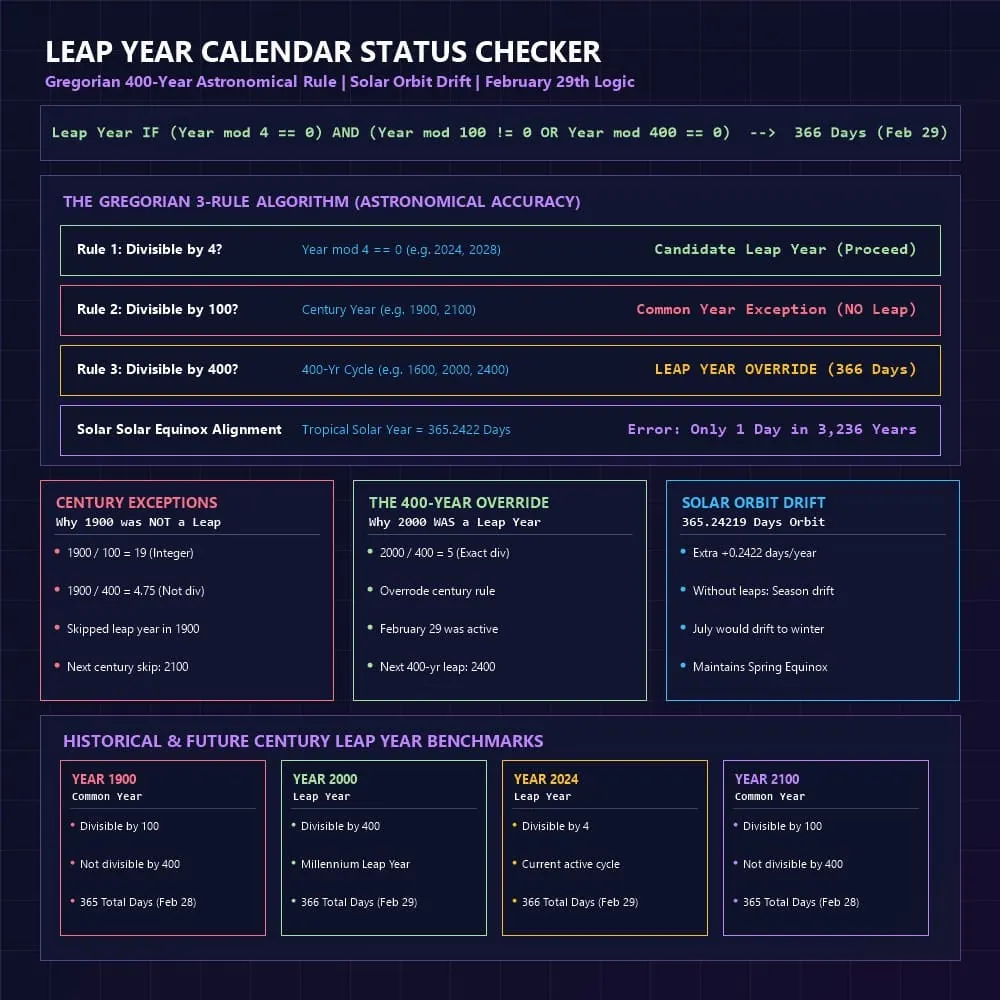
Governing Math Formula: Leap Year Rule: Year is a leap year IF divisible by 4 AND (NOT divisible by 100 OR divisible by 400). Example: 2000 & 2024 are leap years; 1900 & 2100 are common years.
Target Applications: Provides real-time quantitative solutions in Everyday Tools for students, engineers, researchers, and finance professionals.
Leap Year Calendar Status Checker: Gregorian 400-Year Astronomical Rules & Solar Drift Guide
1. Introduction
Why does our calendar occasionally add an extra 29th day to February? Why was the year 2000 a leap year, while the year 1900 was not, and the future year 2100 will also be a standard 365-day common year?
The concept of a Leap Year (Intercalary Year) is a brilliant mathematical and astronomical correction. The Earth does not orbit the Sun in precisely 365 days; a true tropical solar year (the time between vernal equinoxes) is approximately 365.24219 solar days (). Without an extra intercalary day added every 4 years, our calendar would drift by approximately 1 day every 4 years, shifting the seasons by nearly a full month every 120 years and eventually placing Christmas in the scorching northern summer.
graph LR
    YEAR_IN["📅 Target Year (YYYY)
e.g. 2000, 2024, 2100"] --> RULE1{"Rule 1: Divisible by 4?
Year mod 4 == 0"}
    RULE1 -->|"No"| COMMON1["❌ Common Year (365 Days)
February has 28 Days"]
    RULE1 -->|"Yes"| RULE2{"Rule 2: Divisible by 100?
Century Year mod 100 == 0"}
    RULE2 -->|"No"| LEAP1["✨ Standard Leap Year (366 Days)
February has 29 Days"]
    RULE2 -->|"Yes"| RULE3{"Rule 3: Divisible by 400?
Year mod 400 == 0"}
    RULE3 -->|"No"| COMMON2["❌ Century Common Year (365 Days)
e.g. 1900, 2100"]
    RULE3 -->|"Yes"| LEAP2["🌟 400-Year Override Leap Year (366 Days)
e.g. 1600, 2000, 2400"]
Mastering leap year mathematics and Gregorian calendar rules enables astronomers, software engineers, financial analysts, and historians to:
- Implement the exact 3-step Gregorian leap year algorithm without software bugs (preventing famous leap-year coding crashes).
- Understand why Pope Gregory XIII excised 10 days from the calendar in October 1582 to correct Julian calendar drift.
- Calculate exact day counts for annual bond interest accruals (e.g., Actual/365 vs. Actual/360 financial day-count conventions).
- Determine when someone born on February 29 (a "Leapling") celebrates their legal non-leap birthdays (February 28 vs. March 1).
- Forecast the next upcoming leap years for project milestones and multi-decade planning.
2. Definitions & Mathematical Formulations
2.1 The Simple Definition
- Tropical Solar Year: The exact time it takes the Earth to complete one full revolution around the Sun ().
- Common Year: A standard calendar year with 365 days (February has 28 days).
- Leap Year: A calendar year containing 366 days (an intercalary day, February 29th, is added to synchronize with the solar cycle).
- Century Rule Exception: Years divisible by 100 are NOT leap years unless they are also evenly divisible by 400.
2.2 Formal Mathematical Formulations
1. The Gregorian Leap Year Boolean Predicate
A year is a leap year if and only if the logical expression evaluates to true:
Where:
- is the integer modulo operator.
- $\land$ denotes logical AND.
- $\lor$ denotes logical OR.
2. Average Gregorian Calendar Year Length
In every 400-year Gregorian cycle, there are:
- total calendar years.
- years divisible by .
- Minus century years ($100, 200, 300, 400$).
- Plus century year divisible by ().
- Total Leap Years in 400 Years = .
3. Residual Astronomical Error
The difference between the Gregorian calendar () and the actual astronomical tropical year () is:
flowchart TD
    START["Input Year Y (Integer)"] --> DIV4{"Is Y % 4 == 0?"}
    DIV4 -->|"No"| NOT_LEAP["Result: Common Year (365 Days)"]
    DIV4 -->|"Yes"| DIV100{"Is Y % 100 == 0?"}
    DIV100 -->|"No"| IS_LEAP["Result: Standard Leap Year (366 Days)"]
    DIV100 -->|"Yes"| DIV400{"Is Y % 400 == 0?"}
    DIV400 -->|"No"| NOT_LEAP_CENT["Result: Century Common Year (365 Days)"]
    DIV400 -->|"Yes"| IS_LEAP_400["Result: 400-Year Override Leap Year (366 Days)"]
    NOT_LEAP --> DISPLAY["Display February 28 Days + Days in Year: 365"]
    NOT_LEAP_CENT --> DISPLAY
    IS_LEAP --> DISPLAY_LEAP["Display February 29 Days + Days in Year: 366"]
    IS_LEAP_400 --> DISPLAY_LEAP
3. History & Astronomical Milestones
timeline
    title History of the Calendar & Leap Year Corrections
    45 BCE : Julius Caesar institutes Julian Calendar (365.25 days, leap year every 4 years)
    325 CE : Council of Nicaea fixes Spring Equinox on March 21 for Easter calculations
    1582 : Pope Gregory XIII introduces Gregorian Calendar, excising 10 drift days
    1752 : Great Britain & American Colonies adopt Gregorian calendar, skipping 11 days
    2000 : Millennium 400-year leap year celebrated globally without Y2K calendar bugs
2100 : Next upcoming Century Common Year exception (Leap year will be skipped)- The Julian Calendar (45 BCE): Advised by the Alexandrian astronomer Sosigenes, Julius Caesar reformed the Roman calendar, setting the year length to with a leap year every 4 years.
- The 11-Minute Julian Drift: Because $365.25$ is slightly longer than $365.2422$, the Julian calendar gained approximately 11 minutes and 14 seconds per year (1 full day every 128 years). By 1582, the spring equinox had drifted from March 21 to March 11.
- The Gregorian Reform (1582): Pope Gregory XIII issued the papal bull Inter gravissimas, dropping 10 days from October (October 4, 1582 was followed immediately by October 15, 1582) and establishing the 400-year century rule.
- British Adoption (1752): When the British Empire and American colonies transitioned to the Gregorian calendar in September 1752, they had to skip 11 days (September 2 was followed by September 14), leading to famous historical "calendar riots."
4. Master Benchmark Matrix: Historic & Future Years
| Target Year | Divisible by 4? | Divisible by 100? | Divisible by 400? | Calendar Status | Total Days | February Days |
|---|---|---|---|---|---|---|
| 1600 | Yes () | Yes () | Yes () | 🌟 Leap Year | ||
| 1700 | Yes () | Yes () | No ($4.25$) | ❌ Common Year | ||
| 1800 | Yes () | Yes () | No ($4.50$) | ❌ Common Year | ||
| 1900 | Yes () | Yes () | No ($4.75$) | ❌ Common Year | ||
| 2000 | Yes () | Yes () | Yes () | 🌟 Leap Year | ||
| 2024 | Yes () | No ($20.24$) | — | ✨ Leap Year | ||
| 2028 | Yes () | No ($20.28$) | — | ✨ Leap Year | ||
| 2100 | Yes () | Yes () | No ($5.25$) | ❌ Common Year | ||
| 2400 | Yes () | Yes () | Yes () | 🌟 Leap Year |
5. Step-by-Step Practical Walkthroughs
Example 1: Checking the Year 2024
- Rule 1 (Divisible by 4):
- Rule 2 (Divisible by 100):
- Conclusion: Because 2024 is divisible by 4 and is not a century year, it is a Standard Leap Year with 366 total days and 29 days in February.
Example 2: Checking the Year 2100
- Rule 1 (Divisible by 4):
- Rule 2 (Divisible by 100):
- Rule 3 (Divisible by 400):
- Conclusion: Even though 2100 is divisible by 4, it is a century year not divisible by 400. Therefore, 2100 is a Common Year with 365 total days and 28 days in February.
6. Real-World Applications
graph TD
    LEAP_APP["📅 Leap Year Practical Applications"] --> SOFTWARE["💻 Software & Database Systems
Preventing DateTime overflow & leap day crash bugs"]
    LEAP_APP --> FINANCE["💰 Financial Day-Count Accruals
Actual/365 & Actual/360 bond interest coupon yields"]
    LEAP_APP --> LEGAL["⚖️ Legal Birthdays & Contracts
Determining legal age of adulthood for Leaplings (Feb 29)"]
    LEAP_APP --> ASTRONOMY["🔭 Space Navigation & Ephemeris
Orbital trajectory calculations and satellite epoch time"]
1. Software Engineering & The "Leap Day Bug"
Poorly coded date parsers that assume February always has 28 days (or that all years divisible by 4 are leap years) crash on February 29. Prominent outages have historically impacted airline booking engines, banking ATMs, and gaming consoles (such as the Sony PS3 "ApocalyPS3" bug in 2010).
2. Financial Day-Count Conventions
Bond markets calculate daily accrued interest using standardized conventions:
- Actual/Actual (ICMA): Uses 366 days during leap years and 365 during common years.
- Actual/360: Uses exact days divided by a 360-day commercial base.
3. Legal Status of "Leaplings" (Born Feb 29)
In most jurisdictions (such as the UK and US), a person born on February 29 legally turns 18 or 21 on March 1 in non-leap years, while in countries like Taiwan and New Zealand, legal adulthood takes effect on February 28.
7. Common Leap Year Misconceptions
Beware of these three persistent calendar myths:
- "Every 4th Year is Always a Leap Year": False! Century years like 1700, 1800, 1900, 2100, 2200, and 2300 skip the leap year.
- "The Gregorian Calendar is 100% Perfect": The Gregorian calendar still drifts by ~1 day every 3,225 years. Future astronomers may need to skip the leap year in the year 4000 or 4800.
- "Leap Seconds are the Same as Leap Days": Leap Days correct for the Earth’s 365.2422-day solar orbit around the Sun. Leap Seconds correct for minute fluctuations in the Earth’s rotational speed on its own axis.
8. Frequently Asked Questions (FAQ)
What is the exact mathematical rule for a leap year?
A year is a leap year if it is divisible by 4, unless it is divisible by 100, in which case it must also be divisible by 400.
Why was 2000 a leap year but 1900 was not?
Both are divisible by 100, but 2000 is divisible by 400 (), making it a leap year, while 1900 is NOT divisible by 400 (), making it a common year.
How many days are in a leap year?
A leap year has 366 days (an extra 29th day is added to February).
When is the next century year that will NOT be a leap year?
The year 2100 will be a common year (365 days) because .
What is someone born on February 29 called?
A person born on February 29 is called a "Leapling" or "Leaper."
How often do leap years occur?
Leap years occur 97 times every 400 years, averaging approximately once every .
Why is February the shortest month?
Under the ancient Roman calendar of Romulus, the year began in March, and February was the last month of the calendar year, making it the natural place to add or subtract intercalary days.
What is the difference between the Julian and Gregorian calendars?
The Julian calendar had a leap year every 4 years (). The Gregorian calendar introduced the century exception rule (), eliminating 3 leap days every 400 years to prevent seasonal drift.
What code represents a leap year in JavaScript?
const isLeap = (year) => (year % 4 === 0 && year % 100 !== 0) || (year % 400 === 0);Will the year 3000 be a leap year?
No. , so the year 3000 will be a common year with 365 days.
9. Summary Checklist
- ✔ Check Modulo 4: Verify if
Year % 4 == 0.
- ✔ Check Century Modulo 100: If divisible by 100, verify if
Year % 400 == 0.
- ✔ Determine Days in February: 29 days if Leap Year, 28 days if Common Year.
- ✔ Calculate Total Year Days: 366 days (Leap) vs. 365 days (Common).
- ✔ Forecast Upcoming Leap Years: Identify next active intercalary cycle.
Additional Technical Guidelines & Measurement Standards
When conducting calculations for Leap Year Calendar Status Checker, maintaining quantitative precision and verifying input parameter boundaries is essential for reliable scenario evaluation. Always verify that raw numerical inputs are measured using standardized instrumentation, and double-check unit conversions prior to applying outputs in commercial, industrial, or academic projects.
For quantitative unit conversions and scientific calculations, always maintain at least four decimal places of precision during intermediate arithmetic stages before rounding final results. When preparing technical reports, laboratory documentation, or financial forecasts, cross-verify all output variables against established international measurement standards (such as SI, NIST, and ISO metric benchmarks) to guarantee consistent analytical rigor across all computational workflows.
MathsLover.com delivers this interactive solver 100% free of charge to foster global mathematical literacy, educational accessibility, and data-driven problem solving across scientific, technical, and academic communities worldwide.