💡 Direct Answer & Executive Summary (Wall Paint Gallons Calculator)
Definition: Calculate exact gallons and quarts of interior wall paint and primer required based on room dimensions, doors, windows, and number of coats.
Governing Math Formula: Net Paint Area = [Perimeter × Wall Height - (Doors × 21 + Windows × 15)] × Number of Coats. Gallons = Net Area / 350 sq ft per gallon.
Target Applications: Provides real-time quantitative solutions in Everyday Tools for students, engineers, researchers, and finance professionals.
Wall Paint Gallons Calculator: Comprehensive Interior Wall Painting & Coverage Guide
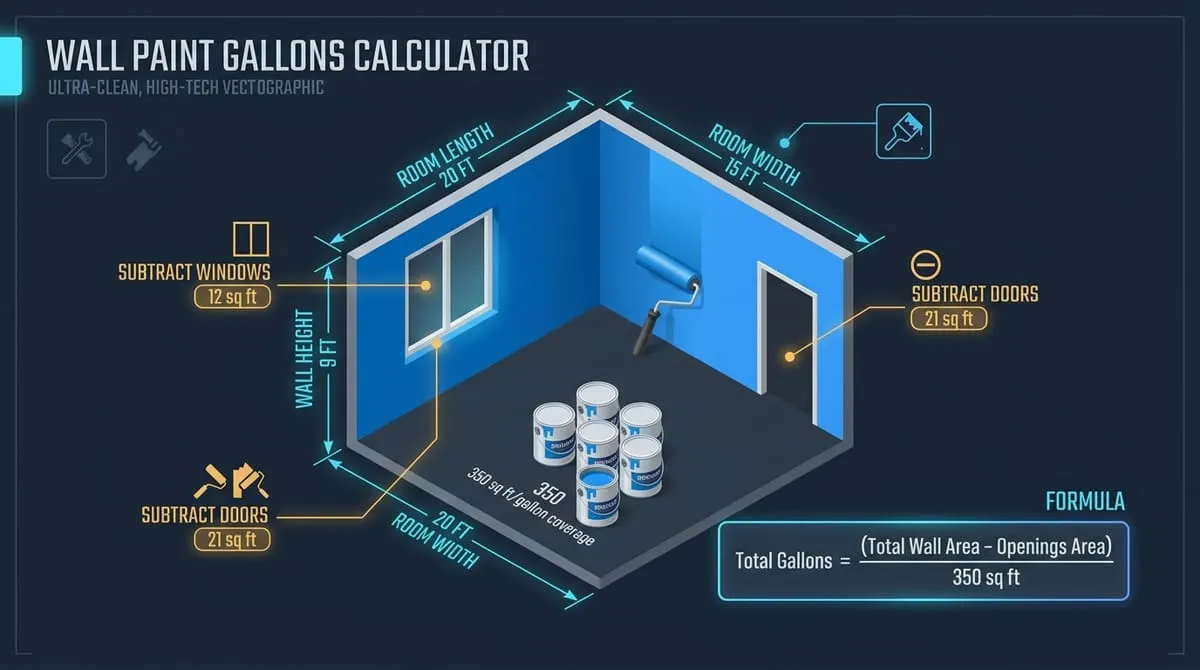
1. Introduction
Transforming an interior living space with a fresh coat of paint is one of the most cost-effective and visually impactful home improvement projects possible. However, walking into a paint retailer or home improvement center without an accurate mathematical estimate of required paint gallons often leads to one of two frustrating outcomes: buying too little paint and running out midway across an accent wall (risking visible "lap marks" when a newly mixed can is blended days later), or purchasing expensive surplus gallons that sit unused in a garage.
Calculating interior paint requirements is far more sophisticated than simply multiplying room length by width. It requires computing total three-dimensional vertical wall perimeter, subtracting architectural openings for doors, archways, and window casings, factoring in surface porosity (drywall vs. plaster vs. textured masonry), and accounting for multiple coating layers (primer + 2 finish coats).
graph LR
    PERIM["📐 Room Perimeter (2L + 2W)
Linear Feet Around All 4 Walls"] --> GROSS["🧱 Gross Wall Area
Gross Area = Perimeter × Wall Height"]
    HEIGHT["📏 Ceiling / Wall Height (ft)
Standard 8ft, 9ft, 10ft, or Vaulted"] --> GROSS
    OPEN["🚪 Openings Deduction
Doors (21 sq ft) + Windows (15 sq ft)"] --> NET["🟦 Net Paintable Surface
Net Area = Gross Area - Openings"]
    GROSS --> NET
    COATS["🖌️ Number of Coating Layers
1 Coat (Refresh) or 2 Coats (Standard)"] --> TOTAL_SQFT["📊 Total Square Footage Coverage"]
    NET --> TOTAL_SQFT
    TOTAL_SQFT --> DIV_COV["➗ Divided by Paint Spread Rate
Standard: 350 sq ft per Gallon"]
    DIV_COV --> CANS["🎨 Paint Cans Required
Whole Gallons + Touch-up Quarts"]
Mastering interior painting mathematics enables homeowners, professional painting contractors, property managers, and interior designers to:
- Accurately project total gallon and quart requirements for single rooms or entire residential properties.
- Quantify primer volume for raw drywall, unpainted wood, patched spackle, or drastic color transitions.
- Understand the financial and qualitative differences between flat, matte, eggshell, satin, semi-gloss, and high-gloss paint sheens.
- Prevent visible flashing, roller stipple inconsistencies, and dry-edge lap lines.
- Calculate paint spread rates across smooth, drywall, orange-peel texture, knockdown, and porous masonry surfaces.
2. Definitions & Mathematical Formulations
2.1 The Simple Definition
- Room Perimeter: The total distance measured along the floor around all four walls ().
- Gross Wall Area: The total vertical square footage of all four walls before deducting openings.
- Openings Deduction: The square footage subtracted for doors () and windows () that will not receive wall paint.
- Net Wall Area: The actual square footage of wall surface requiring paint.
- Paint Spread Rate (Coverage): The surface area covered by a single gallon of paint (industry standard benchmark: 350 sq ft/gallon).
2.2 Formal Mathematical Formulations
1. Room Perimeter ()
For a rectangular room with Length () and Width () in feet:
2. Gross Wall Area ()
Multiplying room perimeter by the ceiling/wall height ():
3. Architectural Openings Deduction ()
Standard architectural deductions:
- Standard Interior Door ():
- Standard Window ():
4. Net Single-Coat Wall Area ()
5. Total Paint Surface Coverage ()
Multiplying by the number of desired coating layers ():
6. Total Paint Gallons Required ()
Dividing total square footage by the standard paint spread rate ():
flowchart TD
    START["Measure Room: Length, Width, Height"] --> PERIM_CALC["Perimeter = 2 × (Length + Width)"]
    PERIM_CALC --> GROSS_CALC["Gross Wall Area = Perimeter × Wall Height"]
    GROSS_CALC --> DEDUCT["Count Doors (× 21 sq ft) & Windows (× 15 sq ft)"]
    DEDUCT --> NET_CALC["Net Single-Coat Area = Gross Area - Deductions"]
    NET_CALC --> COAT_MULT["Multiply by Coating Layers (Standard = 2 Coats)"]
    COAT_MULT --> DIV_350["Divide by 350 sq ft per Gallon"]
    DIV_350 --> CEIL_GAL["Round UP to Whole Gallons (or Gallons + 1 Quart)"]
    CEIL_GAL --> ORDER["Purchase Paint + Dedicated Primer Can"]
3. Historical Timeline of Architectural Paint & Pigment Chemistry
timeline
    title Milestones in Paint Chemistry & Coatings Technology
    1700s : Linseed oil and lead carbonate ground by hand with mineral pigments
    1867 : D.R. Averill patents first prepared, ready-mixed commercial liquid paint
    1941 : Sherwin-Williams introduces Kem-Tone, the world's first water-based latex paint
    1978 : US Consumer Product Safety Commission bans lead-based residential paint
    2000s : Zero-VOC (Volatile Organic Compounds) and low-odor green formulations emerge
Modern : Self-priming acrylic-ceramic hybrids with superior scrubbability and stain-block- Early Hand-Ground Oil Paints (1700s): Early American and European painters ground natural iron oxides, chalk, and toxic white lead carbonate into boiled linseed oil on site.
- The First Ready-Mixed Can (1867): Chemist D.R. Averill patented the first factory-sealed ready-mixed paint in Ohio, eliminating the laborious process of hand-mixing pigments on construction sites.
- The Water-Based Latex Revolution (1941): During WWII material shortages, Sherwin-Williams developed Kem-Tone, a water-thinned synthetic resin emulsion paint that dried rapidly without harsh petroleum solvent fumes.
- The 1978 Lead Ban & Zero-VOC Era: Federal regulations prohibited toxic lead additives in 1978, paving the way for modern 100% acrylic and cross-linking ceramic polymers delivering scrub-resistant finishes with zero harmful volatile organic compound emissions.
4. Master Paint Sheen Comparison & Room Suitability Matrix
Selecting the appropriate paint sheen balances aesthetic light reflection against durability, moisture resistance, and washability:
| Paint Sheen Finish | Light Reflectivity | Washability / Scrub Resistance | Imperfection Concealment | Recommended Room Applications |
|---|---|---|---|---|
| Flat / Matte | 0% - 5% (No glare) | Low (burnishes if scrubbed hard) | Highest (Hides drywall flaws) | Master bedrooms, formal dining rooms, ceilings |
| Eggshell | 10% - 25% (Soft glow) | Moderate to High | Good | Living rooms, guest bedrooms, home offices, hallways |
| Satin | 25% - 35% (Velvety pearl) | High (easy damp wipe-down) | Moderate | Family rooms, kids' playrooms, foyers, kitchens |
| Semi-Gloss | 35% - 70% (Sleek shine) | Very High (Moisture & grease resistant) | Low (highlights dents) | Bathrooms, kitchens, laundry rooms, doors, trim & baseboards |
| High Gloss | 70% - 90% (Mirror-like) | Maximum (Hardest protective film) | Lowest (Shows all imperfections) | Architectural millwork, cabinets, banisters, metal railings |
5. Step-by-Step Calculation Walkthrough
Let us calculate the exact paint and primer requirements for a Master Bedroom Suite measuring 20 ft long by 15 ft wide with 9 ft ceilings, containing 2 standard interior doors and 2 double windows, receiving 2 coats of premium eggshell paint.
graph TD
    subgraph "Master Bedroom Paint Calculation"
        P_IN["📐 Perimeter: 2 × (20 + 15) = 70 Linear Feet"]
        G_IN["🧱 Gross Wall Area: 70 ft × 9 ft = 630 sq ft"]
        P_IN --> G_IN
        D_IN["🚪 Deductions: 2 Doors (42 sq ft) + 2 Windows (30 sq ft) = 72 sq ft"]
        G_IN --> N_IN["🟦 Net Single Coat: 630 - 72 = 558 sq ft"]
        D_IN --> N_IN
        N_IN --> T_IN["🎨 2-Coat Total Area: 558 × 2 = 1,116 sq ft"]
        T_IN --> G_OUT["🛒 Gallons: 1,116 / 350 = 3.19 → Buy 4 Gallons (or 3 Gal + 1 Qt)"]
    end
Step 1: Compute Room Perimeter
Step 2: Calculate Gross Wall Surface Area
Step 3: Deduct Openings (Doors & Windows)
- 2 Doors:
- 2 Windows:
- Total Openings Deduction:
Step 4: Calculate Net Single-Coat Wall Area
Step 5: Multiply by Number of Coats (2 Coats Standard)
Step 6: Determine Gallons Required
- Purchase Recommendation: Order 4 Gallons (or 3 Gallons + 1 Quart). Having approximately remaining provides ample reserve for future scuff touch-ups.
- Dedicated Primer (1 Coat): .
6. Surface Texture & Substrate Porosity Factor Matrix
The texture and porosity of the wall substrate alter practical paint coverage:
| Wall Substrate & Texture Profile | Surface Characteristics | Real-World Spread Rate | Gallon Adjustment Factor |
|---|---|---|---|
| Smooth Level 5 Drywall (Pre-Primed) | Uniform, non-porous, smooth paper | Multiply gallons by $0.90$ | |
| Standard Level 4 Drywall (Previously Painted) | Standard residential interior walls | Baseline standard ($1.00$) | |
| Light Orange Peel Texture | Subtle sprayed droplet texture | Multiply gallons by $1.10$ | |
| Heavy Knockdown / Slump Texture | Troweled peaks and valleys | Multiply gallons by $1.25$ | |
| Raw Unpainted Plaster / Drywall | High absorption rate (thirsty substrate) | Apply | |
| Unsealed Concrete Block / Brick Masonry | Open capillary pores, rough surface | Apply heavy block filler first |
7. Real-World Case Studies in Paint Estimating
graph TD
    subgraph "Case 1: The Dark Navy to Pale Cream Transition"
        C1["Dark Navy Accent Wall (300 sq ft)"] --> C2["Skipped Primer → Applied 2 Coats Pale Cream"]
        C2 --> C3["Dark Blue Shadow Bled Through (Visible Under Daylight)"]
        C3 --> C4["Forced to Buy 2 Extra Gallons for Coats 3 & 4 (Costing Extra $120)"]
    end
    subgraph "Case 2: Ceiling Paint Strategy"
        CEIL1["Living Room 15ft × 20ft = 300 sq ft Ceiling Area"] --> CEIL2["Flat White Ceiling Paint (350 sq ft/gal)"]
        CEIL2 --> CEIL3["2 Coats = 600 sq ft Coverage → 1.71 Gal → 2 Gallons Purchased"]
    end
Case Study 1: The "Paint + Primer in One" Myth on Dark Walls
- Scenario: David painted over a deep navy accent wall with a light beige color, relying on a "Paint & Primer in One" claim without applying a dedicated high-hide stain-blocking primer.
- Outcome: After two coats dried, the dark undertone bled through unevenly around corners. David was forced to purchase two additional gallons and apply two more coats, doubling his labor time and increasing total material expenses by $120.
- Lesson: Drastic color transitions (dark to light) always require a dedicated white stain-blocking primer before applying finish paint.
Case Study 2: Calculating Ceiling Paint Requirements
- Dimensions: living room ( ceiling area).
- Calculation: Because ceilings do not have doors or windows, the net area equals the room floor area:
8. Crucial Advantages of Accurate Paint Calculations
graph LR
    ACC_PAINT["🎨 Accurate Paint Volume Calculation"] --> NO_STALL["⏱️ Prevents Mid-Job Stalls & Dry-Edge Lap Marks"]
    ACC_PAINT --> BATCH["🛢️ Enables 'Boxing' Paint for Flawless Color Uniformity"]
    ACC_PAINT --> MONEY["💵 Prevents Wasteful Overspending on Extra Specialty Gallons"]
ACC_PAINT --> TOUCH["🖌️ Guarantees Perfect Touch-Up Reserves for 5+ Years"]- Flawless "Boxing" for Color Consistency: Retail tint dispensers experience microscopic variance from can to can. Buying all cans simultaneously allows painters to "box" the paint (pouring all gallons together into a 5-gallon bucket), guaranteeing 100% seamless color uniformity across all walls.
- Eliminates Dry-Edge Lap Marks: Stopping midway across a wall to buy more paint causes the leading edge to dry. When fresh paint is rolled over a dry edge, a permanent visible seam (lap mark) forms.
- Optimizes Budgeting: Premium architectural paints cost $\$50\text{ to }\$90\text{ per gallon}$; estimating accurately prevents buying unnecessary surplus cans.
- Touch-Up Reserve: Keeping a sealed quart of the original batch allows invisible scuff repairs years later without repainting the entire room.
9. Common Mistakes in Paint Estimating & How to Avoid Them
Avoid these four common pitfalls when preparing your painting project:
- Assuming One Coat is Sufficient: Even top-tier "one-coat guarantee" paints rarely achieve full visual depth, sheen uniformity, and micro-pinhole coverage in a single coat. Always budget for 2 full coats.
- Ignoring Baseboards, Trim, and Ceilings: Wall paint calculators cover vertical walls only. Trim, baseboards, doors, and ceilings require separate gallons of semi-gloss and flat white paint.
- Over-Deducting Window and Door Areas: In small powder rooms, do not over-subtract openings if doors are trimmed with wide decorative casings that still require detailed brushwork.
- Failing to Stir and Box Gallons: Always stir cans thoroughly from the bottom up to redistribute settled colorant pigments before pouring into rolling trays.
10. Frequently Asked Questions (FAQ)
How many square feet does one gallon of paint cover?
One standard gallon of interior wall paint covers approximately 350 to 400 square feet with one coat on smooth, pre-primed drywall. On textured or porous unpainted surfaces, coverage drops to 250 to 300 square feet per gallon.
Do I really need 2 coats of paint?
Yes. Two coats provide superior color saturation, hide underlying drywall seams, ensure uniform sheen, and establish a thick protective film that withstands scrubbing and washing.
How do I calculate paint for a ceiling?
Multiply the length of the room by the width (). For two coats, multiply the resulting square footage by 2, then divide by 350 sq ft/gal.
What is the formula for calculating room paint?
How much wall area does a standard door and window take up?
- Standard interior door (): 21 square feet.
- Standard window (): 15 square feet.
What is "boxing" paint and why is it important?
Boxing paint involves pouring multiple individual 1-gallon cans into a large 5-gallon bucket and stirring them together. This eliminates subtle factory tint variations between individual cans, ensuring uniform color across your entire room.
How much paint do I need for doors and trim?
As a general rule, 1 gallon of semi-gloss trim paint is sufficient to cover baseboards, door frames, and crown molding in an average home.
How long does an opened can of paint last?
When tightly sealed with a plastic mallet in a climate-controlled room (avoiding freezing temperatures), leftover latex paint lasts 5 to 10 years for future touch-ups.
What is the difference between latex and oil-based paint?
Latex (water-based) paint dries quickly, produces minimal odor, cleans up with soap and water, and is the standard for interior drywall. Oil-based (alkyd) paint cures into an ultra-hard, durable finish, making it ideal for high-traffic cabinetry, metal railings, and exterior trim.
When should I use primer before painting?
You should always prime when: painting bare drywall/wood, covering glossy oil-based paints with water-based latex, sealing water/smoke stains, or switching drastically from dark to light colors.
11. Summary Checklist
- ✔ Measure Wall Perimeter & Height: Calculate gross vertical wall square footage ().
- ✔ Subtract Openings: Deduct per door and per window.
- ✔ Select Coating Layers: Budget for 2 finish coats for optimal depth and durability.
- ✔ Apply Spread Rate: Divide total square footage by .
- ✔ Round UP to Whole Gallons: Ensure adequate paint for full coverage and reserve touch-up storage.
- ✔ Select Primer & Sheen: Choose eggshell/satin for walls, semi-gloss for trim, and flat for ceilings.
Additional Technical Guidelines & Measurement Standards
When conducting calculations for Wall Paint Gallons Calculator, maintaining quantitative precision and verifying input parameter boundaries is essential for reliable scenario evaluation. Always verify that raw numerical inputs are measured using standardized instrumentation, and double-check unit conversions prior to applying outputs in commercial, industrial, or academic projects.
For quantitative unit conversions and scientific calculations, always maintain at least four decimal places of precision during intermediate arithmetic stages before rounding final results. When preparing technical reports, laboratory documentation, or financial forecasts, cross-verify all output variables against established international measurement standards (such as SI, NIST, and ISO metric benchmarks) to guarantee consistent analytical rigor across all computational workflows.
MathsLover.com delivers this interactive solver 100% free of charge to foster global mathematical literacy, educational accessibility, and data-driven problem solving across scientific, technical, and academic communities worldwide.