💡 Direct Answer & Executive Summary (Salary Time Card Payroll Calculator)
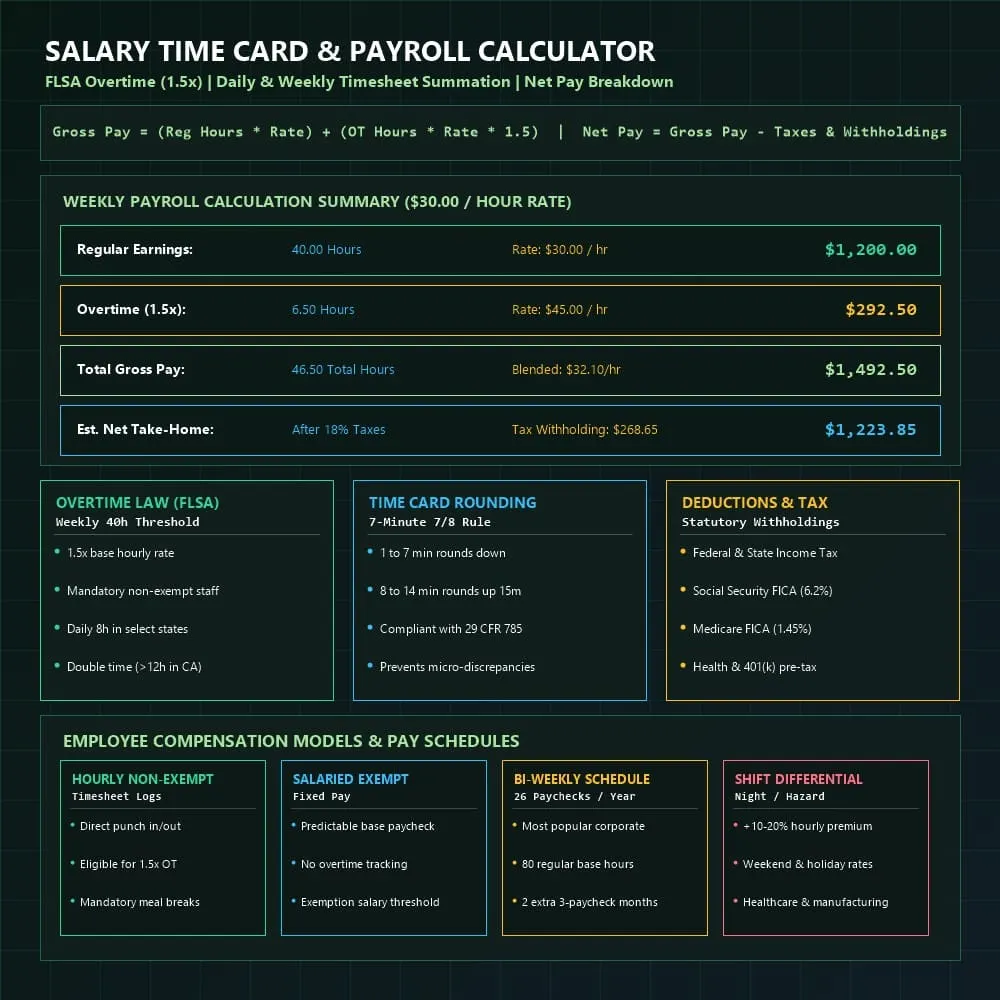
Definition: Calculate gross earnings, FLSA overtime pay (1.5x), estimated statutory tax deductions, and net take-home pay from weekly time card hours.
Governing Math Formula: Regular Pay = Regular Hours × Base Rate. Overtime Pay = OT Hours × Base Rate × 1.5. Gross Pay = Regular Pay + Overtime Pay. Net Pay = Gross Pay × (1 - Tax Rate).
Target Applications: Provides real-time quantitative solutions in Everyday Tools for students, engineers, researchers, and finance professionals.
Salary Time Card Payroll Calculator: Comprehensive FLSA Overtime, Timesheet & Net Pay Guide
1. Introduction
Whether you are an hourly employee double-checking your weekly paycheck, a freelance consultant invoicing corporate clients, or a payroll manager computing bi-weekly wage disbursements for a mid-sized enterprise, time card and payroll calculations are critical to financial accuracy and labor compliance.
Under the United States Fair Labor Standards Act (FLSA) and international employment standards, calculating gross earnings requires strictly segregating regular hours from overtime hours (typically compensated at the regular rate for hours worked beyond 40 in a standard workweek). Furthermore, understanding how gross pay translates into net take-home pay after federal, state, and FICA statutory tax withholdings is essential for household budgeting and financial peace of mind.
graph LR
    PUNCH["📋 Time Card Hours
Regular Hours + OT Hours"] --> GROSS_ENG["💰 Gross Earnings Engine
Reg Pay = H_reg × Rate
OT Pay = H_ot × Rate × 1.5"]
    RATE_IN["💵 Base Hourly Pay Rate
Hourly Wage ($/hr)"] --> GROSS_ENG
    TAX_IN["🏛️ Tax Withholding Rate
FICA (7.65%) + Federal + State"] --> NET_ENG["📉 Net Take-Home Engine
Taxes = Gross × Tax %
Net Pay = Gross - Taxes"]
    GROSS_ENG --> NET_ENG
    NET_ENG --> OUT["🏆 Final Output: Gross Pay + Net Pay + Blended Hourly Rate"]
Mastering time card payroll calculations enables employees, employers, and payroll administrators to:
- Verify regular earnings and calculate exact 1.5x overtime premiums for non-exempt staff.
- Apply the federal 7-minute (7/8) time card rounding rule (29 CFR § 785.48) to resolve punch clock micro-discrepancies.
- Estimate statutory tax deductions including FICA Social Security (6.2%), FICA Medicare (1.45%), and income taxes.
- Determine the true effective blended hourly wage across heavy overtime weeks.
- Differentiate between FLSA Non-Exempt hourly positions and Salaried Exempt corporate classifications.
2. Definitions & Mathematical Formulations
2.1 The Simple Definition
- Gross Pay: Total earnings before any taxes, insurance premiums, or retirement contributions are deducted.
- Net Pay (Take-Home Pay): The final cash amount deposited into an employee’s bank account after all withholdings.
- Overtime (OT): Hours worked in excess of the statutory threshold (typically ), paid at a premium rate ( base wage).
- FICA Tax: Mandatory federal payroll taxes funding Social Security (6.2%) and Medicare (1.45%), totaling 7.65%.
2.2 Formal Mathematical Formulations
1. Regular Pay Formula
2. Overtime Pay Formula (1.5x Multiplier)
3. Total Gross Earnings Formula
4. Statutory Taxes & Net Take-Home Pay
Where:
- $\tau$ is the total combined effective tax rate percentage (Federal + State + FICA + Local).
5. Effective Blended Hourly Rate
flowchart TD
    START["Input Base Hourly Rate ($/hr), Regular Hours, OT Hours, Tax Rate %"] --> REG_CALC["Compute Regular Pay = Reg Hours × Hourly Rate"]
    REG_CALC --> OT_CALC["Compute Overtime Pay = OT Hours × (Hourly Rate × 1.5)"]
    OT_CALC --> GROSS_CALC["Gross Pay = Regular Pay + Overtime Pay"]
    GROSS_CALC --> TAX_CALC["Calculate Tax Withholdings = Gross Pay × (Tax Rate / 100)"]
    TAX_CALC --> NET_CALC["Net Take-Home Pay = Gross Pay - Tax Withholdings"]
    NET_CALC --> BLEND_CALC["Compute Blended Hourly Rate = Gross Pay / Total Hours"]
    BLEND_CALC --> DISPLAY["Display Formatted Paycheck Summary Stub"]
3. History & Legal Evolution of Payroll Standards
timeline
    title Milestones in Labor Laws & Payroll Standardization
    1911 : Frederick Winslow Taylor publishes The Principles of Scientific Management (Time Studies)
    1938 : US Congress enacts Fair Labor Standards Act (FLSA), creating 44-hour workweek & $0.25 min wage
    1940 : FLSA amended to establish permanent 40-hour standard workweek and mandatory 1.5x overtime
    1961 : 29 CFR 785 formalizes standard 7-minute / 15-minute time card punch rounding rules
    1986 : Electronic automated biometric badge swipe and digital punch time clocks proliferate
Modern : Automated cloud payroll engines execute real-time multi-jurisdiction tax withholding- Taylorism & Time Studies (1911): Mechanical engineer Frederick Taylor introduced standardized time cards and stopwatch motion studies to American factories, establishing precise tracking of employee labor units.
- The Fair Labor Standards Act of 1938: Signed into law by President Franklin D. Roosevelt, the FLSA established the first federal minimum wage ($\$0.25/\text{hour}$), banned oppressive child labor, and instituted mandatory time-and-a-half overtime pay.
- The 40-Hour Workweek Standard (1940): The initial 44-hour threshold was reduced to the universal 40-hour limit, cementing the standard 8-hour, 5-day work schedule.
- 29 CFR § 785.48 Rounding Standards: Federal regulations codified that employers may round punch times to the nearest 15 minutes, provided they utilize a fair 7-minute rounding threshold that does not systematically underpay employees.
4. Master Payroll Comparison Matrix: Standard vs. Overtime Shifts
| Pay Component | Base Rate ($/hr) | Hours Worked | Rate Multiplier | Calculated Subtotal | Notes / Guidelines |
|---|---|---|---|---|---|
| Regular Hours | $30.00 | $1,200.00 | Standard 40-hour non-exempt weekly base | ||
| Overtime (1.5x) | $30.00 | ($\$45.00/\text{hr}$) | $292.50 | Statutory FLSA time-and-a-half | |
| Double Time (2.0x) | $30.00 | $2.00\text{ hrs}$ | $2.0\times$ ($\$60.00/\text{hr}$) | $120.00 | California daily / holiday rule |
| Total Gross Pay | — | Blended: $\$33.25/\text{hr}$ | $1,612.50 | Pre-tax total compensation | |
| Est. Net Pay | — | — | After | $1,322.25 | Estimated take-home check |
5. Step-by-Step Practical Walkthrough
Problem: Weekly Non-Exempt Payroll Calculation
- Employee Hourly Wage: $\$28.50/\text{hour}$
- Timesheet Log: Worked $47.50\text{ total hours}$ ($40\text{ regular hours}7.50\text{ overtime hours}$).
- Tax Withholding Rate: Estimated 20.0% combined (Federal, State, FICA).
Step-by-Step Calculations:
- Regular Earnings:
- Overtime Hourly Rate ():
- Overtime Earnings:
- Total Gross Pay:
- Estimated Tax Withholding ($20\%$):
- Net Take-Home Pay:
- Effective Blended Rate:
6. The 7-Minute Punch Clock Rounding Rule (29 CFR § 785.48)
In high-volume hourly workplaces, employees punch in/out within minutes of their scheduled shift. Federal regulations allow employers to round times to the nearest 15-minute quarter hour:
graph TD
    PUNCH_IN["⏰ Clock Punch Time (Minutes)"] --> CHECK{"Check Minute Interval (0-14)"}
    CHECK -->|"1 to 7 Minutes"| ROUND_DOWN["⬇️ Round DOWN to Nearest Quarter Hour
(e.g., 8:07 AM → 8:00 AM)"]
    CHECK -->|"8 to 14 Minutes"| ROUND_UP["⬆️ Round UP to Next Quarter Hour
(e.g., 8:08 AM → 8:15 AM)"]
    ROUND_DOWN --> COMPLIANT["⚖️ FLSA Compliant (Must be applied neutrally)"]
ROUND_UP --> COMPLIANTRounding must be neutral and symmetrical. Employers cannot round down when employees clock in late while refusing to round up when they work late.
7. Common Payroll Mistakes
Watch out for these four frequent labor compliance and payroll calculation errors:
- Misclassifying Non-Exempt Workers as Exempt: Simply paying an employee a "salary" does not waive overtime rights unless their job duties and salary meet the Department of Labor FLSA exemption salary thresholds.
- Averaging Hours Across Bi-Weekly Pay Periods: Calculating overtime on an 80-hour bi-weekly basis is illegal under the FLSA. If an employee works 50 hours in Week 1 and 30 hours in Week 2, they are legally entitled to 10 hours of overtime in Week 1.
- Failing to Include Non-Discretionary Bonuses in OT Rate: Production bonuses and attendance incentives must be factored into the "regular rate of pay" when computing the 1.5x overtime multiplier.
- Confusing Gross Pay with Net Take-Home: Forgetting to account for the mandatory 7.65% employee FICA contribution alongside federal and state income tax brackets when estimating personal cash flow.
8. Frequently Asked Questions (FAQ)
How is overtime calculated under the FLSA?
Overtime is paid at the employee’s regular hourly rate for all hours worked exceeding 40 hours in a single 7-day workweek.
What is the difference between Gross Pay and Net Pay?
- Gross Pay: Total earnings before any taxes or deductions are removed.
- Net Pay: The actual money received after deducting taxes (Federal, State, FICA), insurance, and retirement contributions.
What taxes are automatically withheld from a paycheck?
- Federal Income Tax (FIT) based on your W-4 form.
- State & Local Income Tax (where applicable).
- FICA Social Security Tax (6.2%).
- FICA Medicare Tax (1.45%).
What is the 7-minute rounding rule?
Under 29 CFR § 785.48, employers rounding to 15-minute increments round down for minutes 1 through 7, and round up for minutes 8 through 14.
Can an employer force you to take "Comp Time" instead of Overtime?
Private sector employers cannot substitute compensatory time off in lieu of paying overtime cash to non-exempt employees. Comp time is only permissible for certain public government agency workers.
What is "Double Time"?
Double time ( base rate) is required by law in specific jurisdictions (such as California for hours worked beyond 12 in a single workday or beyond 8 hours on the 7th consecutive workday) or under union collective bargaining agreements.
What is a blended overtime rate?
When an employee works heavy overtime, their effective earnings per hour increase because the extra hours are paid at , resulting in a blended rate higher than their base wage.
How do salaried exempt vs. non-exempt employees differ?
- Exempt: Paid a fixed predetermined salary; exempt from overtime requirements.
- Non-Exempt: Paid for all hours worked; entitled to 1.5x overtime pay for hours .
How many pay periods are in a bi-weekly schedule?
A bi-weekly schedule contains 26 pay periods per year, meaning employees receive three paychecks instead of two in two months of the year.
How do pre-tax deductions affect take-home pay?
Pre-tax deductions (such as traditional 401(k) contributions and health insurance premiums) reduce your taxable gross income, lowering the total amount of income tax withheld.
9. Summary Checklist
- ✔ Enter Base Wage: Input standard hourly pay rate ($\$/\text{hour}$).
- ✔ Log Regular Hours: Enter standard hours up to the 40-hour limit.
- ✔ Log Overtime Hours: Input hours worked beyond 40 to calculate pay.
- ✔ Set Estimated Tax Rate: Enter combined withholding percentage (Federal + State + FICA).
- ✔ Review Paycheck Stub: Examine gross pay, tax withheld, and net take-home pay.
Additional Technical Guidelines & Measurement Standards
When conducting calculations for Salary Time Card Payroll Calculator, maintaining quantitative precision and verifying input parameter boundaries is essential for reliable scenario evaluation. Always verify that raw numerical inputs are measured using standardized instrumentation, and double-check unit conversions prior to applying outputs in commercial, industrial, or academic projects.
For quantitative unit conversions and scientific calculations, always maintain at least four decimal places of precision during intermediate arithmetic stages before rounding final results. When preparing technical reports, laboratory documentation, or financial forecasts, cross-verify all output variables against established international measurement standards (such as SI, NIST, and ISO metric benchmarks) to guarantee consistent analytical rigor across all computational workflows.
MathsLover.com delivers this interactive solver 100% free of charge to foster global mathematical literacy, educational accessibility, and data-driven problem solving across scientific, technical, and academic communities worldwide.