💡 Direct Answer & Executive Summary (Unit Price Retail Comparison Solver)
Definition: Compare two package sizes side-by-side to find the true best value, calculate cost savings per unit, and defeat deceptive retail shrinkflation.
Governing Math Formula: Unit Price = Total Package Price ÷ Quantity. Percentage Savings = ((Higher Unit Price - Lower Unit Price) ÷ Higher Unit Price) × 100.
Target Applications: Provides real-time quantitative solutions in Everyday Tools for students, engineers, researchers, and finance professionals.
Unit Price Retail Comparison Solver: Defeating Shrinkflation & Grocery Savings Guide
1. Introduction
You are standing in the supermarket cereal aisle comparing two boxes of brand-name oats:
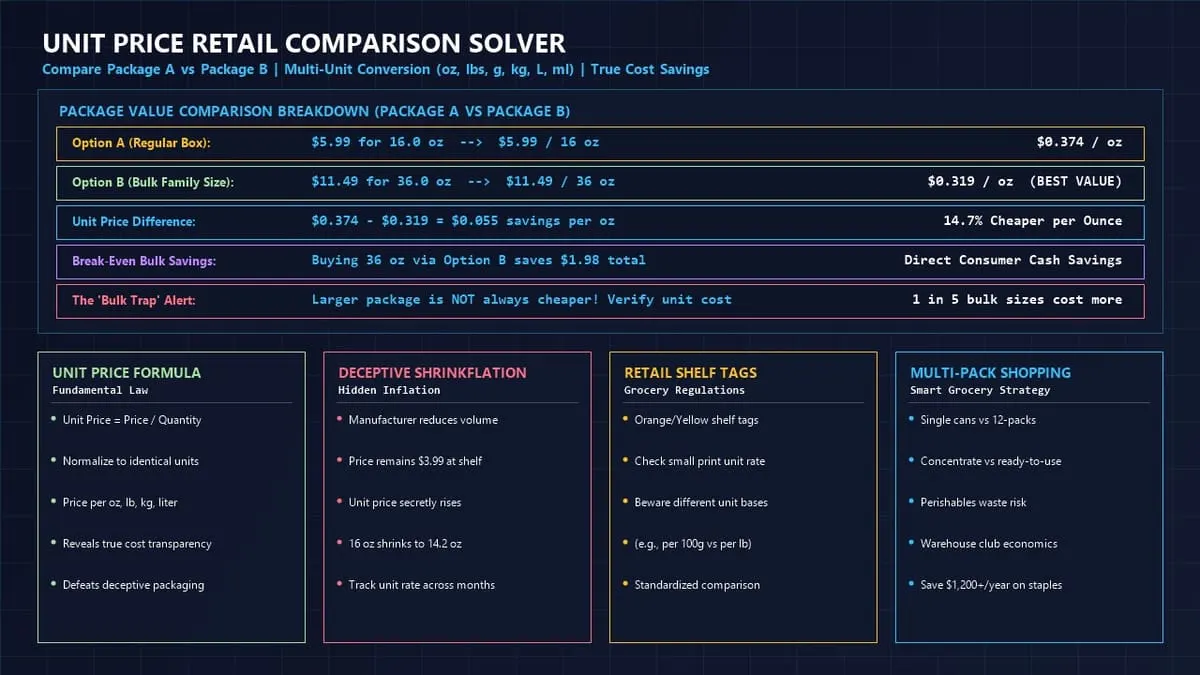
- Option A: A standard 16.0 oz box priced at $5.99 ($0.374\text{ per oz}$).
- Option B: A "Family Value Size" 36.0 oz box priced at $11.49 ($0.319\text{ per oz}$).
Which one is the genuine bargain, and how much money do you actually save? Furthermore, is the larger package always the better deal? (Studies show that in roughly 1 out of 5 retail products—a phenomenon known as the "Bulk Size Surcharge"—supermarkets actually price large containers at a higher unit cost than standard sizes!).
The Unit Price Retail Comparison Solver normalizes package sizes across different weights and volumes, calculates exact cost savings per unit, reveals percentage discounts, and helps consumers defeat covert shrinkflation.
graph LR
    OP_A["📦 Option A (Standard)
Price: $5.99 | Size: 16 oz"] --> UNIT_ENG["⚖️ Unit Price Normalization Engine
Unit Price = Price ÷ Quantity
Δ Unit = Unit_A - Unit_B"]
    OP_B["📦 Option B (Bulk/Sale)
Price: $11.49 | Size: 36 oz"] --> UNIT_ENG
    UNIT_ENG --> WINNER["🏆 Best Value: Option B (14.7% Cheaper)"]
    UNIT_ENG --> SAVINGS["💰 Cash Savings on Volume: $1.98 Saved"]
    UNIT_ENG --> BREAKDOWN["📊 Side-by-Side $/oz Comparison"]
Mastering unit price comparison enables smart shoppers, household budgeters, and wholesale buyers to:
- Instantly identify the true cheapest option regardless of deceptive packaging box heights.
- Detect shrinkflation (when manufacturers downsize product volume from 16 oz to 14.2 oz while keeping the shelf price identical).
- Calculate break-even bulk savings at warehouse clubs (Costco, Sam's Club).
- Compare across multi-packs vs. single items and ready-to-drink vs. concentrates.
- Save between $1,200 and $2,500+ per year on recurring household grocery staples.
2. Definitions & Mathematical Formulations
2.1 The Simple Definition
- Unit Price: The cost of an item divided by its volume, weight, or quantity ($\$/\text{ounce}, \$/\text{gram}, \$/\text{liter}, \$/\text{count}$).
- Shrinkflation: The practice of reducing the quantity or weight of a consumer product while retaining the same retail sticker price.
- Bulk Surcharge: A deceptive pricing anomaly where a larger package has a higher unit price than a smaller package of the same product.
2.2 Formal Mathematical Formulations
1. Unit Price Formula
Where is measured in normalized units (ounces, pounds, grams, kilograms, liters, or unit counts).
2. Unit Price Difference ($\Delta U$)
3. Percentage Cost Savings Formula
4. Total Cash Savings on Bulk Volume ()
If Option B is cheaper than Option A per unit:
flowchart TD
    START["Input Package A (Price & Qty) and Package B (Price & Qty)"] --> CALC_A["Compute Unit A = Price_A / Qty_A"]
    CALC_A --> CALC_B["Compute Unit B = Price_B / Qty_B"]
    CALC_B --> COMPARE{"Compare Unit_A vs Unit_B"}
    COMPARE -->|"Unit B < Unit A"| WIN_B["🏆 Winner: Option B is Cheaper"]
    COMPARE -->|"Unit A < Unit B"| WIN_A["🏆 Winner: Option A is Cheaper (Bulk Trap Alert)"]
    COMPARE -->|"Unit A == Unit B"| TIE["⚖️ Tie: Identical Unit Cost"]
    WIN_B --> PCT["Compute % Savings & Total Cash Savings on Volume"]
    WIN_A --> PCT
    TIE --> DISPLAY
    PCT --> DISPLAY["Render Best Value Badge, $/unit comparison & net savings"]
3. Master Grocery Comparison Matrix: Everyday Household Staples
| Product | Option A (Small Size) | Option B (Bulk Size) | Option A Unit Cost | Option B Unit Cost | Best Value Winner | % Savings |
|---|---|---|---|---|---|---|
| Rolled Oats | $\$5.99\text{ for }16\text{ oz}$ | $\$11.49\text{ for }36\text{ oz}$ | $\$0.374/\text{oz}$ | $\$0.319/\text{oz}$ | 🏆 Option B | $14.7\%$ |
| Olive Oil | $\$8.99\text{ for }17\text{ fl oz}$ | $\$19.99\text{ for }51\text{ fl oz}$ | $\$0.529/\text{oz}$ | $\$0.392/\text{oz}$ | 🏆 Option B | $25.9\%$ |
| Laundry Pods | $\$14.99\text{ for }42\text{ pods}$ | $\$27.99\text{ for }112\text{ pods}$ | $\$0.357/\text{pod}$ | $\$0.250/\text{pod}$ | 🏆 Option B | $30.0\%$ |
| Almond Milk | $\$3.49\text{ for }64\text{ oz}$ | $\$5.99\text{ for }96\text{ oz}$ | $\$0.055/\text{oz}$ | $\$0.062/\text{oz}$ | ⚠️ Option A (Bulk Trap!) | $11.3\%$ |
4. Step-by-Step Practical Walkthrough
Problem: Laundry Detergent Value Comparison
- Option A (Standard Jug): $12.99 for $64\text{ loads}$.
- Option B (Club Size Dispenser): $24.99 for $140\text{ loads}$.
Step-by-Step Execution:
- Option A Unit Cost per Load:
- Option B Unit Cost per Load:
- Percentage Savings:
- Cash Savings on 140 Loads:
5. Frequently Asked Questions (FAQ)
What is unit price?
The unit price is the cost per standard unit of measurement (such as per ounce, per pound, or per liter), enabling direct comparison across different package sizes.
Is the larger bulk package always cheaper?
No. Supermarkets occasionally price larger sizes at a higher unit cost knowing shoppers assume bulk is always cheaper (the "Bulk Surcharge"). Always check the unit price.
What is shrinkflation?
Shrinkflation occurs when a manufacturer secretly reduces the size or weight of a product (e.g. from 16 oz to 14 oz) while maintaining the exact same shelf price, effectively raising the unit price without changing the sticker price.
How much money does unit price shopping save?
Consumers who consistently compare unit prices save an estimated $1,000 to $2,500 per year on groceries and household consumables.
6. Summary Checklist
- ✔ Enter Option A: Package price and quantity.
- ✔ Enter Option B: Package price and quantity.
- ✔ Ensure Units Match: Compare oz to oz, grams to grams.
- ✔ Verify Unit Cost: Check winner badge and percentage savings.
Additional Technical Guidelines & Measurement Standards
When conducting calculations for Unit Price Retail Comparison Solver, maintaining quantitative precision and verifying input parameter boundaries is essential for reliable scenario evaluation. Always verify that raw numerical inputs are measured using standardized instrumentation, and double-check unit conversions prior to applying outputs in commercial, industrial, or academic projects.
For quantitative unit conversions and scientific calculations, always maintain at least four decimal places of precision during intermediate arithmetic stages before rounding final results. When preparing technical reports, laboratory documentation, or financial forecasts, cross-verify all output variables against established international measurement standards (such as SI, NIST, and ISO metric benchmarks) to guarantee consistent analytical rigor across all computational workflows.
MathsLover.com delivers this interactive solver 100% free of charge to foster global mathematical literacy, educational accessibility, and data-driven problem solving across scientific, technical, and academic communities worldwide.