💡 Direct Answer & Executive Summary (Car Financing Payments Calculator)
Definition: Estimate monthly auto loan payments, tax additions, and interest schedules.
Governing Math Formula: M = P [ i(1 + i)^n ] / [ (1 + i)^n – 1 ].
Target Applications: Provides real-time quantitative solutions in Finance for students, engineers, researchers, and finance professionals.
Car Financing Payments Calculator
1. Introduction
For many people, purchasing a vehicle is the second-largest transaction they will make, surpassed only by buying a home. Whether you need a car for your daily commute, family road trips, or commercial purposes, vehicles represent a significant capital commitment. To make this purchase manageable, most buyers rely on car financing.
Car financing allows you to drive a vehicle home while paying for it over time in structured installments. However, auto loans are complex, featuring variables like purchase price, down payment credit, trade-in values, interest rates, and loan terms. Failing to understand how these factors interact can lead to borrowing more than you can afford.
The Car Financing Payments Calculator is an educational tool designed to clarify your auto borrowing costs. By inputting your vehicle price, down payment or trade-in value, and term, you can instantly estimate your monthly payments and evaluate total interest schedules.
This guide provides a comprehensive overview of car financing mathematics, step-by-step guides for manual calculation, and practical dealer negotiation tips.
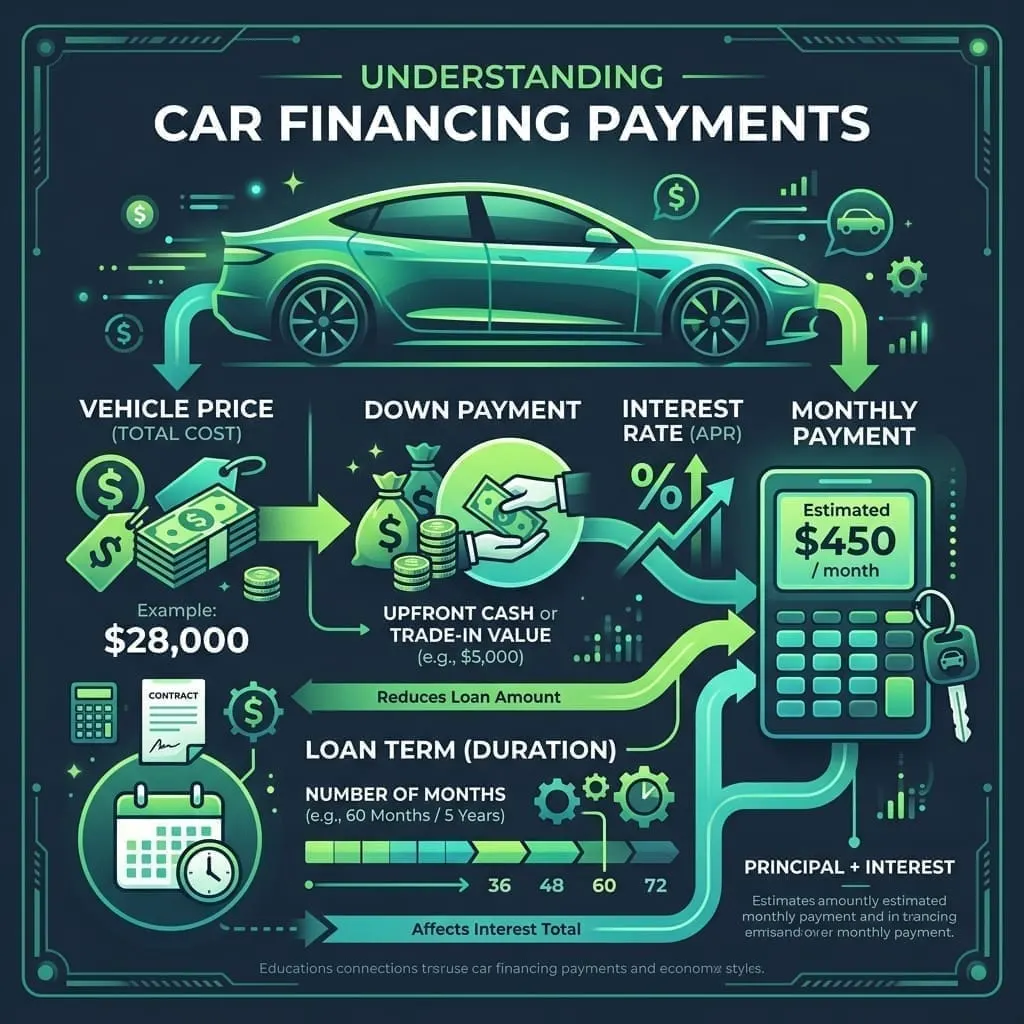
graph TD
    A["Vehicle Purchase Price"] --> B["Subtract Down Payment / Trade-in"]
    B --> C["Net Auto Principal (P)"]
    C --> D["Apply Monthly Interest Rate (i)"]
    D --> E["Calculate Over Term Months (n)"]
    E --> F["Monthly Auto Payment (M)"]
2. Core Definitions & Analogy
To build a solid financial foundation, let us define car financing in both simple and technical terms:
- Simple Definition: Car financing is a personal loan specifically used to buy a car, where you repay the borrowed amount plus interest in fixed monthly payments over a set number of years.
- Technical Definition: An auto loan is a secured, amortizing installment agreement collateralized by the vehicle. The monthly payment (M) is computed using the standard annuity formula based on the net principal (P), periodic rate (i), and months (n), formulated as M = P [ i (1 + i)^n ] / [ (1 + i)^n - 1 ].
- Conceptual Analogy: Think of car financing like subscribing to a premium software plan. The down payment is the initial setup fee, and the monthly installments are the subscription fees. The main difference is that at the end of your subscription term, you own the software (the car) completely.
3. History & Milestones
The history of car financing is closely linked to the expansion of the modern automobile industry:
- The Model T Era (1908): In the early days, Henry Ford insisted on cash purchases, believing consumer debt was harmful. However, this limited the number of families who could afford cars.
- Establishment of GMAC (1919): General Motors established the General Motors Acceptance Corporation (GMAC) to offer credit directly to dealers and consumers. This marked the birth of modern auto financing.
- Dealer Networks: Over the 20th century, auto financing became a primary revenue stream for dealerships, introducing lease structures and promotional interest rates (like 0% APR) to stimulate sales.
4. Core Concepts & Parameters
To evaluate car financing, you must understand three key inputs:
- Vehicle Purchase Price: The negotiated price of the vehicle, excluding taxes and dealer fees.
- Trade-in or Down Payment: The upfront cash you pay, combined with the trade-in value of your old vehicle, which is subtracted from the purchase price.
- Car Loan Term: The length of time you have to pay back the loan (typically 3 to 7 years, or 36 to 84 months).
5. The Mathematical Model & Formula
The monthly payment for a fixed-rate auto loan is solved using the standard amortization formula:
Monthly Payment Formula
Monthly Payment (M) = P * [ i * (1 + i)^n ] / [ (1 + i)^n - 1 ]
Variable Breakdown:
- M: The monthly auto payment (USD)
- P: The net loan principal (Vehicle Purchase Price minus Down Payment/Trade-in)
- i: The monthly interest rate (Annual Rate divided by 12, then divided by 100). For standard calculations in our system, this rate is established at a benchmark of 5.5% annual APR.
- n: The total number of monthly payments (Term in Years multiplied by 12)
6. Step-by-Step Manual Procedure
Let us walk through a manual calculation using our default calculator values:
- Determine the Loan Principal (P):
Vehicle Purchase Price = $30,000Trade-in / Down Payment = $5,000Principal (P) = 30,000 - 5,000 = $25,000 - Calculate the Monthly Interest Rate (i):
Benchmark Annual Rate = 5.5%Monthly Rate (i) = (5.5 / 100) / 12 = 0.0045833 - Calculate the Total Number of Payments (n):
Term = 5 YearsTotal Months (n) = 5 * 12 = 60 months - Apply the Amortization Formula:
M = 25,000 * [ 0.0045833 * (1 + 0.0045833)^60 ] / [ (1 + 0.0045833)^60 - 1 ]M = 25,000 * [ 0.0045833 * 1.315704 ] / [ 1.315704 - 1 ]M = 25,000 * [ 0.0060303 ] / [ 0.315704 ]M = 25,000 * 0.0191011 = 477.53Your monthly car payment is approximately $477.53.The total amount you pay back is $28,651.80 (477.53 multiplied by 60 months).
7. Visual Diagram
The flowchart below displays the calculation path for car financing:
graph TD
    Start["Enter Price & Down Payment / Trade-in"] --> CalcP["Calculate Principal: P = Price - Down Payment"]
    CalcP --> CalcMonths["Compute Months: Term Years * 12"]
    CalcMonths --> SolveFormula["Calculate Monthly Auto Payment: M"]
    SolveFormula --> Results["Output: Monthly Payment, Total Repayment"]
8. Parameter Comparison Matrix
The table below shows how varying the loan term affects a $25,000 net vehicle principal (at 5.5% interest):
| Principal (P) | Annual Rate | Term (Years) | Monthly Payment | Total Repayment | Total Interest Paid |
|---|---|---|---|---|---|
| $25,000 | 5.5% | 3 Years | $754.85 | $27,174.60 | $2,174.60 |
| $25,000 | 5.5% | 4 Years | $581.28 | $27,901.44 | $2,901.44 |
| $25,000 (Default) | 5.5% | 5 Years | $477.53 | $28,651.80 | $3,651.80 |
| $25,000 | 5.5% | 6 Years | $408.57 | $29,417.04 | $4,417.04 |
| $25,000 | 5.5% | 7 Years | $359.50 | $30,198.00 | $5,198.00 |
9. Real-World Applications
Car financing metrics are used by buyers in several transaction scenarios:
- Dealer Negotiations: Knowing your monthly payment limits keeps you focused on the total out-the-door cost of the car rather than just dealer-advertised monthly payments.
- Term Comparisons: Helps you decide if you want lower monthly payments (longer term) or less total interest paid (shorter term).
- Budget Alignment: Establishes a clear financial framework, helping you avoid purchasing a vehicle that strains your monthly budget.
10. Case Studies
Case Study 1: The Trap of Long-Term Loans
A buyer purchases a $30,000 car with a $5,000 down payment. They compare a 5-year loan with a 7-year loan.
- 5-Year Term: Payment is $477.53/month, and total interest paid is $3,651.80.
- 7-Year Term: Payment is $359.50/month, and total interest paid is $5,198.00.
- Outcome: The 7-year term lowers the monthly payment by $118, but costs $1,546.20 more in interest. Additionally, the car's value may depreciate faster than the loan balance is paid off.
Case Study 2: Reinvesting Trade-In Equity
A commuter trades in an old vehicle valued at $5,000 toward a new $30,000 car, keeping the term at 5 years.
- With Trade-In: Principal is $25,000, and the monthly payment is $477.53.
- Without Trade-In: Principal is $30,000, and the monthly payment is $573.04.
- Outcome: The trade-in saves the commuter $95.51 per month and cuts total interest costs by $730.
11. Advantages of Using the Tool
- Budget Clarity: Instantly calculates monthly obligations.
- Negotiation Aid: Helps you check dealer numbers in real-time.
- Simple Comparisons: Easily evaluates how down payments alter your loan totals.
12. Limitations & Boundary Conditions
This calculator estimates the baseline principal and interest (P&I) auto payment. Dealership transactions typically include sales taxes, registration fees, documentation charges, and optional products like GAP insurance or extended warranties, which must be added to the purchase price.
13. Common Mistakes
- Negotiating Only Monthly Payments: Dealers can make payments look affordable by stretching the term (e.g. to 84 months), which significantly increases your total interest costs. Always negotiate the total out-the-door price first.
- Ignoring Depreciation: Cars lose value quickly. Taking out a long-term loan with a low down payment can leave you "underwater," meaning you owe more on the loan than the car is worth.
12. Frequently Asked Questions
Q1: What is car financing?
Car financing is borrowing money from a bank, credit union, or dealership to buy a car, which you repay over time with interest.
Q2: What is the average car loan term?
The average term is 60 to 72 months (5 to 6 years), balancing affordable monthly payments with reasonable interest costs.
Q3: What is a trade-in?
A trade-in is selling your old vehicle to the dealership, which applies its value as a credit toward the purchase price of your new car.
Q4: How does a down payment affect my car payment?
A down payment reduces the loan balance, which lowers your monthly payments and decreases the total interest paid.
Q5: Can I pay off my car loan early?
Yes, most auto loans allow early payments with no penalty, helping you pay off the principal faster and save on interest.
Q6: What does APR mean in car financing?
Annual Percentage Rate, representing the yearly cost of borrowing money, including interest and basic fees.
Q7: Why do longer loan terms cost more?
Because you pay interest over a longer period, and lenders often charge higher interest rates for longer terms.
Q8: What does being "underwater" on a car loan mean?
It means you owe more on the auto loan than the vehicle's current market value, which is common with low down payments and long terms.
Q9: Is it better to finance through a bank or the dealer?
It is best to get pre-approved by a bank or credit union first, then check if the dealership can beat that rate.
Q10: What is the monthly payment formula?
The formula is M = P * [ i(1 + i)^n ] / [ (1 + i)^n - 1 ], where P is principal, i is monthly rate, and n is total months.
15. Expert Tips
- Follow the 20/4/10 Rule: Put down at least 20%, finance for no more than 4 years, and ensure total transportation costs do not exceed 10% of your gross monthly income.
- Get pre-approved first: Secure financing from a credit union before visiting the dealership to leverage better rates.
16. Summary
- Car financing allows you to pay off a vehicle over time in structured installments.
- Monthly payments are determined by the vehicle price, down payment/trade-in, and term.
- The auto payment formula is
M = P * [ i(1 + i)^n ] / [ (1 + i)^n - 1 ].
- Shorter terms and larger down payments minimize total borrowing costs.
Additional Technical Guidelines & Measurement Standards
When conducting calculations for Car Financing Payments Calculator, maintaining quantitative precision and verifying input parameter boundaries is essential for reliable scenario evaluation. Always verify that raw numerical inputs are measured using standardized instrumentation, and double-check unit conversions prior to applying outputs in commercial, industrial, or academic projects.
For quantitative unit conversions and scientific calculations, always maintain at least four decimal places of precision during intermediate arithmetic stages before rounding final results. When preparing technical reports, laboratory documentation, or financial forecasts, cross-verify all output variables against established international measurement standards (such as SI, NIST, and ISO metric benchmarks) to guarantee consistent analytical rigor across all computational workflows.
MathsLover.com delivers this interactive solver 100% free of charge to foster global mathematical literacy, educational accessibility, and data-driven problem solving across scientific, technical, and academic communities worldwide.