💡 Direct Answer & Executive Summary (Savings Compound Interest Calculator)
Definition: Calculate how your savings grow over time with periodic compound interest additions.
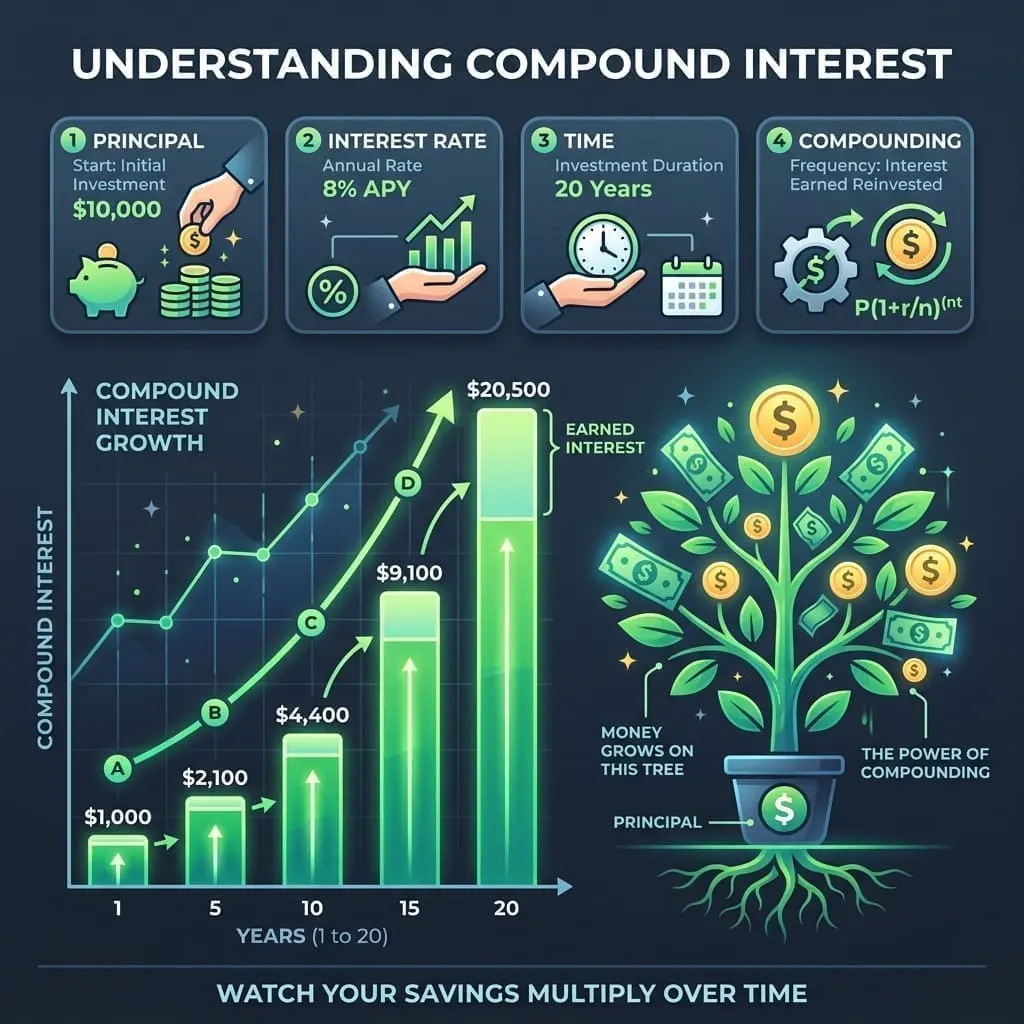
Governing Math Formula: A = P(1 + r/n)^(nt), where A is final balance, P is principal, r is annual interest rate.
Target Applications: Provides real-time quantitative solutions in Finance for students, engineers, researchers, and finance professionals.
Savings Compound Interest Calculator
1. Introduction
Building personal wealth requires consistency, time, and understanding the core financial mechanisms that grow money. While saving cash in a box preserves your principal, inflation slowly erodes its purchasing power. To grow your capital over time, you must put your savings to work in accounts that earn interest.
Among all wealth-building concepts, compound interest is the most powerful. Often described as interest earning interest, compounding allows your savings to grow exponentially over time. What begins as modest monthly returns can snowball into a significant financial cushion over several years or decades.
The Savings Compound Interest Calculator is an educational tool designed to map this growth. By inputting your initial deposit, annual interest rate, and term, you can instantly project your future balance and see the exponential difference compounding makes.
This guide provides a comprehensive breakdown of compound interest mathematics, historical origins, step-by-step calculation guides, and practical savings scenarios.
graph TD
    A["Initial Deposit (P)"] --> B["Apply Interest Rate (r)"]
    B --> C["Choose Compounding Interval (n)"]
    C --> D["Calculate Balance Over Years (t)"]
    D --> E["Result:
Future Balance (A)"]
2. Core Definitions & Analogy
To build a solid financial foundation, let us define compound interest in both simple and technical terms:
- Simple Definition: Compound interest is when the interest you earn on your savings is added back into your account balance, so you earn interest on your original deposit plus the interest you've already accumulated.
- Technical Definition: Compound interest is a non-linear financial function where the future value of an investment (A) grows exponentially based on the principal (P), periodic nominal rate (r), compounding frequency (n), and total time periods (t). It is expressed as A = P (1 + r/n)^(nt).
- Conceptual Analogy: Think of compound interest like a rolling snowball. As you roll it down a snow-covered hill, it picks up snow. The larger the snowball gets, the more surface area it has to pick up even more snow on its way down. The snowball grows faster and faster the longer it rolls.
3. History & Milestones
The discovery and mathematical formalization of compound interest transformed ancient commerce into modern capitalism:
- Ancient Babylonia (c. 2000 BC): Clay tablets reveal that ancient Mesopotamians understood compound interest, using it to calculate grain and silver debts, often with interest rates compounding annually.
- Richard Witt (1613): A London mathematician named Richard Witt published "Arithmeticall Questions," one of the first books dedicated to compound interest mathematics, establishing standard tables for merchants.
- Albert Einstein: Legend has it that physicist Albert Einstein called compound interest the eighth wonder of the world, stating, "He who understands it, earns it... he who doesn't, pays it."
4. Core Concepts & Parameters
To evaluate savings growth, you must understand four key input metrics:
- Initial Deposit (P): The original sum of money you deposit into the savings account.
- Annual Interest Rate (r): The percentage yield promised by the bank or investment fund per year.
- Investment Term (t): The number of years you leave the money in the account to compound.
- Compounding Frequency (n): How often the interest is calculated and added to the principal balance (e.g. monthly is 12 times a year, annually is 1, and daily is 365).
5. The Mathematical Model & Formula
The future value of savings under compound interest is solved using the standard compounding equation:
Future Value Formula
Future Value (A) = P * (1 + r/n)^(n*t)
Variable Breakdown:
- A: The future account balance including interest (USD)
- P: The initial deposit principal (USD)
- r: The nominal annual interest rate (written as a decimal, e.g. 4% becomes 0.04)
- n: The compounding frequency per year (default monthly n = 12)
- t: The investment term in years
Why the Formula Works:
With simple interest, you earn the same amount of interest every period. Under compounding, the interest earned at the end of each period is added to the principal balance. The next period's interest is calculated on this new, larger balance. This creates a geometric progression represented by the exponent in the formula.
6. Step-by-Step Manual Procedure
Let us walk through a manual calculation using our default calculator values:
- Identify the variables:
Initial Deposit (P) = $5,000Annual Interest Rate (r) = 4% = 0.04Investment Term (t) = 5 YearsCompounding Frequency (n) = 12 (Monthly) - Calculate the Periodic Rate (r/n):
r/n = 0.04 / 12 = 0.0033333 - **Calculate the Total Compounding Periods (n * t):**
n * t = 12 * 5 = 60 periods - Apply the Compound Interest Formula:
A = 5,000 * (1 + 0.0033333)^60A = 5,000 * (1.0033333)^60A = 5,000 * 1.220997A = 6,104.98The future account balance is approximately $6,104.98.The total interest earned is $1,104.98 (6,104.98 minus 5,000).
7. Visual Diagram
The flowchart below displays the computation path for compounding interest:
graph TD
    Start["Enter Deposit P, Rate r, Term t"] --> ConvertRate["Convert Annual Rate to Monthly: r / 12"]
    ConvertRate --> ConvertMonths["Convert Term to Months: t * 12"]
    ConvertMonths --> CompoundingLoop["Compute: A = P * (1 + r/12)^Months"]
    CompoundingLoop --> DisplayResults["Output: Future Balance (A), Total Interest Earned"]
8. Parameter Comparison Matrix
The table below shows how a $5,000 deposit grows over time under different annual rates (compounded monthly):
| Principal (P) | Annual Rate | Term (t) | Future Balance (A) | Total Interest Earned | Yield Growth Factor |
|---|---|---|---|---|---|
| $5,000 | 2.0% | 5 Years | $5,525.39 | $525.39 | 1.10x |
| $5,000 (Default) | 4.0% | 5 Years | $6,104.98 | $1,104.98 | 1.22x |
| $5,000 | 6.0% | 5 Years | $6,744.25 | $1,744.25 | 1.35x |
| $5,000 | 4.0% | 10 Years | $7,454.16 | $2,454.16 | 1.49x |
| $5,000 | 6.0% | 10 Years | $9,096.98 | $4,096.98 | 1.82x |
9. Real-World Applications
Compound interest is the cornerstone of modern personal finance and retirement planning:
- Retirement Accounts (401k / IRA): Long-term retirement accounts leverage compound growth over 30 to 40 years to turn small contributions into massive retirement nests.
- High-Yield Savings Accounts (HYSA): Banks offer monthly compound interest on savings accounts, encouraging consumers to deposit funds.
- Investment Portfolios: Reinvesting dividends from stocks allows investors to compound their share counts and capital gains over time.
10. Case Studies
Case Study 1: The Power of Starting Early
Two friends, Sarah and Mark, invest $5,000 at a 6% annual rate compounded monthly.
* Sarah's Plan: Sarah starts at age 25 and leaves the money to compound for 40 years until age 65.
Sarah's Balance at 65 = 5,000 * (1 + 0.06/12)^480 = $54,858
- Mark's Plan: Mark waits until age 45 to invest the same amount, leaving it to compound for 20 years.
Mark's Balance at 65 = 5,000 * (1 + 0.06/12)^240 = $16,551
- Outcome: By starting 20 years earlier, Sarah earns $38,307 more than Mark with the exact same initial deposit.
Case Study 2: Choosing Daily vs. Annual Compounding
An investor deposits $50,000 at a 5% interest rate for 10 years, comparing different compounding frequencies.
- Annual Compounding (n=1):
Balance = 50,000 * (1 + 0.05)^10 = $81,444.73
- Daily Compounding (n=365):
Balance = 50,000 * (1 + 0.05/365)^3650 = $82,432.64
- Outcome: Daily compounding yields $987.91 more than annual compounding over the term.
11. Advantages of Using the Tool
- Instant Projections: Estimates long-term wealth metrics in milliseconds.
- Clear Planning: Shows the exact yield differences between rate offers.
- No Coding Required: Eliminates the need to write exponent equations in spreadsheets.
12. Limitations & Boundary Conditions
This calculator assumes a constant interest rate and term, with no additional monthly contributions. Real-world savings accounts may feature fluctuating rates (variable rates) and regular monthly deposits, which require an annuity formula.
13. Common Mistakes
- Ignoring the Compounding Frequency: Assuming that all 5% interest rates yield the same returns. Daily or monthly compounding yields higher returns than annual compounding.
- Confusing Nominal Rate with APY: The Annual Percentage Yield (APY) represents the actual rate earned after accounting for compounding. Always check the APY when comparing accounts.
12. Frequently Asked Questions
Q1: What is compound interest?
Compound interest is interest calculated on the initial principal and also on the accumulated interest of previous periods.
Q2: What is the formula for compound interest?
The formula is A = P * (1 + r/n)^(n*t), where P is principal, r is rate, n is compounding frequency, and t is time in years.
Q3: How is simple interest different from compound interest?
Simple interest only earns interest on the original deposit, while compound interest earns interest on the principal plus all interest already paid.
Q4: What is the Rule of 72?
A quick shortcut to estimate how long it takes to double your money. Divide 72 by your annual interest rate (e.g. at 6% interest, it takes about 12 years to double: 72 / 6 = 12).
Q5: What does "initial deposit" mean?
The initial sum of money you deposit into the account when opening it, before interest begins accumulating.
Q6: Does compounding monthly earn more than compounding annually?
Yes, because interest is added to your balance 12 times a year instead of once, creating a larger balance to earn interest in subsequent months.
Q7: Can I calculate daily compounding?
Yes, by setting the compounding frequency (n) to 365 inside the mathematical model.
Q8: What does APY mean?
Annual Percentage Yield, representing the real annual rate of return including the effect of compounding interest.
Q9: Does compounding work on debt?
Yes, credit cards and loans compound interest on unpaid balances, which is why debt can grow rapidly if left unpaid.
Q10: What is principal?
Principal is the original sum of money deposited or borrowed, excluding interest.
15. Expert Tips
- Reinvest your dividends: If you invest in stocks or mutual funds, turn on the Dividend Reinvestment Plan (DRIP) to automatically compound your shares.
- Start as early as possible: Time is the most critical factor in compound growth. Even small amounts grow significantly if left to compound for decades.
16. Summary
- Compound interest earns interest on interest, leading to exponential growth.
- The compound interest formula is
A = P * (1 + r/n)^(n*t).
- Higher compounding frequencies (monthly/daily) yield higher returns.
- Starting early maximizes the compounding effect over time.
Additional Technical Guidelines & Measurement Standards
When conducting calculations for Savings Compound Interest Calculator, maintaining quantitative precision and verifying input parameter boundaries is essential for reliable scenario evaluation. Always verify that raw numerical inputs are measured using standardized instrumentation, and double-check unit conversions prior to applying outputs in commercial, industrial, or academic projects.
For quantitative unit conversions and scientific calculations, always maintain at least four decimal places of precision during intermediate arithmetic stages before rounding final results. When preparing technical reports, laboratory documentation, or financial forecasts, cross-verify all output variables against established international measurement standards (such as SI, NIST, and ISO metric benchmarks) to guarantee consistent analytical rigor across all computational workflows.
MathsLover.com delivers this interactive solver 100% free of charge to foster global mathematical literacy, educational accessibility, and data-driven problem solving across scientific, technical, and academic communities worldwide.