💡 Direct Answer & Executive Summary (Current Ratio Cash Flow Solver)
Definition: Compute values for Current Ratio Cash Flow Solver inside the financial analytics domain.
Governing Math Formula: Standard industry financial equation for Current Ratio Cash Flow Solver.
Target Applications: Provides real-time quantitative solutions in Finance for students, engineers, researchers, and finance professionals.
Current Ratio Cash Flow Solver
1. Introduction
When analyzing a company's financial health, solvency—the ability to pay long-term obligations—and liquidity—the ability to pay short-term bills—are both critical. Even if a business has highly profitable operations, it can quickly fail if it cannot pay its monthly bills, suppliers, or employees on time.
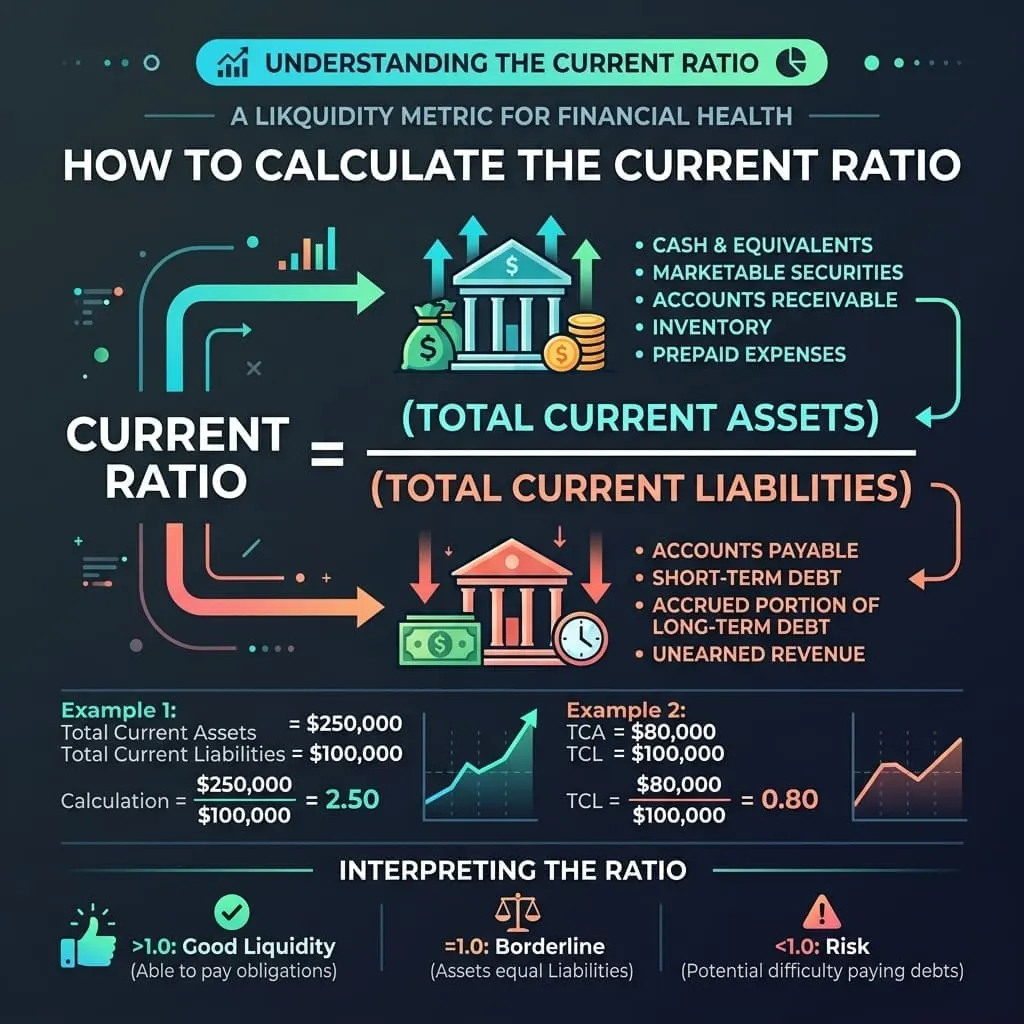
The most widely used metric to measure this short-term liquidity is the Current Ratio. This ratio compares a company's total current assets against its total current liabilities, indicating if the business has enough resources to cover its bills due within the next 12 months.
The Current Ratio Cash Flow Solver is an educational tool designed to calculate this liquidity. By entering your total current assets and total current liabilities, you can instantly estimate your current ratio multiple.
This guide provides a comprehensive breakdown of current ratio mathematics, asset vs. liability management, manual calculation guidelines, and working capital strategies.
graph TD
    A["Total Current Assets"] --> C["Divide:
Assets / Liabilities"]
    B["Total Current Liabilities"] --> C
    C --> D["Result:
Current Ratio Liquidity Multiple"]
2. Core Definitions & Analogy
To build a solid financial foundation, let us define the current ratio in both simple and technical terms:
- Simple Definition: The current ratio measures whether a company has enough cash, inventory, and other short-term resources to pay all its bills due within the next year.
- Technical Definition: The current ratio is a liquidity ratio that measures a company's ability to cover its short-term obligations due within one year using its current assets, expressed as Current Ratio = Total Current Assets / Total Current Liabilities.
- Conceptual Analogy: Think of running a business like planning a road trip. Your total current assets represent the amount of fuel in your gas tank plus the spare canisters you carry in the trunk (cash, receivables, and inventory). Your current liabilities represent the fuel needed to reach your next destination (short-term bills). The current ratio measures if your fuel supply is large enough to cover the distance.
3. History & Milestones
The formalization of the current ratio emerged alongside commercial banking and accounting standards:
- Bank Credit Analysis (late 1800s): Bankers popularized liquidity analysis, establishing the "two-to-one" rule of thumb (a current ratio of 2.0) as the minimum standard for corporate safety.
- GAAP Standardization: Standardized accounting rules established the categorization of "current" vs. "long-term" on corporate balance sheets, simplifying working capital analysis.
4. Core Concepts & Parameters
To evaluate a current ratio, you must understand two key parameters:
- Total Current Assets: Cash, cash equivalents, marketable securities, accounts receivable, inventory, and prepaid expenses that are expected to be converted into cash or used up within one year.
- Total Current Liabilities: Financial obligations due within one year, including accounts payable, short-term debt, accrued interest, and current tax liabilities.
5. The Mathematical Model & Formula
The current ratio is calculated using a straightforward division equation:
Current Ratio Formula
Current Ratio = Total Current Assets / Total Current Liabilities
Variable Breakdown:
- Current Assets: Total current assets on the balance sheet (USD)
- Current Liabilities: Total current liabilities on the balance sheet (USD)
Why it Matters:
A current ratio of 2.0 indicates that a company has $2.00 of current assets for every $1.00 of current liabilities. If the ratio drops below 1.0, the business is in a net working capital deficit, meaning its short-term obligations exceed its short-term resources.
6. Step-by-Step Manual Procedure
Let us walk through a manual calculation using our default calculator values:
- Identify the variables:
Total Current Assets = $80,000Total Current Liabilities = $40,000 - Divide current assets by current liabilities:
Current Ratio = 80,000 / 40,000 = 2.00Your current ratio is 2.00, indicating a highly liquid working capital position.
7. Visual Diagram
The flowchart below displays the computation path for current ratios:
graph TD
    Start["Enter Current Assets & Current Liabilities"] --> DivideVals["Divide:
Current Assets / Current Liabilities"]
    DivideVals --> Display["Output: Current Ratio Multiple & Liquidity Status"]
8. Parameter Comparison Matrix
The table below shows how varying current assets affects the current ratio for a business with $40,000 in current liabilities:
| Total Current Assets | Total Current Liabilities | Current Ratio Multiple | Liquidity Position Status |
|---|---|---|---|
| $20,000 | $40,000 | 0.50 | Illiquid Position (High risk of default) |
| $30,000 | $40,000 | 0.75 | Marginally Illiquid |
| $40,000 | $40,000 | 1.00 | Balanced (No safety buffer) |
| $80,000 (Default) | $40,000 (Default) | 2.00 | Highly Liquid (Strong safety margin) |
| $120,000 | $40,000 | 3.00 | Excess Liquidity (Potential idle cash) |
9. Real-World Applications
Current ratio metrics are utilized daily by business owners, creditors, and investors:
- Supplier Risk Evaluation: Suppliers review a client's current ratio before extending inventory credit terms.
- Corporate Financial Planning: CFOs use current ratios to set working capital guidelines and plan short-term cash allocations.
- Investment Screeners: Stock investors filter companies with current ratios under 1.0 to avoid investing in financially distressed firms.
10. Case Studies
Case Study 1: The Danger of Liquidity Deficits
A wholesale business has $30,000 in current assets and $40,000 in current liabilities (Current Ratio = 0.75).
- Scenario: A supplier invoice of $10,000 comes due.
- Outcome: Because the current ratio is below 1.0, the business lacks the resources to pay the supplier on time, forcing them to take on high-interest short-term loans or default on the invoice.
Case Study 2: Managing Excess Liquidity
A retail store has $120,000 in current assets and $40,000 in current liabilities (Current Ratio = 3.0).
- Analysis: The current ratio shows excellent safety. However, the store is holding $80,000 in excess cash in a non-interest-bearing account.
- Adjustment: The manager decides to invest $40,000 of the excess cash in inventory to support a new store launch, lowering the current ratio to a still-safe 2.0 while putting their capital to work.
11. Advantages of Using the Tool
- Instant Analysis: Solves for liquidity metrics in milliseconds.
- Risk Mitigation: Flags potential working capital deficits.
- Creditor Support: Helps ensure your business qualifies for supplier credit.
12. Limitations & Boundary Conditions
The current ratio includes inventory, which can take time to sell. If a company's current assets are heavily weighted in slow-moving inventory, its actual liquidity may be lower than the current ratio indicates, requiring a quick ratio analysis.
13. Common Mistakes
- Assuming a High Ratio is Always Good: A very high current ratio (e.g. over 4.0) can indicate that a company is not using its cash or assets efficiently to grow the business.
- Comparing Across Different Sectors: Comparing a supermarket chain's current ratio (typically low due to fast inventory turnover) with a manufacturer's ratio.
12. Frequently Asked Questions
Q1: What is the current ratio?
A liquidity ratio that measures a company's ability to cover its short-term liabilities using its total current assets.
Q2: What is the formula for the current ratio?
The formula is Current Ratio = Total Current Assets / Total Current Liabilities.
Q3: What is a good current ratio?
A current ratio between 1.5 and 2.5 is generally considered healthy for most industries, providing a solid safety buffer.
Q4: How does it differ from the quick ratio?
The current ratio includes inventory in current assets, while the quick ratio excludes it to provide a more conservative liquidity measure.
Q5: What happens if the current ratio is below 1.0?
The company has a net working capital deficit, meaning its short-term debts exceed its short-term assets, indicating liquidity risks.
Q6: What does "current asset" mean?
An asset that is expected to be converted into cash or used up within 12 months (e.g. cash, accounts receivable, and inventory).
Q7: Does this calculator include long-term loans?
No. Calculations focus strictly on current liabilities due within one year.
Q8: How can a business improve its current ratio?
By paying off short-term liabilities using cash, collecting accounts receivable faster, or increasing its gross sales.
Q9: Can a company have a high current ratio but still run out of cash?
Yes, if its current assets are mostly tied up in unsold inventory or uncollectible accounts receivable.
Q10: How often do public companies report their current ratio?
Quarterly and annually in their balance sheets.
15. Expert Tips
- Track inventory turnover: Keep inventory levels optimized so that your current assets are backed by cash and receivables rather than unsold stock.
- Compare with industry averages: Always evaluate your current ratio relative to your industry benchmarks to ensure a fair analysis.
16. Summary
- The current ratio measures short-term liquidity:
Current Assets / Current Liabilities.
- A ratio between 1.5 and 2.5 is healthy.
- The current ratio includes cash, accounts receivable, and inventory.
- Ratios below 1.0 indicate potential payment difficulties.
Additional Technical Guidelines & Measurement Standards
When conducting calculations for Current Ratio Cash Flow Solver, maintaining quantitative precision and verifying input parameter boundaries is essential for reliable scenario evaluation. Always verify that raw numerical inputs are measured using standardized instrumentation, and double-check unit conversions prior to applying outputs in commercial, industrial, or academic projects.
For quantitative unit conversions and scientific calculations, always maintain at least four decimal places of precision during intermediate arithmetic stages before rounding final results. When preparing technical reports, laboratory documentation, or financial forecasts, cross-verify all output variables against established international measurement standards (such as SI, NIST, and ISO metric benchmarks) to guarantee consistent analytical rigor across all computational workflows.
MathsLover.com delivers this interactive solver 100% free of charge to foster global mathematical literacy, educational accessibility, and data-driven problem solving across scientific, technical, and academic communities worldwide.