💡 Direct Answer & Executive Summary (Debt-to-Income (DTI) Ratio Calculator)
Definition: Compute front-end and back-end DTI percentage ratios for mortgage underwriting.
Governing Math Formula: DTI = Monthly Debt Obligations / Monthly Gross Income.
Target Applications: Provides real-time quantitative solutions in Finance for students, engineers, researchers, and finance professionals.
Debt-to-Income (DTI) Ratio Calculator
1. Introduction
Securing a mortgage or large personal loan can feel like an intimidating process. Lenders review several aspects of your financial profile to determine if you qualify. While your credit score reflects your payment history, lenders also evaluate your capacity to take on new monthly debt.
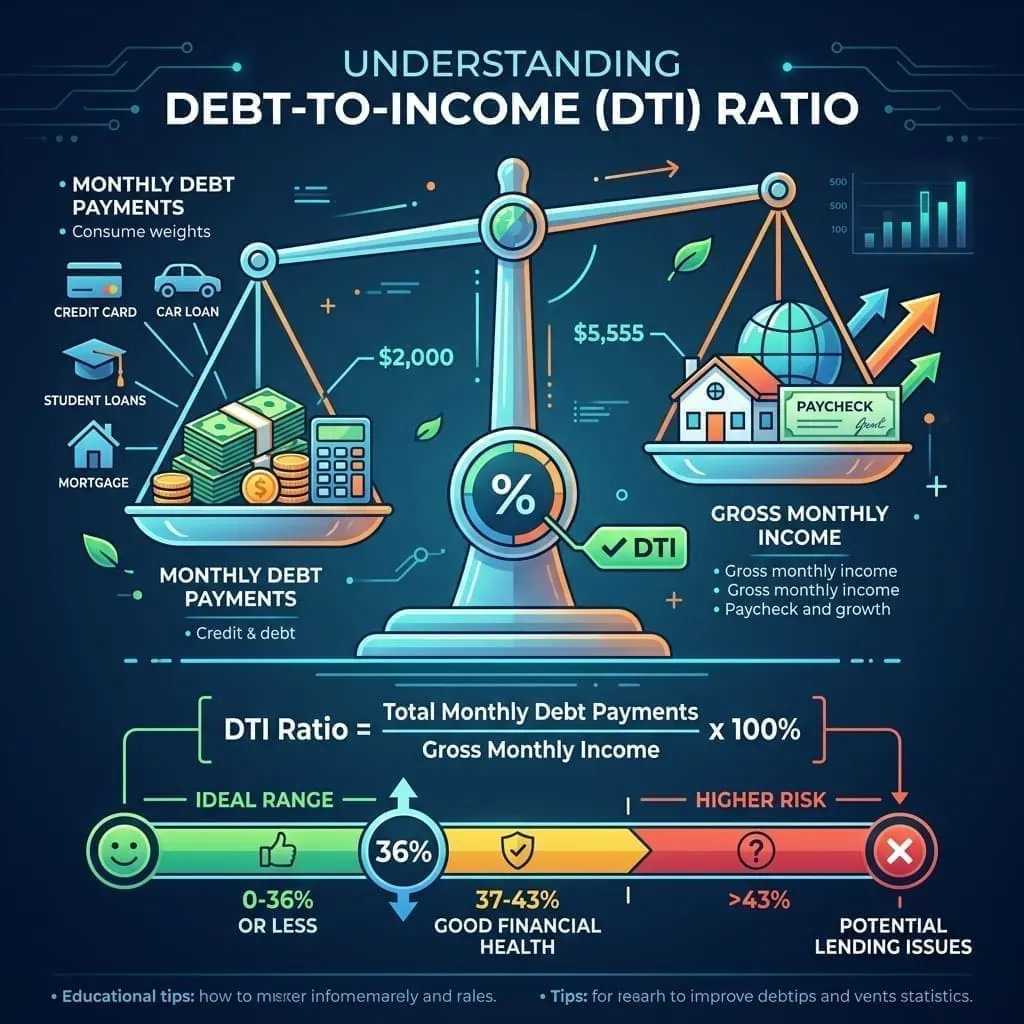
The primary tool used to measure this capacity is the Debt-to-Income (DTI) ratio. This ratio compares your monthly debt payments against your gross monthly income. It is a key underwriting metric used to evaluate lending risk, with high DTI ratios indicating that a borrower is overextended.
The Debt-to-Income (DTI) Ratio Calculator is an educational tool designed to help you check your numbers before applying. By entering your total monthly debts and gross monthly income, you can instantly estimate your DTI percentage.
This guide provides a comprehensive overview of DTI mathematics, front-end vs. back-end ratios, manual calculation guidelines, and credit underwriting benchmarks.
graph TD
    A["Total Monthly Debts"] --> C["Divide:
Debts / Income"]
    B["Monthly Gross Income"] --> C
    C --> D["Multiply by 100"]
    D --> E["Result:
Debt-to-Income (DTI) Ratio (%)"]
2. Core Definitions & Analogy
To build a solid financial foundation, let us define the DTI ratio in both simple and technical terms:
- Simple Definition: The DTI ratio is the percentage of your monthly income that goes toward paying off debts, helping lenders determine if you can afford new loan payments.
- Technical Definition: The DTI ratio is a personal solvency metric that divides your total monthly debt service obligations by your gross monthly income, expressed as DTI = (Total Monthly Debt Obligations / Monthly Gross Income) * 100.
- Conceptual Analogy: Think of your monthly income like a fresh loaf of bread. The slices you cut off to pay for your rent, student loans, and credit cards represent your debt obligations. The DTI ratio measures what percentage of the loaf is eaten up by debts before you can use the remaining bread to buy food, gas, and other daily necessities.
3. History & Milestones
The formalization of the DTI ratio evolved alongside standard mortgage underwriting practices:
- Pre-Depression Lending: Home buyers historically relied on local banks, which reviewed creditworthiness informally without standardized debt-to-income limits.
- Establishment of the FHA (1934): The Federal Housing Administration standardized underwriting guidelines, introducing structured income and debt limits to stabilize the mortgage market.
- The Qualified Mortgage (QM) Rule (2014): Following the 2008 financial crisis, the Consumer Financial Protection Bureau established the QM rule, setting a standard DTI threshold of 43% for qualifying safe mortgages.
4. Core Concepts & Parameters
To evaluate your DTI ratio, you must understand two key parameters:
- Total Monthly Debts: The sum of your monthly debt obligations, including housing costs (mortgage/rent), student loans, car payments, and minimum credit card payments.
- Monthly Gross Income: Your total pre-tax earnings per month, including salary, bonuses, alimony, and rental income.
5. The Mathematical Model & Formula
The DTI ratio is calculated using a straightforward percentage equation:
DTI Ratio Formula
DTI Ratio Percentage = ( Total Monthly Debt Obligations / Monthly Gross Income ) * 100
Variable Breakdown:
- Debts: Total monthly debt obligations (USD)
- Income: Monthly gross income before taxes (USD)
Front-End vs. Back-End Ratios:
Mortgage lenders often calculate two separate DTI ratios:
- Front-End DTI: The percentage of income that goes toward housing costs alone (mortgage principal, interest, taxes, and insurance). Lenders typically look for a front-end DTI of 28% or lower.
- Back-End DTI: The percentage of income that goes toward all monthly debt obligations combined (housing costs plus student loans, car payments, and credit cards). Lenders typically target a back-end DTI of 36% to 43% or lower.
6. Step-by-Step Manual Procedure
Let us walk through a manual calculation using our default calculator values:
- Identify the variables:
Total Monthly Debts = $2,000Monthly Gross Income = $6,000 - Divide monthly debts by monthly gross income:
2,000 / 6,000 = 0.3333 - Multiply by 100 to get the percentage:
0.3333 * 100 = 33.33%Your Debt-to-Income (DTI) ratio is 33.33%.
7. Visual Diagram
The flowchart below displays the computation path for DTI ratios:
graph TD
    Start["Enter Monthly Debts & Gross Income"] --> DivideVals["Divide:
Monthly Debts / Gross Income"]
    DivideVals --> MultPercent["Multiply by 100 for Percentage"]
    MultPercent --> Display["Output: Debt-to-Income (DTI) Ratio (%)"]
8. Parameter Comparison Matrix
The table below shows how varying gross monthly income affects the DTI ratio for a borrower with $2,000 in monthly debt obligations:
| Total Monthly Debts | Gross Monthly Income | DTI Ratio Percentage | Underwriting Risk Status |
|---|---|---|---|
| $2,000 | $4,000 | 50.00% | High Risk (Hard to qualify) |
| $2,000 | $5,000 | 40.00% | Moderate Risk (Qualifies under QM limits) |
| $2,000 (Default) | $6,000 (Default) | 33.33% | Low Risk (Strong qualification profile) |
| $2,000 | $8,000 | 25.00% | Very Low Risk |
| $2,000 | $10,000 | 20.00% | Excellent Risk Profile |
9. Real-World Applications
The DTI ratio is utilized across several lending and financial planning scenarios:
- Mortgage Qualification: Underwriters use DTI ratios to determine the maximum home loan amount you can borrow.
- Personal Financial Planning: Financial advisors use DTI metrics to check if a client has too much debt relative to their income.
- Rental Applications: Landlords review DTI metrics to verify that an applicant can afford the monthly rent.
10. Case Studies
Case Study 1: First-Time Homebuyer
A borrower earns $5,000 gross per month. They have a $300 car payment and a $100 student loan payment. They want to qualify for a mortgage with a $1,200 monthly housing payment.
- Total Monthly Debts: 300 (car) + 100 (student loan) + 1,200 (mortgage) = $1,600.
- DTI calculation: \( (1,600 / 5,000) * 100 = 32\% \).
- Outcome: Since the back-end DTI is 32% (well below the 36% target), the borrower easily qualifies for the home loan.
Case Study 2: Debt payoff acceleration
A borrower earns $6,000 per month and has $3,000 in monthly debts (DTI = 50%), making it hard to qualify for a home loan. They pay off a $1,000 credit card installment and a $200 personal loan installment.
- New Monthly Debts: 3,000 - 1,200 = $1,800.
- New DTI calculation: \( (1,800 / 6,000) * 100 = 30\% \).
- Outcome: Paying off these debts drops the DTI ratio from 50% to 30%, qualifying them for competitive mortgage rates.
11. Advantages of Using the Tool
- Financial Clarity: Instantly calculates DTI metrics.
- Supports Loan Prep: Helps you check your qualification status before applying.
- Identifies Debt Risks: Flags high DTI ratios to warn you about potential debt issues.
12. Limitations & Boundary Conditions
The DTI ratio measures only your monthly debt obligations relative to gross income. It does not account for other monthly expenses like utilities, groceries, child care, and healthcare costs, which also impact your monthly budget.
13. Common Mistakes
- Using Net Income Instead of Gross Income: Lenders base DTI ratios on pre-tax gross income, not take-home net income. Using net income will skew your calculations.
- Excluding Housing Costs: Forgetting to include your prospective mortgage payment in your monthly debt total when qualifying for a home loan.
12. Frequently Asked Questions
Q1: What is the Debt-to-Income (DTI) ratio?
The percentage of your pre-tax monthly income that goes toward paying off monthly debt obligations.
Q2: What is the formula for the DTI ratio?
The formula is DTI = (Total Monthly Debts / Monthly Gross Income) * 100.
Q3: What DTI ratio do lenders prefer?
Most lenders prefer a back-end DTI ratio of 36% or lower, though some qualifying programs allow up to 43% or 50% under specific conditions.
Q4: What is the difference between front-end and back-end DTI?
Front-end DTI calculates only your monthly housing costs relative to income. Back-end DTI calculates all monthly debt obligations combined relative to income.
Q5: Do lenders use gross or net income to calculate DTI?
Lenders use gross monthly income (pre-tax earnings) to calculate DTI ratios.
Q6: What counts as a monthly debt obligation?
Mortgage/rent, student loans, car payments, personal loans, and minimum credit card payments.
Q7: Do utilities and groceries count as debt in DTI calculations?
No. Daily living expenses like food, gas, utilities, and cell phone bills are not considered debt obligations.
Q8: How can I lower my DTI ratio?
By paying off credit card balances, refinancing auto loans to lower payments, or increasing your gross monthly income.
Q9: What is the maximum DTI for a Qualified Mortgage (QM)?
The standard maximum DTI ratio for a Qualified Mortgage is 43%.
Q10: Does a co-signer help lower the DTI ratio?
Yes. Adding a co-signer adds their gross monthly income to the equation, lowering the combined DTI ratio.
15. Expert Tips
- Aim for the 28/36 rule: Keep your housing costs below 28% of gross income (front-end) and total debt obligations below 36% of gross income (back-end).
- Pay off credit card balances: Focus on paying off small credit card balances to eliminate monthly minimum payments, which directly lowers your DTI ratio.
16. Summary
- The DTI ratio compares monthly debt payments against gross monthly income.
- The DTI formula is
(Monthly Debts / Gross Income) * 100.
- Lenders prefer a back-end DTI of 36% or lower.
- Front-end DTI covers housing costs; back-end DTI covers all debt obligations.
Additional Technical Guidelines & Measurement Standards
When conducting calculations for Debt-to-Income (DTI) Ratio Calculator, maintaining quantitative precision and verifying input parameter boundaries is essential for reliable scenario evaluation. Always verify that raw numerical inputs are measured using standardized instrumentation, and double-check unit conversions prior to applying outputs in commercial, industrial, or academic projects.
For quantitative unit conversions and scientific calculations, always maintain at least four decimal places of precision during intermediate arithmetic stages before rounding final results. When preparing technical reports, laboratory documentation, or financial forecasts, cross-verify all output variables against established international measurement standards (such as SI, NIST, and ISO metric benchmarks) to guarantee consistent analytical rigor across all computational workflows.
MathsLover.com delivers this interactive solver 100% free of charge to foster global mathematical literacy, educational accessibility, and data-driven problem solving across scientific, technical, and academic communities worldwide.