💡 Direct Answer & Executive Summary (Straight-Line Asset Depreciation Calculator)
Definition: Compute annual depreciation schedules for fixed business assets over asset useful life.
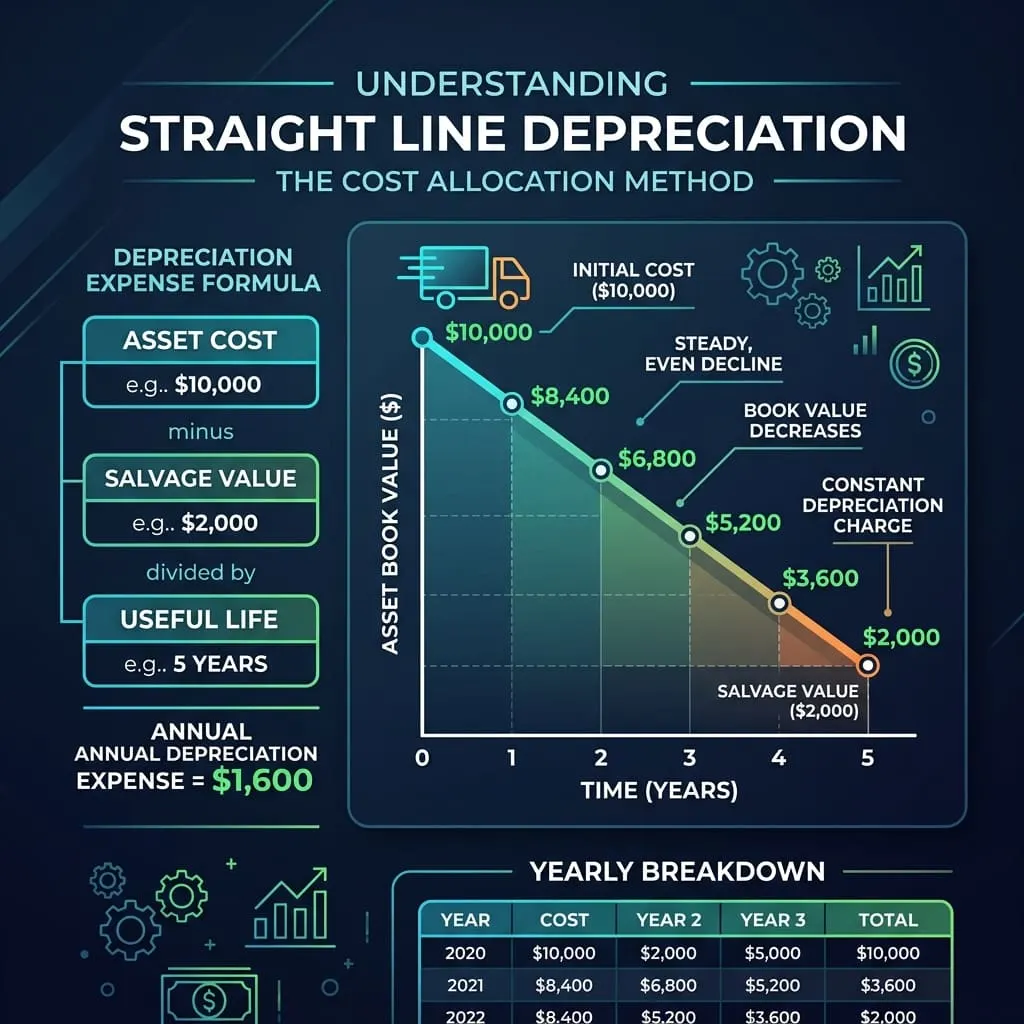
Governing Math Formula: Annual Depreciation = (Asset Cost - Salvage Value) / Useful Life.
Target Applications: Provides real-time quantitative solutions in Finance for students, engineers, researchers, and finance professionals.
Straight-Line Asset Depreciation Calculator
1. Introduction
When a business purchases physical assets—such as company vehicles, manufacturing machinery, office computers, or buildings—these items do not remain brand new forever. Over time, wear and tear, usage, and obsolescence reduce their value.
In business accounting, this gradual loss of value is recorded as depreciation. Instead of writing off the entire cost of a major equipment purchase in the first year, depreciation allows companies to spread the cost over the asset's useful life, matching the expense with the revenue the asset helps generate.
The Straight-Line Asset Depreciation Calculator is an educational tool designed to map this schedule. By entering your asset cost price, salvage scrap value, and useful asset life, you can instantly estimate your annual depreciation expenses.
This guide provides a comprehensive breakdown of straight-line depreciation mathematics, tax impacts, manual calculation guidelines, and accounting standards.
graph TD
    A["Asset Cost Price"] --> C["Determine Depreciable Base: Cost - Salvage"]
    B["Salvage Scrap Value"] --> C
    C --> D["Divide by Useful Life (Years)"]
    D --> E["Result:
Annual Depreciation Expense"]
2. Core Definitions & Analogy
To build a solid accounting foundation, let us define depreciation in both simple and technical terms:
- Simple Definition: Depreciation is the process of writing off the cost of a long-term business asset over the years you use it, rather than all at once when you buy it.
- Technical Definition: Straight-line depreciation is a method of amortization where the asset's value is reduced by equal increments in each accounting period over its useful life. The annual expense is calculated as Depreciation = (Asset Cost - Salvage Value) / Useful Life.
- Conceptual Analogy: Think of buying a major business asset like purchasing a giant 5-pound tub of coffee for the office kitchen. You don't drink the entire tub on the first day. Instead, you scoop out a small, equal portion every morning over several weeks. Depreciation is like recording the cost of those daily scoops of coffee over time, rather than charging the entire tub to the first day's expenses.
3. History & Milestones
The development of modern industrial equipment and income tax laws established depreciation as a standard accounting practice:
- The Railroad Boom (1800s): The construction of massive railroad networks required operators to account for the gradual wear and tear of steel tracks and steam engines, paving the way for systematic depreciation schedules.
- Corporate Income Tax (1913): The legalization of corporate income tax in the United States made depreciation a critical tax shield, allowing companies to deduct asset depreciation to reduce their taxable profits.
- Generally Accepted Accounting Principles (GAAP): Standardized rules established straight-line depreciation as the default, easiest method to report asset values to shareholders and tax agencies.
4. Core Concepts & Parameters
To evaluate straight-line depreciation, you must understand three key parameters:
- Asset Cost Price: The total initial cost to purchase and install the asset, including shipping, setup fees, and testing costs.
- Salvage Scrap Value: The estimated residual value of the asset at the end of its useful life (what you expect to sell it for as scrap or used equipment).
- Useful Asset Life: The number of years the asset is expected to remain functional and productive for the business.
5. The Mathematical Model & Formula
Straight-line depreciation is calculated using a straightforward division equation:
1. Depreciable Base Formula
Depreciable Base = Asset Cost Price - Salvage Scrap Value
2. Annual Depreciation Expense Formula
Annual Depreciation = Depreciable Base / Useful Asset Life in Years
Variable Breakdown:
- Cost: Initial purchase and setup cost of the asset (USD)
- Salvage: Expected scrap or resale value at the end of useful life (USD)
- Useful Life: Number of years the asset is used (Years)
Why the Formula Works:
Straight-line depreciation spreads the depreciable cost of an asset evenly across its useful life. It assumes that the asset depreciates at a constant rate every year.
6. Step-by-Step Manual Procedure
Let us walk through a manual calculation using our default calculator values:
- Identify the variables:
Asset Cost Price = $25,000Salvage Scrap Value = $5,000Useful Asset Life = 5 Years - Calculate the Depreciable Base: Subtract salvage value from cost.
Depreciable Base = 25,000 - 5,000 = $20,000This represents the total value of the asset that will be written off over time. - Calculate the Annual Depreciation: Divide depreciable base by useful life.
Annual Depreciation = 20,000 / 5 = $4,000Your company will record a $4,000 depreciation expense every year for 5 years. - Track Book Value over time:*
Year 0 (Purchase):Book Value = $25,000*Year 1:Book Value = 25,000 - 4,000 = $21,000*Year 2:Book Value = 21,000 - 4,000 = $17,000*Year 3:Book Value = 17,000 - 4,000 = $13,000*Year 4:Book Value = 13,000 - 4,000 = $9,000*Year 5:Book Value = 9,000 - 4,000 = $5,000 (Salvage Value reached)
7. Visual Diagram
The flowchart below displays the computation path for straight-line depreciation:
graph TD
    Start["Enter Cost Price, Salvage, Life Years"] --> CalcBase["Compute Depreciable Base: Cost - Salvage"]
    CalcBase --> CalcDep["Compute Annual Depreciation: Base / Life"]
    CalcDep --> BuildSchedule["Generate Book Value Schedule Year-by-Year"]
    BuildSchedule --> Display["Output: Annual Depreciation Expense ($)"]
8. Parameter Comparison Matrix
The table below shows how useful life affects the annual depreciation expense for a $25,000 asset with a $5,000 salvage value:
| Initial Asset Cost | Salvage Scrap Value | Useful Life (Years) | Depreciable Base | Annual Depreciation | Annual Depreciation Rate |
|---|---|---|---|---|---|
| $25,000 | $5,000 | 3 Years | $20,000 | $6,666.67 | 33.33% |
| $25,000 | $5,000 | 4 Years | $20,000 | $5,000.00 | 25.00% |
| $25,000 (Default) | $5,000 (Default) | 5 Years (Default) | $20,000 | $4,000.00 | 20.00% |
| $25,000 | $5,000 | 8 Years | $20,000 | $2,500.00 | 12.50% |
| $25,000 | $5,000 | 10 Years | $20,000 | $2,000.00 | 10.00% |
9. Real-World Applications
Depreciation is a fundamental accounting practice used by businesses of all sizes:
- Tax Reporting: Businesses deduct depreciation expenses to reduce their taxable net income, saving on tax bills.
- Balance Sheet Audits: Companies adjust the book value of their assets on the balance sheet to reflect their actual current worth.
- Capital Budgeting: Managers project future depreciation schedules to plan for equipment upgrades and cash flow allocations.
10. Case Studies
Case Study 1: Office Computer Hardware Upgrades
A tech consulting firm purchases new server racks and laptops for $25,000. They estimate the hardware will be obsolete in 5 years, with a resale scrap value of $5,000.
- Calculation: Depreciable Base = 4,000.
- Outcome: The firm records a $4,000 expense annually, helping them offset taxable income and save for new hardware upgrades in 5 years.
Case Study 2: Delivery Van Acquisition
A local florist buys a delivery van for $45,000, expecting to sell it after 10 years of use for $5,000.
- Calculation: Depreciable Base = 4,000.
- Outcome: The florist deducts $4,000 per year, matching the cost of the van with the floral delivery revenue it helps generate.
11. Advantages of Using the Tool
- Accounting Accuracy: Instantly computes annual depreciation expenses.
- Tax Planning Support: Helps estimate corporate tax deductions easily.
- Simple Audits: Instantly shows how salvage values alter asset book values.
12. Limitations & Boundary Conditions
Straight-line depreciation assumes that the asset depreciates at a constant rate every year. In the real world, many assets (like vehicles) lose value much faster in their first few years of use, which may require accelerated depreciation methods like Double Declining Balance.
13. Common Mistakes
- Not Including Setup Fees in Cost: Forgetting to add shipping and installation costs to the initial asset price, which underestimates your depreciation.
- Assuming Salvage Value is Zero: Neglecting to estimate a residual scrap value can lead to incorrect depreciation write-offs.
12. Frequently Asked Questions
Q1: What is straight-line depreciation?
An accounting method that spreads the cost of a physical business asset evenly across its useful life.
Q2: What is the formula for straight-line depreciation?
The formula is Annual Depreciation = (Asset Cost - Salvage Value) / Useful Life.
Q3: What is salvage value?
The estimated scrap or resale value of an asset at the end of its useful life.
Q4: What is depreciable base?
The total cost of the asset that will be depreciated over time (Purchase Cost minus Salvage Value).
Q5: How does depreciation help reduce taxes?
Depreciation is recorded as a business expense on the income statement, which lowers your taxable net income and reduces your corporate tax bill.
Q6: Can land be depreciated?
No. Under standard accounting rules, land is not depreciated because it does not wear out or become obsolete over time.
Q7: What does "book value" mean?
The current value of an asset recorded on the balance sheet (Initial Cost minus accumulated depreciation).
Q8: What is useful life?
The estimated number of years an asset is expected to remain productive and functional for the business.
Q9: Can an asset be depreciated below its salvage value?
No. An asset's book value cannot be depreciated below its estimated salvage value.
Q10: What is accelerated depreciation?
A depreciation method where larger expenses are recorded in the early years of the asset's life, and smaller expenses are recorded in the later years.
15. Expert Tips
- Review salvage values annually: Adjust your residual value estimates if market conditions or resale prices for used equipment change.
- Consult tax codes: Verify that your useful life estimates align with standard IRS asset class guidelines for tax purposes.
16. Summary
- Depreciation spreads asset costs across useful life years.
- The straight-line formula is
(Asset Cost - Salvage Value) / Useful Life.
- Salvage value is the expected scrap value at the end of the asset's life.
- Deducting depreciation reduces taxable net income, saving on taxes.
Additional Technical Guidelines & Measurement Standards
When conducting calculations for Straight-Line Asset Depreciation Calculator, maintaining quantitative precision and verifying input parameter boundaries is essential for reliable scenario evaluation. Always verify that raw numerical inputs are measured using standardized instrumentation, and double-check unit conversions prior to applying outputs in commercial, industrial, or academic projects.
For quantitative unit conversions and scientific calculations, always maintain at least four decimal places of precision during intermediate arithmetic stages before rounding final results. When preparing technical reports, laboratory documentation, or financial forecasts, cross-verify all output variables against established international measurement standards (such as SI, NIST, and ISO metric benchmarks) to guarantee consistent analytical rigor across all computational workflows.
MathsLover.com delivers this interactive solver 100% free of charge to foster global mathematical literacy, educational accessibility, and data-driven problem solving across scientific, technical, and academic communities worldwide.