💡 Direct Answer & Executive Summary (Emergency Fund Size Calculator)
Definition: Compute values for Emergency Fund Size Calculator inside the financial analytics domain.
Governing Math Formula: Standard industry financial equation for Emergency Fund Size Calculator.
Target Applications: Provides real-time quantitative solutions in Finance for students, engineers, researchers, and finance professionals.
Emergency Fund Size Calculator
1. Introduction
Life is unpredictable. Unexpected events—such as a sudden job loss, medical emergencies, major car repairs, or urgent home maintenance—can happen at any moment. Without a financial safety net, these events can force you to take on high-interest credit card debt or personal loans, derailing your financial progress.
The foundation of personal financial security is an emergency fund. This is cash set aside in a separate, liquid account specifically to cover living expenses during unexpected events, providing you with a financial buffer.
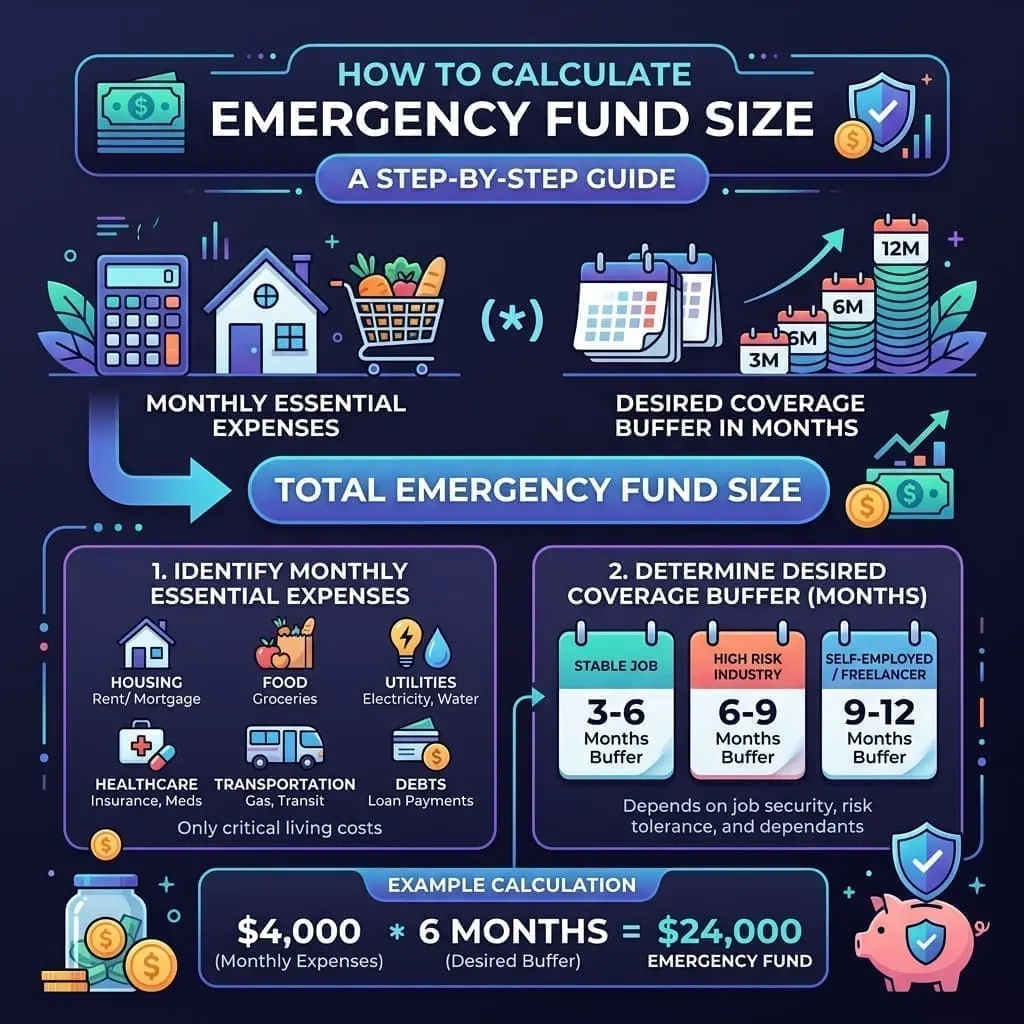
The Emergency Fund Size Calculator is an educational tool designed to help you plan this buffer. By entering your monthly operating expenses and desired coverage buffer in months, you can instantly estimate your required emergency fund size.
This guide provides a comprehensive overview of emergency fund planning, monthly expense tracking, manual calculation guidelines, and safety net strategies.
graph TD
    A["Monthly Operating Expenses"] --> C["Multiply:
Expenses * Months"]
    B["Desired Coverage Buffer (Months)"] --> C
    C --> D["Result:
Required Emergency Fund Size ($)"]
2. Core Definitions & Analogy
To build a solid personal finance foundation, let us define the emergency fund in both simple and technical terms:
- Simple Definition: An emergency fund is a savings reserve of cash specifically set aside to pay for your basic living expenses if you lose your job or face an unexpected bill.
- Technical Definition: An emergency fund is a highly liquid capital reserve. The required size (F) is calculated by multiplying your average monthly essential operating expenses (E) by your desired coverage buffer in months (b), expressed as F = E * b.
- Conceptual Analogy: Think of building an emergency fund like packing a parachute for a flight. You hope you never have to pull the cord, but if the engine fails (a job loss or medical emergency), having a properly sized parachute is the only thing that ensures a safe landing, preventing a financial crash.
3. History & Milestones
The formalization of emergency reserves emerged alongside modern personal finance and safety net policies:
- The Great Depression (1930s): Massive job losses highlighted the need for emergency reserves, leading to the creation of government safety nets (like unemployment insurance) and encouraging personal savings habits.
- The 3-to-6 Month Rule: Over the late 20th century, financial planners standardized the recommendation to hold 3 to 6 months of living expenses in cash, establishing it as the default personal finance safety benchmark.
4. Core Concepts & Parameters
To evaluate your emergency fund size, you must understand two key parameters:
- Monthly Operating Expenses: The total cost to cover your essential living expenses for one month, including housing (rent/mortgage), utilities, groceries, insurance, and minimum debt payments.
- Desired Coverage Buffer: The number of months you want to be able to survive without any income (typically 3 to 6 months).
5. The Mathematical Model & Formula
The emergency fund size is calculated using a straightforward multiplication equation:
Emergency Fund Formula
Required Fund Size = Monthly Operating Expenses * Coverage Buffer in Months
Variable Breakdown:
- Monthly Expenses: Average monthly cost of essential living expenses (USD)
- Buffer: Number of months of coverage target (Months, default b = 6)
Identifying Essential Expenses:
When calculating monthly expenses for an emergency fund, focus on essential "needs" rather than discretionary "wants":
- Essential (Include): Rent/mortgage, utilities, food, healthcare, transportation, and debt payments.
- Discretionary (Exclude): Dining out, entertainment, subscription services, and luxury shopping.
6. Step-by-Step Manual Procedure
Let us walk through a manual calculation using our default calculator values:
- Identify the variables:
Monthly Operating Expenses = $3,000Desired Coverage Buffer = 6 Months - Multiply monthly expenses by the coverage buffer:
Required Fund Size = 3,000 * 6 = $18,000You should target an emergency fund of $18,000, which will cover your living expenses for 6 months.
7. Visual Diagram
The flowchart below displays the computation path for emergency funds:
graph TD
    Start["Enter Monthly Expenses & Coverage Months"] --> MultiplyVals["Multiply:
Expenses * Months"]
    MultiplyVals --> Display["Output: Required Emergency Fund Size ($)"]
8. Parameter Comparison Matrix
The table below shows how the coverage buffer affects the required fund size for a household with $3,000 in monthly operating expenses:
| Monthly Expenses | Coverage Buffer | Required Fund Size | Safety Coverage Profile |
|---|---|---|---|
| $3,000 | 3 Months | $9,000 | Minimum Safe Buffer (Single income / Stable job) |
| $3,000 (Default) | 6 Months (Default) | $18,000 | Healthy Buffer (Dual income / Standard) |
| $3,000 | 9 Months | $27,000 | High Protection Buffer (Freelancer / Variable income) |
| $3,000 | 12 Months | $36,000 | Maximum Protection Buffer (Sole earner / Business owner) |
9. Real-World Applications
Emergency fund metrics are essential for financial planning and budgeting:
- Financial Safety Audits: Households review their savings monthly to check if their cash reserves match their monthly expense changes.
- Career Transition Planning: Employees build a larger emergency buffer before launching a startup or changing careers.
- Debt Prevention: Maintaining cash reserves prevents you from having to use credit cards to cover emergency repairs.
10. Case Studies
Case Study 1: Job Loss Survival
A graphic designer earns $4,000 gross per month, with essential living expenses at $3,000. They build a 6-month emergency fund of $18,000.
- Event: The designer is laid off due to company restructuring.
- Survival: With $18,000 in cash, they cover their basic living expenses for 6 months, allowing them to search for a quality new job without financial panic.
Case Study 2: Freelancer Safety Net
A freelance writer has variable monthly income, with expenses at $3,000. Because their income is irregular, they target a 9-month emergency fund ($27,000) instead of the standard 3 months.
- Event: A major client cancels their contract, reducing the writer's income by 50% for several months.
- Outcome: The $27,000 buffer covers the income shortfall, allowing the writer to find new clients without falling behind on bills.
11. Advantages of Using the Tool
- Saves Time: Instantly calculates emergency fund targets.
- Provides Security: Establishes a clear financial goal to build safety.
- Supports Planning: Easily shows how changing your expenses alters your required buffer.
12. Limitations & Boundary Conditions
This calculator assumes your monthly expenses remain constant during an emergency. In a real emergency (like a job loss), most households cut discretionary spending, which extends the actual coverage of their cash reserves.
13. Common Mistakes
- Including Discretionary Spending in Expenses: Calculating your fund size based on gross income or luxury budgets, which overestimates your required savings target.
- Keeping the Fund in Low-Yield Accounts: Storing your emergency fund in a standard savings account earning 0.01% interest, rather than a high-yield savings account (HYSA) that pays 4% to 5% interest.
12. Frequently Asked Questions
Q1: What is an emergency fund?
A cash reserve set aside in a separate, liquid account to cover living expenses during unexpected events like job losses or medical emergencies.
Q2: What is the formula for emergency fund size?
The formula is Required Fund Size = Monthly Operating Expenses * Coverage Buffer in Months.
Q3: How many months of expenses should I save?
Financial planners typically recommend saving 3 to 6 months of essential living expenses, though freelancers or sole earners may want to target 9 to 12 months.
Q4: Where should I keep my emergency fund?
In a highly liquid, safe account—such as a High-Yield Savings Account (HYSA) or a Money Market Account—that earns interest but allows quick access to cash.
Q5: What counts as an emergency?
Unexpected, necessary expenses like job losses, medical emergencies, major car repairs, or urgent home maintenance.
Q6: Should I pay off debt before building an emergency fund?
It is best to build a starter emergency fund of $1,000 to $2,000 first to avoid taking on new debt, then focus on paying off high-interest debt.
Q7: Do credit cards count as an emergency fund?
No. Relying on credit cards during an emergency traps you in high-interest debt, making your financial situation worse.
Q8: What expenses should I exclude from my monthly calculation?
Discretionary costs like dining out, luxury shopping, entertainment, and non-essential subscription services.
Q9: Does a co-signer help lower the DTI ratio?
This question is for mortgage qualification; in emergency planning, focus on household-level cash reserves.
Q10: How often should I review my emergency fund size?
At least annually, or whenever your rent/mortgage, debt payments, or basic living expenses change.
15. Expert Tips
- Automate your savings: Set up an automatic transfer of your target monthly savings amount to a separate savings account on payday to remove temptation.
- Use a high-yield savings account: Keep your savings in an HYSA earning 4% to 5% interest to let compound growth help you reach your goal faster.
16. Summary
- Emergency funds provide a safety net during unexpected events.
- The required fund size formula is
Monthly Expenses * Coverage Months.
- Financial planners recommend saving 3 to 6 months of expenses.
- Keep your emergency fund in a separate, liquid, interest-bearing account.
Additional Technical Guidelines & Measurement Standards
When conducting calculations for Emergency Fund Size Calculator, maintaining quantitative precision and verifying input parameter boundaries is essential for reliable scenario evaluation. Always verify that raw numerical inputs are measured using standardized instrumentation, and double-check unit conversions prior to applying outputs in commercial, industrial, or academic projects.
For quantitative unit conversions and scientific calculations, always maintain at least four decimal places of precision during intermediate arithmetic stages before rounding final results. When preparing technical reports, laboratory documentation, or financial forecasts, cross-verify all output variables against established international measurement standards (such as SI, NIST, and ISO metric benchmarks) to guarantee consistent analytical rigor across all computational workflows.
MathsLover.com delivers this interactive solver 100% free of charge to foster global mathematical literacy, educational accessibility, and data-driven problem solving across scientific, technical, and academic communities worldwide.