💡 Direct Answer & Executive Summary (Hourly Wage to Annual Salary Calculator)
Definition: Compute values for Hourly Wage to Annual Salary Calculator inside the financial analytics domain.
Governing Math Formula: Standard industry financial equation for Hourly Wage to Annual Salary Calculator.
Target Applications: Provides real-time quantitative solutions in Finance for students, engineers, researchers, and finance professionals.
Hourly Wage to Annual Salary Calculator
1. Introduction
When negotiating employment terms, planning personal finances, or comparing job opportunities, your compensation is usually presented in one of two formats: an hourly rate (e.g. $25 per hour) or an annual salary (e.g. $52,000 per year). While hourly wages show the direct value of your working hours, annual salaries are better for long-term budgeting.
To build a secure financial plan, you must know how your hourly rate translates into annual earnings. This conversion helps you set savings goals, qualify for rental housing, and compare contract work with salaried positions.
The Hourly Wage to Annual Salary Calculator is an educational tool designed to simplify this calculation. By entering your hourly pay rate and weekly work hours, you can instantly estimate your annual salary.
This guide provides a comprehensive overview of wage mathematics, standard work calendars, manual calculation guidelines, and paycheck budgeting strategies.
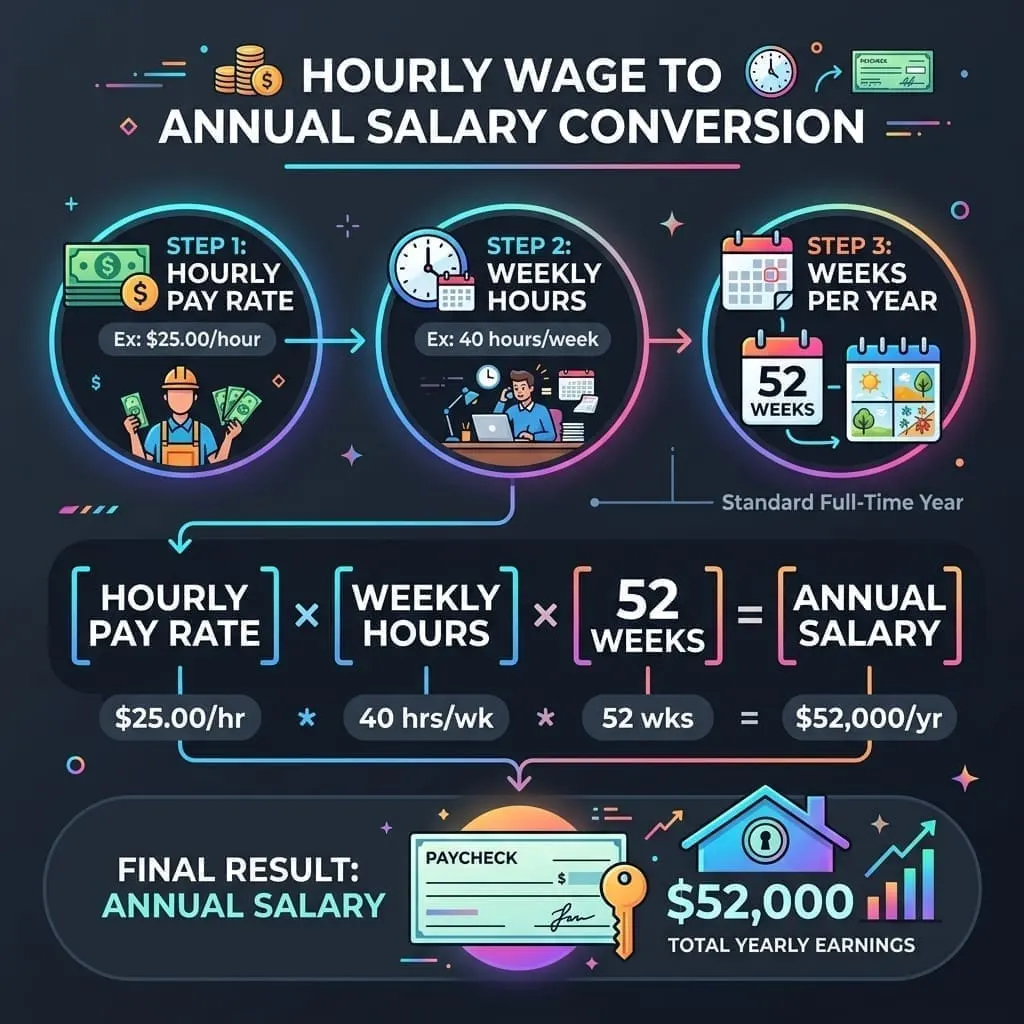
graph TD
    A["Hourly Pay Rate"] --> C["Determine Annual Hours: Weekly Hours * 52"]
    B["Weekly Work Hours"] --> C
    C --> D["Multiply:
Hourly Rate * Annual Hours"]
    D --> E["Result:
Annual Salary ($ / year)"]
2. Core Definitions & Analogy
To build a solid personal finance foundation, let us define wages in both simple and technical terms:
- Simple Definition: Converting an hourly wage to an annual salary shows you the total gross amount of money you would earn in a full year of work, based on your weekly working hours.
- Technical Definition: The hourly wage to annual salary conversion is a product that multiplies the hourly pay rate (w) by the weekly work hours (h) and the number of weeks in a standard year (52), expressed as Annual Salary = w h 52.
- Conceptual Analogy: Think of your working hours like steps on a ladder. Your hourly wage is the height of each step, and your weekly work hours determine how many steps you climb each week. Multiplying these together over 52 weeks tells you the total height (your annual salary) you will reach at the end of the year.
3. History & Milestones
The formalization of wage standards and hourly pay structures evolved alongside labor laws:
- The Fair Labor Standards Act (1938): This federal legislation established the standard 40-hour work week, introduced the minimum wage, and mandated overtime pay for hourly workers.
- The Salaried Exemption Standard: Modern labor laws separated workers into "exempt" (salaried employees who do not receive overtime pay) and "non-exempt" (hourly workers entitled to overtime), making wage calculations essential to ensure compliance.
4. Core Concepts & Parameters
To convert your hourly wage to an annual salary, you must understand two key parameters:
- Hourly Pay Rate: The dollar amount you earn for a single hour of work.
- Weekly Work Hours: The average number of hours you work per week (typically 40 hours for a standard full-time position).
5. The Mathematical Model & Formula
The hourly wage to annual salary conversion is solved using a standard time-based multiplication equation:
1. Annual Work Hours Formula
Annual Work Hours = Weekly Work Hours * 52 Weeks
2. Annual Salary Formula
Annual Salary = Hourly Pay Rate * Annual Work Hours
Variable Breakdown:
- Hourly Rate: Gross hourly pay rate before taxes (USD)
- Weekly Hours: Number of working hours per week (Hours, default h = 40)
Why the Formula Works:
This calculation assumes a standard calendar of 52 weeks per year. It multiplies your hourly rate by the total hours you work over those 52 weeks to estimate your gross annual earnings.
6. Step-by-Step Manual Procedure
Let us walk through a manual calculation using our default calculator values:
- Identify the variables:
Hourly Pay Rate = $25Weekly Work Hours = 40 Hours - Calculate the Annual Work Hours: Multiply weekly hours by 52.
Annual Work Hours = 40 * 52 = 2,080 hoursA standard full-time employee works 2,080 hours per year. - Multiply the hourly rate by the annual work hours:
Annual Salary = 25 * 2,080 = $52,000Your estimated annual salary is $52,000 per year, with a gross weekly pay of $1,000.00 (25 multiplied by 40).
7. Visual Diagram
The flowchart below displays the computation path for hourly-to-salary conversions:
graph TD
    Start["Enter Hourly Rate & Weekly Hours"] --> CalcAnnualHours["Compute Annual Hours: Weekly Hours * 52"]
    CalcAnnualHours --> MultiplyRate["Multiply:
Hourly Rate * Annual Hours"]
    MultiplyRate --> Display["Output: Annual Salary ($ / year) & Weekly Gross Pay"]
8. Parameter Comparison Matrix
The table below shows how weekly work hours affect the annual salary for a $25 hourly pay rate:
| Hourly Pay Rate | Weekly Work Hours | Annual Work Hours | Annual Salary Equivalent | Weekly Gross Pay |
|---|---|---|---|---|
| $25 | 20 Hours (Part-time) | 1,040 Hours | $26,000 | $500.00 |
| $25 | 30 Hours (Part-time) | 1,560 Hours | $39,000 | $750.00 |
| $25 | 35 Hours (Full-time) | 1,820 Hours | $45,500 | $875.00 |
| $25 (Default) | 40 Hours (Default) | 2,080 Hours | $52,000 | $1,000.00 |
| $25 | 45 Hours (Overtime) | 2,340 Hours | $58,500 | $1,125.00 |
9. Real-World Applications
Hourly wage calculations are utilized by workers and employers in several scenarios:
- Job Offer Comparisons: Candidates compare an hourly contract offer with a salaried position to check which pays more for their actual time.
- Qualifying for Housing: Landlords and mortgage lenders review your hourly wage and convert it to an annual salary to verify that you meet income requirements.
- Personal Budgeting: Households convert their hourly earnings to an annual salary to plan their yearly savings and expense budgets.
10. Case Studies
Case Study 1: Evaluating a Contract Offer
A freelancer is offered a contract role paying $25 per hour for 40 hours per week.
- Calculation: 25 40 52 = $52,000 per year.
- Outcome: The freelancer knows their annual gross earnings target is $52,000, helping them budget for taxes and health insurance.
Case Study 2: Part-Time vs. Full-Time Calculations
An employee works part-time (30 hours/week) earning $25 per hour. They are offered a full-time position (40 hours/week) at the same rate.
- Part-Time Salary: 25 30 52 = $39,000/year.
- Full-Time Salary: 25 40 52 = $52,000/year.
- Outcome: Moving to full-time hours increases their annual earnings by $13,000, helping them evaluate the value of the extra working hours.
11. Advantages of Using the Tool
- Saves Time: Instantly converts hourly rates to annual salaries.
- Supports Financial Planning: Helps you set annual savings targets.
- Housing Qualification Helper: Quickly calculates the annual income needed for rental applications.
12. Limitations & Boundary Conditions
This calculator assumes constant weekly work hours with no unpaid time off. It does not factor in overtime pay rates (typically 1.5 times the hourly rate) or corporate benefits (like health insurance and paid time off), which increase the total value of a position.
13. Common Mistakes
- Assuming a Flat Year-Round Schedule: Forgetting to account for unpaid holidays or sick leave, which can reduce your actual annual earnings if you do not have paid time off.
- Ignoring Taxes: Conforming your gross annual salary to your actual take-home pay without subtracting federal and local tax deductions.
12. Frequently Asked Questions
Q1: What is the hourly wage to annual salary conversion?
Converting an hourly pay rate into a yearly salary based on your weekly working hours.
Q2: What is the formula for converting hourly wage to annual salary?
The formula is Annual Salary = Hourly Rate * Weekly Hours * 52.
Q3: How many working hours are in a standard year?
A standard 40-hour work week over 52 weeks equals 2,080 working hours per year.
Q4: Does this calculator include tax deductions?
No. Calculations are based on gross earnings before federal and local taxes are deducted.
Q5: Does this calculator include overtime pay?
No. This calculator assumes a constant straight-time hourly rate.
Q6: How does unpaid time off affect my annual salary?
Unpaid time off reduces your annual work hours, which directly lowers your annual earnings.
Q7: Can I calculate part-time salaries?
Yes, by entering your actual part-time weekly hours (e.g. 20 hours/week) in the weekly hours field.
Q8: What does gross income mean?
Your total earnings before any taxes, health insurance, or retirement contributions are deducted.
Q9: What does net income mean?
Your actual take-home pay after all taxes and deductions have been subtracted from your gross income.
Q10: How do I convert hourly pay to monthly salary?
Multiply your hourly rate by your weekly work hours and then by 4.33 (the average number of weeks in a month).
15. Expert Tips
- Account for unpaid time off: If your job does not offer paid time off, subtract 2 to 3 weeks of earnings from your annual estimate to plan for holidays and sick leave.
- Factor in benefits: When comparing hourly and salaried roles, remember that salaried positions often include health insurance and retirement matches that add to your total compensation.
16. Summary
- Converting hourly pay to annual salary helps you plan long-term budgets.
- The standard conversion formula is
Hourly Rate * Weekly Hours * 52.
- A standard full-time work year contains 2,080 hours.
- Unpaid time off reduces your actual annual earnings.
Additional Technical Guidelines & Measurement Standards
When conducting calculations for Hourly Wage to Annual Salary Calculator, maintaining quantitative precision and verifying input parameter boundaries is essential for reliable scenario evaluation. Always verify that raw numerical inputs are measured using standardized instrumentation, and double-check unit conversions prior to applying outputs in commercial, industrial, or academic projects.
For quantitative unit conversions and scientific calculations, always maintain at least four decimal places of precision during intermediate arithmetic stages before rounding final results. When preparing technical reports, laboratory documentation, or financial forecasts, cross-verify all output variables against established international measurement standards (such as SI, NIST, and ISO metric benchmarks) to guarantee consistent analytical rigor across all computational workflows.
MathsLover.com delivers this interactive solver 100% free of charge to foster global mathematical literacy, educational accessibility, and data-driven problem solving across scientific, technical, and academic communities worldwide.