💡 Direct Answer & Executive Summary (Fixed-Rate Mortgage Payment Calculator)
Definition: Estimate monthly home mortgage principal and interest installments based on property price, down payment, and loan term.
Governing Math Formula: M = P [ i(1 + i)^n ] / [ (1 + i)^n – 1 ], where P is principal, i is monthly interest rate, and n is total months.
Target Applications: Provides real-time quantitative solutions in Finance for students, engineers, researchers, and finance professionals.
Fixed-Rate Mortgage Payment Calculator
1. Introduction
Buying a home is one of the most significant financial milestones in a person's life. However, because real estate requires substantial capital, very few buyers can purchase a property outright with cash. Instead, they rely on a home loan known as a mortgage to bridge the gap.
Among the various home financing structures available, the fixed-rate mortgage is the most popular choice. It offers financial security and predictability by keeping the interest rate and monthly payments constant throughout the entire term. This prevents buyers from experiencing unexpected payment hikes caused by market fluctuations.
The Fixed-Rate Mortgage Payment Calculator is an educational tool designed to help you analyze home financing costs. By entering key variables like property price, down payment, annual interest rate, and term, you can instantly estimate your monthly commitments and understand how interest scales over time.
This guide provides a thorough overview of home mortgage mathematics, historical timelines, step-by-step calculation guidelines, and realistic budgeting case studies.
graph TD
    A["Purchase Price"] --> B["Subtract Down Payment"]
    B --> C["Loan Principal (P)"]
    C --> D["Apply Monthly Interest Rate (i)"]
    D --> E["Calculate Over Term Months (n)"]
    E --> F["Monthly Principal + Interest (M)"]
2. Core Definitions & Analogy
To build solid financial literacy, let us define mortgage parameters in both simple and technical terms:
- Simple Definition: A mortgage is a long-term loan specifically used to buy property, where the property itself acts as security (collateral) for the loan. A fixed-rate mortgage ensures that your interest rate never changes.
- Technical Definition: A fixed-rate mortgage is an amortizing loan structure featuring a fixed interest rate for the entire duration of the loan. The payment is calculated so that the loan balance reaches exactly zero at the end of the term, using a level-payment amortization schedule.
- Conceptual Analogy: Think of a fixed-rate mortgage like renting a flat on a 30-year lease with a locked price agreement. No matter how much property values or inflation rates rise over those 30 years, your landlord cannot raise your monthly rent by even a single penny. This gives you complete budget stability.
3. History & Milestones
The mortgage system has evolved over centuries to make homeownership accessible to the general public:
- Ancient Beginnings: The word "mortgage" comes from Old French, literally meaning "dead pledge" (mort = dead, gage = pledge). It was called a dead pledge because the deal died when the debt was paid off, or the property was seized if the buyer defaulted.
- The Great Depression (1930s): Prior to the 1930s, home loans were short-term (5 to 10 years) balloon loans, requiring buyers to pay off the entire balance at the end. The Home Owners' Loan Corporation and the FHA introduced the modern 30-year amortizing loan to prevent widespread defaults.
- Standardization (1970s): The creation of Fannie Mae and Freddie Mac standardized mortgage underwriting guidelines, establishing the fixed-rate 30-year and 15-year terms as the backbone of the housing market.
4. Core Concepts & Parameters
To evaluate a fixed-rate mortgage, you must understand four key input metrics:
- Home Purchase Price: The total market price of the property you want to buy.
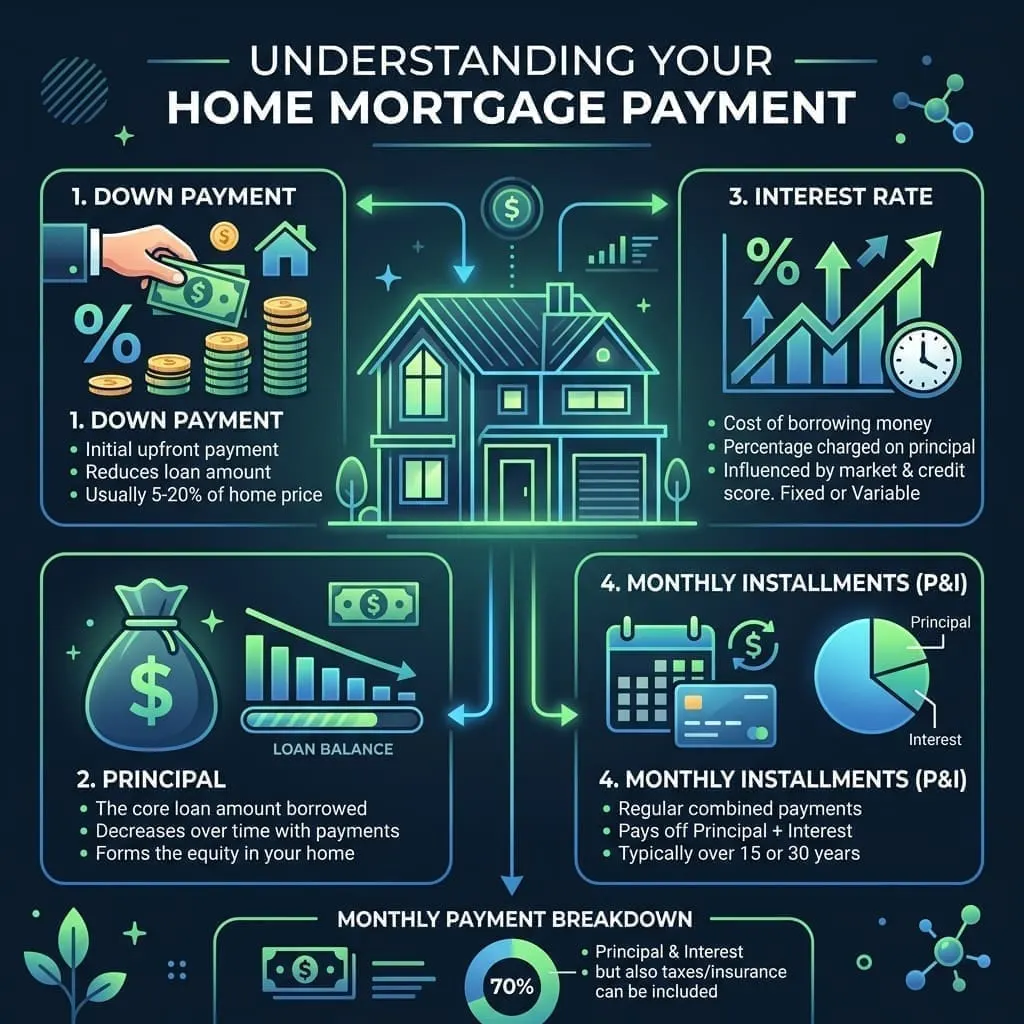
- Down Payment: The upfront cash payment you make toward the purchase. A larger down payment reduces the size of the loan and can help you avoid private mortgage insurance (PMI).
- Loan Term: The length of time you have to pay back the loan (typically 15 or 30 years).
- Interest Rate: The annual percentage rate (APR) charged by the lender for borrowing the principal.
5. The Mathematical Model & Formula
The monthly payment for an amortizing fixed-rate mortgage is solved using the standard loan amortization formula:
Monthly Payment Formula
Monthly Payment (M) = P * [ i * (1 + i)^n ] / [ (1 + i)^n - 1 ]
Variable Breakdown:
- M: The monthly principal and interest payment (USD)
- P: The loan principal amount (Purchase Price minus Down Payment)
- i: The monthly interest rate (Annual Rate divided by 12, then divided by 100)
- n: The total number of monthly payments (Term in Years multiplied by 12)
Why the Formula Works:
Unlike simple interest, which is calculated on the original balance, mortgage interest is computed monthly based on the remaining outstanding principal. The formula uses compounding factors to ensure that as the principal balance decreases, the interest portion of your monthly payment shrinks while the principal portion grows, resulting in a flat monthly payment.
6. Step-by-Step Manual Procedure
Let us walk through a manual calculation using our default calculator values:
- Determine the Loan Principal (P):
Purchase Price = $350,000Down Payment = $50,000Principal (P) = 350,000 - 50,000 = $300,000 - Calculate the Monthly Interest Rate (i):
Annual Rate = 6.5%Monthly Rate (i) = (6.5 / 100) / 12 = 0.0054167 - Calculate the Total Number of Payments (n):
Term = 30 YearsTotal Months (n) = 30 * 12 = 360 months - Apply the Amortization Formula:
M = 300,000 * [ 0.0054167 * (1 + 0.0054167)^360 ] / [ (1 + 0.0054167)^360 - 1 ]M = 300,000 * [ 0.0054167 * 6.991796 ] / [ 6.991796 - 1 ]M = 300,000 * [ 0.0378714 ] / [ 5.991796 ]M = 300,000 * 0.0063205 = 1,896.15The monthly principal and interest payment is approximately $1,896.20.
7. Visual Diagram
The flowchart below displays the decision and calculation path for mortgage analysis:
graph TD
    Start["Enter Home Price & Down Payment"] --> CalcP["Calculate Principal: P = Price - Down Payment"]
    CalcP --> CalcRates["Compute Monthly Rate 'i' & Months 'n'"]
    CalcRates --> SolveFormula["Calculate Monthly Installment 'M'"]
    SolveFormula --> Results["Output: Monthly Payment, Total Interest, Total Cost"]
8. Parameter Comparison Matrix
The table below displays how varying the term and rate impacts a $300,000 loan balance:
| Principal (P) | Annual Rate | Term (Years) | Monthly Payment (P&I) | Total Cost of Loan | Total Interest Paid |
|---|---|---|---|---|---|
| $300,000 | 5.0% | 30 Years | $1,610.46 | $579,765.60 | $279,765.60 |
| $300,000 (Default) | 6.5% | 30 Years | $1,896.20 | $682,632.00 | $382,632.00 |
| $300,000 | 8.0% | 30 Years | $2,201.29 | $792,464.40 | $492,464.40 |
| $300,000 | 5.0% | 15 Years | $2,372.38 | $427,028.40 | $127,028.40 |
| $300,000 | 6.5% | 15 Years | $2,613.54 | $470,437.20 | $170,437.20 |
9. Real-World Applications
Mortgage payment calculations are essential in real estate planning:
- Affordability Planning: Buyers use calculations to ensure that their prospective housing cost fits within their monthly income limits.
- Loan Term Comparison: Comparing a 30-year vs. a 15-year term helps buyers decide if they want lower monthly payments (30-year) or significant interest savings (15-year).
- Refinance Evaluation: Homeowners use formulas to check if refinancing to a lower interest rate will yield net monthly savings.
10. Case Studies
Case Study 1: First-Time Homebuyers
A young couple wants to buy a starter home priced at $350,000. They have saved $50,000 for the down payment and qualify for a 30-year fixed mortgage at 6.5%.
- Results: Their monthly principal and interest payment is $1,896.20.
- Decision: Since their combined monthly income is $8,000, this payment accounts for roughly 24% of their gross income, placing them safely within the standard 28% housing expense guideline.
Case Study 2: 15-Year Term Acceleration
A buyer purchasing the same home wants to compare the 30-year mortgage with a 15-year term at a slightly lower interest rate of 6.0%.
- 15-Year Payment: $2,531.57 per month.
- Total Interest Paid (15-Year): $155,682.
- Total Interest Paid (30-Year): $382,632.
- Outcome: By opting for the 15-year mortgage, the buyer pays $635 more per month but saves $226,950 in interest and pays off their home in half the time.
11. Advantages of Using the Tool
- Saves Time: Avoids manual exponent calculations.
- Accurate Projections: Instantly shows how down payments affect loan totals.
- Enables Planning: Helps buyers calculate interest vs. principal splits easily.
12. Limitations & Boundary Conditions
This calculator computes only the principal and interest (P&I) payments. Real-world mortgage payments typically include additional costs like property taxes, homeowners insurance, private mortgage insurance (PMI), and homeowners association (HOA) fees.
13. Common Mistakes
- Forgetting Property Taxes and Insurance: Assuming the P&I payment is your entire housing bill can lead to severe budget shortfalls. Always account for taxes and insurance.
- Overlooking Down Payment Limits: Not planning for a minimum down payment can lead to unexpected PMI charges from lenders.
12. Frequently Asked Questions
Q1: What is a fixed-rate mortgage?
A fixed-rate mortgage is a home loan where the interest rate and monthly principal and interest payments remain constant for the entire life of the loan.
Q2: What is the most common mortgage term?
The 30-year term is the most common because it offers the lowest monthly payments, making home purchases more affordable.
Q3: What is principal?
Principal is the total amount of money borrowed from the lender (the home price minus your down payment).
Q4: How does a down payment affect my monthly payment?
A larger down payment reduces the loan principal, which decreases both your monthly payment and the total interest paid over the life of the loan.
Q5: What is amortization?
Amortization is the process of spreading out a loan into equal monthly payments, structured so that you pay off both principal and interest over the term.
Q6: Does early payment reduce mortgage interest?
Yes. Making extra principal payments reduces the remaining balance, which cuts down the interest calculated in future months and helps pay off the loan early.
Q7: Why are early mortgage payments mostly interest?
Because interest is calculated based on the outstanding principal balance. Since the balance is highest at the beginning of the loan, the interest portion is also highest.
Q8: What does PMI stand for?
Private Mortgage Insurance, an extra fee required by lenders if your down payment is less than 20% of the home's value.
Q9: Can I change my fixed interest rate?
The interest rate on a fixed mortgage cannot change. The only way to get a different rate is to refinance the loan.
Q10: What is the formula for mortgage payment?
The formula is M = P * [ i(1 + i)^n ] / [ (1 + i)^n - 1 ], where P is principal, i is monthly interest rate, and n is total months.
15. Expert Tips
- Aim for a 20% down payment: This eliminates the need for private mortgage insurance (PMI), saving you hundreds of dollars monthly.
- Make one extra payment per year: Making one extra monthly payment annually can shave 4 to 5 years off a 30-year mortgage and save you thousands in interest.
16. Summary
- Fixed-rate mortgages offer stable, predictable monthly payments.
- Monthly payments are determined by the loan principal, interest rate, and term.
- The standard mortgage payment formula is
M = P * [ i(1 + i)^n ] / [ (1 + i)^n - 1 ].
- Larger down payments and shorter terms reduce the total interest paid.
Additional Technical Guidelines & Measurement Standards
When conducting calculations for Fixed-Rate Mortgage Payment Calculator, maintaining quantitative precision and verifying input parameter boundaries is essential for reliable scenario evaluation. Always verify that raw numerical inputs are measured using standardized instrumentation, and double-check unit conversions prior to applying outputs in commercial, industrial, or academic projects.
For quantitative unit conversions and scientific calculations, always maintain at least four decimal places of precision during intermediate arithmetic stages before rounding final results. When preparing technical reports, laboratory documentation, or financial forecasts, cross-verify all output variables against established international measurement standards (such as SI, NIST, and ISO metric benchmarks) to guarantee consistent analytical rigor across all computational workflows.
MathsLover.com delivers this interactive solver 100% free of charge to foster global mathematical literacy, educational accessibility, and data-driven problem solving across scientific, technical, and academic communities worldwide.