💡 Direct Answer & Executive Summary (Target Monthly Savings Goal Calculator)
Definition: Compute values for Target Monthly Savings Goal Calculator inside the financial analytics domain.
Governing Math Formula: Standard industry financial equation for Target Monthly Savings Goal Calculator.
Target Applications: Provides real-time quantitative solutions in Finance for students, engineers, researchers, and finance professionals.
Target Monthly Savings Goal Calculator
1. Introduction
Whether you are saving for a down payment on a home, purchasing a car, planning a wedding, or funding a dream vacation, achieving major financial milestones requires structured planning. Trying to save a large sum of money all at once is rarely realistic.
Instead, the most effective approach is to break down your target savings amount into manageable monthly contributions. By identifying your target sum and the number of years you have to accumulate it, you can establish a clear, structured monthly savings plan.
The Target Monthly Savings Goal Calculator is an educational tool designed to simplify this planning. By entering your target savings amount and accumulation term, you can instantly estimate your required monthly savings.
This guide provides a comprehensive overview of savings planning, budget structures, manual calculation guidelines, and personal finance strategies.
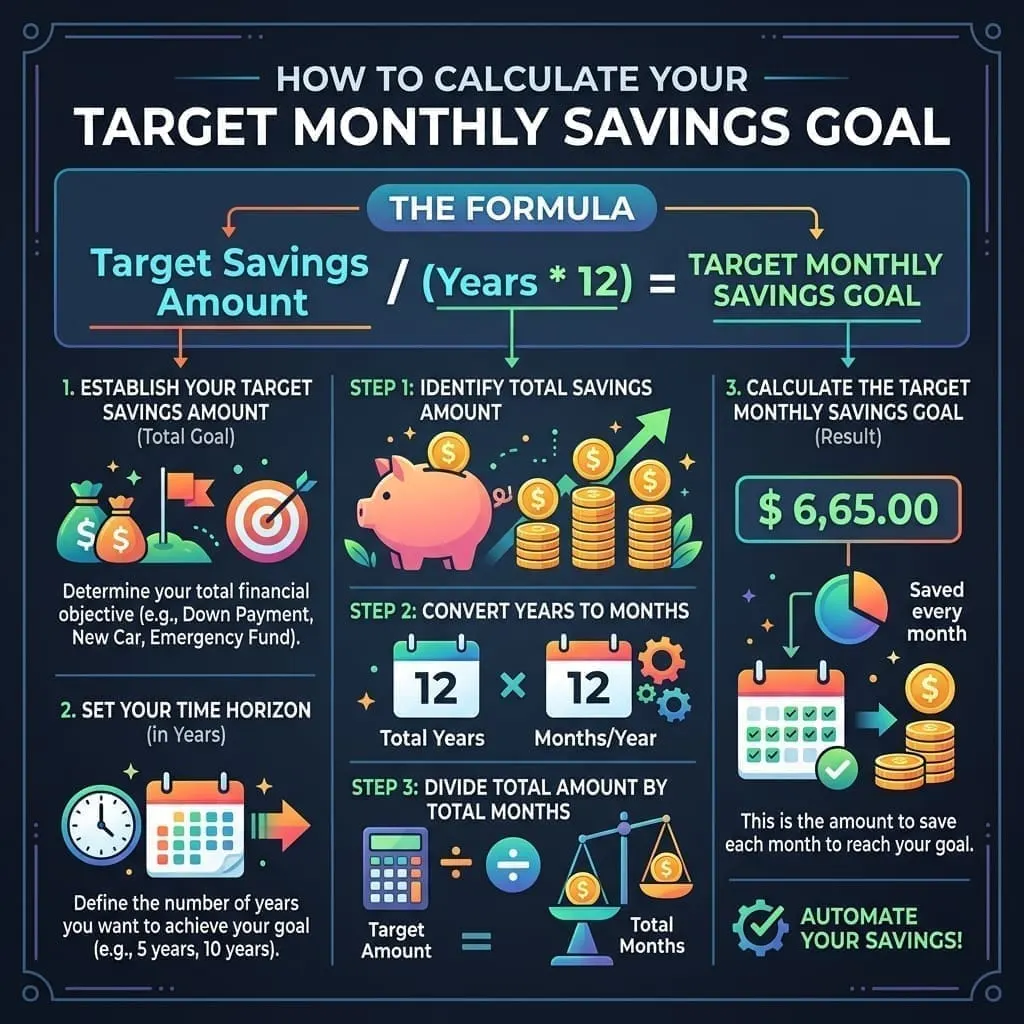
graph TD
    A["Target Savings Amount"] --> C["Convert Term to Months: Years * 12"]
    B["Accumulation Term (Years)"] --> C
    C --> D["Divide:
Target Amount / Total Months"]
    D --> E["Result:
Required Monthly Savings ($ / month)"]
2. Core Definitions & Analogy
To build a solid personal finance foundation, let us define savings goals in both simple and technical terms:
- Simple Definition: A monthly savings goal is the amount of money you must set aside each month to reach a specific financial target by a set deadline.
- Technical Definition: A target monthly savings goal is a linear cash accumulation schedule where the monthly contribution (S) is calculated by dividing the future value target (FV) by the total number of monthly compounding periods (n), assuming a zero-interest baseline, expressed as S = FV / n.
- Conceptual Analogy: Think of saving for a financial goal like climbing a giant staircase. The target savings amount is the top landing, and the accumulation term determines the number of steps you must climb. Rather than trying to jump to the top landing in a single bound, you take one step every month. Each step is the exact same size, making the climb manageable and predictable.
3. History & Milestones
The practice of structured personal savings evolved alongside banking systems and budgeting models:
- Traditional Savings Clubs: Early communities organized informal savings circles (like Susu or Tandas), where members contributed a fixed monthly amount to help each other accumulate capital.
- The Christmas Club Accounts (1910s): Banks introduced dedicated savings accounts that encouraged customers to deposit a small amount weekly or monthly to save for holiday shopping.
- The 50/30/20 Budgeting Rule (2000s): Popularized by Elizabeth Warren, this personal finance rule allocates 20% of net income directly to savings and debt payoff, establishing a framework for monthly savings planning.
4. Core Concepts & Parameters
To evaluate your monthly savings goal, you must understand two key parameters:
- Target Savings Amount: The total sum of money you want to accumulate at the end of the term.
- Accumulation Term: The number of years you have to save before you need the funds.
5. The Mathematical Model & Formula
The target monthly savings goal is calculated using a straightforward division equation:
1. Total Months Formula
Total Months = Accumulation Term in Years * 12
2. Required Monthly Savings Formula
Monthly Savings = Target Savings Amount / Total Months
Variable Breakdown:
- Target Savings: The total capital target (USD)
- Term: The number of years to save (Years, default t = 5)
Why the Formula Works:
This calculator establishes a zero-interest baseline. It assumes you are setting cash aside in a standard, non-interest-bearing account. This provides a conservative estimate, ensuring that any interest you earn in a high-yield savings account will help you reach your goal even faster.
6. Step-by-Step Manual Procedure
Let us walk through a manual calculation using our default calculator values:
- Identify the variables:
Target Savings Amount = $20,000Accumulation Term = 5 Years - Calculate the Total Months: Multiply the term years by 12.
Total Months = 5 * 12 = 60 months - Divide the target amount by the total months:
Monthly Savings = 20,000 / 60 = $333.33You must save $333.33 per month for 5 years to reach your $20,000 goal.
7. Visual Diagram
The flowchart below displays the computation path for monthly savings goals:
graph TD
    Start["Enter Target Savings & Term Years"] --> ConvertMonths["Compute Months: Term Years * 12"]
    ConvertMonths --> DivideTarget["Divide:
Target Savings / Months"]
    DivideTarget --> Display["Output: Required Monthly Savings ($ / month)"]
8. Parameter Comparison Matrix
The table below shows how the accumulation term affects the required monthly savings for a $20,000 target:
| Target Savings | Accumulation Term | Total Months | Required Monthly Savings |
|---|---|---|---|
| $20,000 | 1 Year | 12 Months | $1,666.67 |
| $20,000 | 3 Years | 36 Months | $555.56 |
| $20,000 (Default) | 5 Years (Default) | 60 Months | $333.33 |
| $20,000 | 7 Years | 84 Months | $238.10 |
| $20,000 | 10 Years | 120 Months | $166.67 |
9. Real-World Applications
Savings calculators are essential tools for personal budgeting and planning:
- Down Payment Planning: Home buyers calculate monthly savings requirements to build a 20% down payment over 3 to 5 years.
- Major Purchase Savings: Consumers set monthly targets to save for vehicles, home remodeling, or travel without taking on debt.
- Emergency Fund Building: Households determine monthly savings contributions to build a 6-month emergency reserve.
10. Case Studies
Case Study 1: Saving for a House Down Payment
A couple wants to save $20,000 for a down payment over 5 years.
- Calculation: Target = $20,000. Term = 5 Years (60 months).
- Monthly Savings: $333.33/month.
- Outcome: The couple automates a monthly transfer of $333.33 to their savings account, ensuring they reach their target on schedule.
Case Study 2: Accelerating Wedding Savings
A couple plans to marry in 3 years and needs $15,000 for wedding costs.
- Calculation: Target = $15,000. Term = 3 Years (36 months).
- Monthly Savings: 15,000 / 36 = $416.67/month.
- Outcome: By budgeting $416.67 monthly, they pay for their wedding in cash, avoiding credit card debt.
11. Advantages of Using the Tool
- Saves Time: Instantly calculates monthly savings goals.
- Supports Budgeting: Integrates easily into monthly paycheck plans.
- Encourages Consistency: Breaks down massive targets into manageable steps.
12. Limitations & Boundary Conditions
This calculator assumes a zero-interest baseline with no compounding interest. Real-world investors can use high-yield savings accounts or mutual funds to earn interest, which reduces the actual monthly contribution required to reach the goal.
13. Common Mistakes
- Setting Unrealistic Deadlines: Trying to save too much in a short period (e.g. saving $20,000 in 1 year requires $1,666.67/month, which may exceed your disposable income).
- Ignoring Interest Opportunities: Keeping long-term savings in a non-interest-bearing account rather than utilizing high-yield savings accounts (HYSA).
12. Frequently Asked Questions
Q1: What is a target monthly savings goal?
The amount of money you must set aside each month to reach a specific financial target by a set deadline.
Q2: What is the formula for required monthly savings?
The formula is Monthly Savings = Target Savings / (Term in Years * 12).
Q3: Does this calculator include interest?
No. This calculator establishes a conservative, zero-interest baseline.
Q4: How does a longer term affect my monthly savings?
A longer term increases the number of months, which significantly reduces the required monthly savings contribution.
Q5: What is a high-yield savings account (HYSA)?
A savings account that pays a higher interest rate than standard accounts, helping your savings grow faster through compounding.
Q6: Can I adjust my savings goal over time?
Yes. If your income increases or your goal changes, you can adjust your monthly contributions.
Q7: What is the 50/30/20 rule?
A budgeting framework that allocates 50% of net income to needs, 30% to wants, and 20% to savings and debt payoff.
Q8: Should I automate my savings?
Yes. Setting up automatic transfers to your savings account on payday is the most effective way to ensure consistency.
Q9: How can I reach my savings goal faster?
By cutting discretionary spending, increasing your income, or placing your savings in an interest-bearing account.
Q10: What is working capital in personal finance?
The cash and liquid assets you have available to cover daily living expenses after setting aside your savings.
15. Expert Tips
- Automate your transfers: Set up an automatic transfer of your target monthly savings amount to a separate savings account on payday to remove temptation.
- Use a high-yield savings account: Keep your savings in an HYSA earning 4% to 5% interest to let compound growth help you reach your goal faster.
16. Summary
- Monthly savings goals break down large targets into manageable steps.
- The required monthly savings formula is
Target Savings / Total Months.
- This calculator uses a conservative, zero-interest baseline.
- Automating transfers is the most effective way to ensure consistency.
Additional Technical Guidelines & Measurement Standards
When conducting calculations for Target Monthly Savings Goal Calculator, maintaining quantitative precision and verifying input parameter boundaries is essential for reliable scenario evaluation. Always verify that raw numerical inputs are measured using standardized instrumentation, and double-check unit conversions prior to applying outputs in commercial, industrial, or academic projects.
For quantitative unit conversions and scientific calculations, always maintain at least four decimal places of precision during intermediate arithmetic stages before rounding final results. When preparing technical reports, laboratory documentation, or financial forecasts, cross-verify all output variables against established international measurement standards (such as SI, NIST, and ISO metric benchmarks) to guarantee consistent analytical rigor across all computational workflows.
MathsLover.com delivers this interactive solver 100% free of charge to foster global mathematical literacy, educational accessibility, and data-driven problem solving across scientific, technical, and academic communities worldwide.