💡 Direct Answer & Executive Summary (US Federal Income Tax Calculator)
Definition: Calculate your US Federal income tax, marginal tax bracket, effective tax rate, FICA taxes, deductions, child tax credits, and estimated refund or balance owed.
Governing Math Formula: Taxable Income = Gross Income - Deductions. Federal Tax = Sum of (Bracket Rate × Income in Bracket). Effective Tax Rate = (Total Federal Tax / Gross Income) × 100%.
Target Applications: Provides real-time quantitative solutions in Finance for students, engineers, researchers, and finance professionals.
US Federal Income Tax Calculator
1. Introduction & Executive Summary
Taxes represent one of the largest ongoing financial obligations for individuals, households, and business owners. Whether you are an employee receiving a Form W-2, a self-employed independent contractor receiving 1099s, or an investor earning capital gains and dividends, understanding how your federal income tax is calculated empowers you to optimize deductions, plan quarterly estimated payments, and avoid costly tax-season penalties.
The US Federal Income Tax Calculator provides a comprehensive estimation of your United States Federal income tax return. By accounting for the progressive bracket system, standard versus itemized deductions, pre-tax contributions, self-employment FICA taxes, capital gains rates, and refundable child/dependent credits, this tool delivers an instant breakdown of your marginal tax bracket, your true effective tax rate, and your estimated federal refund or balance owed.
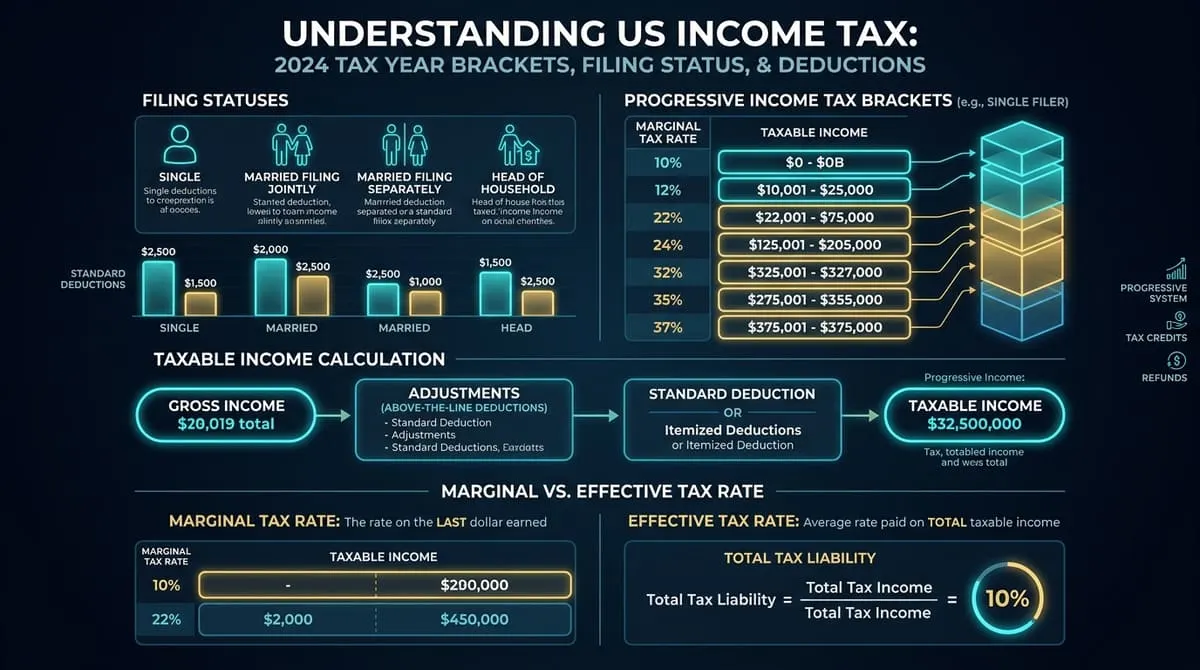
graph TD
    A["Gross Total Income
(W-2, 1099, Investments)"] --> B["Above-the-Line Adjustments
(IRA, 401k, 1/2 SE Tax)"]
    B --> C["Adjusted Gross Income (AGI)"]
    C --> D["Subtract Deductions
(Standard or Itemized)"]
    D --> E["Taxable Income"]
    E --> F["Apply Progressive Tax Brackets
(10% to 37%)"]
    F --> G["Total Tax Before Credits"]
    G --> H["Subtract Tax Credits
(Child & Dependent Credits)"]
    H --> I["Final Federal Income Tax Liability"]
    I --> J["Compare Withholdings & Estimated Payments"]
    J --> K["Estimated Refund OR Balance Due"]
2. Core Definitions & Conceptual Analogy
To understand federal taxation, you must distinguish between four critical tax terms:
- Gross Income: The sum of all earnings before any deductions, including wages, bonuses, freelance net profits, taxable interest, dividends, rental income, and realized capital gains.
- Adjusted Gross Income (AGI): Gross income minus allowable "above-the-line" deductions, such as traditional retirement contributions, student loan interest, and the 50% self-employment tax deduction. AGI serves as the eligibility threshold for many credits and deductions.
- Taxable Income: AGI minus either the Standard Deduction or Itemized Deductions. This is the actual amount evaluated through federal tax brackets.
- Marginal Tax Rate: The highest tax bracket percentage applied to your last dollar of ordinary taxable income.
- Effective Tax Rate: The actual percentage of your total income paid in federal taxes, calculated as
(Total Tax Liability / Gross Income) * 100%. Because the US operates on a tiered bracket system, your effective tax rate is almost always significantly lower than your marginal bracket.
The Water Bucket Analogy of Progressive Taxation
Imagine your income as water filling a series of connected buckets stacked vertically. The bottom bucket (10% rate) holds the first $11,925 of taxable income. Once that bucket overflows, only the next layer of water pours into the 12% bucket (up to $48,475), followed by the 22% bucket. Reaching a higher tax bracket never causes your entire income to be taxed at that higher rate; only the portion inside that specific bucket is taxed at that rate.
3. United States Federal Tax Brackets (2025 & 2026)
Federal income tax rates range progressively from 10% to 37%. Below are the official federal tax rate thresholds for Tax Year 2025 (returns filed in 2026):
| Marginal Rate | Single Filers | Married Filing Jointly | Head of Household | Married Filing Separately |
|---|---|---|---|---|
| 10% | $0 to $11,925 | $0 to $23,850 | $0 to $17,000 | $0 to $11,925 |
| 12% | $11,926 to $48,475 | $23,851 to $96,950 | $17,001 to $64,850 | $11,926 to $48,475 |
| 22% | $48,476 to $103,350 | $96,951 to $206,700 | $64,851 to $103,350 | $48,476 to $103,350 |
| 24% | $103,351 to $197,300 | $206,701 to $394,600 | $103,351 to $197,300 | $103,351 to $197,300 |
| 32% | $197,301 to $250,525 | $394,601 to $501,050 | $197,301 to $250,500 | $197,301 to $250,525 |
| 35% | $250,526 to $626,350 | $501,051 to $751,600 | $250,501 to $626,350 | $250,526 to $375,800 |
| 37% | Over $626,350 | Over $751,600 | Over $626,350 | Over $375,800 |
Standard Deduction Amounts by Year & Status
The Standard Deduction is a flat dollar amount that reduces your taxable income, automatically available without receipts:
- Single / Married Filing Separately: $15,000 (2025) / $15,700 (2026)
- Married Filing Jointly / Surviving Spouse: $30,000 (2025) / $31,400 (2026)
- Head of Household: $22,500 (2025) / $23,550 (2026)
4. Standard vs. Itemized Deductions
Every taxpayer can choose between the Standard Deduction and Itemizing their deductions on Schedule A:
- When to Take the Standard Deduction: If your total allowable deductions (state and local taxes capped at $10,000, mortgage interest, charitable donations, and medical expenses exceeding 7.5% of AGI) are less than the standard allowance for your filing status, take the standard deduction. Over 88% of US filers utilize the standard deduction.
- When to Itemize: If your combined qualifying expenses exceed the standard threshold—frequently occurring among homeowners with high mortgage interest or substantial charitable contributions—itemizing yields a greater tax savings.
5. Tax Deductions vs. Tax Credits
Understanding the distinction between deductions and credits is vital for effective tax planning:
- Tax Deduction: Lowers your taxable income before brackets are applied. A $2,000 deduction for someone in the 22% tax bracket saves $440 in tax liability ($2,000 × 0.22).
- Tax Credit: Directly reduces your tax bill dollar-for-dollar. A $2,000 Child Tax Credit saves exactly $2,000 off your bottom-line tax balance.
Key Tax Credits Included in this Calculator:
- Child Tax Credit (CTC): Up to $2,000 per qualifying child under age 17 at the end of the tax year.
- Credit for Other Dependents (ODC): Up to $500 per dependent (such as college students age 17-23 or elderly parents).
6. Self-Employment & Payroll Taxes (FICA)
Unlike employees whose employers cover half of Medicare and Social Security, independent contractors and freelancers pay Self-Employment (SE) tax:
- Social Security Tax: 12.4% on net business profit up to the wage cap ($171,600 in 2025).
- Medicare Tax: 2.9% on all net self-employment earnings with no income ceiling.
- Above-the-Line Deduction: Self-employed individuals are permitted to deduct 50% of their total SE tax from gross income when determining AGI.
7. Worked Mathematical Example
Let us examine a realistic filing scenario:
- Filing Status: Single
- Tax Year: 2025
- W-2 Salary: $90,000
- Traditional 401(k) / IRA Contribution: $6,000
- Deduction: Standard ($15,000)
- Tax Withheld: $10,500
Step 1: Compute Adjusted Gross Income (AGI)
AGI = $90,000 - $6,000 = $84,000
Step 2: Compute Taxable Income
Taxable Income = $84,000 - $15,000 = $69,000
Step 3: Compute Federal Income Tax by Brackets
- Bracket 1 (10% on $0 to $11,925):
$11,925 × 0.10 = $1,192.50
- Bracket 2 (12% on $11,925 to $48,475):
($48,475 - $11,925) × 0.12 = $36,550 × 0.12 = $4,386.00
- Bracket 3 (22% on $48,475 to $69,000):
($69,000 - $48,475) × 0.22 = $20,525 × 0.22 = $4,515.50
- Total Federal Tax Liability:
$1,192.50 + $4,386.00 + $4,515.50 = $10,094.00
Step 4: Calculate Effective Tax Rate
Effective Tax Rate = ($10,094 / $90,000) × 100% = 11.22%
(Notice that while the top marginal bracket is 22%, the overall tax burden is only 11.22%).
Step 5: Calculate Refund or Amount Owed
Refund = Total Withheld ($10,500) - Total Tax ($10,094) = +$406.00 (Tax Refund)
8. Strategies to Lower Your Effective Tax Rate
- Maximize Pre-Tax Retirement Accounts: Contributing to a 401(k), 403(b), or traditional IRA directly reduces your current-year AGI.
- Fund a Health Savings Account (HSA): HSAs offer a "triple tax advantage"—contributions are tax-deductible, growth is tax-free, and withdrawals for qualified medical expenses are completely tax-free.
- Hold Assets for Long-Term Capital Gains: Investments held for more than 12 months benefit from lower capital gains rates (0%, 15%, or 20%) rather than standard ordinary income brackets (up to 37%).
- Harvest Investment Losses: Capital losses can offset unlimited capital gains plus up to $3,000 of ordinary wage income annually.
- Utilize Section 529 College Plans & FSAs: Pre-tax commuter, dependent care, and educational plans minimize taxable payroll amounts.
9. Frequently Asked Questions (FAQ)
What is the difference between Marginal and Effective Tax Rates?
The marginal tax rate is the percentage applied to the highest bracket of your income (your last dollar earned). The effective tax rate is the blended average percentage you pay across your entire gross income. Because of progressive brackets and standard deductions, your effective rate is substantially lower than your marginal rate.
How do I know if I will receive a tax refund or owe money?
If the total amount of federal income tax withheld from your paychecks (plus any quarterly estimated payments) is greater than your final calculated tax liability, the IRS issues you a refund for the difference. If your withholdings are less than your liability, you must pay the balance due by the April filing deadline.
Does getting a raise ever cause you to lose money due to higher tax brackets?
No. In the US progressive tax system, entering a higher tax bracket only taxes the specific dollars that exceed the bracket threshold. You will always have more take-home pay after a raise than before it.
What is the difference between W-2 income and 1099 freelance income?
W-2 employees have federal income tax and half of their FICA taxes (7.65%) automatically withheld by their employer. 1099 independent contractors receive gross payments without tax withholding and must pay self-employment tax (15.3%) alongside quarterly estimated income taxes via Form 1040-ES.
What is the deadline to file federal income tax returns?
For most taxpayers, federal returns and final payments are due on April 15th following the close of the tax year. If April 15 falls on a weekend or holiday, the deadline moves to the next business day. Filers can submit Form 4868 to request an automatic 6-month extension to file (until October 15th), although any estimated tax owed must still be paid by April 15th to prevent interest charges.
Additional Technical Guidelines & Measurement Standards
When conducting calculations for US Federal Income Tax Calculator, maintaining quantitative precision and verifying input parameter boundaries is essential for reliable scenario evaluation. Always verify that raw numerical inputs are measured using standardized instrumentation, and double-check unit conversions prior to applying outputs in commercial, industrial, or academic projects.
For quantitative unit conversions and scientific calculations, always maintain at least four decimal places of precision during intermediate arithmetic stages before rounding final results. When preparing technical reports, laboratory documentation, or financial forecasts, cross-verify all output variables against established international measurement standards (such as SI, NIST, and ISO metric benchmarks) to guarantee consistent analytical rigor across all computational workflows.
MathsLover.com delivers this interactive solver 100% free of charge to foster global mathematical literacy, educational accessibility, and data-driven problem solving across scientific, technical, and academic communities worldwide.