💡 Direct Answer & Executive Summary (Weighted Average Cost of Capital (WACC) Calculator)
Definition: Calculate corporate capital cost discounting rate based on equity and debt proportions.
Governing Math Formula: WACC = (E/V × Re) + (D/V × Rd × (1 - Tc)).
Target Applications: Provides real-time quantitative solutions in Finance for students, engineers, researchers, and finance professionals.
Weighted Average Cost of Capital (WACC) Calculator
1. Introduction
For corporations, expanding operations, building factories, or launching new products requires substantial capital. To fund these ventures, companies secure capital from two primary sources: issuing equity (selling stock shares) or taking on debt (issuing bonds or securing bank loans).
However, capital is never free. Investors who purchase stock expect a return, and banks charge interest on loans. To make sound investment decisions, a company must calculate the average cost of all its capital sources combined. This is resolved using the Weighted Average Cost of Capital (WACC).
The Weighted Average Cost of Capital (WACC) Calculator is an educational tool designed to model this cost. By entering your cost of equity, cost of debt, and equity proportion, you can instantly estimate your company's corporate cost of capital.
This guide provides a comprehensive overview of WACC mathematics, equity vs. debt structures, manual calculation guidelines, and corporate evaluation benchmarks.
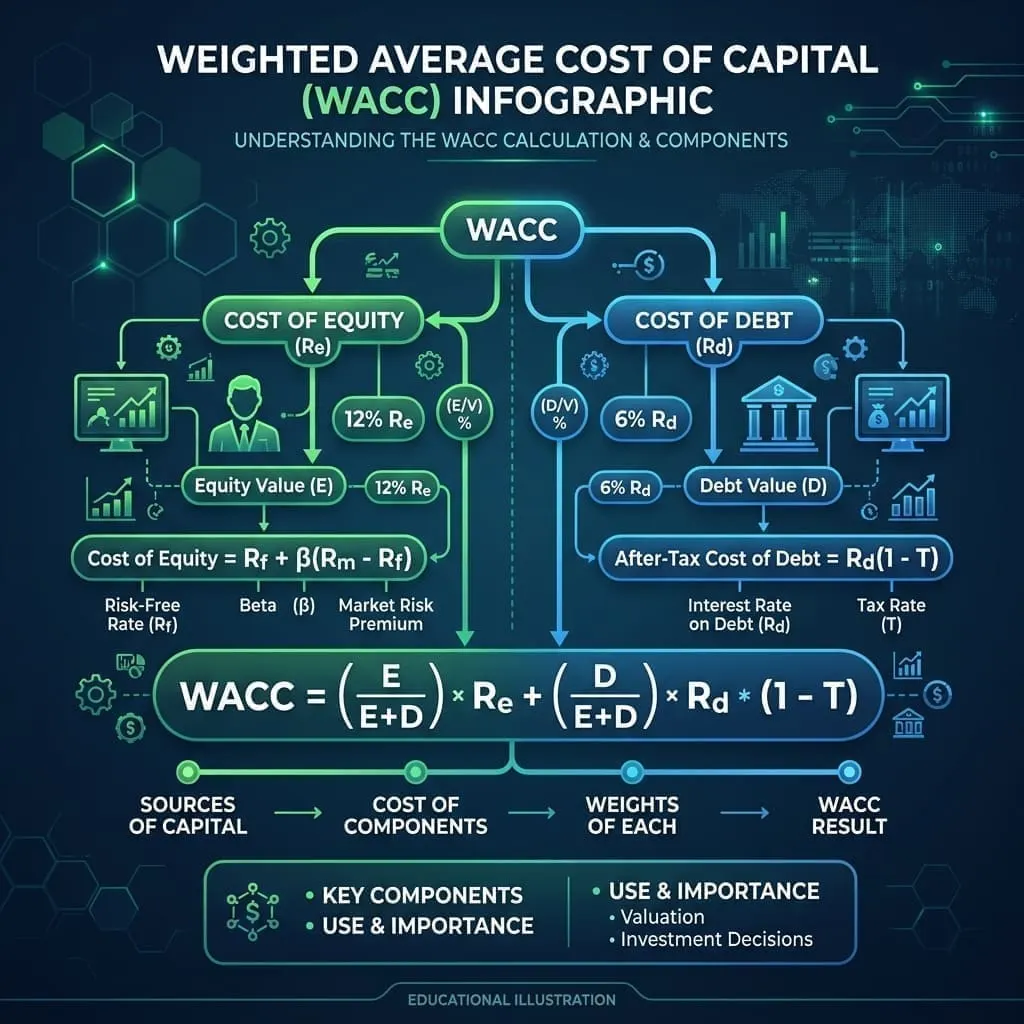
graph TD
    A["Cost of Equity (Re)"] --> D["Multiply by Equity Proportion: Re * E/V"]
    B["Equity Proportion (E/V)"] --> D
    C["Cost of Debt (Rd)"] --> E["Multiply by Debt Proportion & Tax Shield: Rd * (1 - E/V) * (1 - T)"]
    E --> F["Combine: Equity Cost + Debt Cost"]
    D --> F
    F --> G["Result:
Weighted Average Cost of Capital (WACC)"]
2. Core Definitions & Analogy
To build a solid corporate finance foundation, let us define WACC in both simple and technical terms:
- Simple Definition: WACC is the average rate of return a company must pay to all its financial backers (investors and lenders) to finance its operations.
- Technical Definition: WACC is the corporate hurdle rate representing the weighted average of the cost of equity (Re) and the after-tax cost of debt (Rd), using capital structure weights. It is expressed as WACC = [ (E/V) Re ] + [ (D/V) Rd * (1 - Tc) ], where E/V is the equity proportion, D/V is the debt proportion, and Tc is the corporate tax rate (fixed at 30% for standard models in our system).
- Conceptual Analogy: Think of funding a business like mixing a custom cocktail. Equity is like premium fruit juice (expensive but adds character), while debt is like carbonated water (cheap and accessible). WACC is the average cost per ounce of the entire drink, determined by the proportions of juice and water you mix together.
3. History & Milestones
The development of corporate finance theory established WACC as a standard valuation tool:
- Modigliani-Miller Theorem (1958): Franco Modigliani and Merton Miller published groundbreaking papers on capital structure, proving how debt and taxes affect a company's total valuation.
- Capital Asset Pricing Model (1960s): The creation of CAPM standardized the calculation of the cost of equity (Re), using market beta and risk-free rates to evaluate investor return expectations.
- Discounted Cash Flow (DCF) Models: Over the late 20th century, WACC became the standard discount rate used by investment bankers to evaluate corporate acquisitions and stock valuations.
4. Core Concepts & Parameters
To evaluate WACC, you must understand three key parameters:
- Cost of Equity: The return rate expected by shareholders. Since equity is riskier than debt, the cost of equity is typically higher.
- Cost of Debt: The interest rate a company pays on its borrowed funds.
- Equity Proportion (E/V): The percentage of the company's capital structure made up of equity. The debt proportion is simply the remainder:
1 - E/V.
5. The Mathematical Model & Formula
The Weighted Average Cost of Capital is solved using the standard weighted capital equation:
WACC Formula
WACC = (Equity Proportion * Cost of Equity) + (Debt Proportion * Cost of Debt * (1 - Tax Rate))
Variable Breakdown:
- Cost of Equity (Re): Investor yield target (%, written as a value in calculations)
- Cost of Debt (Rd): Annual interest rate (%, written as a value in calculations)
- Equity Proportion (E/V): The weight of equity in the capital structure (written as a decimal, e.g. 70% is 0.7)
- Debt Proportion (D/V): The weight of debt in the capital structure (calculated as
1 - E/V)
- Corporate Tax Rate (Tc): The tax shield rate. For standard calculations in our system, this rate is established at a benchmark of 30% (0.3).
Why the Tax Shield Works:
Interest payments on debt are tax-deductible expenses. This deduction reduces the company's taxable income, which lowers its actual borrowing costs. The after-tax cost of debt is calculated as Rd * (1 - Tc). Equity payouts (dividends) are not tax-deductible, so they do not receive a tax shield.
6. Step-by-Step Manual Procedure
Let us walk through a manual calculation using our default calculator values:
- Identify the variables:
Cost of Equity (Re) = 10%Cost of Debt (Rd) = 6%Equity Proportion (E/V) = 0.7Corporate Tax Rate (Tc) = 30% = 0.3 - Calculate the Debt Proportion (D/V): Subtract equity proportion from 1.
Debt Proportion = 1 - 0.7 = 0.3 - Calculate the Weighted Cost of Equity: Multiply equity cost by equity weight.
Weighted Equity Cost = 0.7 * 10 = 7.00% - Calculate the After-Tax Cost of Debt: Apply the tax shield.
After-Tax Debt Cost = 6 * (1 - 0.3) = 6 * 0.7 = 4.20% - Calculate the Weighted Cost of Debt: Multiply after-tax debt cost by debt weight.
Weighted Debt Cost = 0.3 * 4.20 = 1.26% - Combine the weighted costs to get WACC:
WACC = 7.00 + 1.26 = 8.26%Your Weighted Average Cost of Capital is 8.26%.
7. Visual Diagram
The flowchart below displays the calculation path for WACC:
graph TD
    Start["Enter Re, Rd, and Equity Ratio"] --> CalcDebtRatio["Compute Debt Ratio: 1 - Equity Ratio"]
    CalcDebtRatio --> CalcTaxShield["Compute After-Tax Debt Cost: Rd * (1 - 0.3)"]
    CalcTaxShield --> CombineWeighted["Compute WACC: (Re * Equity Ratio) + (After-Tax Debt Cost * Debt Ratio)"]
    CombineWeighted --> Display["Output: WACC (%) and Discount Multiplier"]
8. Parameter Comparison Matrix
The table below shows how varying the capital structure affects WACC for a company with a 10% cost of equity and a 6% cost of debt (30% tax rate):
| Cost of Equity (Re) | Cost of Debt (Rd) | Equity Ratio (E/V) | Debt Ratio (D/V) | WACC Percentage | Discount Multiplier |
|---|---|---|---|---|---|
| 10.0% | 6.0% | 0.9 (Low Debt) | 0.1 | 9.42% | 0.0942 |
| 10.0% (Default) | 6.0% (Default) | 0.7 (Default) | 0.3 | 8.26% | 0.0826 |
| 10.0% | 6.0% | 0.5 (Balanced) | 0.5 | 7.10% | 0.0710 |
| 10.0% | 6.0% | 0.3 (High Debt) | 0.7 | 5.94% | 0.0594 |
| 10.0% | 6.0% | 0.1 (Max Debt) | 0.9 | 4.78% | 0.0478 |
9. Real-World Applications
WACC is a standard corporate finance metric used for capital budgeting and investment analysis:
- Project Evaluation (Hurdle Rate): Corporate finance teams use WACC as the minimum rate of return a new project must generate to be approved. If a project's projected return is below WACC, the project is rejected.
- Discounted Cash Flow (DCF) Valuations: Stock analysts use WACC as the discount rate to calculate the present value of a company's future cash flows, determining its intrinsic stock value.
- Capital Structure Optimization: CFOs model different ratios of equity and debt to find the optimal capital structure that minimizes their WACC.
10. Case Studies
Case Study 1: Hurdle Rate Project Rejection
A manufacturing company has a WACC of 8.26%. The research division proposes building a new assembly line with an estimated return on capital of 7.5%.
- Comparison: Proposed Return = 7.5%, Hurdle Rate (WACC) = 8.26%.
- Outcome: The CFO rejects the proposal. Building the assembly line would destroy shareholder value, because the cost to raise the required capital is higher than the project's return.
Case Study 2: Capital Structure Optimization
A technology startup is financed 100% with equity, with a cost of equity of 12% (WACC = 12%). The founders decide to issue corporate bonds (debt) at 6% interest to fund expansion, shifting the capital structure to 80% equity and 20% debt (corporate tax rate is 30%).
- Weighted Cost of Equity: 0.8 * 12 = 9.6%.
- Weighted After-Tax Cost of Debt: 0.2 [ 6 (1 - 0.3) ] = 0.2 * 4.2 = 0.84%.
- New WACC: 9.6 + 0.84 = 10.44%.
- Outcome: Shifting to a mixed capital structure lowers the startup's WACC from 12% to 10.44%, reducing their average cost of capital.
11. Advantages of Using the Tool
- Corporate Planning: Instantly estimates WACC to establish a project hurdle rate.
- Valuation Model Prep: Provides the discount multiplier needed for DCF analysis.
- Scenario Modeling: Easily shows how changing debt proportions alters capital costs.
12. Limitations & Boundary Conditions
WACC assumes a static capital structure and constant costs of equity and debt. In the real world, as a company takes on more debt, its financial risk increases, which can cause lenders to charge higher interest rates (raising the cost of debt) and investors to expect higher returns (raising the cost of equity).
13. Common Mistakes
- Ignoring the Tax Shield: Failing to apply the tax reduction to the cost of debt will overestimate your WACC.
- Using Book Values Instead of Market Values: Calculating capital proportions based on balance sheet book values rather than the actual market value of outstanding stocks and bonds.
12. Frequently Asked Questions
Q1: What is the Weighted Average Cost of Capital (WACC)?
The average rate of return a company must pay to all its capital providers (shareholders and lenders) to finance its assets and operations.
Q2: What is the formula for WACC?
The formula is WACC = (Equity Weight * Cost of Equity) + (Debt Weight * Cost of Debt * (1 - Tax Rate)).
Q3: Why is the cost of debt multiplied by (1 - Tax Rate)?
Because interest payments on debt are tax-deductible expenses, which creates a tax shield that lowers the actual cost of borrowing.
Q4: Why is the cost of equity usually higher than the cost of debt?
Because equity investors take on more risk. If a company goes bankrupt, debt holders are paid first, while shareholders receive whatever remains.
Q5: What is a hurdle rate?
The minimum rate of return a project must generate to cover its financing costs and be approved by management.
Q6: How does inflation affect WACC?
Inflation causes central banks to raise interest rates, which increases borrowing costs and raises both the cost of debt and the cost of equity, increasing WACC.
Q7: What is the equity proportion?
The percentage of a company's total capital structure funded by issuing stock.
Q8: Does this calculator include dividend tax rates?
No. Calculations are based on corporate cost of equity and cost of debt, excluding personal investor taxes.
Q9: What happens to WACC if a company takes on more debt?
Initially, WACC decreases because debt is cheaper than equity and benefits from a tax shield. However, taking on too much debt increases bankruptcy risks, raising both borrowing and equity costs.
Q10: How do analysts use the discount multiplier?
They divide future cash flows by the discount multiplier to determine their present value today.
15. Expert Tips
- Establish a target structure: Optimize your capital structure by balancing cheap, tax-advantaged debt with stable, risk-mitigating equity.
- Review rates regularly: Update your cost of debt and equity inputs whenever interest rates or market risks shift.
16. Summary
- WACC is the combined average cost of equity and debt capital.
- The WACC formula is
(E/V * Re) + (D/V * Rd * (1 - Tc)).
- Interest payments on debt are tax-deductible, creating a tax shield.
- WACC acts as the hurdle rate used to evaluate corporate investments.
Additional Technical Guidelines & Measurement Standards
When conducting calculations for Weighted Average Cost of Capital (WACC) Calculator, maintaining quantitative precision and verifying input parameter boundaries is essential for reliable scenario evaluation. Always verify that raw numerical inputs are measured using standardized instrumentation, and double-check unit conversions prior to applying outputs in commercial, industrial, or academic projects.
For quantitative unit conversions and scientific calculations, always maintain at least four decimal places of precision during intermediate arithmetic stages before rounding final results. When preparing technical reports, laboratory documentation, or financial forecasts, cross-verify all output variables against established international measurement standards (such as SI, NIST, and ISO metric benchmarks) to guarantee consistent analytical rigor across all computational workflows.
MathsLover.com delivers this interactive solver 100% free of charge to foster global mathematical literacy, educational accessibility, and data-driven problem solving across scientific, technical, and academic communities worldwide.