💡 Direct Answer & Executive Summary (Coffee-to-Water Brew Ratio Calculator)
Definition: Calculate exact coffee bean mass (in grams) for any target water volume or brew method strength.
Governing Math Formula: Coffee Mass (g) = Water Volume (mL) / Ratio Factor.
Target Applications: Provides real-time quantitative solutions in Food for students, engineers, researchers, and finance professionals.
Coffee-to-Water Brew Ratio Calculator: The Complete Guide to Extraction Precision
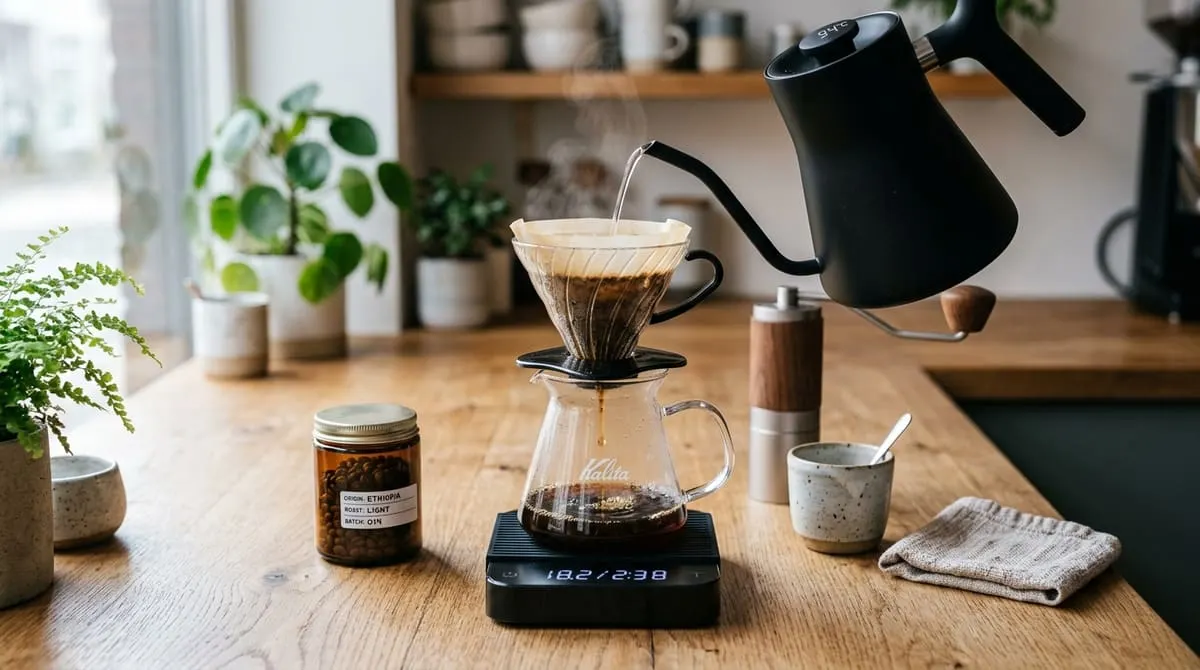
1. Introduction
Brewing exceptional coffee is a stoichiometric balance of soluble solid extraction. The Coffee-to-Water Brew Ratio Calculator determines the exact ground coffee mass (in grams) required for any water brewing volume, or conversely, how much liquid volume you need for your target coffee beans.
Whether preparing a concentrated $1:2$ espresso shot, a balanced $1:16$ French Press immersion brew, or a crisp $1:15$ V60 pour-over, controlling the brew ratio prevents bitter over-extraction and watery under-extraction.
flowchart TD
    BEANS["☕ Select Fresh Whole Bean Origin & Roast Profile"] --> GRIND["⚙️ Set Grind Size: Fine (Espresso), Medium (Pour-Over), Coarse (Immersion)"]
    GRIND --> RATIO["📊 Choose Target Brew Ratio (e.g., 1:15 to 1:17)"]
    RATIO --> CALC["⚖️ Compute Exact Coffee Dose (g) = Water Volume (mL) ÷ Ratio"]
    CALC --> BREW["⏱️ Execute Pour Protocol at 92°C–96°C Water Temperature"]
2. Core Definitions & Analogy
Simple Definition
The Brew Ratio is the weight relationship between coffee grounds and water. A ratio of $1:16$ means 1 gram of coffee for every 16 grams (or milliliters) of hot water.
Technical Definition
Technically, coffee extraction measures Total Dissolved Solids (TDS, target 1.15% - 1.45%) and Extraction Yield (, target 18% - 22%) according to the Specialty Coffee Association (SCA) Golden Cup Standard:
3. History & Milestones
timeline
    title History of Coffee Extraction Standards
    1950s : Dr. E.E. Lockhart establishes the foundational MIT Coffee Brewing Center extraction chart.
    1980s : Specialty Coffee Association of America (SCAA) codifies the Golden Cup Standard (55 g/L).
    2008 : Digital gram scales and precision pour-over kettles become specialty barista defaults.
    2020s : Refractometer TDS profiling and high-extraction precision basket geometry gain adoption.
4. Core Concepts & Brew Ratio Matrix
| Brew Method | Ideal Grind Size | Target Brew Ratio | Recommended Water Temp | Characteristic Profile |
|---|---|---|---|---|
| Ristretto / Espresso | Ultra-Fine | $1:1.5 - 1:2.5$ | Syrupy, dense, intense crema & solubles | |
| Aeropress (Standard) | Medium-Fine | $1:12 - 1:14$ | Full body, clean cup, low acidity | |
| V60 / Kalita Pour-Over | Medium | $1:15 - 1:16$ | Vibrant acidity, articulate floral notes | |
| French Press Immersion | Coarse | $1:15 - 1:17$ | Heavy mouthfeel, natural oils preserved | |
| Cold Brew Concentration | Ultra-Coarse | $1:5 - 1:8$ | Ambient / | Chocolatey, smooth, low acid concentrate |
5. The Mathematical Model & Formulas
1. Coffee Dose Equation:
Where:
- = Dry ground coffee mass in grams ()
- = Hot water volume in milliliters () or grams ()
- = Desired brew ratio factor (e.g. for $1:16$)
2. Required Water Equation:
6. Step-by-Step Computational Procedure
Consider preparing a morning pour-over at a balanced $1:16$ ratio:
- Identify Inputs: Water volume , Brew Ratio .
- Compute Coffee Weight:
- Convert to Household Measures (Approximate):
- Execution: Tare digital scale with V60 server, add ground coffee, pour total water.
7. Visual Explanations
Extraction Yield vs. Brew Ratio Distribution
pie title Ground Coffee Usage Across Brewing Methods (Grams per 250 mL Water)
    "Espresso Concentration (1:2 Ratio)" : 125
    "Aeropress Concentrated (1:12 Ratio)" : 21
    "Pour-Over Standard (1:15 Ratio)" : 17
    "French Press Light (1:17 Ratio)" : 15
8. Parameter Comparison Matrix
| Water Volume (mL) | Brew Ratio | Coffee Weight (g) | Cup Count (8 oz) | Recommended Roast |
|---|---|---|---|---|
| $1:15$ | Light / Ethiopian Floral | |||
| $1:16$ | Medium / Colombian Wash | |||
| $1:16$ | Medium-Dark / Blend | |||
| $1:17$ | Dark / French Roast | |||
| $1:16$ | Batch Brew Filter |
9. Real-World Applications & Case Studies
- Specialty Café Batch Tuning: A high-volume café brewing () of drip coffee at $1:16.67$ uses exactly of coffee per urn.
- Case Study: A home barista experienced astringent bitter notes in their pour-over using scoop measurements. By switching to a digital scale and establishing a consistent $1:15.5$ mass ratio ( coffee to water), the barista stabilized extraction yield at 20.2%, eliminating bitterness.
10. Advantages & Limitations
Advantages
- Ensures 100% cup-to-cup consistency regardless of scoop density variations.
- Eliminates guesswork when switching between light and dark roast beans.
- Prevents wasteful coffee bean over-dosing.
Limitations
- Volumetric scoops vary significantly by bean density; digital scale mass measurement is required for absolute accuracy.
11. Common Pitfalls
Pitfall 1: Measuring Coffee by Volume (Scoops) Instead of Mass (Grams)
Dark roast coffee beans are expanded and porous, weighing , while dense light roast beans weigh . A single scoop of light roast contains up to 40% more coffee mass than dark roast!
12. Frequently Asked Questions (FAQ)
Q: What is the standard golden rule coffee brew ratio?
A: The Specialty Coffee Association (SCA) recommends $1:16$ ( of coffee per of water).
Q: Does 1 mL of water equal 1 gram?
A: Yes! Pure water at room temperature has a density of exactly , making volumetric water measurements directly equal to mass in grams.
Q: What ratio should I use for French Press?
A: Use $1:15$ to $1:17$ depending on your desired strength.
13. Expert Tips & Summary
- Tare Your Scale: Always zero out the container weight before measuring grounds or water.
- Maintain Water Temperature: Use water between and () for optimal extraction kinetics.
- Summary: Precise coffee-to-water mass scaling () unlocks balanced flavor extraction, consistency, and café-quality brewing at home.
Additional Technical Guidelines & Measurement Standards
When conducting calculations for Coffee-to-Water Brew Ratio Calculator, maintaining quantitative precision and verifying input parameter boundaries is essential for reliable scenario evaluation. Always verify that raw numerical inputs are measured using standardized instrumentation, and double-check unit conversions prior to applying outputs in commercial, industrial, or academic projects.
For quantitative unit conversions and scientific calculations, always maintain at least four decimal places of precision during intermediate arithmetic stages before rounding final results. When preparing technical reports, laboratory documentation, or financial forecasts, cross-verify all output variables against established international measurement standards (such as SI, NIST, and ISO metric benchmarks) to guarantee consistent analytical rigor across all computational workflows.
MathsLover.com delivers this interactive solver 100% free of charge to foster global mathematical literacy, educational accessibility, and data-driven problem solving across scientific, technical, and academic communities worldwide.