💡 Direct Answer & Executive Summary (BAC Blood Alcohol Concentration Solver)
Definition: Compute values for BAC Blood Alcohol Concentration Solver in standard exercise science.
Governing Math Formula: Biometric calculation formula for BAC Blood Alcohol Concentration Solver.
Target Applications: Provides real-time quantitative solutions in Health & Fitness for students, engineers, researchers, and finance professionals.
BAC Blood Alcohol Concentration Solver - Forensic Pharmacology & Safety Guide
1. Introduction
Alcohol (ethanol, ) is a central nervous system depressant that is rapidly absorbed into the bloodstream through the stomach and small intestine. Once absorbed, alcohol distributes throughout total body water, crossing the blood-brain barrier where it binds to gamma-aminobutyric acid () receptors, enhances inhibitory neurotransmission, and suppresses excitatory glutamate () pathways.
Blood Alcohol Concentration (BAC) measures the mass of alcohol per unit volume of blood, universally reported in grams of ethanol per 100 milliliters of blood (expressed as a percentage, such as 0.08%).
Understanding BAC is critical for:
- Legal Compliance & Road Safety: The statutory legal limit for operating a motor vehicle in the United States and Canada is 0.08% (and 0.02% to 0.05% across the UK, Australia, and European Union).
- Preventing Alcohol Poisoning: High BAC levels () suppress brainstem respiratory centers, carrying acute risks of hypothermia, coma, aspiration, and fatal respiratory arrest.
- Clinical Pharmacology: Evaluating alcohol-medication interactions and hepatic clearance rates.
In 1932, Swedish physician and forensic chemist Dr. Erik M. P. Widmark published the definitive mathematical model that remains the forensic standard worldwide: the Widmark Formula.
The BAC Blood Alcohol Concentration Solver computes estimated peak blood alcohol concentration, metabolic clearance timelines, and current intoxication state based on standard drinks consumed, body weight, biological sex, and elapsed time. This comprehensive guide covers Widmark's distribution ratios (), hepatic alcohol dehydrogenase () kinetics, zero-order elimination rates (), and legal impairment benchmarks.
2. Core Definitions & Analogy
To understand alcohol pharmacokinetics and BAC calculations, let us examine the core concepts:
- Simple Definition: Blood Alcohol Concentration (BAC) is the percentage of your bloodstream composed of pure alcohol.
- Technical Definition: BAC is the mass concentration of pure ethanol in peripheral whole blood ( or ). Because ethanol is completely water-soluble and lipid-insoluble, its apparent volume of distribution () corresponds directly to total body water mass, modulated by sex-specific adipose-to-water ratios (Widmark -factor).
- The Swimming Pool & Filter Analogy: Imagine pouring a measured bottle of concentrated blue dye (alcohol) into a swimming pool (total body water). If the pool is small (lower body weight or higher fat percentage with less water), the dye concentration turns dark blue very quickly. If the pool is large (higher body weight and high muscle water), the dye is diluted to a light pale blue. The pool filter (your liver) runs at a constant fixed speed, removing one gallon of dye per hour regardless of how dark the pool is (zero-order elimination rate).
3. Standard Drink Equivalents & Alcohol Mass
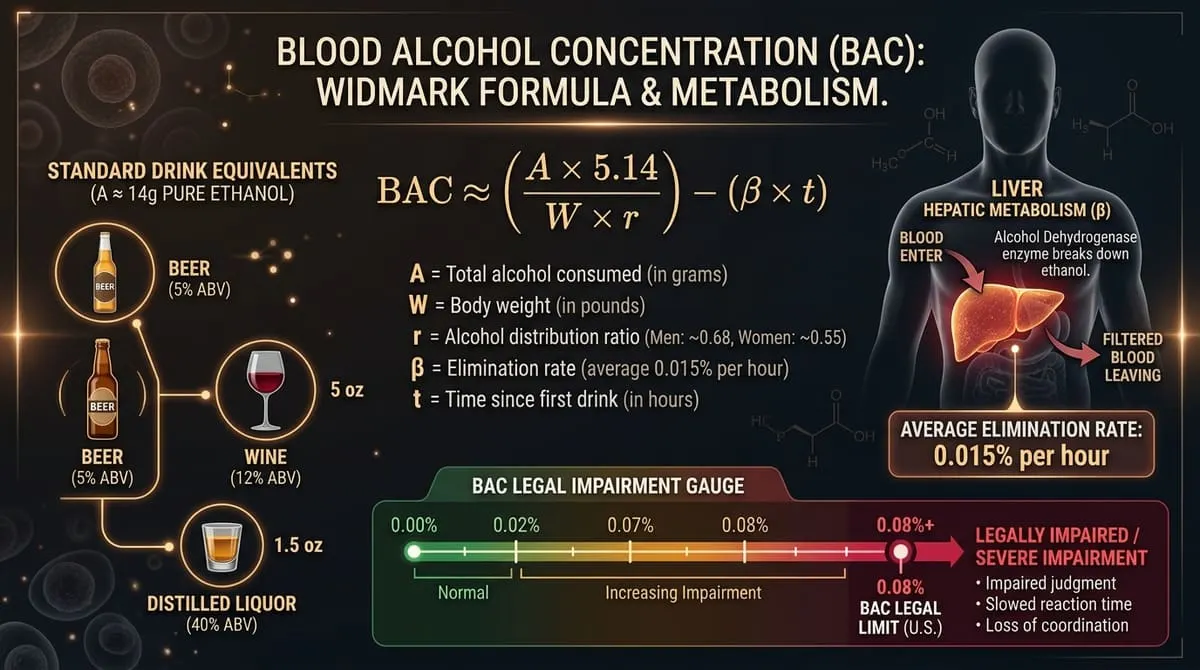
Under international health and forensic guidelines (such as the CDC and NIAAA), one "Standard Drink" contains precisely 14.0 grams (0.6 fluid ounces) of pure ethanol:
flowchart LR
    SD["1 Standard Drink = 14 Grams Pure Ethanol"]
    SD --> B["12 oz (355 mL) Regular Beer (~5% ABV)"]
    SD --> W["5 oz (148 mL) Table Wine (~12% ABV)"]
SD --> L["1.5 oz (44 mL) 80-Proof Distilled Spirits (~40% ABV)"]- 12 oz Regular Beer: .
- 5 oz Table Wine: .
- 1.5 oz Hard Liquor (Vodka/Whiskey/Tequila): .
4. The Mathematical Formulas
The solver uses the classic Widmark Equation with time-decay elimination:
Widmark Equation (Imperial Units: Weight in lbs):
Where:
- or .
- (Alternatively using grams: )
- .
- :Men:* (higher average body water, ~60%)Women:* (lower average body water, ~52%)
- (Average: ).
- .
Time to Complete Sobriety ():
5. BAC Impairment & Physiological Effects Table
The table below outlines progressive BAC tiers, neurological symptoms, and driving impairment levels:
| BAC Range (%) | Clinical Intoxication Stage | Central Nervous System Symptoms | Driving Impairment |
|---|---|---|---|
| 0.01% – 0.03% | Normal to Mild Relaxation | Slight mood elevation, warmth, mild relaxation. | Subtle tracking decline. |
| 0.04% – 0.06% | Euphoria / Lowered Inhibitions | Exaggerated behavior, minor loss of reasoning, reduced caution. | Impaired steering, lowered alertness. |
| 0.07% – 0.09% | Legally Impaired (0.08% Limit) | Slower reaction time, blunted speech, impaired balance and judgment. | Major braking and speed control degradation. |
| 0.10% – 0.15% | Obvious Intoxication (Ataxia) | Gross motor impairment, slurred speech, blurred vision, loss of peripheral control. | Extreme crash risk, failure to stay in lane. |
| 0.16% – 0.20% | Severe Intoxication | Blackouts, nausea, vomiting, dizziness, emotional instability. | Severe motor incapacity. |
| 0.21% – 0.30% | Stupor / Heavy Sedation | Sensory numbness, memory loss, severe disorientation, risk of aspiration. | Inability to stand or walk. |
| 0.31% – 0.40%+ | Coma / Life-Threatening Toxicity | Loss of consciousness, hypothermia, respiratory arrest, potential death. | Medical emergency. |
6. Step-by-Step Practical Calculations
Example 1: 160-Pound Male after 3 Drinks over 2 Hours
- Parameters: Gender = Male (), Weight = 160 lbs, Drinks = 3 (Alcohol mass ), Elapsed Time .
- Step 1 (Raw Absorption Peak):
- Step 2 (Subtract 2 Hours of Liver Metabolism):
- Step 3 (Final Current BAC):
- Step 4 (Time to Zero):
Example 2: 130-Pound Female after 3 Drinks over 2 Hours
- Parameters: Gender = Female (), Weight = 130 lbs, Drinks = 3 (), Time .
- Step 1: .
- Step 2: .
- Key Insight: Because females carry higher average essential adipose tissue (less total water volume for alcohol dilution), the same 3 drinks produces a BAC nearly 80% higher (0.100% vs. 0.055%), putting her significantly above the legal driving limit.
7. Hepatic Metabolism: Zero-Order Elimination Kinetics
flowchart TD
    ETH["Ingested Ethanol (C₂H₅OH)"] --> ADH["Hepatic Alcohol Dehydrogenase (ADH) [Rate-Limiting Step: Zero-Order ~0.015%/hr]"]
    ADH --> ACET["Acetaldehyde (CH₃CHO) - Toxic Intermediate (Nausea, Flushing, Hangover)"]
    ACET --> ALDH["Aldehyde Dehydrogenase (ALDH2)"]
    ALDH --> ACETATE["Acetate (CH₃COO⁻)"]
    ACETATE --> KREBS["Krebs Cycle → CO₂ + H₂O + ATP Energy (7.1 kcal/g)"]
Unlike most medications that follow first-order exponential clearance, alcohol follows zero-order elimination kinetics. The liver's ADH enzymes saturate rapidly at very low blood concentrations (). Once saturated, the liver burns alcohol at a constant linear rate of approximately regardless of whether your BAC is 0.08% or 0.25%.
8. Factors That Alter Alcohol Absorption
- Food in the Stomach: A full meal (especially protein and fats) delays gastric emptying into the duodenum, slowing peak absorption and reducing peak BAC by up to 20% to 30%.
- Carbonation (Champagne / Soda Mixers): Carbon dioxide () accelerates gastric pressure, speeding alcohol transit into the small intestine and producing a faster BAC spike.
- Biological Sex & Gastric ADH: Women have lower levels of first-pass gastric mucosal alcohol dehydrogenase enzymes, allowing more intact ethanol to enter systemic circulation directly.
9. Debunking Hangover & Sobriety Myths
- Myth: Cold Showers or Coffee Sober You Up: Caffeine and cold showers may increase subjective alertness, but they do not accelerate liver ADH enzymes. Your BAC drops at strictly .
- Myth: Vomiting Lowers Current BAC: Vomiting expels unabsorbed alcohol currently in the stomach, but has zero effect on alcohol already absorbed into the bloodstream.
10. Frequently Asked Questions (FAQ)
- How long does it take for 1 drink to leave your system?One standard drink raises BAC by approximately 0.020% in an average male. At an elimination rate of , it takes roughly 1 hour and 20 minutes to clear 1 standard drink completely.
- Can you calculate breathalyzer results from this formula?Breathalyzers measure ethanol in deep alveolar exhaled air, using a partition ratio of $2,100:1$ to estimate BAC. The Widmark formula provides an excellent theoretical estimate of expected breathalyzer readings.
- What is the legal BAC limit for commercial drivers?Commercial driver license (CDL) holders in the US are subject to a stricter federal limit of 0.04%, and pilots are restricted to 0.02% with an "8 hours bottle-to-throttle" rule.
11. Expert Safety Recommendations & Summary
- Never Drink and Drive: If your calculated BAC is above 0.00%, arrange a designated driver, rideshare, or public transit.
- Pace Your Intake: Limit consumption to a maximum of 1 standard drink per hour to match your liver's metabolic clearance rate.
- Hydrate and Eat First: Always consume a protein-rich meal and drink a glass of water between each alcoholic beverage.
Additional Technical Guidelines & Measurement Standards
When conducting calculations for BAC Blood Alcohol Concentration Solver, maintaining quantitative precision and verifying input parameter boundaries is essential for reliable scenario evaluation. Always verify that raw numerical inputs are measured using standardized instrumentation, and double-check unit conversions prior to applying outputs in commercial, industrial, or academic projects.
For quantitative unit conversions and scientific calculations, always maintain at least four decimal places of precision during intermediate arithmetic stages before rounding final results. When preparing technical reports, laboratory documentation, or financial forecasts, cross-verify all output variables against established international measurement standards (such as SI, NIST, and ISO metric benchmarks) to guarantee consistent analytical rigor across all computational workflows.
MathsLover.com delivers this interactive solver 100% free of charge to foster global mathematical literacy, educational accessibility, and data-driven problem solving across scientific, technical, and academic communities worldwide.