💡 Direct Answer & Executive Summary (Basal Metabolic Rate (BMR) Mifflin-St Jeor Calculator)
Definition: Estimate baseline calories burned at rest using the gold-standard Mifflin-St Jeor clinical equation.
Governing Math Formula: Men: BMR = 10w + 6.25h - 5a + 5. Women: BMR = 10w + 6.25h - 5a - 161.
Target Applications: Provides real-time quantitative solutions in Health & Fitness for students, engineers, researchers, and finance professionals.
Basal Metabolic Rate (BMR) Mifflin-St Jeor Calculator - The Complete Scientific Guide
1. Introduction
Every breath you take, every heartbeat, every cell dividing, and every signal firing across your nervous system requires energy. Even while sleeping completely motionless in a dark room, your body functions as a bustling biochemical engine burning hundreds of calories every single hour. The baseline level of energy needed to sustain these involuntary biological life-support functions is known as your Basal Metabolic Rate (BMR).
Understanding your BMR is the cornerstone of modern clinical nutrition, sports dietetics, weight management, and metabolic health. Without an accurate estimate of your baseline energy demands, crafting a sustainable fat-loss deficit, calculating a clean muscle-building surplus, or diagnosing metabolic adaptations is pure guesswork.
The Basal Metabolic Rate (BMR) Mifflin-St Jeor Calculator uses the clinical gold-standard predictive equation developed by Dr. M. D. Mifflin and Dr. S. T. St Jeor to provide an exceptionally reliable estimate of your daily resting caloric expenditure. In this comprehensive guide, you will learn the biometrics behind basal metabolism, the mathematical formulation of the equation, the difference between BMR and TDEE, and how to apply these numbers to reach your health goals safely and sustainably.
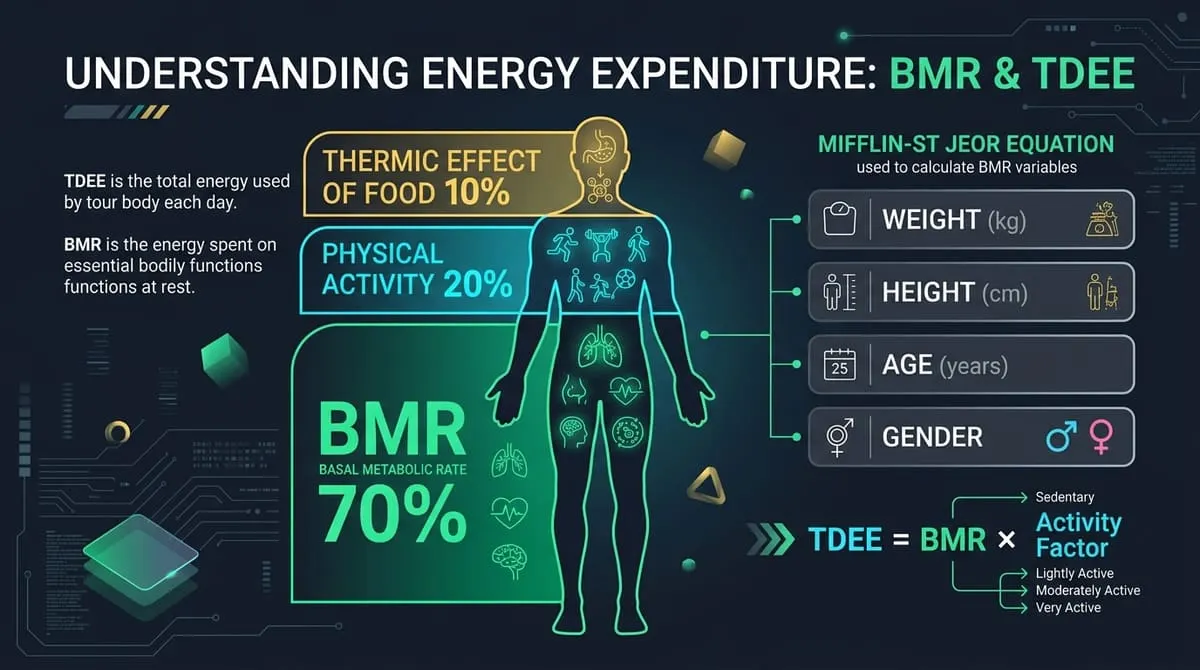
2. Core Definitions & Analogy
To build an intuitive foundation for metabolic calculations, let us explore the concept through three distinct perspectives:
- Simple Definition: Basal Metabolic Rate (BMR) is the absolute minimum number of calories (energy) your body burns in 24 hours just to stay alive while resting completely, without digesting food or moving a single muscle.
- Technical Definition: Basal Metabolic Rate (BMR) is the rate of energy expenditure per unit time by endothermic animals at rest. It represents the minimum power output required to maintain cellular homeostasis, cellular protein turnover, ionic transmembrane gradient pumps (Na+/K+ ATPase), organ perfusion, neuroendocrine synthesis, and core thermoregulation under post-absorptive, thermoneutral, and completely supine conditions. It is measured in kilocalories per day (kcal/day) or megajoules per day (MJ/day).
- The Idling Engine Analogy: Imagine a high-performance automobile sitting parked in your driveway with the transmission in park and the handbrake engaged. Even though the car is not driving anywhere, the engine is running ("idling"). It consumes gasoline every minute just to keep the alternator turning, coolant circulating, electrical sensors alive, and internal combustion steady. Your BMR is the exact biological equivalent of your body's "idling speed." Physical activity is like stepping on the gas pedal—it burns extra fuel on top of the idle rate.
3. History & The Evolution of Metabolic Formulas
Metabolic rate prediction has evolved dramatically over more than a century of clinical experimentation:
flowchart TD
    HB["1919: Harris-Benedict (Original)"] --> RS["1984: Roza and Shizgal Revision"]
    RS --> MSJ["1990: Mifflin-St Jeor Equation"]
    MSJ --> KM["1996: Katch-McArdle (LBM Formula)"]
    KM --> ADA["2005: ADA Clinical Validation Review"]
The Harris-Benedict Breakthrough (1919)
The first widely used metabolic prediction formula was formulated in 1919 by J. Arthur Harris and Francis G. Benedict at the Carnegie Institution of Washington. While groundbreaking for its era, the study examined a relatively small, homogeneous sample of young, lean individuals living in early 20th-century conditions. Over subsequent decades, changes in human body composition, average height, lifestyle, and obesity prevalence caused the classic Harris-Benedict formula to systematically overestimate caloric needs by 5% to 15%.
The Mifflin-St Jeor Revolution (1990)
In 1990, Dr. M. D. Mifflin, Dr. S. T. St Jeor, and their research team at the University of Nevada School of Medicine published a pivotal study in The American Journal of Clinical Nutrition titled "A new predictive equation for resting energy expenditure in healthy individuals."
Evaluating 498 healthy subjects (247 males and 251 females, aged 19–78 years, spanning normal-weight to severely obese individuals), they formulated a modernized mathematical model. Subsequent independent systematic reviews—most notably a landmark 2005 review by the American Dietetic Association (ADA)—demonstrated that the Mifflin-St Jeor equation is accurate within ±10% of measured indirect calorimetry in more than 82% of individuals, outperforming Harris-Benedict, Owen, and Schofield equations.
4. Core Concepts & Organ Energy Breakdown
Where do all these baseline calories go? Many people mistakenly believe that skeletal muscles burn the majority of calories at rest. In reality, your vital organs are the true metabolic heavyweights.
Organ-Specific Resting Energy Demands
Despite accounting for only about 5% to 6% of total body weight, the internal organs account for nearly 60% to 70% of your total BMR:
| Organ / Tissue | Approximate % of Body Weight | % of Total BMR Expenditure | Relative Energy Density (kcal/kg/day) |
|---|---|---|---|
| Liver | ~2.6% | 27% | ~200 kcal/kg |
| Brain | ~2.0% | 19% | ~240 kcal/kg |
| Skeletal Muscle | ~40.0% | 18% | ~13 kcal/kg |
| Kidneys | ~0.5% | 10% | ~440 kcal/kg |
| Heart | ~0.5% | 7% | ~440 kcal/kg |
| Adipose Tissue (Fat) | ~20.0% | 5% | ~4.5 kcal/kg |
| Other Tissues (Skin, GI) | ~34.4% | 14% | ~12 kcal/kg |
Key Metabolic Components: BMR vs. RMR vs. TEF vs. TDEE
flowchart TD
    TDEE["Total Daily Energy Expenditure (TDEE) - 100%"]
    TDEE --> BMR["Basal Metabolic Rate (BMR) - 60% to 75%"]
    TDEE --> TEF["Thermic Effect of Food (TEF) - 8% to 10%"]
    TDEE --> PA["Physical Activity Energy Expenditure - 15% to 30%"]
    PA --> EAT["Exercise Activity Thermogenesis (EAT) - 5% to 15%"]
PA --> NEAT["Non-Exercise Activity Thermogenesis (NEAT) - 10% to 20%"]- BMR (Basal Metabolic Rate): Measured under strict laboratory conditions immediately upon waking after an overnight fast, without movement.
- RMR (Resting Metabolic Rate): Measured under slightly less restrictive conditions (relaxed resting state without an overnight stay). RMR is typically 3% to 5% higher than BMR.
- TEF (Thermic Effect of Food): The energy required to chew, digest, absorb, and metabolize nutrients (proteins require ~20-30% of their energy to digest, carbohydrates ~5-10%, fats ~0-3%).
- NEAT (Non-Exercise Activity Thermogenesis): Calories burned through subconscious movement, walking, typing, fidgeting, posture maintenance, and daily chores.
- EAT (Exercise Activity Thermogenesis): Deliberate sports, cardio sessions, and resistance training.
5. The Mifflin-St Jeor Mathematical Formulas
The Mifflin-St Jeor equation calculates resting metabolic rate as a function of body mass (weight), stature (height), age, and biological sex.
Metric Formula
For weight in kilograms (W), height in centimeters (H), and age in years (A):
- For Men:
BMR = (10 × Weight in kg) + (6.25 × Height in cm) - (5 × Age in years) + 5
- For Women:
BMR = (10 × Weight in kg) + (6.25 × Height in cm) - (5 × Age in years) - 161
Imperial Conversion Formula
For weight in pounds (W_lbs) and height in inches (H_in):
- For Men:
BMR = (4.536 × Weight in lbs) + (15.875 × Height in inches) - (5 × Age in years) + 5
- For Women:
BMR = (4.536 × Weight in lbs) + (15.875 × Height in inches) - (5 × Age in years) - 161
Variable Deconstruction
- 10 × W (Weight Factor): Represents the mass component. Every kilogram of body mass adds 10 calories to your baseline daily burn.
- 6.25 × H (Height Factor): Represents total surface area and skeletal dimensions. Taller bodies require greater circulatory pressure and convective heat dissipation.
- -5 × A (Age Factor): Captures the biological reduction in metabolic activity over time. On average, humans experience a decline of approximately 5 kcal/day per year of life after early adulthood due to cellular senescence and natural sarcopenia.
- +5 vs -161 (Sex Constant): Reflects differences in average body composition between biological sexes. On average, biological males possess higher proportions of lean body mass and bone density compared to adipose tissue, leading to a baseline offset of +166 kcal/day relative to females of identical height and weight.
6. Step-by-Step Practical Calculations
Example 1: Healthy Adult Male
- Profile: 32-year-old male, weight = 82 kg, height = 182 cm.
- Step 1: Calculate Weight Contribution:
10 × 82 = 820
- Step 2: Calculate Height Contribution:
6.25 × 182 = 1137.5
- Step 3: Calculate Age Deduction:
5 × 32 = 160
- Step 4: Apply Gender Constant:
+5
- Step 5: Combine Values:
BMR = 820 + 1137.5 - 160 + 5 = 1802.5 ≈ 1803 kcal/day
Example 2: Healthy Adult Female
- Profile: 28-year-old female, weight = 64 kg, height = 168 cm.
- Step 1: Calculate Weight Contribution:
10 × 64 = 640
- Step 2: Calculate Height Contribution:
6.25 × 168 = 1050
- Step 3: Calculate Age Deduction:
5 × 28 = 140
- Step 4: Apply Gender Constant:
-161
- Step 5: Combine Values:
BMR = 640 + 1050 - 140 - 161 = 1389 kcal/day
7. Total Daily Energy Expenditure (TDEE) Multipliers
To turn your baseline BMR into your actual total daily calorie burn, apply the standard Physical Activity Level (PAL) multipliers:
| Activity Level | Multiplier | Description & Lifestyle Match |
|---|---|---|
| Sedentary | 1.200 | Desk job, minimal walking, no intentional sports or workouts. |
| Lightly Active | 1.375 | Light exercise or sports 1–3 days per week, regular casual walking. |
| Moderately Active | 1.550 | Moderate exercise or sports 3–5 days per week, active job or routine. |
| Very Active | 1.725 | Hard exercise or sports 6–7 days per week, strenuous physical occupation. |
| Extra / Athlete | 1.900 | Twice-per-day training, heavy labor, competitive endurance sports. |
8. Real-World Applications & Examples
1. Sustainable Weight Loss (Caloric Deficit)
- User: 40-year-old male with BMR of 1750 kcal. Sedentary desk job with light evening walks (
TDEE = 1750 × 1.375 = 2406 kcal).
- Target Deficit: A safe 500 kcal/day deficit creates approximately 0.5 kg (1 lb) of fat loss per week.
- Target Intake:
2406 - 500 = 1906 kcal/day. Note that target intake remains safely above the baseline BMR (1750 kcal), preventing metabolic slowdown.
2. Hypertrophy & Muscle Growth (Lean Bulking)
- User: 24-year-old female lifter with BMR of 1420 kcal. Trains heavy 5 days/week (
TDEE = 1420 × 1.55 = 2201 kcal).
- Target Surplus: A conservative 200–300 kcal/day surplus supports maximal muscle protein synthesis while minimizing fat gain.
- Target Intake:
2201 + 250 = 2451 kcal/day.
3. Marathon Endurance Preparation
- User: 30-year-old runner with BMR of 1650 kcal. Training 15–20 hours weekly (
TDEE = 1650 × 1.9 = 3135 kcal).
- Strategy: High carbohydrate loading prioritizing sustained glycogen replenishment to match the 3100+ kcal daily output.
9. In-Depth Clinical Case Studies
Case Study 1: Reversing Crash Dieting Metabolic Adaptation
- Background: Jessica, a 35-year-old female (70 kg, 165 cm), had restricted her intake to 1,000 kcal/day for 6 months. Her weight loss stalled, and she suffered from lethargy, hair thinning, and cold intolerance.
- BMR Calculation:
BMR = 10(70) + 6.25(165) - 5(35) - 161 = 700 + 1031.25 - 175 - 161 = 1395 kcal/day.
- Diagnosis: Chronic under-eating below her BMR suppressed thyroid hormone (T3) output and plummeted her spontaneous NEAT.
- Intervention: Jessica underwent a structured "reverse diet," increasing caloric intake by 100 kcal each week until reaching her maintenance TDEE of 1,950 kcal/day. Her energy restored, hormonal profiles normalized, and upon returning to a sensible deficit of 1,600 kcal/day, healthy fat loss resumed immediately.
Case Study 2: Bodybuilder Muscle Mass Discrepancy
- Background: Marcus, a 28-year-old natural bodybuilder (95 kg, 180 cm, 8% body fat).
- Mifflin-St Jeor Calculation:
BMR = 10(95) + 6.25(180) - 5(28) + 5 = 1940 kcal/day.
- Katch-McArdle Comparison (Using Lean Mass 87.4 kg):
BMR = 370 + (21.6 × 87.4) = 2258 kcal/day.
- Outcome: Because Marcus carries an exceptional quantity of metabolic lean muscle tissue, standard weight-based equations under-predicted his needs by over 300 kcal/day. Applying lean-mass adjustments prevented unintended muscle catabolism.
10. Advantages of the Mifflin-St Jeor Formula
- Clinically Proven Reliability: Consistently demonstrates the lowest mean absolute error across normal, overweight, and obese cohorts.
- Accessibility: Requires only basic demographic measurements (weight, height, age, sex) without needing costly DEXA scans or metabolic cart visits.
- Universal Acceptance: Recommended by the Academy of Nutrition and Dietetics, Mayo Clinic, and national health services globally.
11. Limitations & Edge Cases
- Body Composition Invisibility: The formula assumes average muscle-to-fat ratios. It slightly underestimates needs in extremely muscular athletes and slightly overestimates needs in individuals with severe sarcopenia or high body fat percentages.
- Endocrine Variations: Conditions such as hypothyroidism (Hashimoto's) or hyperthyroidism (Graves' disease) alter basal metabolic kinetics independently of body dimensions.
- Adaptive Thermogenesis: Prolonged calorie restriction triggers evolutionary conservation mechanisms, lowering actual metabolic rate below mathematical predictions by up to 10–15%.
12. Common Beginner Mistakes
- Eating Below Your BMR: Slashing calories below basal needs forces the body into conservation mode, driving muscle loss, hormonal dysregulation, and intense binge cravings.
- Confusing BMR with TDEE: Eating only your BMR calories while working an active job results in an extreme, unplanned caloric deficit.
- Overestimating Exercise Calorie Burn: Fitness trackers and cardio machines frequently overestimate workout calories by 20% to 40%.
- Failing to Recalculate as Weight Drops: As you lose weight, your BMR naturally decreases (a smaller body requires fewer calories to run). Recalculate your BMR every 4–5 kg of weight change.
13. Frequently Asked Questions (FAQ)
- What is a good BMR number?There is no single "good" BMR number because your BMR is directly proportional to your unique frame, height, sex, and weight. For average adult females, BMR typically spans 1,200 to 1,500 kcal/day, while for average adult males it ranges from 1,600 to 2,000 kcal/day.
- Can you increase your BMR permanently?Yes! The most effective method is building skeletal muscle through progressive resistance training. Adding lean muscle tissue increases 24-hour basal caloric demand and improves insulin sensitivity.
- Why do men have higher BMRs than women?Men generally possess higher average height, skeletal mass, and testosterone-driven muscle mass, alongside lower average essential fat percentages, leading to higher resting cellular energy consumption.
- Does drinking cold water or eating spicy food boost BMR?While ice water and capsaicin (chili peppers) create minor acute thermogenic spikes, their long-term effect on 24-hour basal metabolic rate is clinically negligible (less than 15–20 calories per day).
- How does aging affect BMR?After age 30, metabolic rate declines by roughly 1% to 2% per decade, primarily caused by gradual loss of muscle mass (sarcopenia) and subtle reductions in organ metabolic activity. Consistent strength training largely prevents this decline.
- Does sleep deprivation affect BMR?Yes. Chronic sleep deprivation elevates cortisol, impairs glucose regulation, and downregulates daytime NEAT, while often triggering cravings for calorie-dense foods.
- What is the difference between Mifflin-St Jeor and Harris-Benedict?The Mifflin-St Jeor formula is newer (1990 vs. 1919), calibrated against modern populations, and shown in peer-reviewed trials to be significantly more accurate (±10% vs ±15%) across diverse body mass categories.
- Should I eat back the calories burned during workouts?Generally, no. Your chosen TDEE activity multiplier already accounts for your average workout frequency. Eating back raw cardio tracker estimates often leads to inadvertent caloric surpluses.
- Can a metabolic cart test replace this calculator?Indirect calorimetry via a metabolic cart (measuring VO2 and VCO2 gas exchange) is the clinical gold standard. However, the Mifflin-St Jeor calculator provides a fast, accurate, and free approximation within 5–10% of metabolic cart results.
- What should my minimum daily calorie intake be?As a general medical guideline, daily calorie intake should rarely fall below 1,200 kcal/day for women or 1,500 kcal/day for men without direct medical supervision.
14. Expert Recommendations & Summary
- Calculate Your Baseline: Use the Mifflin-St Jeor equation to find your true resting threshold.
- Establish TDEE: Multiply your BMR by your realistic lifestyle activity factor.
- Set Intentional Targets: Choose a 300–500 kcal deficit for fat loss or a 200–300 kcal surplus for lean muscle hypertrophy.
- Preserve Lean Mass: Combine calorie control with high dietary protein (1.6 to 2.2 g/kg of body weight) and progressive resistance training.
- Track & Adjust: Treat the calculated BMR as an intelligent baseline hypothesis; monitor your real-world 3-week weight trajectory and adjust intake accordingly.
Additional Technical Guidelines & Measurement Standards
When conducting calculations for Basal Metabolic Rate (BMR) Mifflin-St Jeor Calculator, maintaining quantitative precision and verifying input parameter boundaries is essential for reliable scenario evaluation. Always verify that raw numerical inputs are measured using standardized instrumentation, and double-check unit conversions prior to applying outputs in commercial, industrial, or academic projects.
For quantitative unit conversions and scientific calculations, always maintain at least four decimal places of precision during intermediate arithmetic stages before rounding final results. When preparing technical reports, laboratory documentation, or financial forecasts, cross-verify all output variables against established international measurement standards (such as SI, NIST, and ISO metric benchmarks) to guarantee consistent analytical rigor across all computational workflows.
MathsLover.com delivers this interactive solver 100% free of charge to foster global mathematical literacy, educational accessibility, and data-driven problem solving across scientific, technical, and academic communities worldwide.