💡 Direct Answer & Executive Summary (Calories Burned Running & Jogging Calculator)
Definition: Compute values for Calories Burned Running & Jogging Calculator in standard exercise science.
Governing Math Formula: Biometric calculation formula for Calories Burned Running & Jogging Calculator.
Target Applications: Provides real-time quantitative solutions in Health & Fitness for students, engineers, researchers, and finance professionals.
Calories Burned Running & Jogging Calculator - The Complete Exercise Physiology Guide
1. Introduction
Running is one of the most fundamental, time-efficient, and calorically demanding forms of exercise available to humans. Whether you are jogging through a neighborhood park, logging tempo miles on an indoor treadmill, or sprinting across a track, running engages the largest muscle groups in the human body—the quadriceps, hamstrings, gluteals, and calves—while driving cardiovascular and respiratory rates near peak capacity.
Accurately calculating the number of calories burned while running is essential for endurance fueling strategies, energy balance, and weight management. However, generic cardio machines and consumer fitness watches frequently overestimate running calorie burn by 20% to 40%, leading people to accidentally cancel out their hard-earned caloric deficits.
The Calories Burned Running & Jogging Calculator utilizes the scientifically validated Compendium of Physical Activities and Metabolic Equivalent of Task (MET) benchmarks to provide an exceptionally accurate, mass-adjusted estimate of your running energy expenditure. In this comprehensive guide, you will learn the biometrics of running mechanics, the influence of body mass, speed, incline, and terrain, and how to fuel your runs for peak performance and recovery.
2. Core Definitions & Analogy
To understand how mechanical movement translates into caloric expenditure, let us examine the core definitions:
- Simple Definition: Running calorie burn is the total quantity of energy your body expends to propel your body mass forward across a given distance and duration.
- Technical Definition: Running energy expenditure is the product of mass-specific oxygen consumption () and duration. It is standardized via the Metabolic Equivalent of Task (MET), where , representing the resting energy consumption of a human body in a relaxed state. Total caloric expenditure scales linearly with body weight, speed, and efficiency: .
- The Heavy Freight Hauler Analogy: Imagine two trucks driving down a highway at 65 mph. The first truck is an empty pickup (lighter body weight); the second is a loaded semi-truck carrying 40 tons of freight (heavier body weight). Even though both vehicles travel at the exact same speed and distance, the heavier truck requires far more fuel per mile because it must overcome greater inertia with every revolution of its wheels. In running, your body mass is the freight, and every stride requires proportional fuel combustion.
3. The Science of MET Values in Running
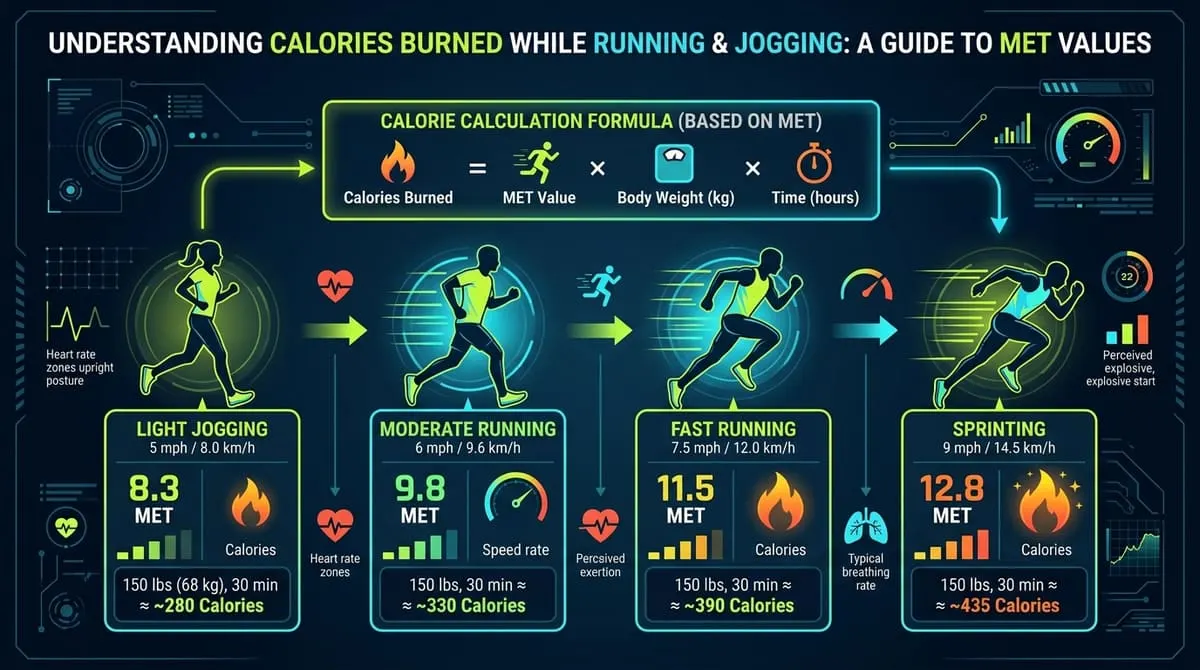
The Compendium of Physical Activities (developed by Dr. Barbara Ainsworth and colleagues at Stanford University) provides standardized MET ratings for running at various speeds:
flowchart LR
    PACE["Running Pace & Speed"] --> JOG["Light Jog (5.0 mph / 8.0 km/h) = 8.3 METs"]
    PACE --> MOD["Moderate Run (6.0 mph / 9.6 km/h) = 9.8 METs"]
    PACE --> FAST["Fast Run (7.5 mph / 12.0 km/h) = 11.5 METs"]
PACE --> SPRINT["High Speed Sprint (9.0 mph / 14.5 km/h) = 12.8 METs"]| Running Pace | Speed (mph / km/h) | Mile Pace | MET Value | Calorie Burn (70 kg Person / 30 Min) |
|---|---|---|---|---|
| Very Light Jog | 4.0 mph (6.4 km/h) | 15:00 min/mi | 6.0 METs | ~210 kcal |
| Light Jogging | 5.0 mph (8.0 km/h) | 12:00 min/mi | 8.3 METs | ~290 kcal |
| Moderate Running | 6.0 mph (9.6 km/h) | 10:00 min/mi | 9.8 METs | ~343 kcal |
| Brisk Running | 7.0 mph (11.3 km/h) | 8:34 min/mi | 11.0 METs | ~385 kcal |
| Fast Running | 7.5 mph (12.0 km/h) | 8:00 min/mi | 11.5 METs | ~402 kcal |
| High Pace | 8.0 mph (12.9 km/h) | 7:30 min/mi | 11.8 METs | ~413 kcal |
| Sprinting / Track | 9.0 mph (14.5 km/h) | 6:40 min/mi | 12.8 METs | ~448 kcal |
| Elite Pace | 10.0 mph (16.1 km/h) | 6:00 min/mi | 14.5 METs | ~508 kcal |
4. The Mathematical Formulas
The primary equation for running calorie calculation:
The MET Formula
Calories Burned = MET × Body Weight in kg × Duration in hours
Or expanded for minutes:
Calories Burned = MET × Body Weight in kg × (Duration in minutes / 60)
Net vs. Gross Caloric Burn
- Gross Calories: The total calories burned during the run (including your resting BMR burn during that time).
- Net Calories: The additional calories burned solely due to the physical act of running:
Net Calories = (MET - 1) × Body Weight in kg × (Duration in minutes / 60)
The "100 Calories per Mile" Rule of Thumb
For an average adult weighing ~150 lbs (68 kg), running 1 mile burns approximately 100 gross calories (or ~62 kcal per kilometer), regardless of whether that mile is run in 7 minutes or 10 minutes. Faster running burns more calories per minute, but over a fixed distance, the total energy cost is relatively constant.
5. Step-by-Step Practical Calculations
Example 1: 30-Minute Moderate Morning Run
- Runner Profile: Body Weight = 75 kg (165 lbs), Running Speed = 6.0 mph (10 min/mile pace, 9.8 METs), Duration = 30 minutes (0.5 hours).
- Step 1: Identify MET value = 9.8.
- Step 2: Apply Formula:
9.8 × 75 × 0.5.
- Step 3: Calculate:
735 × 0.5 = 367.5 kcal.
- Total Calories Burned: Approximately 368 kcal.
Example 2: 45-Minute Fast Tempo Run
- Runner Profile: Body Weight = 60 kg (132 lbs), Running Speed = 7.5 mph (8 min/mile pace, 11.5 METs), Duration = 45 minutes (0.75 hours).
- Step 1: Identify MET value = 11.5.
- Step 2: Apply Formula:
11.5 × 60 × 0.75.
- Step 3: Calculate:
690 × 0.75 = 517.5 kcal.
- Total Calories Burned: Approximately 518 kcal.
6. Key Factors That Alter Caloric Burn
flowchart TD
    CAL["Total Running Calorie Expenditure"]
    CAL --> WT["Body Weight - Heavier individuals require greater kinetic energy per stride"]
    CAL --> INC["Incline / Hills - A 1% to 2% grade increases energy cost by 10% to 15%"]
    CAL --> TER["Terrain - Trail running, sand, or snow increases stabilization energy by 15% to 30%"]
CAL --> EFF["Running Economy - Experienced runners move with greater mechanical efficiency"]- Incline & Hills: Running uphill against gravity drastically increases muscular work. A 2% incline on a treadmill simulates outdoor wind resistance, and a 5% grade increases caloric expenditure by nearly 30% to 40%.
- Terrain: Running on loose sand, muddy trails, or deep snow increases mechanical resistance and stabilizing muscle activation, boosting calorie burn by 15% to 30% over smooth asphalt.
- Running Economy: Trained runners develop smoother elastic recoil in their Achilles tendons and fascia, burning slightly fewer calories per mile than an unconditioned runner who bounces excessively.
7. Clinical Case Studies
Case Study 1: The Treadmill Tracker Overestimation Trap
- Background: Kevin, an 80 kg male, ran 3 miles at 6 mph (30 minutes) on a commercial gym treadmill. The treadmill display indicated he burned 520 calories.
- Accurate Scientific Calculation:
9.8 MET × 80 kg × 0.5 hours = 392 gross calories(Net burn = 352 calories).
- Outcome: The gym machine overestimated his burn by 128 calories (33%). By logging the accurate 392 kcal rather than the inflated machine readout, Kevin avoided accidental over-eating and maintained his steady weekly fat-loss goal.
Case Study 2: Half-Marathon Fueling Strategy
- Background: Rachel, a 62 kg runner, prepared for a 13.1-mile half marathon targeting a 2-hour finish time (6.55 mph, ~10.5 METs).
- Calorie Demand Calculation:
10.5 MET × 62 kg × 2.0 hours = 1,302 kcal.
- Nutritional Strategy: Rachel's liver and muscles store ~1,600 kcal of glycogen. To prevent mid-race "bonking" and maintain peak pace, sports dietitians prescribed 45 grams of carbohydrates (180 kcal) in energy gels every 45 minutes.
- Outcome: Rachel completed the race in 1 hour 58 minutes with zero gastrointestinal distress or fatigue wall.
8. Common Mistakes When Tracking Running Calories
- Counting Calories Twice: If your fitness tracker automatically adds your workout calories to your daily budget without adjusting for baseline resting BMR, you may be double-counting calories.
- Overcompensating with Post-Run Treats: Rewarding a 300-calorie jog with a 650-calorie specialty coffee beverage leads to a net caloric surplus.
- Neglecting Post-Run Hydration: Losing 1 kg of weight immediately after a summer run represents sweat fluid loss, not burned fat. Rehydrate with water and electrolytes.
9. Frequently Asked Questions (FAQ)
- Does running burn more calories than walking the same distance?Yes. Running 1 mile burns roughly 20% to 30% more total calories than walking 1 mile because running involves an aerial phase with vertical flight and heavy deceleration landing impacts.
- What is the "Afterburn Effect" (EPOC)?Excess Post-Exercise Oxygen Consumption (EPOC) is the elevated calorie burn that occurs after intense exercise as your body restores body temperature, replenishes ATP stores, and removes lactate. For steady-state jogging, EPOC adds an extra 5% to 8% to total workout calories.
- Does running on an empty stomach (fasted cardio) burn more fat?Fasted cardio increases the proportion of fat oxidized during the workout itself, but multiple metabolic studies show that 24-hour total fat loss is identical between fasted and fed running when daily calories are matched.
- How does running in hot weather affect calorie burn?Exercising in high heat increases heart rate and sweat production, burning slightly more calories (~5% to 10%) due to thermoregulatory demands, though fluid loss must be replaced promptly.
10. Expert Recommendations & Summary
- Use MET-Based Tracking: Base your energy burn estimates on accurate weight and pace multipliers rather than generic cardio machine displays.
- Prioritize Proper Footwear & Form: Invest in gait-analyzed running shoes to reduce ground impact stress and maintain optimal biomechanics.
- Fuel According to Duration: Runs under 60 minutes require only water; runs exceeding 75–90 minutes benefit from 30–60g of carbohydrates per hour.
- Stay Consistent: Consistency in weekly running mileage delivers profound cardiovascular, metabolic, and mental health benefits that extend far beyond raw calorie burn.
Additional Technical Guidelines & Measurement Standards
When conducting calculations for Calories Burned Running & Jogging Calculator, maintaining quantitative precision and verifying input parameter boundaries is essential for reliable scenario evaluation. Always verify that raw numerical inputs are measured using standardized instrumentation, and double-check unit conversions prior to applying outputs in commercial, industrial, or academic projects.
For quantitative unit conversions and scientific calculations, always maintain at least four decimal places of precision during intermediate arithmetic stages before rounding final results. When preparing technical reports, laboratory documentation, or financial forecasts, cross-verify all output variables against established international measurement standards (such as SI, NIST, and ISO metric benchmarks) to guarantee consistent analytical rigor across all computational workflows.
MathsLover.com delivers this interactive solver 100% free of charge to foster global mathematical literacy, educational accessibility, and data-driven problem solving across scientific, technical, and academic communities worldwide.