💡 Direct Answer & Executive Summary (FFMI Fat-Free Mass Index Calculator)
Definition: Compute values for FFMI Fat-Free Mass Index Calculator in standard exercise science.
Governing Math Formula: Biometric calculation formula for FFMI Fat-Free Mass Index Calculator.
Target Applications: Provides real-time quantitative solutions in Health & Fitness for students, engineers, researchers, and finance professionals.
FFMI Fat-Free Mass Index Calculator - Muscular Potential & Sports Science Guide
1. Introduction
For decades, the Body Mass Index (BMI) has served as the default screening tool for public health and obesity. However, BMI possesses a fatal biological flaw: it cannot distinguish between dense contractile skeletal muscle tissue and excess adipose fat tissue. Under basic BMI formulas, elite bodybuilders, rugby players, sprinters, and gymnasts are routinely misclassified as "overweight" or "clinically obese."
To provide a precise, objective metric of muscular development that is completely independent of body fat, Dr. Elena Kouri and Dr. Harrison Pope introduced the Fat-Free Mass Index (FFMI) in 1995 in a landmark study published in the Clinical Journal of Sport Medicine.
FFMI quantifies the amount of lean muscle mass an individual carries relative to their skeletal height. Today, FFMI is widely regarded as the gold-standard metric for:
- Assessing athletic muscular development and bodybuilding potential.
- Distinguishing natural genetic ceilings from pharmacological enhancement.
- Evaluating sarcopenic muscle wasting in clinical medicine and aging populations.
The FFMI Fat-Free Mass Index Calculator calculates your unadjusted FFMI, height-normalized FFMI (), and muscular potential classification based on your lean mass and height. This comprehensive guide covers mathematical derivations, natural muscular upper bounds, comparative athlete benchmarks, and strategies for maximizing drug-free hypertrophy.
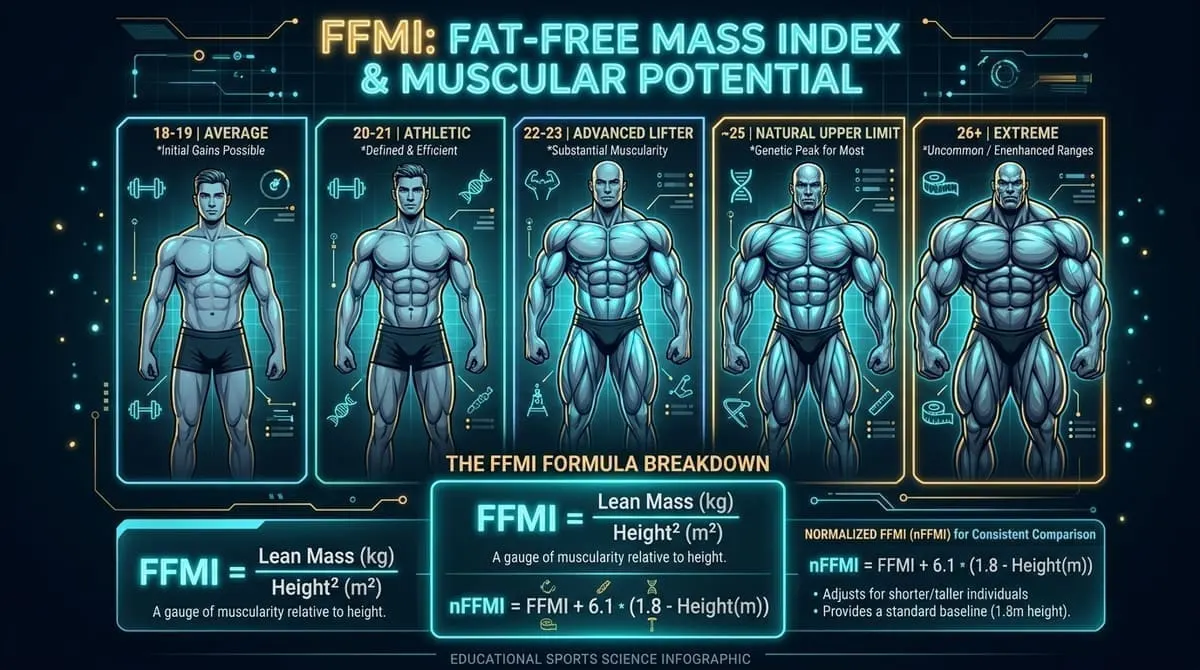
2. Core Definitions & Analogy
To grasp the mechanics of the Fat-Free Mass Index, let us explore the core definitions:
- Simple Definition: FFMI is like a BMI score for pure muscle—it measures how muscular you are relative to your height, completely ignoring your body fat.
- Technical Definition: Fat-Free Mass Index () is the ratio of an individual's total fat-free mass (in kilograms) to the square of their standing stature (in meters): . Normalized FFMI () applies an empirical linear height-adjustment regression anchored to a standard stature of () to prevent height-dependent distortion.
- The Skyscraper Steel Architecture Analogy: Imagine two buildings of the same height (e.g., 50 stories). One is built with a lightweight steel frame and filled with heavy furniture and storage boxes (average muscle, high body fat). The other is constructed with double-reinforced industrial titanium-steel girders (elite muscular development, low body fat). A standard scale measures both buildings as having identical total weight (identical BMI). FFMI strips away the furniture and boxes to measure strictly the thickness and density of the structural steel framework.
3. History of FFMI & The Landmark 1995 Pope Study
In 1995, Dr. Harrison G. Pope, Dr. Elena M. Kouri, and their research team at McLean Hospital and Harvard Medical School investigated muscular limits in athletes:
flowchart TD
    A["Pre-1940s: Golden Era Bodybuilders (Steve Reeves, John Grimek, Eugen Sandow) - Pre-Anabolic Steroid Era"] --> B["1995: Landmark Pope & Kouri Study (157 Male Athletes)"]
    B --> C["Establishment of Natural Threshold (FFMI ≈ 25.0 Upper Natural Limit)"]
    C --> D["Modern Day: Universal Metric in Anti-Doping Screening, Bodybuilding & Sarcopenia Research"]
The Study Findings:
- Non-Steroid Users (83 athletes): Averaged an FFMI of . Not a single natural subject exceeded an FFMI of $25.0$.
- Anabolic Steroid Users (74 athletes): Averaged an FFMI of , with many exceeding $27.0$ to $32.0+$.
- Pre-Steroid Era Mr. America Champions (1939–1959): Analysis of 20 historical bodybuilding champions prior to the introduction of synthetic testosterone/Dianabol revealed a mean normalized FFMI of $25.4$, representing the approximate genetic zenith of human drug-free muscularity.
4. The Mathematical Formulas
Calculating your Fat-Free Mass Index follows three sequential steps:
Step 1: Determine Fat-Free Mass (FFM)
Step 2: Calculate Standard FFMI
Step 3: Calculate Normalized FFMI ()
Because taller individuals naturally carry proportionally slightly more fat-free mass due to bone dimensions, Pope and Kouri developed a normalized adjustment scaled to a baseline height of 1.80 meters (5' 11"):
5. FFMI Muscularity Classification Matrix
The table below details FFMI ranges and their corresponding muscular development tiers for men and women:
| Male FFMI / | Female FFMI Range | Muscularity Classification | Description & Typical Profile |
|---|---|---|---|
| < 17.5 | < 13.5 | Below Average | Low muscle mass, sedentary, or clinical sarcopenia. |
| 17.5 – 19.5 | 13.5 – 15.5 | Average | Untrained general population with typical muscle tone. |
| 19.5 – 21.5 | 15.5 – 17.5 | Athletic / Above Average | Regular resistance training, visible muscle definition. |
| 21.5 – 23.5 | 17.5 – 19.5 | Excellent / Advanced Lifter | 3–5+ years of dedicated progressive strength training. |
| 23.5 – 25.0 | 19.5 – 21.0 | Genetic Ceiling (Elite Natural) | Peak natural muscular potential achieved by top ~1% of drug-free lifters. |
| > 25.5 – 28.0+ | > 21.5+ | Exceptional / Enhanced Range | Highly unlikely without pharmacological assistance (anabolics/PEDs). |
6. Step-by-Step Practical Calculations
Example 1: Advanced Natural Bodybuilder
- Parameters: Height = 1.78 m, Total Weight = 82 kg, Measured Body Fat = 10%.
- Step 1 (Fat-Free Mass):**
- Step 2 (Standard FFMI):
- Step 3 (Normalized FFMI):
- Classification: Elite Advanced Natural Muscularity.
Example 2: Tall Recreational Lifter
- Parameters: Height = 1.90 m, Total Weight = 95 kg, Body Fat = 15%.
- Step 1: .
- Step 2: .
- Step 3: .
- Classification: Athletic / Above Average Lifter.
7. Comparative Athletic Benchmarks
flowchart LR
    SED["Sedentary Adult (FFMI: 18 - 19)"] --> ATH["CrossFit / Collegiate Athlete (FFMI: 21 - 22)"]
    ATH --> NAT["Natural Bodybuilder Contest Lean (FFMI: 24 - 25)"]
NAT --> PRO["IFBB Pro Open Division (FFMI: 28 - 35+) [Enhanced]"]- Steve Reeves (1950 Mr. Universe - Drug-Free Era): Height = 1.85 m, Contest Weight = 98 kg, Body Fat ~8%, .
- Arnold Schwarzenegger (1974 Mr. Olympia - Enhanced Era): Height = 1.88 m, Weight = 107 kg, Body Fat ~7%, .
- Modern Open IFBB Pros: Weighing 120–135 kg at 5% body fat frequently register scores exceeding .
8. Clinical & Geriatric Applications: Sarcopenia Diagnosis
Beyond athletic aesthetics, FFMI is an essential clinical biomarker in medicine: 1. Sarcopenia & Frailty Screening: The European Working Group on Sarcopenia in Older People (EWGSOP) uses low FFMI thresholds ( in men, in women) to diagnose muscle-wasting disease, fall risk, and post-surgical mortality. 2. Oncology Cachexia: Tracking FFMI changes during chemotherapy detects rapid loss of metabolic lean tissue before noticeable drops in total scale weight occur.
9. Limitations & Practical Tips
- Garbage In, Garbage Out (Body Fat Accuracy): An incorrect body fat estimate directly distorts FFMI. Using DEXA, hydrostatic weighing, or Bod Pod provides far more reliable FFMI inputs than consumer bioimpedance bathroom scales.
- Skeletal Frame Size Variance: Individuals with large wrist/ankle joint girth (broad bone structure) have slightly higher natural muscular ceilings () than narrow-framed individuals.
10. Frequently Asked Questions (FAQ)
- Can a natural lifter reach an FFMI over 25?It is exceedingly rare, representing fewer than 1 in 1,000 individuals with exceptional genetic bone thickness, myostatin deficiencies, and a decade of dedicated heavy lifting. For 99% of drug-free lifters, an FFMI of 24.5 to 25.0 represents their true physiological limit.
- What is a good FFMI for women?Women carry naturally higher essential body fat and lower testosterone, making an FFMI of 17.5 to 19.0 excellent, and 19.5 to 21.0 elite natural status.
- Why is normalized FFMI () necessary?Because mass scales with volume () while FFMI scales by , taller lifters without normalization would appear artificially more muscular than shorter lifters with identical relative muscularity.
11. Expert Recommendations & Summary
- Use Accurate Body Fat Measurements: Pair the FFMI calculator with validated DEXA or caliper testing.
- Focus on Progressive Overload: If your FFMI is currently between 18 and 21, you have substantial natural muscular growth potential ahead through disciplined training and nutrition.
- Track Lean Gains: Recalculate your FFMI every 6 months to ensure that weight gained during bulking phases represents pure functional muscle mass.
Additional Technical Guidelines & Measurement Standards
When conducting calculations for FFMI Fat-Free Mass Index Calculator, maintaining quantitative precision and verifying input parameter boundaries is essential for reliable scenario evaluation. Always verify that raw numerical inputs are measured using standardized instrumentation, and double-check unit conversions prior to applying outputs in commercial, industrial, or academic projects.
For quantitative unit conversions and scientific calculations, always maintain at least four decimal places of precision during intermediate arithmetic stages before rounding final results. When preparing technical reports, laboratory documentation, or financial forecasts, cross-verify all output variables against established international measurement standards (such as SI, NIST, and ISO metric benchmarks) to guarantee consistent analytical rigor across all computational workflows.
MathsLover.com delivers this interactive solver 100% free of charge to foster global mathematical literacy, educational accessibility, and data-driven problem solving across scientific, technical, and academic communities worldwide.