💡 Direct Answer & Executive Summary (Macronutrient Split (Protein/Carb/Fat) Calculator)
Definition: Compute values for Macronutrient Split (Protein/Carb/Fat) Calculator in standard exercise science.
Governing Math Formula: Biometric calculation formula for Macronutrient Split (Protein/Carb/Fat) Calculator.
Target Applications: Provides real-time quantitative solutions in Health & Fitness for students, engineers, researchers, and finance professionals.
Macronutrient Split (Protein/Carb/Fat) Calculator - The Complete Nutrition & Fueling Guide
1. Introduction
While tracking total calorie intake dictates whether you gain, lose, or maintain weight, your Macronutrient Split determines the quality of your physiological transformation. Two individuals consuming the exact same 2,000 calories per day will develop radically different physiques, energy levels, athletic performance, and metabolic biomarkers depending on whether those calories come from high-quality protein, complex carbohydrates, and essential fats, or refined sugars and ultra-processed lipids.
Macronutrients—commonly referred to as "macros"—are the primary nutritional chemical compounds your body consumes in large daily quantities to generate cellular adenosine triphosphate (ATP), synthesize hormones, repair muscular micro-trauma, and sustain cognitive focus.
The Macronutrient Split (Protein/Carb/Fat) Calculator translates your daily caloric target into precise, actionable gram targets tailored to your specific training style, lifestyle, and physique goals. This comprehensive guide covers the biochemical roles of each macronutrient, energy densities, optimal distribution ratios, meal timing strategies, and real-world nutrition protocols.
2. Core Definitions & Analogy
To build an intuitive foundation for nutritional planning, let us define the core concepts:
- Simple Definition: A macronutrient split is the percentage breakdown of your total daily calories allocated among the three primary fuel sources: Protein, Carbohydrates, and Dietary Fats.
- Technical Definition: Macronutrient partitioning is the quantitative stoichiometric distribution of dietary substrate intake (). Each class of macronutrient undergoes distinct metabolic pathways (amino acid transamination/proteolysis, glycolysis/glycogenesis, and beta-oxidation/lipogenesis) yielding variable net metabolizable energy (Atwater general factors) and unique hormonal responses.
- The Construction Vehicle Analogy: Imagine your body is an industrial construction site. Protein is the raw building material (steel beams, bricks, and concrete) needed to build and repair physical structures. Carbohydrates are the high-octane gasoline that powers the excavators and cranes during heavy lifting. Dietary Fats are the engine oil, hydraulic fluids, and electrical wiring insulation that prevent parts from grinding, maintain cellular communication, and keep operations running smoothly.
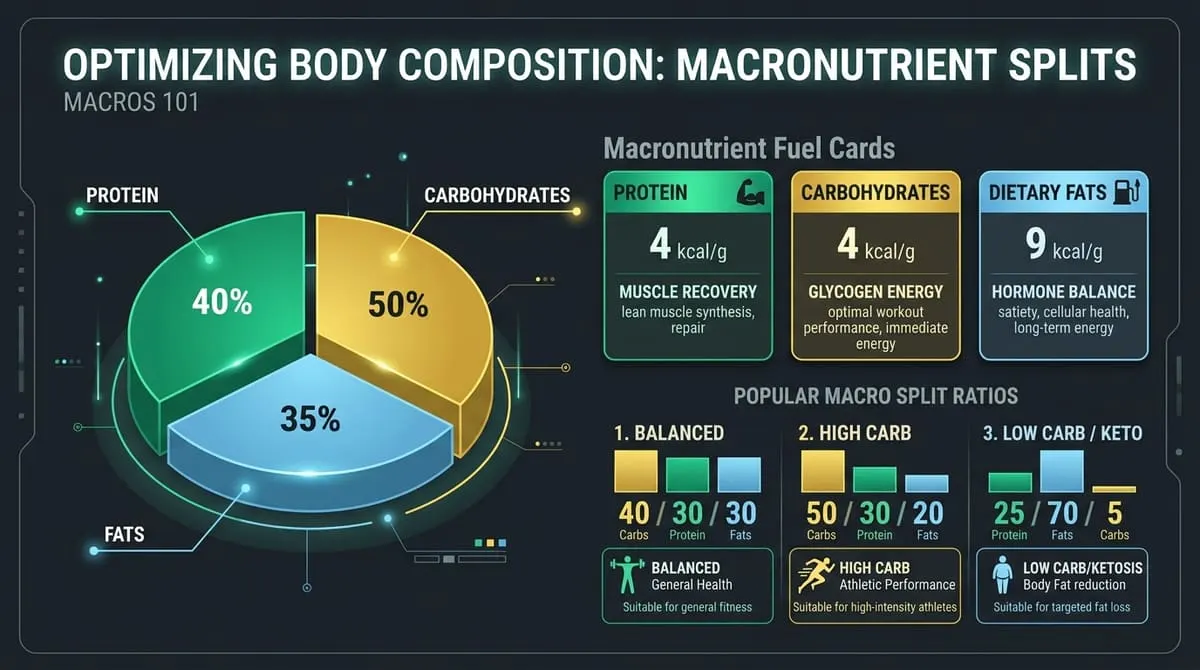
3. The Big Three: Energy Densities & Biological Roles
Each macronutrient delivers a specific caloric energy density defined by the Atwater system:
flowchart TD
    MACROS["Total Daily Caloric Intake (100%)"]
    MACROS --> PRO["Protein: 4 kcal per gram - Muscle Protein Synthesis, Satiety, Tissue Repair"]
    MACROS --> CARB["Carbohydrates: 4 kcal per gram - Muscle Glycogen, High-Intensity Fuel, CNS Glucose"]
    MACROS --> FAT["Dietary Fats: 9 kcal per gram - Hormone Synthesis, Cell Membranes, Vitamin Absorption"]
1. Dietary Protein (4 kcal/g)
- Primary Function: Provides essential amino acids (EAAs) and branched-chain amino acids (BCAAs like Leucine) to stimulate mammalian target of rapamycin (mTOR) signaling for muscle protein synthesis and enzymatic repair.
- Thermic Effect: Possesses the highest Thermic Effect of Food (TEF) at 20% to 30%, meaning nearly a quarter of protein calories are burned simply during digestion and assimilation.
- Satiety: Triggers release of peptide YY (PYY) and cholecystokinin (CCK) while suppressing ghrelin (the hunger hormone).
2. Carbohydrates (4 kcal/g)
- Primary Function: Broken down into blood glucose and stored in skeletal muscle (~400–500 g) and the liver (~100 g) as glycogen.
- Performance Role: The primary substrate for anaerobic glycolysis during strength training, sprinting, and high-intensity interval training (HIIT).
- Hormonal Impact: Elevates insulin, which blunts muscle protein breakdown (anti-catabolic effect) and aids nutrient transport into cells.
3. Dietary Fats (9 kcal/g)
- Primary Function: Essential fatty acids (Omega-3 and Omega-6) serve as building blocks for cellular phospholipid bilayers and steroid hormone synthesis (including testosterone and estrogen).
- Absorption: Required for the bioavailability and uptake of fat-soluble vitamins (A, D, E, and K).
- Energy Density: At 9 kcal per gram, fats are more than twice as calorically dense as proteins or carbohydrates, providing steady, sustained baseline energy.
4. Popular Macronutrient Split Profiles
Depending on your athletic focus, metabolic health, and personal preferences, several proven macronutrient distributions exist:
| Macro Strategy | Protein % | Carb % | Fat % | Primary Use Case & Target Audience |
|---|---|---|---|---|
| Balanced / Standard Fitness | 30% | 40% | 30% | General body recomposition, recreational gym-goers, sustainable long-term health. |
| High-Carb Athletic Performance | 25% – 30% | 50% – 55% | 20% | Competitive endurance athletes, crossfitters, hypertrophy-focused bodybuilders. |
| Zone / Moderate Carb | 30% | 40% | 30% | Steady glycemic control, cross-training, consistent all-day energy. |
| Low-Carb / Ketogenic | 25% | 5% – 10% | 65% – 70% | Neurological health, insulin resistance, individuals who prefer high-fat meals. |
5. The Mathematical Formulas & Gram Calculations
To calculate exact gram targets from your total daily calorie budget:
Protein Calculation
Protein Grams = (Total Daily Calories × Protein %) / 4
Carbohydrate Calculation
Carb Grams = (Total Daily Calories × Carb %) / 4
Fat Calculation
Fat Grams = (Total Daily Calories × Fat %) / 9
6. Step-by-Step Practical Calculations
Example 1: Balanced Hypertrophy Split (2,400 kcal)
- Target Split: 30% Protein / 45% Carbohydrates / 25% Fat.
- Protein:
(2400 × 0.30) / 4 = 720 kcal / 4 = 180 grams protein.
- Carbohydrates:
(2400 × 0.45) / 4 = 1080 kcal / 4 = 270 grams carbs.
- Fats:
(2400 × 0.25) / 9 = 600 kcal / 9 ≈ 67 grams fat.
- Daily Total:
180g P / 270g C / 67g F = 2,403 kcal.
Example 2: Fat Loss Cut on a Low-Carb Split (1,800 kcal)
- Target Split: 40% Protein / 20% Carbohydrates / 40% Fat.
- Protein:
(1800 × 0.40) / 4 = 720 kcal / 4 = 180 grams protein.
- Carbohydrates:
(1800 × 0.20) / 4 = 360 kcal / 4 = 90 grams carbs.
- Fats:
(1800 × 0.40) / 9 = 720 kcal / 9 = 80 grams fat.
- Daily Total:
180g P / 90g C / 80g F = 1,800 kcal.
7. Clinical Case Studies
Case Study 1: Resolving Chronic Fatigue in an Endurance Runner
- Background: Liam, a 28-year-old marathon runner (70 kg, TDEE = 2,800 kcal), followed a low-carb diet (15% carb, 40% protein, 45% fat). He experienced heavy legs, mid-run bonking, and poor recovery.
- Intervention: Shifted to an athletic performance split: 60% Carbs (420g), 20% Protein (140g, 2.0 g/kg), 20% Fat (62g).
- Outcome: Liam's muscle glycogen replenishment improved dramatically. His average pace dropped by 22 seconds per mile, and post-run soreness cleared within 24 hours.
Case Study 2: Preventing Lean Tissue Catabolism in a Caloric Deficit
- Background: Maria, a 33-year-old female (64 kg, 28% body fat), restricted calories to 1,500 kcal with a generic low-protein split (15% protein = 56g/day).
- Problem: Maria lost 4 kg over 8 weeks, but DEXA scan revealed 2.2 kg was lost muscle tissue rather than fat.
- Adjustment: Rebalanced to a high-protein fat-loss split (35% protein = 131g/day, 2.05 g/kg, 35% carb = 131g, 30% fat = 50g).
- Outcome: Over the next 8 weeks, Maria lost another 4 kg with 100% of the loss coming from adipose fat stores, preserving full lean muscle mass.
8. Common Mistakes When Tracking Macros
- Forgetting Food Scale Accuracy: Volume measurements (cups, tablespoons) can vary by 20% to 50% for dense foods like nuts, oils, and peanut butter. Use a digital gram scale.
- Ignoring Liquid Calories & Cooking Oils: 1 tablespoon of olive oil in the pan adds 14 grams of fat (126 kcal) that often goes unlogged.
- Under-eating Protein on Rest Days: Muscle protein synthesis remains elevated for 24 to 48 hours following resistance training. Keep daily protein consistent across all 7 days of the week.
- Dropping Dietary Fat Too Low: Slashing dietary fat below 15% of total calories can disrupt steroid hormone production, leading to low testosterone, disrupted menstrual cycles, and dry skin.
9. Frequently Asked Questions (FAQ)
- Is hitting total calories more important than hitting exact macros?Total calories dictate net weight gain or loss, but macronutrient distribution determines whether that weight change consists of fat tissue or lean muscle mass. Both work in synergy.
- How much protein is optimal per day?Extensive sports nutrition literature supports 1.6 to 2.2 grams of protein per kilogram of body weight (0.8 to 1.0 g/lb) for active individuals looking to build or preserve muscle.
- Should I count net carbs or total carbs?For standard balanced and athletic diets, counting total carbohydrates is simplest and most accurate. For ketogenic diets, subtracting dietary fiber (net carbs) is standard practice.
- Does protein timing matter?Distributing protein across 3 to 5 meals throughout the day (each containing 25 to 40 grams with at least 2.5g of Leucine) stimulates muscle protein synthesis more effectively than consuming your entire daily protein in a single meal.
- Can you eat too much protein?In individuals with healthy kidneys, high-protein diets (up to 3.0 g/kg) have been shown in clinical trials to be safe, though very high intakes offer diminishing returns for muscle synthesis.
10. Expert Recommendations & Summary
- Lock in Protein First: Set daily protein to 1.6–2.2 g/kg of body weight based on your target physique.
- Set Dietary Fat Baseline: Allocate 20% to 30% of total calories to healthy fats to support hormones and vitamin absorption.
- Fill the Rest with Carbohydrates: Use complex carbohydrates to fuel training performance, high-intensity workouts, and daily cognitive focus.
- Practice Flexible Dieting (80/20 Rule): Aim for 80% of your macronutrients from nutrient-dense whole foods while leaving 20% flexibility for social occasions and lifestyle sustainability.
Additional Technical Guidelines & Measurement Standards
When conducting calculations for Macronutrient Split (Protein/Carb/Fat) Calculator, maintaining quantitative precision and verifying input parameter boundaries is essential for reliable scenario evaluation. Always verify that raw numerical inputs are measured using standardized instrumentation, and double-check unit conversions prior to applying outputs in commercial, industrial, or academic projects.
For quantitative unit conversions and scientific calculations, always maintain at least four decimal places of precision during intermediate arithmetic stages before rounding final results. When preparing technical reports, laboratory documentation, or financial forecasts, cross-verify all output variables against established international measurement standards (such as SI, NIST, and ISO metric benchmarks) to guarantee consistent analytical rigor across all computational workflows.
MathsLover.com delivers this interactive solver 100% free of charge to foster global mathematical literacy, educational accessibility, and data-driven problem solving across scientific, technical, and academic communities worldwide.