💡 Direct Answer & Executive Summary (One Rep Max (1RM Epley Formula) Calculator)
Definition: Compute values for One Rep Max (1RM Epley Formula) Calculator in standard exercise science.
Governing Math Formula: Biometric calculation formula for One Rep Max (1RM Epley Formula) Calculator.
Target Applications: Provides real-time quantitative solutions in Health & Fitness for students, engineers, researchers, and finance professionals.
One Rep Max (1RM Epley Formula) Calculator - The Complete Strength Science Guide
1. Introduction
In strength training, powerlifting, Olympic weightlifting, and sports conditioning, the One Repetition Maximum (1RM) is the ultimate benchmark of neuromuscular capacity. Defined as the maximal amount of weight an athlete can lift for a single, full repetition through a complete range of motion with proper technique, your 1RM serves as the anchor point for all percentage-based strength programming.
However, attempting a true maximal 1RM lift under a heavy barbell carries substantial injury risk to ligaments, tendons, and the central nervous system (CNS), particularly for intermediate and recreational lifters.
To estimate maximal strength safely and accurately without risking injury under a crushing load, sports scientists developed submaximal predictive equations. Among these, the Epley Formula—developed by Boyd Epley in 1985—is the most widely validated and utilized linear equation in modern strength and conditioning.
The One Rep Max (1RM Epley Formula) Calculator computes your theoretical 1RM, percentage-based training loads, and repetition targets based on any submaximal set performed to technical fatigue. This comprehensive guide details the physiology of maximal strength, the mathematics of the Epley equation, repetition velocity profiles, and how to program percentage-based training cycles.
2. Core Definitions & Analogy
To understand maximal strength metrics, let us define 1RM from three foundational perspectives:
- Simple Definition: Your 1RM (One Rep Max) is the heaviest weight you can lift for exactly one repetition on a given exercise.
- Technical Definition: 1RM represents peak voluntary dynamic concentric force production () generated through maximal spatial and temporal motor unit recruitment, high-threshold Henneman size principle motor unit activation, rate coding acceleration, and inter-muscular coordination across an exercise-specific kinematic pathway.
- The Bridge Load Capacity Analogy: Imagine an architectural suspension bridge. The bridge has a maximum theoretical load limit—the absolute heaviest single freight convoy it can support before catastrophic structural failure (1RM). Rather than parking thousands of tons on the bridge every day to test if it collapses, structural engineers measure how much the bridge flexes under a standard 10-ton truck (submaximal reps) and mathematically compute its maximum load limit with high precision.
3. History of the Epley Formula & Strength Modeling
In 1985, Boyd Epley—the founder of the National Strength and Conditioning Association (NSCA) and head strength coach at the University of Nebraska—sought a reliable method to test hundreds of collegiate football players without exhausting their recovery capacities before game days.
flowchart TD
    A["Direct 1RM Testing (High Injury & Fatigue Risk)"] --> B["Boyd Epley Submaximal Empirical Testing (1985)"]
    B --> C["The Epley Linear Formula: 1RM = Weight × (1 + Reps / 30)"]
    C --> D["Adopted Across NCAA, NSCA, Powerlifting & Strength Programming"]
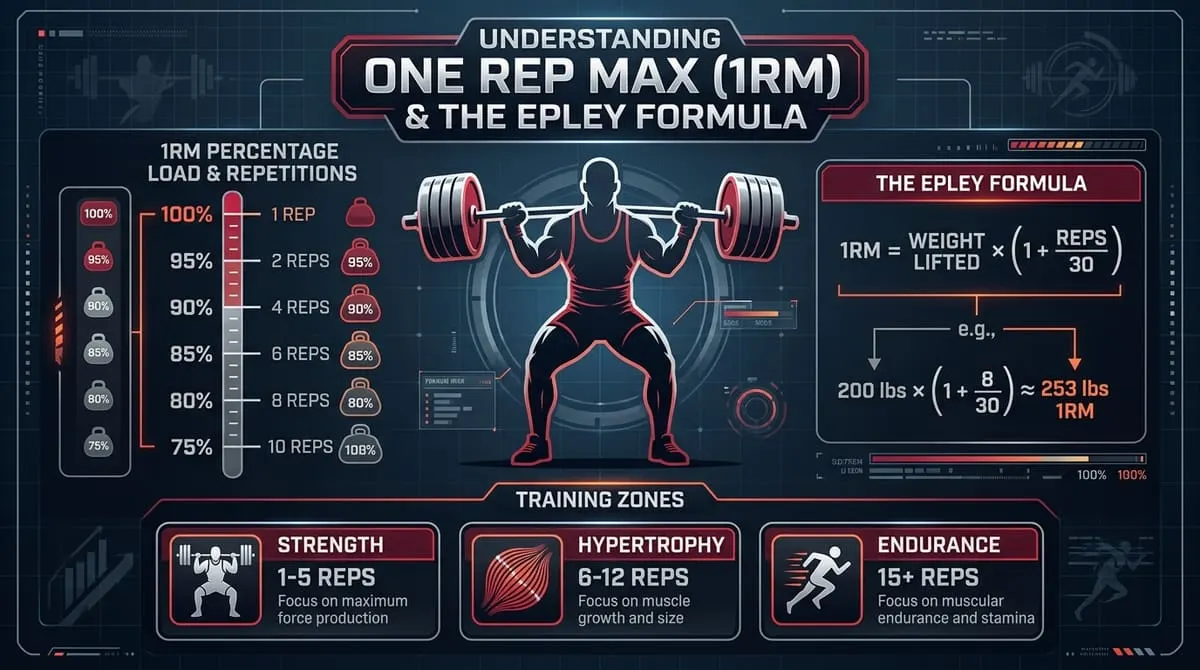
Epley analyzed thousands of multi-rep sets (spanning 2 to 10 repetitions) across the bench press, back squat, and deadlift. He discovered a remarkably consistent linear degradation curve: every repetition performed at a given weight represents an additional ~3.33% (1/30th) of an athlete's 1RM capacity.
4. The Mathematical Formulas
The standard Epley equation and its inverse formulations:
The Epley 1RM Equation
1RM = Weight Lifted × [ 1 + (Reps / 30) ]
Or expanded arithmetically:
1RM = Weight Lifted + (Weight Lifted × Reps × 0.0333)
Inverse Formula: Weight for a Desired Rep Target
If you know your 1RM and want to know how much weight to load for a target number of reps (e.g. 5 reps):
Load = 1RM / [ 1 + (Target Reps / 30) ]
Alternative Comparison: Brzycki Formula
For comparison, another popular formula is the Matt Brzycki (1993) equation:
1RM = Weight Lifted / ( 1.0278 - 0.0278 × Reps )
Note: The Epley formula is exceptionally accurate for sets of 2 to 8 repetitions, while Brzycki performs well between 5 and 10 repetitions.
5. Standard 1RM Percentage & Repetition Table
The table below outlines the relationship between percentage of 1RM, expected maximum repetitions, and physiological training adaptations:
| % of 1RM | Repetition Maximum | Primary Training Adaptation | Neuromuscular Adaptation Focus |
|---|---|---|---|
| 100% | 1 Rep | Peak Maximal Strength | Maximal motor unit synchronization, Rate of Force Development (RFD). |
| 95% | 2 Reps | Maximal Strength | High-threshold motor unit recruitment. |
| 90% | 3 – 4 Reps | Strength & Power | Heavy strength development with low metabolic fatigue. |
| 85% | 5 – 6 Reps | Strength & Hypertrophy | The classic strength-building zone (e.g. 5x5 protocols). |
| 80% | 7 – 8 Reps | Mechanical Tension | Optimal balance of mechanical tension and muscular hypertrophy. |
| 75% | 9 – 10 Reps | Hypertrophy | Metabolic stress and muscle fiber volumization. |
| 70% | 11 – 12 Reps | Muscular Hypertrophy | Sarcoplasmic hypertrophy and high blood flow (pump). |
| 60% – 65% | 15 – 20 Reps | Muscular Endurance | Capillary density, lactate buffering, mitochondrial density. |
6. Step-by-Step Practical Calculations
Example 1: Barbell Back Squat
- Performance: An athlete squats 315 lbs (142.9 kg) for 5 clean repetitions.
- Step 1: Calculate the rep multiplier:
5 / 30 = 0.1667.
- Step 2: Add 1:
1 + 0.1667 = 1.1667.
- Step 3: Multiply by weight lifted:
315 × 1.1667 = 367.5 lbs(approximately 368 lbs / 167 kg).
- Result: The athlete's estimated 1RM back squat is 368 lbs.
Example 2: Barbell Bench Press
- Performance: A lifter benches 100 kg (220.5 lbs) for 8 repetitions.
- Step 1: Calculate the rep multiplier:
8 / 30 = 0.2667.
- Step 2: Add 1:
1 + 0.2667 = 1.2667.
- Step 3: Multiply by weight lifted:
100 × 1.2667 = 126.67 kg(approximately 127 kg / 279 lbs).
- Result: The lifter's estimated 1RM bench press is 127 kg.
7. Programming Percentage-Based Strength Cycles
flowchart LR
    TEST["Submaximal Set Test (e.g. 225 lbs × 5 reps)"] --> CALC["Epley 1RM Calculation (= 262.5 lbs)"]
    CALC --> W1["Week 1: 70% 1RM (185 lbs × 8 reps) - Volume Accumulation"]
    CALC --> W2["Week 2: 77.5% 1RM (205 lbs × 6 reps) - Progressive Overload"]
    CALC --> W3["Week 3: 85% 1RM (225 lbs × 4 reps) - Intensification"]
    CALC --> W4["Week 4: 92.5% 1RM (245 lbs × 2 reps) - Realization & Deload"]
Percentage-based training protocols (such as 5/3/1, Texas Method, or Sheiko) require knowing your baseline 1RM:
- Volume Blocks: Train at 65% to 75% of 1RM for sets of 8 to 12 reps to build muscular hypertrophy and work capacity.
- Intensification Blocks: Train at 80% to 87.5% of 1RM for sets of 3 to 5 reps to build neural drive.
- Peaking Blocks: Train at 90%+ of 1RM for singles and doubles to prepare for powerlifting meets or PR attempts.
8. Clinical Case Studies
Case Study 1: Safe 1RM Estimation in High School Athletes
- Background: Coach Miller needed to test back squat baselines for 45 varsity athletes without exposing younger lifters to spinal buckling under maximal single attempts.
- Protocol: Athletes performed a controlled 5RM test with strict spotters.
- Outcome: All 45 athletes received accurate 1RM baselines in a single 60-minute session with zero injuries or missed technical lifts, allowing immediate programming of custom percentage weight cards.
Case Study 2: Tracking Strength Recovery Post-ACL Reconstruction
- Background: Tyler, a 24-year-old soccer player, was cleared for leg press training 6 months post-ACL repair.
- Test: Completed 10 reps at 150 kg on the leg press with full stability.
- Estimated 1RM:
150 × (1 + 10/30) = 150 × 1.333 = 200 kg.
- Rehab Progression: Physical therapists used the calculated 200 kg 1RM to safely program recovery sets at exactly 60% of 1RM (120 kg × 15 reps), preventing patellar tendon overload while accelerating quadriceps hypertrophy.
9. Limitations & Testing Best Practices
- Accuracy Drops Beyond 10 Repetitions: The Epley formula is most precise between 2 and 8 reps. Once a set exceeds 10–12 repetitions, cardiovascular conditioning, muscle fiber composition, and mental fatigue skew the calculation.
- Fast-Twitch vs. Slow-Twitch Variance: Lifters with high percentages of Type II (fast-twitch) muscle fibers often perform fewer reps at 80% 1RM than slow-twitch dominant lifters.
- Maintain Technical Strictness: Never count "grinder" reps where form breaks down (e.g. knees caving, hips shooting up on squats, or bouncing the bar off the chest on bench press). Only count clean repetitions performed with competition-standard technique.
10. Frequently Asked Questions (FAQ)
- How accurate is the Epley formula compared to a real 1RM?Extensive biomechanical testing shows the Epley equation predicts actual 1RM within ±2% to 4% when calculated from a 3RM to 5RM test performed with strict form.
- Should beginners test a true 1RM?No. Beginners should always use submaximal calculations (like 5RM or 8RM) because their motor patterns and connective tissues are not yet adapted to handle true maximal skeletal loads safely.
- What is RPE and RIR, and how do they connect to 1RM?RPE (Rate of Perceived Exertion, scale 1–10) and RIR (Reps in Reserve) quantify proximity to failure. If you complete 5 reps with an RIR of 2 (meaning you could have done 7 reps total), calculate your 1RM using 7 reps for an accurate baseline.
- Does the Epley formula work for all exercises?The formula is designed primarily for multi-joint compound barbell movements (Squat, Bench Press, Deadlift, Overhead Press). It is less reliable for isolation exercises like bicep curls or lateral raises.
- How often should I re-test my 1RM?Re-evaluate your estimated 1RM every 4 to 8 weeks at the conclusion of a structured training mesocycle.
11. Expert Recommendations & Summary
- Use the 3-to-5 Rep Range for Testing: Perform a clean set of 3 to 5 reps to failure for the most accurate Epley calculation.
- Program with a "Training Max" (90% of 1RM): Base your weekly workout percentages on 90% of your calculated 1RM to account for daily energy fluctuations and prevent overtraining.
- Prioritize Technique Over Numbers: A high calculated 1RM with sloppy form increases injury risk; always prioritize clean biomechanics.
- Track Progressive Overload: If your 5RM increases by 5 lbs over a month, your calculated 1RM has improved, confirming that your strength training program is working.
Additional Technical Guidelines & Measurement Standards
When conducting calculations for One Rep Max (1RM Epley Formula) Calculator, maintaining quantitative precision and verifying input parameter boundaries is essential for reliable scenario evaluation. Always verify that raw numerical inputs are measured using standardized instrumentation, and double-check unit conversions prior to applying outputs in commercial, industrial, or academic projects.
For quantitative unit conversions and scientific calculations, always maintain at least four decimal places of precision during intermediate arithmetic stages before rounding final results. When preparing technical reports, laboratory documentation, or financial forecasts, cross-verify all output variables against established international measurement standards (such as SI, NIST, and ISO metric benchmarks) to guarantee consistent analytical rigor across all computational workflows.
MathsLover.com delivers this interactive solver 100% free of charge to foster global mathematical literacy, educational accessibility, and data-driven problem solving across scientific, technical, and academic communities worldwide.