💡 Direct Answer & Executive Summary (Pregnancy Due Date Naegele Rule Solver)
Definition: Compute values for Pregnancy Due Date Naegele Rule Solver in standard exercise science.
Governing Math Formula: Biometric calculation formula for Pregnancy Due Date Naegele Rule Solver.
Target Applications: Provides real-time quantitative solutions in Health & Fitness for students, engineers, researchers, and finance professionals.
Pregnancy Due Date Naegele Rule Solver - The Complete Obstetric & Gestational Guide
1. Introduction
From the moment a pregnancy test turns positive, the first and most anticipated question for expecting parents and healthcare providers is: "When is the baby expected to arrive?" Establishing an accurate Estimated Due Date (EDD) or Estimated Date of Delivery is the cornerstone of clinical obstetrics. It dictates the timing of essential prenatal screenings, fetal ultrasound growth scans, chromosomal genetic testing, and clinical labor management decisions.
In standard clinical practice, human gestational age is calculated not from the day of conception (which is often difficult to pinpoint), but from the first day of the pregnant individual's Last Menstrual Period (LMP).
In 1812, German obstetrician Dr. Franz Karl Naegele formalized a simple, elegant mathematical rule that remains the foundational obstetric standard worldwide: Naegele's Rule.
The Pregnancy Due Date Naegele Rule Solver computes your estimated delivery date based on your LMP. In this comprehensive guide, you will learn the biological timeline of human gestation, the three trimesters of fetal development, menstrual cycle length adjustments, clinical ultrasound dating comparisons, and essential prenatal milestones.
2. Core Definitions & Analogy
To understand how gestational dating works, let us examine the core concepts:
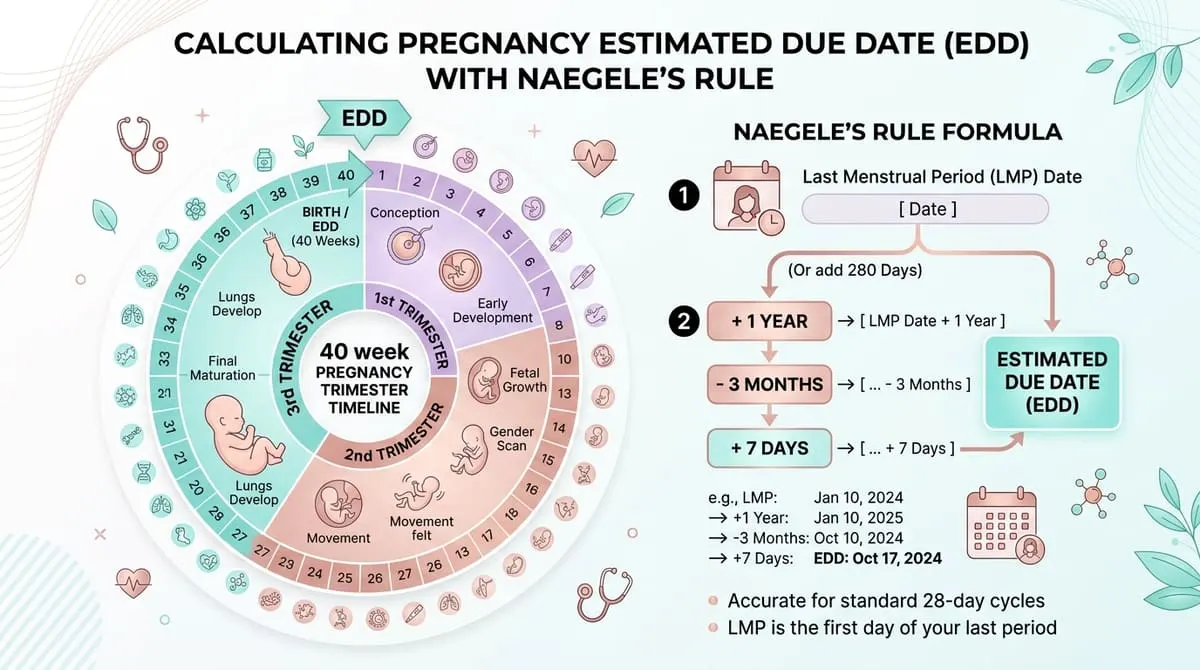
- Simple Definition: Naegele's Rule is a standard clinical method to calculate an estimated delivery date by adding 1 year, subtracting 3 months, and adding 7 days to the first day of your last menstrual period.
- Technical Definition: Naegele's Rule calculates gestational age assuming an idealized 280-day (40-week or 10 lunar months) post-menstrual timeline for human singleton pregnancies. It presumes a standardized 28-day ovulatory cycle wherein fertilization occurs approximately 14 days following the onset of menses: .
- The Agricultural Planting & Harvest Analogy: Think of pregnancy like planting a prize heirloom seed in a greenhouse. While the seedling officially germinates beneath the soil when the seed meets water (ovulation and fertilization around day 14), gardeners track the growth timeline from the day the soil bed was prepared and tilled (the first day of the menstrual cycle). The 40-week timeline accounts for both soil preparation and the full growing season until harvest.
3. History of Naegele's Rule
In the early 19th century, obstetric calculations varied widely across Europe. In 1812, Dr. Franz Karl Naegele, a renowned professor of obstetrics at the University of Heidelberg, published his textbook on midwifery.
flowchart TD
    A["Early Midwifery Rules of Thumb (Hermann Boerhaave 1744)"] --> B["Dr. Franz Karl Naegele Formalization (Heidelberg, 1812)"]
    B --> C["40-Week (280-Day) Gestational Calendar Becomes Global Standard"]
    C --> D["Modern Integration with 1st Trimester Crown-Rump Length (CRL) Ultrasounds"]
Naegele credited Dutch physician Hermann Boerhaave (1744) with the initial concept of adding 7 days and subtracting 3 months, but Naegele systematically tested and integrated the rule into clinical midwifery education, cementing it as the global medical standard for obstetric calendar dating.
4. The Mathematical Formulas & Calculation Steps
Naegele's Rule calculates the Estimated Due Date (EDD) through a simple chronological sequence:
The Classical Calendar Formula
- Start with the First Day of the Last Menstrual Period (LMP).
- Add 1 Year to the calendar year.
- Subtract 3 Months from the calendar month.
- Add 7 Days to the calendar day.
Direct Day Count Method
Estimated Due Date (EDD) = LMP Date + 280 Days (40 Weeks)
Adjusting for Non-28-Day Cycles
The classical rule assumes a standard 28-day menstrual cycle with ovulation on Day 14. If your regular cycle is longer or shorter, adjust the day addition:
Days to Add = 7 + (Cycle Length in Days - 28)
- Example for 32-Day Cycle: Add
7 + (32 - 28) = 11 days.
- Example for 25-Day Cycle: Add
7 + (25 - 28) = 4 days.
5. The 40-Week Trimester Timeline
A full-term human pregnancy is clinically divided into three distinct developmental trimesters:
flowchart LR
    LMP["LMP Date (Week 0)"] --> T1["First Trimester (Weeks 1 to 13) - Embryogenesis & Organogenesis"]
    T1 --> T2["Second Trimester (Weeks 14 to 27) - Fetal Growth & Anatomy Scan"]
    T2 --> T3["Third Trimester (Weeks 28 to 40) - Rapid Lung & Brain Maturation"]
T3 --> TERM["Full Term Delivery (Weeks 37 to 42)"]| Trimester | Gestational Weeks | Key Embryonic / Fetal Milestones | Clinical Screenings & Care |
|---|---|---|---|
| 1st Trimester | Weeks 1 – 13 | Conception, heart tube pulsation (wk 6), neural tube formation, organogenesis. | First prenatal visit, blood typing, NIPT chromosomal screen, 12-wk dating ultrasound. |
| 2nd Trimester | Weeks 14 – 27 | Fetal movements felt ("quickening"), gender identification, bone ossification, hearing. | 20-week comprehensive anatomy ultrasound, maternal alpha-fetoprotein. |
| 3rd Trimester | Weeks 28 – 40 | Rapid weight gain, surfactant production in lungs, antibodies transfer, brain maturation. | Glucose tolerance test (gestational diabetes), Group B Strep (GBS) swab at 36 weeks. |
6. Step-by-Step Practical Calculations
Example 1: Standard Calculation (Spring LMP)
- LMP Date: May 10, 2026 (Day: 10, Month: 5, Year: 2026).
- Step 1 (Add 1 Year): May 10, 2027.
- Step 2 (Subtract 3 Months): February 10, 2027.
- Step 3 (Add 7 Days): February 17, 2027.
- Estimated Due Date (EDD): February 17, 2027.
Example 2: Month-Crossing Calculation (Late Fall LMP)
- LMP Date: November 26, 2026 (Day: 26, Month: 11, Year: 2026).
- Step 1 (Add 1 Year): November 26, 2027.
- Step 2 (Subtract 3 Months): August 26, 2027.
- Step 3 (Add 7 Days): August 33 → August has 31 days → September 2, 2027.
- Estimated Due Date (EDD): September 2, 2027.
7. Due Date Accuracy: Reality vs. Statistics
It is important for parents to understand that an estimated due date is an approximation, not an exact appointment:
| Timing of Spontaneous Birth | Percentage of Deliveries | Clinical Classification |
|---|---|---|
| On the Exact Due Date | ~4% – 5% | Exact 40 Weeks Day 0 |
| Within 1 Week of Due Date | ~60% – 70% | Full Term (Weeks 39 to 41) |
| Within 2 Weeks of Due Date | ~90% | Full Term Window (Weeks 38 to 42) |
| Preterm (Before 37 Weeks) | ~8% – 10% | Preterm Labor |
| Post-Term (After 42 Weeks) | ~3% – 5% | Post-Mature (Often Induced) |
8. Naegele's Rule vs. First-Trimester Ultrasound Dating
While Naegele's Rule provides an immediate starting estimate, the American College of Obstetricians and Gynecologists (ACOG) guidelines state that a first-trimester ultrasound measuring fetal Crown-Rump Length (CRL) is the most accurate method for establishing gestational age:
- Ultrasound at 8–13 Weeks: Accurate within ±5 to 7 days.
- ACOG Redating Rule: If the first-trimester ultrasound dating differs from Naegele's LMP calculation by more than 7 days, the clinical due date is officially adjusted to match the ultrasound date.
9. Clinical Case Studies
Case Study 1: Irregular Cycle Adjustment
- Background: Sarah had a 35-day menstrual cycle. Her LMP was March 4.
- Standard Naegele (Unadjusted): March 4 - 3 months + 1 year + 7 days = December 11.
- Adjusted Naegele: Because her cycle was 35 days (7 days longer than standard 28), ovulation occurred on Day 21 rather than Day 14. Adding an extra 7 days (
7 + (35 - 28) = 14 days) yielded an adjusted due date of December 18.
- Validation: Sarah's 10-week dating ultrasound confirmed gestational age aligned with December 19, avoiding false concerns about delayed fetal growth.
Case Study 2: Preventing Unnecessary Labor Induction
- Background: Elena, unsure of her exact LMP date due to spotting, was estimated at 41 weeks by unconfirmed menstrual dates and scheduled for immediate labor induction.
- Review: Doctors cross-referenced her early 8-week CRL ultrasound scan, which showed the baby was actually at 39 weeks and 2 days.
- Outcome: Induction was cancelled, allowing Elena to experience a safe, natural spontaneous vaginal birth 10 days later at true full term.
10. Frequently Asked Questions (FAQ)
- Why is pregnancy counted as 40 weeks if it is 9 months?40 gestational weeks equals approximately 9 calendar months plus 1 week (or 10 four-week lunar cycles). The calculation begins two weeks before conception occurs.
- What if I don't know the exact date of my last period?If your LMP is uncertain or you have irregular cycles, your healthcare provider will perform an early dating ultrasound (transvaginal or abdominal) between weeks 7 and 12 to determine your due date based on fetal dimensions.
- What does "Full Term" mean?* Early Term: 37 weeks 0 days to 38 weeks 6 days.* Full Term: 39 weeks 0 days to 40 weeks 6 days (optimal for lung and brain maturity).* Late Term: 41 weeks 0 days to 41 weeks 6 days.* Post-Term: 42 weeks 0 days and beyond.
- Does Naegele's Rule work for IVF pregnancies?For IVF pregnancies, the due date is calculated with exact precision from the embryo transfer date:* Day 3 Embryo Transfer: Add 263 days to transfer date.* Day 5 Blastocyst Transfer: Add 261 days to transfer date.
- Can traveling across leap years affect the calculation?Leap years introduce an extra calendar day (February 29), which can shift the day count by 24 hours, but this variation has zero clinical impact on fetal development.
11. Expert Recommendations & Summary
- Document LMP Accurately: Keep a record of the first day of bleeding for your last menstrual period.
- Confirm with an Early Ultrasound: Schedule a first-trimester ultrasound between weeks 8 and 12 for the highest dating accuracy.
- Treat the Due Date as a Window: Prepare for delivery during the 4-week window between 38 and 42 weeks rather than fixating on a single calendar day.
Additional Technical Guidelines & Measurement Standards
When conducting calculations for Pregnancy Due Date Naegele Rule Solver, maintaining quantitative precision and verifying input parameter boundaries is essential for reliable scenario evaluation. Always verify that raw numerical inputs are measured using standardized instrumentation, and double-check unit conversions prior to applying outputs in commercial, industrial, or academic projects.
For quantitative unit conversions and scientific calculations, always maintain at least four decimal places of precision during intermediate arithmetic stages before rounding final results. When preparing technical reports, laboratory documentation, or financial forecasts, cross-verify all output variables against established international measurement standards (such as SI, NIST, and ISO metric benchmarks) to guarantee consistent analytical rigor across all computational workflows.
MathsLover.com delivers this interactive solver 100% free of charge to foster global mathematical literacy, educational accessibility, and data-driven problem solving across scientific, technical, and academic communities worldwide.