💡 Direct Answer & Executive Summary (Target Heart Rate Karvonen Zone Calculator)
Definition: Compute values for Target Heart Rate Karvonen Zone Calculator in standard exercise science.
Governing Math Formula: Biometric calculation formula for Target Heart Rate Karvonen Zone Calculator.
Target Applications: Provides real-time quantitative solutions in Health & Fitness for students, engineers, researchers, and finance professionals.
Target Heart Rate Karvonen Zone Calculator - The Complete Aerobic Training Guide
1. Introduction
Whether you are training for your first 5K, seeking to burn body fat efficiently, or preparing for an ultra-endurance marathon, exercising at the correct cardiovascular intensity is the single most important factor for success. Training too hard too often leads to chronic overtraining, adrenal fatigue, and plateaued progress, while training too lightly fails to trigger the physiological adaptations needed to boost aerobic capacity.
To individualize cardiovascular training zones, traditional methods simply subtract your age from 220. However, this generic method ignores a crucial biometric indicator of cardiovascular fitness: your Resting Heart Rate (RHR).
In 1957, Finnish physiologist Dr. Martti Karvonen developed a breakthrough formula that incorporates your resting pulse through a concept called Heart Rate Reserve (HRR).
The Target Heart Rate Karvonen Zone Calculator determines your personalized five-zone cardiovascular training spectrum. In this comprehensive guide, you will learn the exercise physiology of heart rate reserve, the biochemical shifts between fat oxidation and glycogen burning, how to calculate your specific target training zones, and how to program polarized endurance cycles for optimal health.
2. Core Definitions & Analogy
To understand heart rate zones, let us examine the core concepts:
- Simple Definition: The Karvonen formula calculates how fast your heart should beat during exercise based on both your age and your resting baseline fitness.
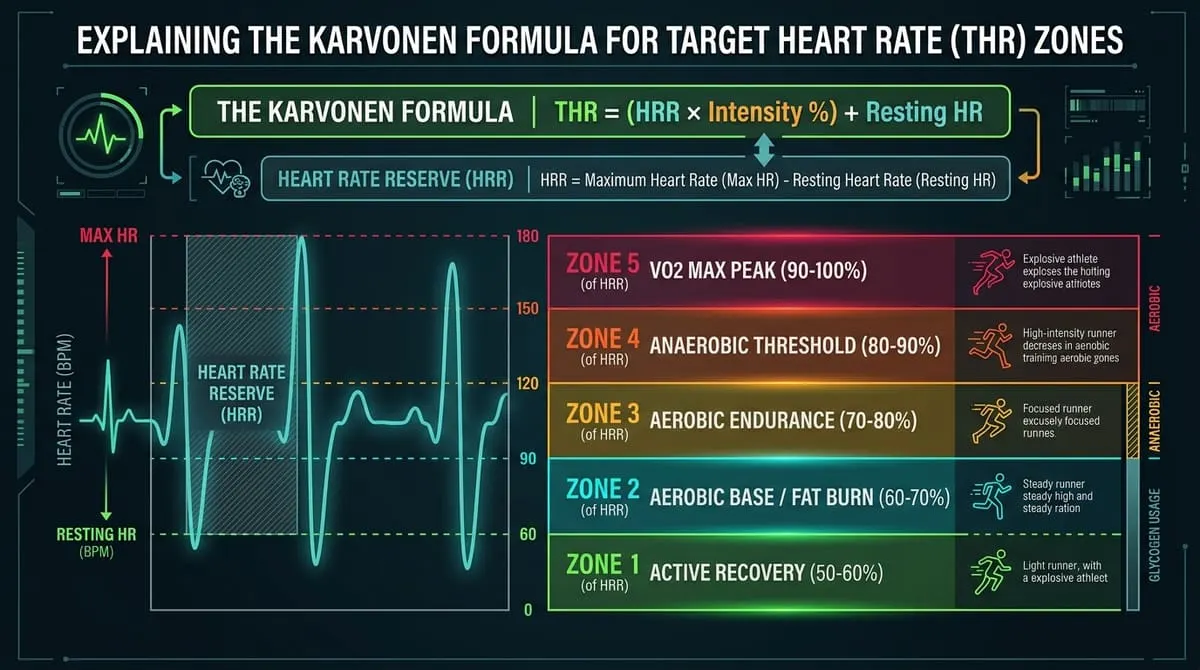
- Technical Definition: The Karvonen method is an exercise prescription formula that determines Target Heart Rate (THR) by calculating Heart Rate Reserve (HRR = HR_max - HR_rest) and scaling it by desired exercise intensity percentages (): . This models cardiovascular work as a function of an individual's dynamic physiological range rather than an arbitrary static ceiling.
- The Tachometer & Idle RPM Analogy: Think of your heart like a sports car engine. A generic formula looks only at the redline RPM (Max Heart Rate). But a tuned race engine with a low idle speed (low Resting Heart Rate) has a much wider powerband (Heart Rate Reserve) than an old engine that idles at high RPMs. The Karvonen formula measures what percentage of your usable powerband you are operating in above your idle baseline.
3. History of the Karvonen Formula
In 1957, Dr. Martti J. Karvonen and his research team at the Institute of Occupational Health in Helsinki, Finland, published a landmark study investigating heart rate responses in cross-country skiers.
flowchart TD
    A["Classic Age Formula (Fox & Haskell 1971: 220 - Age) - Ignores Baseline Fitness"] --> B["Dr. Martti Karvonen Study (1957: Heart Rate Reserve Concept)"]
    B --> C["The Karvonen Equation: THR = (HRR × Intensity) + HR_rest"]
    C --> D["Adopted by ACSM, Olympic Training Centers & Endurance Coaches Globally"]
Karvonen recognized that two 30-year-olds with the same theoretical maximum heart rate of 190 bpm could have drastically different fitness baselines: one sedentary individual with a resting pulse of 80 bpm and an elite athlete with a resting pulse of 42 bpm. By factoring in resting pulse, the Karvonen method accurately matches relative metabolic intensity (percentage of VO2 max) across diverse fitness levels.
4. The Mathematical Formulas
Calculating your Target Heart Rate using the Karvonen method follows three progressive mathematical steps:
Step 1: Estimate Maximum Heart Rate (HR_max)
- Standard Formula:
HR_max = 220 - Age
- (Optional Tanaka Formula for older adults:
HR_max = 208 - (0.7 × Age))
Step 2: Calculate Heart Rate Reserve (HRR)
HRR = HR_max - HR_rest
Step 3: Calculate Target Heart Rate (THR)
Target Heart Rate = (HRR × Intensity Percentage) + HR_rest
5. The 5 Aerobic Cardiovascular Training Zones
The Karvonen formula divides cardiovascular training into five distinct physiological intensity brackets:
| Zone | Intensity (% HRR) | Physiological Focus | Primary Fuel Source | Typical Training Feel |
|---|---|---|---|---|
| Zone 1 | 50% – 60% | Active Recovery | >85% Dietary & Stored Fats | Very easy, conversational, light warm-up or recovery walk. |
| Zone 2 | 60% – 70% | Aerobic Base / Fat Oxidation | 70% – 85% Fat, 15% – 30% Glucose | Comfortable all-day pace; can speak full sentences easily. |
| Zone 3 | 70% – 80% | Aerobic Endurance / Tempo | 50% Fat, 50% Glucose | Moderate effort, breathing deepens, short sentences only. |
| Zone 4 | 80% – 90% | Anaerobic Threshold / Lactate | >80% Muscle Glycogen | Hard effort, lactate begins accumulating, single-word speech. |
| Zone 5 | 90% – 100% | VO2 Max Peak / Neuromuscular | 100% Rapid Glycolysis & ATP-CP | Maximal sprint, unsustainable for more than 1–3 minutes. |
6. Step-by-Step Practical Calculations
Example 1: 25-Year-Old Athlete with High Fitness
- Profile: Age = 25 years, Resting Heart Rate = 50 bpm.
- Step 1 (Max HR):
220 - 25 = 195 bpm.
- Step 2 (HRR):
195 - 50 = 145 bpm.
- Step 3 (Zone 2 Target: 60% – 70%):* Lower Bound (60%):
(145 × 0.60) + 50 = 87 + 50 = 137 bpm.* Upper Bound (70%):(145 × 0.70) + 50 = 101.5 + 50 = 151.5 ≈ 152 bpm.
- Zone 2 Heart Rate Range: 137 to 152 bpm.
Example 2: 45-Year-Old Beginner Starting Fitness
- Profile: Age = 45 years, Resting Heart Rate = 78 bpm.
- Step 1 (Max HR):
220 - 45 = 175 bpm.
- Step 2 (HRR):
175 - 78 = 97 bpm.
- Step 3 (Zone 2 Target: 60% – 70%):* Lower Bound (60%):
(97 × 0.60) + 78 = 58.2 + 78 = 136.2 ≈ 136 bpm.* Upper Bound (70%):(97 × 0.70) + 78 = 67.9 + 78 = 145.9 ≈ 146 bpm.
- Zone 2 Heart Rate Range: 136 to 146 bpm.
7. The Power of Zone 2 Aerobic Base Training
In modern sports physiology, Zone 2 training (60% to 70% HRR) has emerged as the cornerstone of human endurance and metabolic longevity:
flowchart LR
    Z2["Zone 2 Base Training (60% to 70% HRR)"] --> MITO["Mitochondrial Biogenesis - Increases Cellular Energy Density"]
    Z2 --> CAPI["Capillarization - Enhances Oxygen Delivery to Muscle Fibers"]
    Z2 --> LACT["Lactate Clearance - Increases MCT-1 Transporter Proteins"]
    Z2 --> FAT["Fat Oxidation Capacity - Spares Muscle Glycogen Stores"]
World-class endurance athletes (runners, cyclists, triathletes) perform approximately 80% of their total weekly training volume in Zone 2 (the "80/20 Polarized Model"), reserving only 20% for high-intensity Zone 4 and 5 intervals.
8. Clinical Case Studies
Case Study 1: Breaking the "Chronic Moderate Intensity" Rut
- Background: Mark, a 38-year-old amateur marathoner (Resting HR = 62 bpm, Max HR = 182 bpm), ran all his workouts at a "hard tempo" pace (160–165 bpm, Zone 4). Despite running 40 miles a week, his race times stalled and he suffered frequent Achilles tendinitis.
- Diagnosis: Exercising continuously in Zone 4 prevented mitochondrial base development and generated chronic systemic inflammation without proper recovery.
- Karvonen Prescription: Re-programmed his routine to 80% Zone 2 (
(182 - 62) × 0.65 + 62 = 140 bpm) and 20% Zone 5 track intervals.
- Outcome: Within 16 weeks, his resting heart rate dropped from 62 to 54 bpm, tendon pain cleared completely, and his marathon PR improved by 14 minutes.
Case Study 2: Cardiac Rehabilitation & Safe Exercise Prescription
- Background: Linda, a 58-year-old female recovering from mild hypertension (Resting HR = 76 bpm, Max HR = 162 bpm).
- Prescription: Cardiologists prescribed 30 minutes of stationary cycling strictly in Zone 1 to low Zone 2 (50% to 60% HRR = 119 to 128 bpm).
- Outcome: Exercising within targeted Karvonen zones lowered her systolic blood pressure by 12 mmHg over 12 weeks while maintaining zero risk of cardiovascular overexertion.
9. Common Mistakes When Using Heart Rate Zones
- Measuring Resting Heart Rate After Coffee or Stress: RHR must be taken immediately upon waking in bed, before drinking caffeine or checking email.
- Relying on Optical Wrist Sensors During High-Intensity Intervals: Optical wrist trackers often suffer from "cadence lock" during rapid arm swinging. Use a Bluetooth chest strap for precise interval monitoring.
- Ignoring Cardiac Drift in Hot Weather: In high heat or dehydration, heart rate gradually rises over a 60-minute run even at a steady running pace due to blood diversion to the skin for cooling. Adjust pace to keep heart rate in the target zone.
10. Frequently Asked Questions (FAQ)
- How accurate is the 220 - Age formula for Max Heart Rate?The 220 - Age equation has a standard error of ±10 to 12 bpm. If you have completed a clinical treadmill stress test or field ramp test, use your actual measured Max HR for higher precision.
- Why is my Zone 2 running pace feeling so slow initially?If your aerobic base has not been developed, you may need to jog very slowly or take walk intervals to keep your heart rate below 70% HRR. Over 6 to 10 weeks of consistent training, your running speed at the same low heart rate will increase dramatically.
- Does medications like beta-blockers affect Karvonen zones?Yes. Beta-blockers artificially suppress both resting and maximum heart rates. Individuals on cardiac medications should consult their physician for specialized target zones or use the Borg RPE (Rate of Perceived Exertion) scale.
- How often should I recalculate my Karvonen zones?Recalculate every 2 to 3 months as your resting heart rate decreases with improving cardiovascular fitness.
11. Expert Recommendations & Summary
- Measure 3-Day Morning RHR: Take your pulse for 60 seconds on three consecutive mornings upon waking and average the values for your baseline Resting HR.
- Adopt the 80/20 Rule: Dedicate 80% of your weekly cardio to comfortable Zone 2 aerobic base work and 20% to high-intensity Zone 4/5 intervals.
- Listen to Your Body: Heart rate zones guide your effort, but if you feel unusually fatigued or unwell, reduce training intensity regardless of the numbers.
Additional Technical Guidelines & Measurement Standards
When conducting calculations for Target Heart Rate Karvonen Zone Calculator, maintaining quantitative precision and verifying input parameter boundaries is essential for reliable scenario evaluation. Always verify that raw numerical inputs are measured using standardized instrumentation, and double-check unit conversions prior to applying outputs in commercial, industrial, or academic projects.
For quantitative unit conversions and scientific calculations, always maintain at least four decimal places of precision during intermediate arithmetic stages before rounding final results. When preparing technical reports, laboratory documentation, or financial forecasts, cross-verify all output variables against established international measurement standards (such as SI, NIST, and ISO metric benchmarks) to guarantee consistent analytical rigor across all computational workflows.
MathsLover.com delivers this interactive solver 100% free of charge to foster global mathematical literacy, educational accessibility, and data-driven problem solving across scientific, technical, and academic communities worldwide.