💡 Direct Answer & Executive Summary (VO2 Max Estimation from Resting Heart Rate)
Definition: Compute values for VO2 Max Estimation from Resting Heart Rate in standard exercise science.
Governing Math Formula: Biometric calculation formula for VO2 Max Estimation from Resting Heart Rate.
Target Applications: Provides real-time quantitative solutions in Health & Fitness for students, engineers, researchers, and finance professionals.
VO2 Max Estimation from Resting Heart Rate - Cardiovascular Fitness Guide
1. Introduction
In exercise physiology and sports medicine, (Maximal Oxygen Uptake) is universally recognized as the single most definitive metric of an individual's cardiorespiratory endurance, aerobic capacity, and cardiovascular longevity.
defines the maximum volume of oxygen (in milliliters) that your body can absorb through the lungs, transport through the bloodstream via cardiac stroke volume, and extract into skeletal muscle mitochondria per kilogram of body mass per minute ().
Epidemiological studies published in JAMA Network Open demonstrate that cardiorespiratory fitness () is one of the strongest independent predictors of all-cause mortality—patients in the highest fitness percentiles exhibit a 500% lower risk of cardiovascular death compared to those in the lowest percentiles.
While direct laboratory measurement requires an exhaustive graded treadmill ramp test with metabolic mask spirometry (open-circuit Douglas bag calorimetry), sports scientists discovered that your Resting Heart Rate () to Maximum Heart Rate () ratio provides an exceptionally accurate non-invasive estimation.
In 2004, Dr. Niels Uth, Dr. Henrik Sørensen, Dr. Kristian Overgaard, and Dr. Preben K. Pedersen published a validated empirical model in the European Journal of Applied Physiology: the Heart Rate Ratio Method (Uth Equation).
The VO2 Max Estimation from Resting Heart Rate Calculator estimates your maximal aerobic capacity and longevity fitness percentile using your resting and peak cardiac metrics. This comprehensive guide covers oxygen transport kinetics, the Fick Principle, comparative athletic benchmarks, and proven high-intensity interval protocols for boosting .
2. Core Definitions & Analogy
To understand aerobic capacity and oxygen transport kinetics, let us examine the core concepts:
- Simple Definition: is the maximum amount of oxygen your heart, lungs, and muscles can utilize during intense exercise.
- Technical Definition: is the product of maximal cardiac output () and the maximal arteriovenous oxygen difference () as formalized by the Fick Principle:
- The Fireplace Blower & Wood Stove Analogy: Think of your metabolism like a wood-burning stove. Food is the firewood, and oxygen from your lungs is the draft air blower. If you have a weak blower (low ), you can only burn a tiny amount of wood before smoke accumulates and the fire chokes (early anaerobic fatigue). If you upgrade to an industrial high-pressure supercharger blower (high ), the stove can consume massive logs of fuel cleanly, generating tremendous heat and power without clogging.
3. History of the Heart Rate Ratio Method (Uth et al. 2004)
Direct laboratory tests are physically grueling, require expensive gas metabolic analyzers ($>\$25,000$), and carry clinical risks for sedentary or older individuals:
flowchart TD
    A["1870: Adolf Fick Principle - Formalized Oxygen Transport Equation"] --> B["1923: A.V. Hill & Lupton - Discovered VO2 Plateau Ceiling"]
    B --> C["2004: Uth, Sørensen, Overgaard & Pedersen Study (Eur. J. Appl. Physiol.)"]
    C --> D["Validation: Highly correlated (r = 0.88) against direct treadmill spirometry"]
Dr. Niels Uth and his Danish research team recognized that because stroke volume and tissue extraction ratio scale proportionally across healthy human cohorts, the ratio of maximum heart rate to resting heart rate () linearly approximates relative cardiac work capacity. Multiplying this ratio by the empirical constant $15.3$ (or $15.0$) provides a remarkably accurate estimation of .
4. The Mathematical Formulas
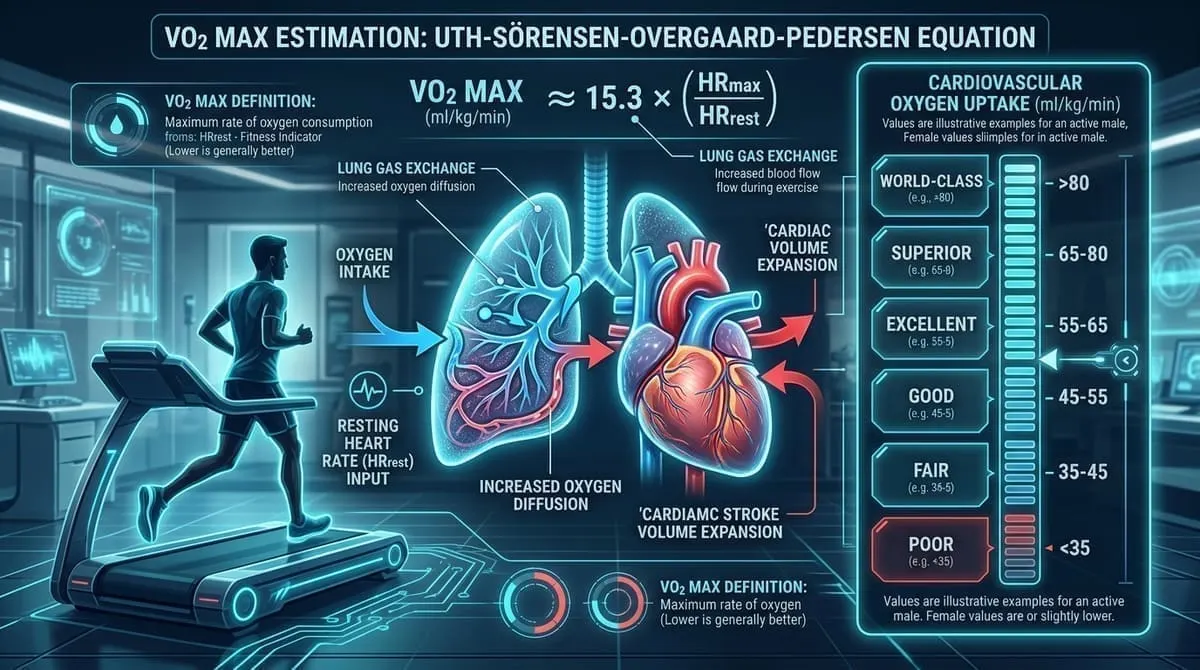
The solver applies the validated Uth-Sørensen-Overgaard-Pedersen Equation:
Step 1: Determine Maximum Heart Rate ()
- Measured Peak Heart Rate from a sprint stress test, OR
- Tanaka Formula: , OR
- Standard Formula:
Step 2: Measure Resting Heart Rate ()
Average resting pulse upon waking over 3 consecutive mornings.
Step 3: Compute Estimated
5. Fitness Norms & Longevity Matrix
The table below outlines age-adjusted standards and cardiorespiratory fitness classifications for men and women:
| Classification | Men (Age 20–39) | Men (Age 40–59) | Women (Age 20–39) | Women (Age 40–59) | Longevity & Health Status |
|---|---|---|---|---|---|
| Poor / Low | < 35 mL/kg/min | < 30 mL/kg/min | < 28 mL/kg/min | < 24 mL/kg/min | High risk of cardiovascular events; early fatigue on stairs. |
| Fair | 35 – 42 | 31 – 38 | 28 – 34 | 25 – 31 | Average sedentary population; basic functional reserve. |
| Good | 43 – 50 | 39 – 45 | 35 – 41 | 32 – 37 | Regular aerobic conditioning; low cardiovascular mortality. |
| Excellent | 51 – 58 | 46 – 52 | 42 – 48 | 38 – 44 | Top 10% fitness; high endurance, rapid heart rate recovery. |
| Superior | 59 – 68 | 53 – 62 | 49 – 56 | 45 – 52 | Competitive endurance athletes (marathoners, cyclists). |
| World-Class | > 70+ | > 63+ | > 60+ | > 54+ | Olympic cross-country skiers, Tour de France competitors. |
6. Step-by-Step Practical Calculations
Example 1: Active 30-Year-Old Marathon Runner
- Parameters: Age = 30 years, Measured , Resting Pulse .
- Step 1 (Heart Rate Ratio):
- Step 2 (Multiply by 15.3 Coefficient):
- Classification: Superior (Top 5% for age cohort).
Example 2: Sedentary 45-Year-Old Desk Professional
- Parameters: Age = 45 years, , Resting Pulse .
- Step 1: .
- Step 2: .
- Classification: Fair to Poor (Indicates substantial room for cardiovascular conditioning improvements).
7. Comparative World-Class Athletic Benchmarks
flowchart LR
    SED["Sedentary Adult (VO2 Max: 30 - 35)"] --> REC["Recreational Runner (VO2 Max: 45 - 52)"]
    REC --> ELITE["Elite Marathoner (VO2 Max: 70 - 78)"]
ELITE --> SKI["Olympic Nordic Skier (VO2 Max: 85 - 96) [Human Biological Peak]"]- Oskar Svendsen (Norwegian Cyclist): Highest recorded in medical literature: .
- Bjørn Dæhlie (8-time Olympic Cross-Country Ski Gold Medalist): .
- Kipchoge Keino & Eliud Kipchoge (Marathon Legends): .
- Joan Benoit Samuelson (Olympic Marathon Champion): .
8. Evidence-Based Protocols to Boost
To increase your , you must stimulate two distinct physiological adaptations: 1. Peripheral Capillarization & Mitochondrial Density (Zone 2 Base): 3 to 4 weekly sessions of 45–60 minutes at 65%–70% maximum heart rate. 2. Central Cardiac Stroke Volume Expansion (The Norwegian 4x4 HIIT Protocol): 4-minute interval at 90% to 95% of Maximum Heart Rate 3-minute active recovery walk/jog in Zone 1 (60%–65% HR) Repeat for 4 total intervals (performed 1–2 times per week) Clinical Outcome: The Norwegian 4x4 protocol increases by 8% to 12% in just 8 to 10 weeks.
9. Limitations & Boundary Considerations
- Cardiac Medications (Beta-Blockers): Medications that pharmacologically suppress resting pulse (such as Metoprolol or Atenolol) artificially inflate the calculated ratio. Use the 12-minute Cooper Run test or Rockport Walk test instead.
- Dehydration & Caffeine: Taking resting heart rate after consuming espresso or when dehydrated inflates resting pulse by 8–10 bpm, underestimating true aerobic capacity.
10. Frequently Asked Questions (FAQ)
- Why is resting heart rate such a powerful indicator of ?An aerobically conditioned heart has a large left ventricular internal chamber with thick muscular walls. It pumps more blood per contraction (high stroke volume, ~120–160 mL/beat vs 70 mL/beat in sedentary individuals), allowing the heart to beat significantly fewer times per minute at rest.
- Can you increase your at any age?Yes! While naturally declines by approximately 1% per year after age 30, structured endurance and interval training can improve aerobic capacity by 15% to 25% in adults in their 50s, 60s, and 70s.
- What is the difference between absolute and relative ?Absolute is measured in Liters of oxygen per minute (), which favors larger individuals (like rowers). Relative divides by body weight (), reflecting weight-bearing athletic efficiency (running and cycling).
11. Expert Recommendations & Summary
- Track Morning Resting Pulse: Use a smartwatch or pulse check on 3 consecutive mornings to establish an accurate resting baseline.
- Incorporate Polarized Cardio: Combine 80% easy Zone 2 aerobic volume with 20% high-intensity interval work (Norwegian 4x4).
- Prioritize for Longevity: Treat your as your primary biological age score and work to keep your score in the "Good" to "Excellent" bracket throughout life.
Additional Technical Guidelines & Measurement Standards
When conducting calculations for VO2 Max Estimation from Resting Heart Rate, maintaining quantitative precision and verifying input parameter boundaries is essential for reliable scenario evaluation. Always verify that raw numerical inputs are measured using standardized instrumentation, and double-check unit conversions prior to applying outputs in commercial, industrial, or academic projects.
For quantitative unit conversions and scientific calculations, always maintain at least four decimal places of precision during intermediate arithmetic stages before rounding final results. When preparing technical reports, laboratory documentation, or financial forecasts, cross-verify all output variables against established international measurement standards (such as SI, NIST, and ISO metric benchmarks) to guarantee consistent analytical rigor across all computational workflows.
MathsLover.com delivers this interactive solver 100% free of charge to foster global mathematical literacy, educational accessibility, and data-driven problem solving across scientific, technical, and academic communities worldwide.