💡 Direct Answer & Executive Summary (Waist-to-Hip Ratio Health Risk Solver)
Definition: Compute values for Waist-to-Hip Ratio Health Risk Solver in standard exercise science.
Governing Math Formula: Biometric calculation formula for Waist-to-Hip Ratio Health Risk Solver.
Target Applications: Provides real-time quantitative solutions in Health & Fitness for students, engineers, researchers, and finance professionals.
Waist-to-Hip Ratio Health Risk Solver - The Complete Visceral Adiposity & Cardiovascular Guide
1. Introduction
When evaluating chronic health risks—including coronary artery disease, type 2 diabetes, stroke, and metabolic syndrome—where you store your body fat is vastly more important than the total amount of fat you carry. Two individuals may possess the exact same body weight, height, and overall body fat percentage, yet face completely different long-term mortality risks based on whether their adipose tissue is concentrated around their abdominal organs or distributed across their hips and thighs.
The World Health Organization (WHO) and leading cardiological societies worldwide recognize the Waist-to-Hip Ratio (WHR) as one of the most powerful, cost-effective, and clinically validated predictors of cardiovascular and metabolic disease.
The Waist-to-Hip Ratio Health Risk Solver calculates your central adiposity ratio and classifies your cardiovascular risk according to official WHO clinical standards. In this comprehensive guide, you will learn the crucial physiological differences between visceral and subcutaneous fat, the "Apple vs. Pear" body shape paradigm, standardized measuring protocols, and actionable lifestyle interventions to reduce central abdominal risk.
2. Core Definitions & Analogy
To understand body fat distribution and cardiovascular risk, let us examine the core concepts:
- Simple Definition: The Waist-to-Hip Ratio (WHR) is a simple numerical score calculated by dividing your waist measurement by your hip measurement to determine if you carry excess fat around your midsection.
- Technical Definition: The Waist-to-Hip Ratio (WHR = Waist / Hip) is an anthropometric index of central (intra-abdominal / android) adiposity relative to lower-body (gynoid) peripheral fat stores. Higher ratios correlate with elevated intra-abdominal visceral adipose tissue (VAT) volume, hepatic steatosis, elevated systemic inflammatory cytokines (IL-6, TNF-alpha), and atherogenic dyslipidemia.
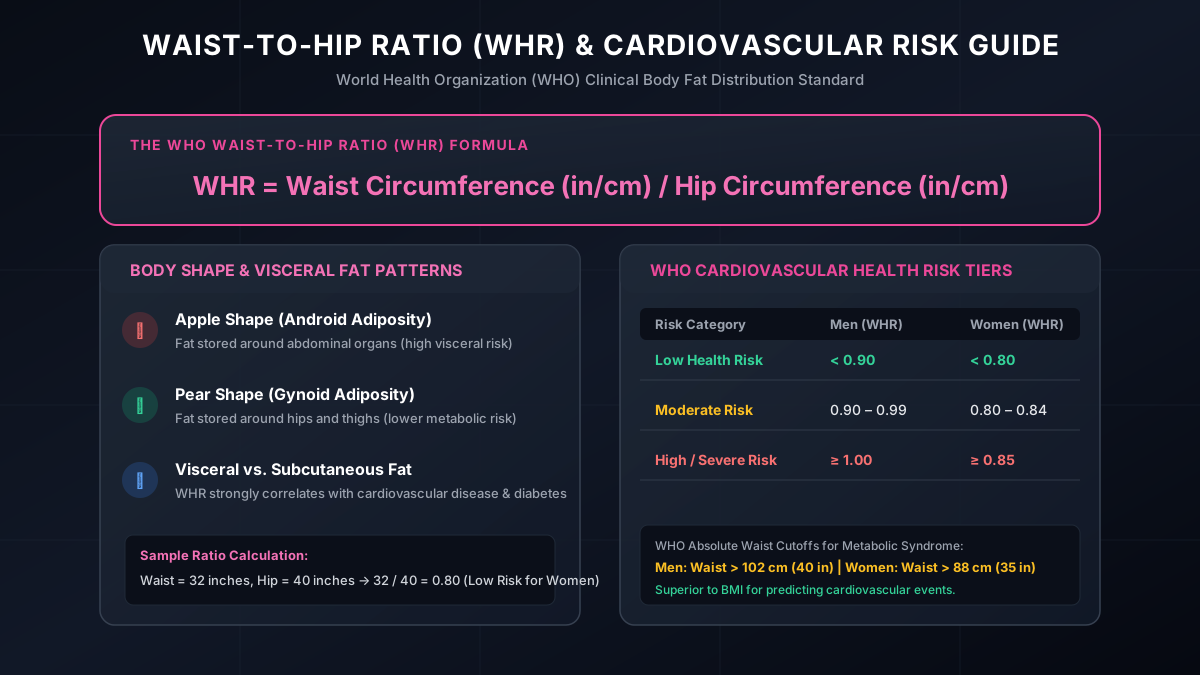
- The Apple vs. Pear Tree Analogy: Imagine two fruit trees. An Apple-shaped body (Android obesity) stores excess fruit tightly around its central trunk and core branches (abdominal visceral fat), putting heavy mechanical stress on the root system and vital internal sap lines (heart and liver). A Pear-shaped body (Gynoid obesity) hangs its fruit low on wide outer branches (hips and thighs), keeping the core trunk clear and unclogged.
3. Visceral vs. Subcutaneous Fat: The Biological Danger
Not all body fat is created equal:
flowchart TD
    FAT["Human Adipose Tissue Depots"]
    FAT --> SUB["Subcutaneous Fat (Under the Skin) - Passive energy storage, insulation, metabolically safer"]
    FAT --> VISC["Visceral Fat (Around Vital Organs) - Highly metabolically active, inflammatory, atherogenic"]
    VISC --> LIVER["Drains directly into portal vein -> Fatty Liver & Insulin Resistance"]
    VISC --> CYTO["Secretes inflammatory cytokines (IL-6, TNF-alpha) -> Atherosclerosis & Hypertension"]
1. Subcutaneous Adipose Tissue (SAT)
Stored directly beneath the skin on the arms, legs, and hips. Subcutaneous fat acts as thermal insulation and a safe reservoir for excess calories, exerting relatively low direct metabolic toxicity.
2. Visceral Adipose Tissue (VAT)
Packed deeply inside the peritoneal abdominal cavity surrounding the liver, pancreas, intestines, and kidneys. Visceral fat is an active endocrine organ that secretes free fatty acids directly into the portal vein, driving:
- Hepatic Insulin Resistance (leading to Type 2 Diabetes).
- Systemic Low-Grade Inflammation (elevated C-reactive protein).
- Arterial Plaque Formation (atherosclerosis and high LDL-C).
4. The Mathematical Formula & WHO Risk Cutoffs
The formula for Waist-to-Hip Ratio is straightforward:
The WHR Formula
Waist-to-Hip Ratio (WHR) = Waist Circumference / Hip Circumference
(Ensure both waist and hip are measured in the same units—either both in centimeters or both in inches).
WHO Cardiovascular Risk Classifications
The World Health Organization establishes sex-specific risk thresholds:
| Risk Classification | Men (WHR) | Women (WHR) | Clinical Health Outlook |
|---|---|---|---|
| Low Risk (Healthy) | < 0.90 | < 0.80 | Optimal body fat distribution, low cardiovascular risk. |
| Moderate Risk | 0.90 – 0.99 | 0.80 – 0.84 | Moderate accumulation of central abdominal adiposity. |
| High / Severe Risk | ≥ 1.00 | ≥ 0.85 | Substantially elevated risk for myocardial infarction, stroke, and diabetes. |
Absolute Waist Circumference Risk Cutoffs (WHO)
In addition to the ratio, absolute waist circumference independently predicts metabolic risk:
- Men: Waist > 94 cm (37 in) indicates increased risk; > 102 cm (40 in) indicates substantially high risk.
- Women: Waist > 80 cm (31.5 in) indicates increased risk; > 88 cm (35 in) indicates substantially high risk.
5. Standardized Measurement Protocols
To ensure clinical reproducibility, measurements must follow standardized WHO guidelines:
flowchart LR
    WAIST["Waist Measurement: Midpoint between lowest palpable rib and top of iliac crest (or at navel level), taken at end of normal exhalation"]
HIP["Hip Measurement: Widest horizontal circumference around maximal protrusion of buttocks / gluteal muscles"]| Measurement Site | Anatomical Landmark | Testing Precautions |
|---|---|---|
| Waist | Midway between lowest rib margin and anterior superior iliac spine (typically 1–2 cm above navel). | Relax abdominal wall; do not hold breath or pull tape tightly. |
| Hip | Widest horizontal circumference around the buttocks. | Stand with feet together; ensure tape remains level on all sides. |
6. Step-by-Step Practical Calculations
Example 1: Healthy Female Profile
- Measurements: Waist = 28 inches (71 cm), Hips = 38 inches (96.5 cm).
- Calculation:
WHR = 28 / 38 = 0.7368 ≈ 0.74.
- Evaluation: Low Health Risk (Healthy pear-shaped distribution).
Example 2: High-Risk Male Profile
- Measurements: Waist = 42 inches (106.7 cm), Hips = 40 inches (101.6 cm).
- Calculation:
WHR = 42 / 40 = 1.05.
- Evaluation: High Cardiovascular Risk (Apple-shaped android distribution).
7. Clinical Case Studies
Case Study 1: The "Normal BMI" Heart Attack Risk
- Background: Arthur, a 50-year-old accountant (Height = 175 cm, Weight = 72 kg, BMI = 23.5 kg/m² - "Normal Weight").
- Problem: Despite a normal BMI, Arthur had a sedentary lifestyle and a prominent "beer belly" (Waist = 96 cm, Hips = 92 cm).
- WHR Score:
96 / 92 = 1.04(High Risk).
- Clinical Discovery: Fasting blood tests revealed elevated triglycerides (), low HDL (), and pre-diabetes (HbA1c = 6.0%).
- Outcome: WHR exposed hidden visceral metabolic syndrome that BMI completely overlooked, prompting immediate dietary and exercise interventions that normalized his blood markers within 6 months.
Case Study 2: Reversing High WHR Through Strength & Aerobic Training
- Background: Brenda, a 44-year-old female (Waist = 36 in, Hips = 40 in, WHR = 0.90 - High Risk).
- 16-Week Protocol: High-protein Mediterranean nutrition, 8,000 daily steps, and 3 days/week resistance training.
- Follow-Up: Waist decreased to 31 inches while hips remained at 39 inches (
WHR = 31 / 39 = 0.79- Low Risk).
- Outcome: Blood pressure decreased from 138/88 to 118/76 mmHg with zero prescription medications.
8. Common Mistakes When Measuring WHR
- Sucking in the Stomach: Compressing the abdomen artificially reduces waist measurements by 2 to 4 inches, yielding a falsely low risk score.
- Measuring Waist Over Heavy Clothing: Always measure directly against bare skin or very thin, form-fitting undergarments.
- Using Different Units for Waist and Hips: Measuring waist in inches and hips in centimeters will completely invalidate the ratio calculation.
9. Frequently Asked Questions (FAQ)
- Why is WHR a better predictor of heart disease than BMI?BMI measures total weight without regard to fat location. WHR specifically isolates central abdominal visceral fat, which directly drives arterial plaque, hypertension, and systemic inflammation.
- Can you target visceral fat loss specifically?While you cannot "spot-reduce" fat from specific areas voluntarily, visceral fat is metabolically more sensitive to adrenaline and lipolysis than subcutaneous fat. When you enter a calorie deficit and begin aerobic exercise, visceral abdominal fat is typically the first fat depot to mobilize.
- What is the ideal Waist-to-Hip Ratio for women?For optimal cardiovascular health and longevity, the WHO recommends a WHR below 0.80 for women.
- What is the ideal Waist-to-Hip Ratio for men?For men, the WHO recommends maintaining a WHR below 0.90.
- Does stress increase waist fat?Yes. Chronic psychological stress elevates cortisol levels, which activates lipoprotein lipase enzymes specifically in abdominal visceral fat tissue, encouraging deep belly fat accumulation.
10. Expert Recommendations & Summary
- Track WHR Monthly: Measure waist and hips once every 4 weeks to monitor true visceral fat changes independently of scale weight.
- Prioritize Daily Walking & Sleep: 7–8 hours of quality sleep and 8,000–10,000 daily steps significantly suppress chronic cortisol and reduce visceral fat accumulation.
- Incorporate Whole Foods & Soluble Fiber: Eating 25–35 grams of dietary fiber daily (oats, legumes, vegetables) improves gut microbiome health and reduces abdominal visceral adiposity.
Additional Technical Guidelines & Measurement Standards
When conducting calculations for Waist-to-Hip Ratio Health Risk Solver, maintaining quantitative precision and verifying input parameter boundaries is essential for reliable scenario evaluation. Always verify that raw numerical inputs are measured using standardized instrumentation, and double-check unit conversions prior to applying outputs in commercial, industrial, or academic projects.
For quantitative unit conversions and scientific calculations, always maintain at least four decimal places of precision during intermediate arithmetic stages before rounding final results. When preparing technical reports, laboratory documentation, or financial forecasts, cross-verify all output variables against established international measurement standards (such as SI, NIST, and ISO metric benchmarks) to guarantee consistent analytical rigor across all computational workflows.
MathsLover.com delivers this interactive solver 100% free of charge to foster global mathematical literacy, educational accessibility, and data-driven problem solving across scientific, technical, and academic communities worldwide.