💡 Direct Answer & Executive Summary (Area of Rectangle Calculator)
Definition: Calculate surface area, perimeter, and diagonal length of a rectangle given length and width.
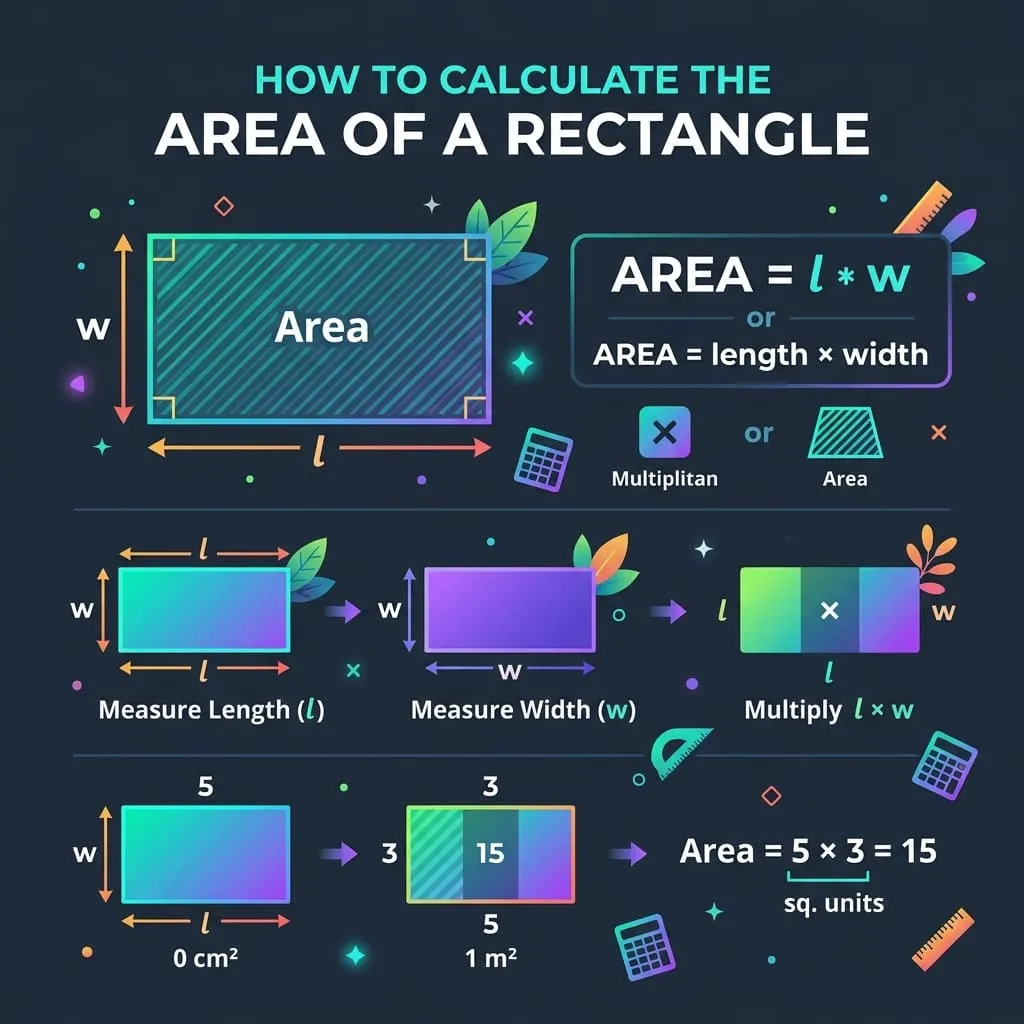
Governing Math Formula: Area = Length × Width (A = l × w). Perimeter = 2(l + w). Diagonal = √(l² + w²).
Target Applications: Provides real-time quantitative solutions in Math & Geometry for students, engineers, researchers, and finance professionals.
Area of Rectangle Calculator
1. Introduction
In geometry and daily life, the rectangle is one of the most common two-dimensional shapes. From the floor plans of our homes and the screens of our smartphones to standard sheets of paper and sports fields, rectangular shapes are everywhere.
Measuring the size of these shapes requires calculating their surface area, boundary perimeter, and diagonal length. Understanding these spatial measurements is essential for construction planning, material estimation, and design layouts.
The Area of Rectangle Calculator is an educational tool designed to solve these measurements. By entering your rectangle's length and width, you can instantly estimate its surface area, perimeter, and diagonal length.
This guide provides a comprehensive overview of rectangular geometry, formula derivations, manual calculation guidelines, and real-world spatial planning.
graph TD
    A["Rectangle Length (l)"] --> C["Area: l * w"]
    B["Rectangle Width (w)"] --> C
    A --> D["Perimeter: 2 * (l + w)"]
    B --> D
    A --> E["Diagonal: sqrt(l^2 + w^2)"]
    B --> E
    C --> F["Results: Area, Perimeter, Diagonal"]
    D --> F
    E --> F
2. Core Definitions & Analogy
To build a solid geometric foundation, let us define a rectangle and its parameters in both simple and technical terms:
- Simple Definition: A rectangle is a four-sided shape where every corner is a right angle (90 degrees). The area is the amount of flat space inside the boundaries of the shape.
- Technical Definition: A rectangle is a quadrilateral in the Euclidean plane with four right angles. Opposite sides are parallel and equal in length. The area (A) is the product of its length (l) and width (w), expressed as A = l * w.
- Conceptual Analogy: Think of a rectangle like a tiled floor. The length is the number of tiles in each row, and the width is the number of rows. Multiplying the length by the width tells you exactly how many square tiles are needed to cover the entire floor.
3. History & Milestones
The geometry of rectangles was standardized by ancient civilizations for land surveying and architecture:
- Ancient Egyptian Land Surveyors (c. 2000 BC): Known as "rope-stretchers," these surveyors used knotted ropes to lay out rectangular farming plots along the Nile River after annual floods.
- Euclidean Geometry (c. 300 BC): Greek mathematician Euclid published "Elements," formalizing the geometric proofs and properties of quadrilaterals that form the basis of modern geometry.
4. Core Concepts & Parameters
To calculate rectangular dimensions, you must understand two key parameters:
- Length (l): The measurement of the longer side of the rectangle.
- Width (w): The measurement of the shorter side of the rectangle.
5. The Mathematical Model & Formula
The dimensions of a rectangle are calculated using three standard geometric equations:
1. Area Formula
Area = Length * Width
2. Perimeter Formula
Perimeter = 2 * ( Length + Width )
3. Diagonal Length Formula
Diagonal = sqrt( Length^2 + Width^2 )
Variable Breakdown:
- Length (l): Horizontal dimension (Units, default l = 8)
- Width (w): Vertical dimension (Units, default w = 5)
6. Step-by-Step Manual Procedure
Let us walk through a manual calculation using our default calculator values:
- Identify the variables:
Length (l) = 8Width (w) = 5 - Calculate the Area: Multiply length by width.
Area = 8 * 5 = 40.00The surface area is 40.00 square units. - Calculate the Perimeter: Add length and width, then multiply by 2.
Perimeter = 2 * (8 + 5) = 2 * 13 = 26.00The perimeter is 26.00 linear units. - Calculate the Diagonal Length: Square both sides, add them, and find the square root.
l^2 + w^2 = 8^2 + 5^2 = 64 + 25 = 89Diagonal = sqrt(89) = 9.434The diagonal length is 9.434 units.
7. Visual Diagram
The flowchart below displays the computation path for rectangular measurements:
graph TD
    Start["Enter Length (l) & Width (w)"] --> CalcArea["Compute Area: l * w"]
    Start --> CalcPerim["Compute Perimeter: 2 * (l + w)"]
    Start --> CalcDiag["Compute Diagonal: sqrt(l^2 + w^2)"]
    CalcArea --> Display["Output: Area, Perimeter, and Diagonal"]
    CalcPerim --> Display
    CalcDiag --> Display
8. Parameter Comparison Matrix
The table below shows how changing the width affects the dimensions of a rectangle with a constant length of 8 units:
| Length (l) | Width (w) | Rectangle Area | Perimeter | Diagonal Length | Shape Classification |
|---|---|---|---|---|---|
| 8 | 1 | 8.0000 | 18.0000 | 8.0623 | Narrow Ribbon |
| 8 | 3 | 24.0000 | 22.0000 | 8.5440 | Oblong |
| 8 (Default) | 5 (Default) | 40.0000 | 26.0000 | 9.4340 | Standard Rectangle |
| 8 | 8 | 64.0000 | 32.0000 | 11.3137 | Square (Equilateral Rectangle) |
| 8 | 12 | 96.0000 | 40.0000 | 14.4222 | Tall Rectangle |
9. Real-World Applications
Rectangular calculations are utilized daily across several fields:
- Construction & Carpentry: Builders calculate floor areas to purchase timber, tiles, or carpet, and measure diagonals to verify that corner angles are square.
- Shipping & Packaging: Logistics teams calculate the footprint of rectangular shipping boxes to optimize warehouse layouts.
- Land Management: Real estate agents calculate property boundary perimeters to install fences and estimate acreage.
10. Case Studies
Case Study 1: Tiling a Rectangular Living Room
A homeowner wants to install ceramic tiles in a living room measuring 8 meters long and 5 meters wide.
- Area calculation: 8 * 5 = 40 square meters.
- Outcome: The homeowner purchases 40 square meters of tiles (plus a 10% buffer for cuts), ensuring they have enough material to complete the floor.
Case Study 2: Squaring a Concrete Form
A concrete contractor builds a rectangular wooden frame for a home driveway. The blueprint specifies a length of 8 meters and a width of 5 meters.
- Verification: To ensure the corners are exactly 90 degrees (perfectly square), the contractor measures the diagonal distance across opposite corners.
- Calculation: Diagonal = sqrt(8^2 + 5^2) = 9.434 meters.
- Outcome: The contractor adjusts the wooden frame until the tape measure reads exactly 9.434 meters across the diagonals, verifying a square frame.
11. Advantages of Using the Tool
- Saves Time: Instantly calculates multiple dimensions.
- Prevents Errors: Automatically solves square roots for diagonals.
- Supports Material Estimations: Easily estimates perimeter fences and floor areas.
12. Limitations & Boundary Conditions
This calculator is designed for flat, two-dimensional rectangles. For three-dimensional rectangular boxes (prisms), you must calculate surface area and volume, which require a depth parameter.
13. Common Mistakes
- Confusing Area and Perimeter: Purchasing fencing material based on the area calculation, or flooring material based on the perimeter calculation.
- Using Inconsistent Units: Multiplying length in feet by width in inches. Always convert all inputs to the same unit (e.g. converting inches to feet) before calculating.
12. Frequently Asked Questions
Q1: What is the formula for the area of a rectangle?
The formula is Area = Length * Width.
Q2: What is the formula for the perimeter of a rectangle?
The formula is Perimeter = 2 * (Length + Width).
Q3: How do you find the diagonal of a rectangle?
Using the Pythagorean theorem: Diagonal = sqrt(Length^2 + Width^2).
Q4: Is a square a rectangle?
Yes. A square is a special type of rectangle where all four sides are equal in length.
Q5: Can length and width be equal?
Yes. If length and width are equal, the rectangle is a square.
Q6: What units are used for area?
Area is always expressed in square units (e.g. square meters, square feet, square inches).
Q7: What units are used for perimeter?
Perimeter is expressed in linear units (e.g. meters, feet, inches).
Q8: How does doubling the length affect the area?
Doubling either the length or the width will double the area of the rectangle.
Q9: Does a diagonal split a rectangle into triangles?
Yes. A diagonal splits a rectangle into two identical right-angled triangles.
Q10: How do you verify if a rectangle's corners are square?
By measuring both diagonals. If the diagonals are equal, the corners are square.
15. Expert Tips
- Measure twice: When estimating materials for home improvements, measure the length and width at multiple points to account for walls that are not perfectly straight.
- Add a waste buffer: When buying flooring or tiling, add 10% to your calculated area to cover cuts and mistakes.
16. Summary
- The area of a rectangle is
Length * Width.
- The perimeter is
2 * (Length + Width).
- The diagonal is
sqrt(Length^2 + Width^2).
- All units must be consistent before calculating.
Additional Technical Guidelines & Measurement Standards
When conducting calculations for Area of Rectangle Calculator, maintaining quantitative precision and verifying input parameter boundaries is essential for reliable scenario evaluation. Always verify that raw numerical inputs are measured using standardized instrumentation, and double-check unit conversions prior to applying outputs in commercial, industrial, or academic projects.
For quantitative unit conversions and scientific calculations, always maintain at least four decimal places of precision during intermediate arithmetic stages before rounding final results. When preparing technical reports, laboratory documentation, or financial forecasts, cross-verify all output variables against established international measurement standards (such as SI, NIST, and ISO metric benchmarks) to guarantee consistent analytical rigor across all computational workflows.
MathsLover.com delivers this interactive solver 100% free of charge to foster global mathematical literacy, educational accessibility, and data-driven problem solving across scientific, technical, and academic communities worldwide.