💡 Direct Answer & Executive Summary (Area of Equilateral Triangle Calculator)
Definition: Calculate area, height, and perimeter of an equilateral triangle with 3 equal sides.
Governing Math Formula: Area = (√3 / 4) × a², Height = (√3 / 2) × a.
Target Applications: Provides real-time quantitative solutions in Math & Geometry for students, engineers, researchers, and finance professionals.
Area of Equilateral Triangle Calculator
1. Introduction
In geometry, symmetry represents the highest standard of balance. The most symmetrical of all three-sided shapes is the equilateral triangle. Featuring three equal sides and three equal angles of 60 degrees, the equilateral triangle is a fundamental element in geometry, art, and structural engineering.
Calculating the dimensions of an equilateral triangle—such as its area, height, and perimeter—is a common task in engineering and design. Because of its symmetry, you can solve all these dimensions using only a single parameter: the side length.
The Area of Equilateral Triangle Calculator is an educational tool designed to solve these measurements. By entering your triangle's side length, you can instantly estimate its surface area and height.
This guide provides a comprehensive overview of equilateral geometry, formula derivations, manual calculation guidelines, and structural design applications.
graph TD
    A["Side Length (a)"] --> C["Area: (sqrt(3) / 4) * a^2"]
    A --> D["Height: (sqrt(3) / 2) * a"]
    C --> E["Results: Area & Height"]
    D --> E
2. Core Definitions & Analogy
To build a solid geometric foundation, let us define an equilateral triangle in both simple and technical terms:
- Simple Definition: An equilateral triangle is a three-sided shape where all three sides are the exact same length, and all three corners are equal angles of 60 degrees.
- Technical Definition: An equilateral triangle is a regular polygon of three sides. The interior angles are congruent and measure exactly 60 degrees (π/3 radians). The area (A) is resolved as A = (sqrt(3) / 4) a², and the height (h) is resolved as h = (sqrt(3) / 2) a, where a is the side length.
- Conceptual Analogy: Think of an equilateral triangle like a perfectly balanced three-way junction. If three people start at the center and walk in opposite directions at equal angles, they form a perfect equilateral triangle. Because the paths are symmetrical, the shape is balanced, allowing you to calculate the spacing between everyone using only their walking distance (side length).
3. History & Milestones
The geometry of equilateral triangles has served as a design anchor for millennia:
- Ancient Monument Design (c. 2500 BC): Egyptian and Mayan architects used equilateral triangles to establish coordinates when building pyramids and temple structures.
- Euclidean Geometry (c. 300 BC): In Proposition 1 of Book 1 of Euclid's "Elements," he demonstrated how to construct a perfect equilateral triangle using a compass and straightedge, proving its fundamental role in geometry.
- The Sierpinski Gasket (1915): The Polish mathematician Waclaw Sierpinski introduced a famous fractal pattern created by repeatedly removing smaller equilateral triangles from a starting equilateral triangle.
4. Core Concepts & Parameters
To calculate equilateral dimensions, you must understand two key parameters:
- Side Length (a): The length of any of the three equal sides of the triangle.
- Square Root of Three (sqrt(3)): An irrational mathematical constant approximately equal to 1.73205, which appears in all equilateral calculations due to their 60-degree angles.
5. The Mathematical Model & Formula
The dimensions of an equilateral triangle are calculated using two standard geometric equations:
1. Area Formula
Area = ( sqrt(3) / 4 ) * Side^2
2. Height Formula
Height = ( sqrt(3) / 2 ) * Side
Variable Breakdown:
- Side (a): Length of any of the three equal sides (Units, default a = 6)
- Constant (sqrt(3)): Square root of 3 (value ≈ 1.7320508)
6. Step-by-Step Manual Procedure
Let us walk through a manual calculation using our default calculator values:
- Identify the variables:
Side Length (a) = 6 - Calculate the Height (h): Multiply the side by (sqrt(3) / 2).
Height = (1.73205 / 2) * 6 = 0.866025 * 6 ≈ 5.1962The height is 5.1962 units. - Calculate the Area: Square the side, then multiply by (sqrt(3) / 4).
a^2 = 6 * 6 = 36Area = (1.73205 / 4) * 36 = 0.4330127 * 36 ≈ 15.5885The surface area is 15.5885 square units.
7. Visual Diagram
The flowchart below displays the computation path for equilateral dimensions:
graph TD
    Start["Enter Side Length (a)"] --> CalcHeight["Compute Height: (sqrt(3)/2) * a"]
    Start --> CalcArea["Compute Area: (sqrt(3)/4) * a^2"]
    CalcHeight --> Display["Output: Area & Height"]
    CalcArea --> Display
8. Parameter Comparison Matrix
The table below shows how the side length affects the area and height of an equilateral triangle:
| Side Length (a) | Triangle Area | Height (h) | Perimeter | Scale Multiplier |
|---|---|---|---|---|
| 1 | 0.4330 | 0.8660 | 3.0000 | Unit Equilateral Triangle |
| 3 | 3.8971 | 2.5981 | 9.0000 | 3x Scale |
| 6 (Default) | 15.5885 | 5.1962 | 18.0000 | 6x Scale |
| 10 | 43.3013 | 8.6603 | 30.0000 | 10x Scale |
| 12 | 62.3538 | 10.3923 | 36.0000 | 12x Scale (Area grows 4x from default) |
9. Real-World Applications
Equilateral calculations are essential across many practical fields:
- Structural Truss Engineering: Bridge builders and roof truss designers use networks of equilateral triangles to distribute structural weight evenly.
- Geodesic Dome Construction: Engineers calculate equilateral coordinates to build geodesic dome roofs and greenhouses.
- Tile & Pattern Design: Interior designers calculate tiling requirements for hexagonal and triangular mosaic patterns.
10. Case Studies
Case Study 1: Designing a Geodesic Dome Panel
A construction engineer is pre-fabricating wooden panels for a geodesic dome roof. Each panel must be a perfect equilateral triangle with a side length of 6 meters.
- Area calculation: (sqrt(3) / 4) * 6^2 = 15.5885 square meters.
- Outcome: Each panel has a surface area of 15.5885 square meters, allowing the engineer to calculate the total timber required to build the dome.
Case Study 2: Sizing a Triangular Highway Sign
A highway department manufactures warning signs that are equilateral triangles. The sign design requires a height of at least 5 meters. The team tests a side length of 6 meters.
- Height calculation: (sqrt(3) / 2) * 6 = 5.1962 meters.
- Outcome: Since the height (5.1962 meters) exceeds the 5-meter safety requirement, the 6-meter side length is approved for production.
11. Advantages of Using the Tool
- Single Parameter Simplicity: Solves all dimensions using only the side length.
- Saves Time: Instantly calculates both height and area.
- High Precision: Uses exact radical constants to prevent rounding errors.
12. Limitations & Boundary Conditions
This calculator assumes all three sides are equal. If your triangle has sides of different lengths (isosceles or scalene), you must use the standard base and height calculator or Heron's formula calculator instead.
13. Common Mistakes
- Confusing Height with Side Length: Assuming the height of the triangle is the same as the slanted side length. Always use the height formula
(sqrt(3) / 2) * Side.
- Forgetting to Square the Side: Multiplying the side by the radical constant without squaring it when calculating the area.
12. Frequently Asked Questions
Q1: What is an equilateral triangle?
A triangle where all three sides are equal in length, and all three interior angles are exactly 60 degrees.
Q2: What is the formula for the area of an equilateral triangle?
The formula is Area = (sqrt(3) / 4) * Side^2.
Q3: What is the formula for the height of an equilateral triangle?
The formula is Height = (sqrt(3) / 2) * Side.
Q4: Why is the square root of 3 used in the formulas?
It is derived from the Pythagorean theorem when you split an equilateral triangle into two identical 30-60-90 right triangles.
Q5: How is the perimeter of an equilateral triangle calculated?
Multiply the side length by 3: Perimeter = 3 * Side.
Q6: What is the value of the square root of 3?
sqrt(3) is approximately equal to 1.73205.
Q7: Can I use the standard 0.5 * base * height formula?
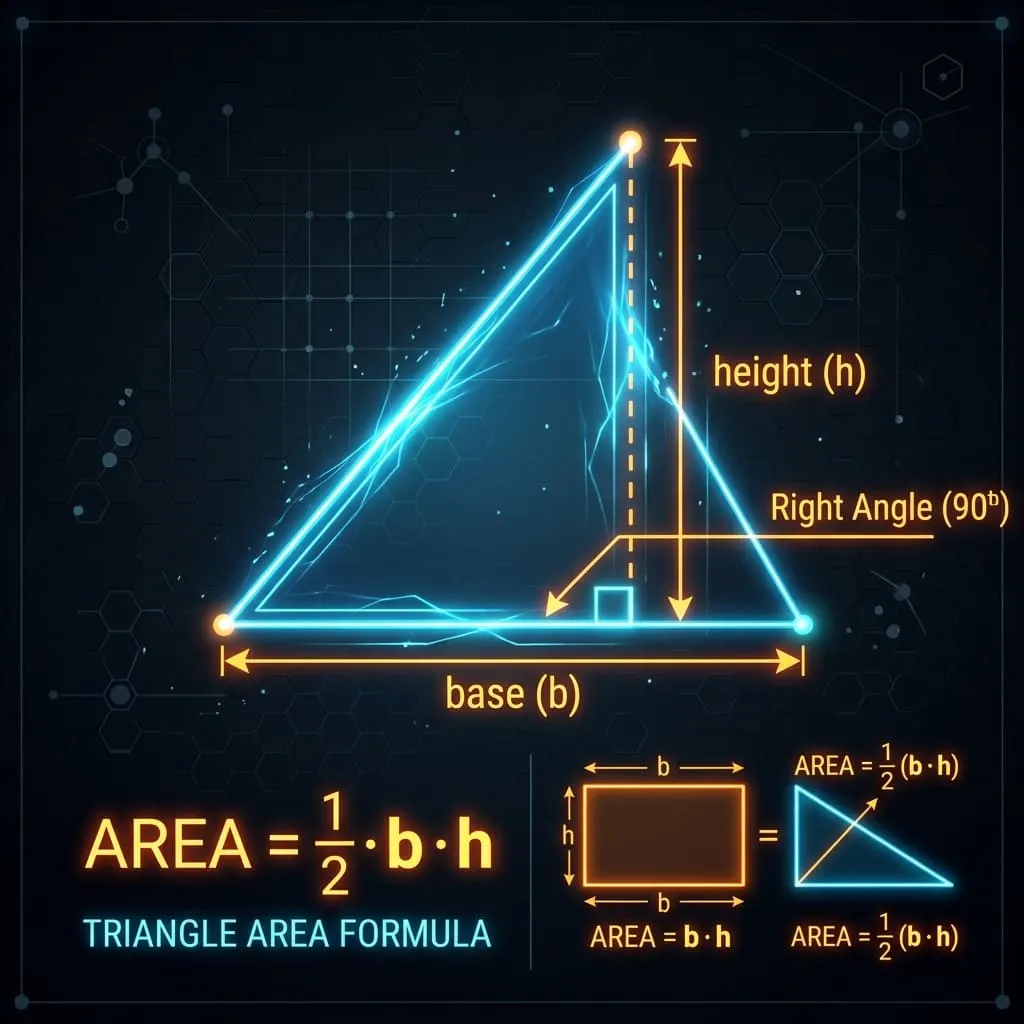
Yes. If you know the height, the standard formula yields the exact same result: 0.5 * Side * Height.
Q8: What units are used for equilateral area?
Area is expressed in square units (e.g. square meters, square feet).
Q9: Does a taller equilateral triangle always have a larger area?
Yes. Since the height is directly proportional to the side length, increasing the height increases the area.
Q10: What is the ratio of height to side length?
The ratio is always sqrt(3) / 2, which is approximately 0.866.
15. Expert Tips
- Remember the 0.866 ratio: To quickly estimate the height of an equilateral triangle mentally, multiply the side length by 0.866.
- Use radical constants: Keep the
sqrt(3)term in your calculations as long as possible when working manually to avoid rounding errors.
16. Summary
- Equilateral triangles have 3 equal sides and 3 equal 60-degree angles.
- The area formula is
(sqrt(3) / 4) * Side^2.
- The height formula is
(sqrt(3) / 2) * Side.
- All calculations are solved using only the side length.
Additional Technical Guidelines & Measurement Standards
When conducting calculations for Area of Equilateral Triangle Calculator, maintaining quantitative precision and verifying input parameter boundaries is essential for reliable scenario evaluation. Always verify that raw numerical inputs are measured using standardized instrumentation, and double-check unit conversions prior to applying outputs in commercial, industrial, or academic projects.
For quantitative unit conversions and scientific calculations, always maintain at least four decimal places of precision during intermediate arithmetic stages before rounding final results. When preparing technical reports, laboratory documentation, or financial forecasts, cross-verify all output variables against established international measurement standards (such as SI, NIST, and ISO metric benchmarks) to guarantee consistent analytical rigor across all computational workflows.
MathsLover.com delivers this interactive solver 100% free of charge to foster global mathematical literacy, educational accessibility, and data-driven problem solving across scientific, technical, and academic communities worldwide.