💡 Direct Answer & Executive Summary (Area of Triangle (Heron's 3-Sides Formula))
Definition: Calculate triangle area when three side lengths (a, b, c) are known using Heron's formula.
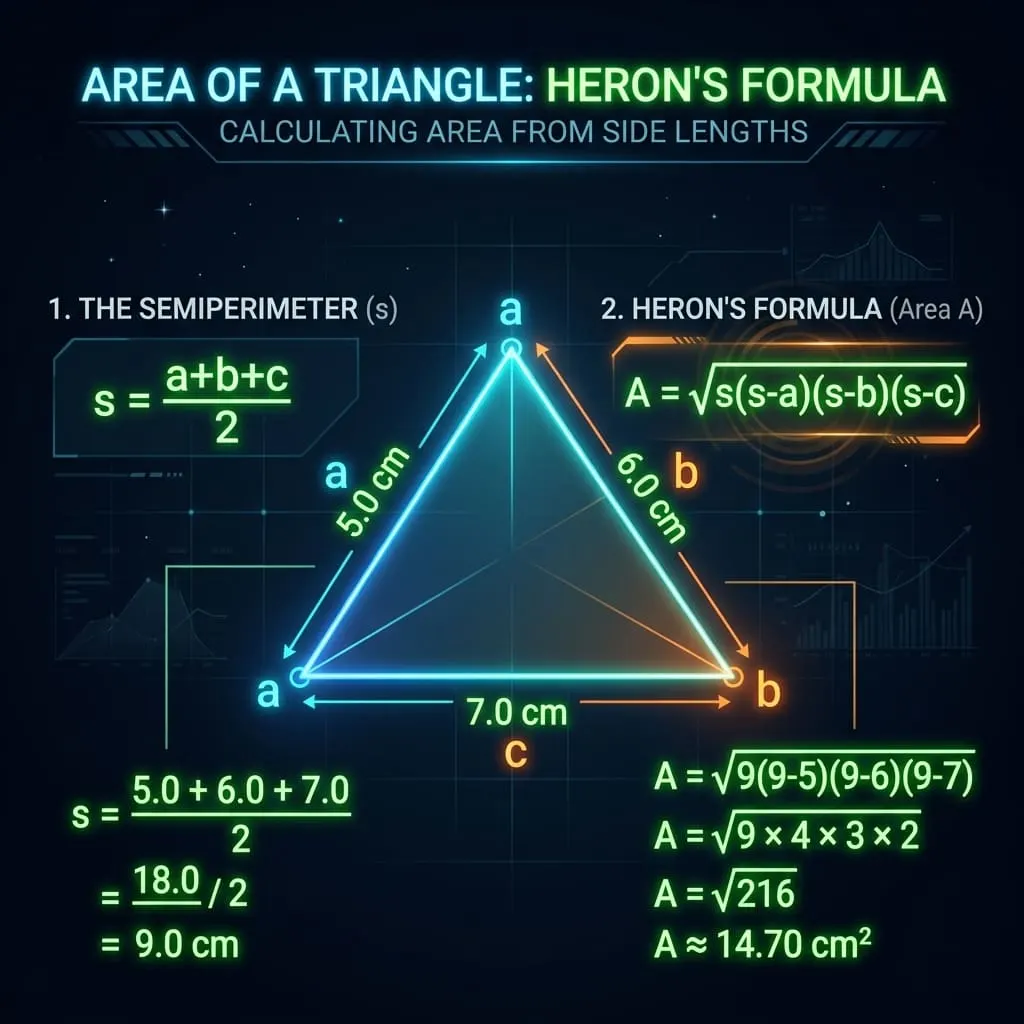
Governing Math Formula: Semi-perimeter s = (a + b + c) / 2. Area = √(s(s - a)(s - b)(s - c)).
Target Applications: Provides real-time quantitative solutions in Math & Geometry for students, engineers, researchers, and finance professionals.
Area of Triangle (Heron's 3-Sides Formula)
1. Introduction
When measuring real estate plots, designing fabric patterns, or surveying land, you often need to calculate the area of a triangle. However, in many real-world scenarios, the perpendicular height of the triangle is unknown and difficult to measure directly.
Instead, you can easily measure the lengths of the three outer sides. To solve for the area using only the three side lengths, mathematicians use a classic geometric formula known as Heron's Formula.
The Area of Triangle (Heron's 3-Sides Formula) Calculator is an educational tool designed to solve this measurement. By entering your triangle's three side lengths, you can instantly estimate its surface area and perimeter.
This guide provides a comprehensive overview of Heron's formula, semi-perimeters, manual calculation guidelines, and land surveying applications.
graph TD
    A["Side Length a"] --> D["Calculate Semi-Perimeter: s = (a + b + c) / 2"]
    B["Side Length b"] --> D
    C["Side Length c"] --> D
    D --> E["Calculate Area: sqrt(s * (s - a) * (s - b) * (s - c))"]
    E --> F["Results: Triangle Area & Perimeter"]
2. Core Definitions & Analogy
To build a solid geometric foundation, let us define Heron's formula and its parameters in both simple and technical terms:
- Simple Definition: Heron's formula is a mathematical rule that allows you to calculate the area of a triangle using only the lengths of its three sides, without needing to know the height.
- Technical Definition: Heron's formula calculates the area (A) of a triangle with side lengths a, b, and c. It uses the semi-perimeter (s), which is half the perimeter, expressed as A = sqrt( s (s - a) (s - b) * (s - c) ), where s = (a + b + c) / 2.
- Conceptual Analogy: Think of the semi-perimeter like a flexible string that matches half the perimeter of your triangle. The formula works by wrapping this string around each corner of the triangle, measuring how much extra string remains at each side, and multiplying these clearances together to estimate the interior surface area.
3. History & Milestones
The discovery of Heron's formula is a landmark in classical mathematics:
- Hero of Alexandria (c. 10–70 AD): The Greek mathematician and engineer Hero (or Heron) published the first recorded proof of the formula in his book "Metrica," showing how to calculate areas of triangles and polygons.
- Archimedes' Earlier Proof: Modern historians believe that Archimedes may have discovered the formula centuries earlier, but Hero's publication popularized the method across the ancient world.
4. Core Concepts & Parameters
To calculate dimensions using Heron's formula, you must understand four key parameters:
- Side Lengths (a, b, c): The lengths of the three outer edges of the triangle.
- Semi-Perimeter (s): Half of the triangle's perimeter (the boundary length).
- Triangle Inequality Theorem: A rule stating that the sum of the lengths of any two sides of a triangle must be strictly greater than the length of the third side. If this rule is violated (e.g. side lengths 1, 2, and 5), the sides cannot connect, and no triangle can exist.
5. The Mathematical Model & Formula
The calculations for Heron's formula are solved using two standard geometric equations:
1. Semi-Perimeter Formula
s = ( a + b + c ) / 2
2. Area Formula (Heron's Equation)
Area = sqrt( s * (s - a) * (s - b) * (s - c) )
Variable Breakdown:
- Side a: Length of first edge (Units, default a = 7)
- Side b: Length of second edge (Units, default b = 8)
- Side c: Length of third edge (Units, default c = 9)
6. Step-by-Step Manual Procedure
Let us walk through a manual calculation using our default calculator values:
- Identify the variables:
a = 7,b = 8,c = 9 - Verify the Triangle Inequality:
7 + 8 = 15 > 9(Pass)7 + 9 = 16 > 8(Pass)8 + 9 = 17 > 7(Pass)The sides form a valid triangle. - Calculate the Semi-Perimeter (s):
s = (7 + 8 + 9) / 2 = 24 / 2 = 12The semi-perimeter is 12.00 units. - Apply Heron's Formula:
Area = sqrt( 12 * (12 - 7) * (12 - 8) * (12 - 9) )Area = sqrt( 12 * 5 * 4 * 3 )Area = sqrt( 720 ) ≈ 26.8328The surface area of the triangle is 26.8328 square units.The total perimeter is 24.00 units (7 + 8 + 9).
7. Visual Diagram
The flowchart below displays the computation path for Heron's formula:
graph TD
    Start["Enter Sides a, b, c"] --> CheckValidity["Verify: a + b > c, etc."]
    CheckValidity -->|Pass| CalcSemi["Compute Semi-Perimeter: s = (a+b+c)/2"]
    CheckValidity -->|Fail| DisplayError["Output: Invalid Sides Error"]
    CalcSemi --> CalcArea["Compute Area: sqrt(s*(s-a)*(s-b)*(s-c))"]
    CalcArea --> Display["Output: Area & Perimeter"]
8. Parameter Comparison Matrix
The table below shows how varying the side lengths affects the area and perimeter:
| Side a | Side b | Side c | Semi-Perimeter (s) | Triangle Area | Perimeter | Validity Status |
|---|---|---|---|---|---|---|
| 3 | 4 | 5 | 6.0 | 6.0000 | 12.0000 | Valid (Right Triangle) |
| 7 (Default) | 8 (Default) | 9 (Default) | 12.0 | 26.8328 | 24.0000 | Valid Scalene Triangle |
| 5 | 5 | 5 | 7.5 | 10.8253 | 15.0000 | Valid (Equilateral) |
| 10 | 10 | 18 | 19.0 | 22.9129 | 38.0000 | Valid Isosceles |
| 2 | 3 | 6 | N/A | N/A | N/A | Invalid (2+3 is not greater than 6) |
9. Real-World Applications
Heron's formula is utilized across many practical industries:
- Land Surveying: Surveyors split irregular properties into triangular plots, measure the boundary lines, and use Heron's formula to calculate acreage without measuring interior heights.
- Civil Engineering: Engineers calculate the surface area of triangular concrete slabs or steel plates.
- Apparel Design: Designers calculate fabric requirements for triangular panels in sails, tents, and clothing.
10. Case Studies
Case Study 1: Measuring an Irregular Land Plot
A land surveyor wants to calculate the area of a triangular plot of land. The boundary lines measure 70 meters, 80 meters, and 90 meters.
- Semi-Perimeter calculation: (70 + 80 + 90) / 2 = 120 meters.
- Area calculation: sqrt(120 50 40 * 30) = sqrt(7,200,000) = 2,683.28 square meters.
- Outcome: The plot area is 2,683.28 square meters, allowing the surveyor to register the land boundary details.
Case Study 2: Spotting an Invalid Boundary Deal
A buyer is offered a triangular property with advertised boundary lines of 20 meters, 30 meters, and 60 meters.
- Verification: The buyer applies the Triangle Inequality Theorem: 20 + 30 = 50. Since 50 is less than 60, the sides cannot connect to form a closed triangle.
- Outcome: The buyer identifies the error and requests a new survey of the property line measurements.
11. Advantages of Using the Tool
- No Height Needed: Calculates area using only outer side lengths.
- Validation Check: Automatically flags invalid side lengths that cannot form a triangle.
- High Precision: Solves complex square roots instantly without rounding errors.
12. Limitations & Boundary Conditions
Heron's formula applies only to valid triangles. If your inputs violate the Triangle Inequality Theorem (meaning the two shorter sides do not add up to more than the longest side), the calculator will return an "Invalid sides" error.
13. Common Mistakes
- Entering Invalid Side Lengths: Trying to calculate the area of a triangle with side lengths like 5, 5, and 12.
- Rounding Semi-Perimeter Too Early: Rounding the value of s to a whole number before finishing the multiplication, which introduces rounding errors.
12. Frequently Asked Questions
Q1: What is Heron's formula?
A geometric formula used to calculate the area of a triangle using only the lengths of its three sides.
Q2: What is the formula for Heron's equation?
Area = sqrt(s * (s - a) * (s - b) * (s - c)), where s = (a + b + c) / 2.
Q3: What is the semi-perimeter (s)?
Exactly half of the triangle's perimeter: s = (a + b + c) / 2.
Q4: What is the Triangle Inequality Theorem?
A rule stating that the sum of the lengths of any two sides of a triangle must be strictly greater than the length of the third side.
Q5: What happens if the sides are invalid?
The sides cannot connect to form a closed triangle, and the formula would require finding the square root of a negative number (which is mathematically invalid for real numbers).
Q6: Does Heron's formula work for all triangles?
Yes, it works for all valid triangles (right, equilateral, isosceles, and scalene).
Q7: What units are used for Heron's area?
Area is expressed in square units (e.g. square meters, square feet).
Q8: How is the perimeter calculated?
Simply add the three side lengths together: Perimeter = a + b + c.
Q9: Who invented Heron's formula?
Hero of Alexandria, a Greek mathematician and engineer who published it in 10-70 AD.
Q10: Can I use this for right triangles?
Yes, though the standard 0.5 * base * height formula is simpler for right triangles.
15. Expert Tips
- Verify side lengths first: Always check that the sum of the two shorter sides exceeds the longest side before starting your calculations.
- Use double-precision calculations: Keep as many decimal places as possible during manual calculations to ensure an accurate final square root.
16. Summary
- Heron's formula calculates triangle areas from three side lengths.
- The formula is
sqrt(s * (s - a) * (s - b) * (s - c)).
- The semi-perimeter (s) is
(a + b + c) / 2.
- Inputs must satisfy the Triangle Inequality Theorem to be valid.
Additional Technical Guidelines & Measurement Standards
When conducting calculations for Area of Triangle (Heron's 3-Sides Formula), maintaining quantitative precision and verifying input parameter boundaries is essential for reliable scenario evaluation. Always verify that raw numerical inputs are measured using standardized instrumentation, and double-check unit conversions prior to applying outputs in commercial, industrial, or academic projects.
For quantitative unit conversions and scientific calculations, always maintain at least four decimal places of precision during intermediate arithmetic stages before rounding final results. When preparing technical reports, laboratory documentation, or financial forecasts, cross-verify all output variables against established international measurement standards (such as SI, NIST, and ISO metric benchmarks) to guarantee consistent analytical rigor across all computational workflows.
MathsLover.com delivers this interactive solver 100% free of charge to foster global mathematical literacy, educational accessibility, and data-driven problem solving across scientific, technical, and academic communities worldwide.