💡 Direct Answer & Executive Summary (Ratio & Proportion Solver)
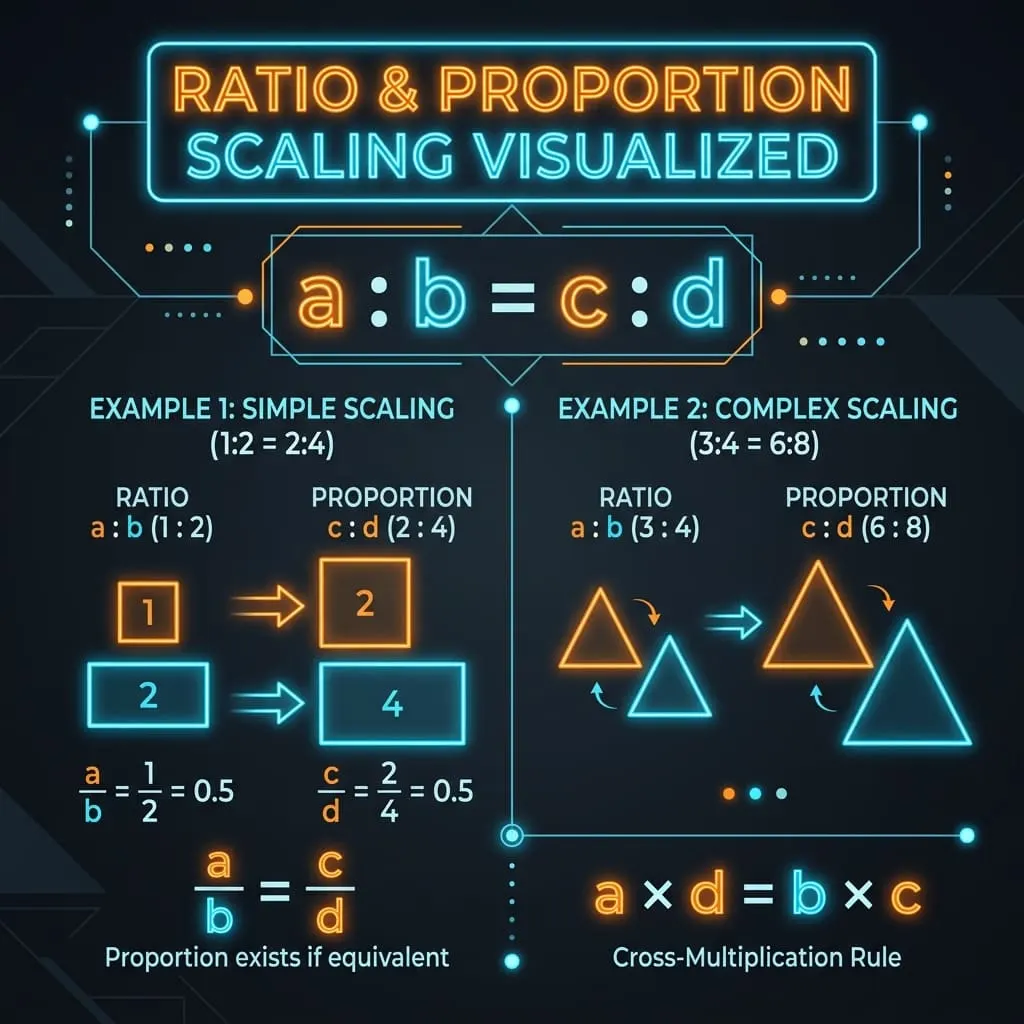
Definition: Solve for missing variable in proportions a:b = c:d.
Governing Math Formula: a · d = b · c.
Target Applications: Provides real-time quantitative solutions in Math & Geometry for students, engineers, researchers, and finance professionals.
Ratio & Proportion Solver
1. Introduction
In daily life, cooking, construction, and engineering, comparing quantities requires maintaining consistent relationships. Whether you are scaling a recipe to serve more guests, mixing concrete, sizing blueprints, or converting currencies, you are working with ratios and proportions.
A ratio compares two quantities (e.g. 2 cups of sugar to 5 cups of flour), while a proportion states that two ratios are equal (e.g. 2:5 = x:15). Solving these equations is essential for scale modeling, business budgeting, and chemistry.
The Ratio & Proportion Solver is an educational tool designed to solve these proportions. By entering your known values and setting the missing variable to 0, you can instantly calculate the solved value.
This guide provides a comprehensive overview of ratio mathematics, cross-multiplication, manual calculation guidelines, and scaling applications.
graph TD
    A["Ratio 1: a / b"] --> C["Proportion Equation: a / b = c / d"]
    B["Ratio 2: c / d"] --> C
    C --> D["Cross-Multiply: a * d = b * c"]
    D --> E["Solve for Missing Variable (set to 0)"]
    E --> F["Result: Solved Value ($)"]
2. Core Definitions & Analogy
To build a solid mathematical foundation, let us define ratios and proportions in both simple and technical terms:
- Simple Definition: A ratio compares the size of one value to another. A proportion is a mathematical statement showing that two ratios are equal.
- Technical Definition: A ratio is a quantitative relation between two amounts showing the number of times one value contains or is contained within the other. A proportion is an equation of the form a/b = c/d, expressing the equivalence of two ratios. By cross-multiplication, a d = b c, allowing you to solve for any missing variable.
- Conceptual Analogy: Think of a photo resize tool on your computer. The original photo has an aspect ratio of 2:5 (width to height). If you want to stretch the photo to a new height of 15 inches while keeping the proportions the same (avoiding a distorted image), the width must change to 6 inches. The ratio solver calculates this width to keep the image sharp and balanced.
3. History & Milestones
The mathematics of proportions has served as a design anchor for millennia:
- The Golden Ratio (c. 300 BC): Euclid and early Greek architects used geometric proportions to design columns and temples, establishing aesthetic standards.
- The Rule of Three: Early Arab and Indian merchants popularized the "Rule of Three," a mathematical method to find a fourth unknown value in a proportion when three values are known, which served as the basis for commercial trade calculations.
4. Core Concepts & Parameters
To calculate proportions, you must understand three key parameters:
- Ratios (a:b and c:d): The relationships between the compared values.
- Cross-Multiplication: The algebraic rule stating that the product of the extremes (a d) equals the product of the means (b c).
- Missing Variable: The unknown value in the proportion (represented as 0 in our calculator inputs, which can solve for c or d).
5. The Mathematical Model & Formula
A proportion is solved using the standard cross-multiplication equation:
1. The Proportion Equation
a / b = c / d
2. The Cross-Multiplication Equation
a * d = b * c
Solved Formulas:
- To solve for c (if c = 0):
c = ( a * d ) / b
- To solve for d (if d = 0):
d = ( b * c ) / a
Variable Breakdown:
- Value a: First term of the first ratio (Units, default a = 2)
- Value b: Second term of the first ratio (Units, default b = 5)
- Value c: First term of the second ratio (Units, default c = 0 to solve)
- Value d: Second term of the second ratio (Units, default d = 15)
6. Step-by-Step Manual Procedure
Let us walk through a manual calculation using our default calculator values:
- Identify the variables:
a = 2,b = 5,c = 0 (to solve),d = 15 - Write the proportion equation:
2 / 5 = c / 15 - Cross-multiply to isolate the unknown variable (c):
2 * 15 = 5 * c30 = 5 * c - Divide to solve for c:
c = 30 / 5 = 6.00The solved value for c is 6.00, yielding the completed proportion: 2:5 = 6:15.
7. Visual Diagram
The flowchart below displays the computation path for ratio solvers:
graph TD
    Start["Enter Values a, b, c, & d"] --> CheckMissing["Identify the variable set to 0"]
    CheckMissing -->|c is 0| SolveC["Compute: c = (a * d) / b"]
    CheckMissing -->|d is 0| SolveD["Compute: d = (b * c) / a"]
    SolveC --> Display["Output: Solved Value ($)"]
    SolveD --> Display
8. Parameter Comparison Matrix
The table below shows how varying the inputs affects the solved proportion value:
| Value a | Value b | Value c | Value d | Solved Variable | Solved Value Result |
|---|---|---|---|---|---|
| 1 | 3 | 0 | 12 | c | 4.0000 (Ratio 1:3 = 4:12) |
| 2 (Default) | 5 (Default) | 0 (Default) | 15 (Default) | c | 6.0000 (Ratio 2:5 = 6:15) |
| 3 | 4 | 9 | 0 | d | 12.0000 (Ratio 3:4 = 9:12) |
| 5 | 8 | 0 | 40 | c | 25.0000 (Ratio 5:8 = 25:40) |
| 10 | 2 | 50 | 0 | d | 10.0000 (Ratio 10:2 = 50:10) |
9. Real-World Applications
Proportion calculations are essential across many practical fields:
- Cooking & Baking: Chefs scale ingredient quantities up or down based on the number of servings needed (e.g. if 2 cups serve 5, x cups serve 15).
- Scale Model Design: Architects and toy manufacturers convert real-world dimensions to scale coordinates (e.g. 1:24 or 1:100 scales).
- Business Finance: Analysts project currency exchange values (e.g. if 1 USD is 0.90 EUR, x USD is 15 EUR).
10. Case Studies
Case Study 1: Scaling a Baking Recipe
A baker is preparing a cake for a party. The standard recipe serves 5 people and requires 2 cups of sugar. The party has 15 guests.
- Proportion equation: 2 / 5 = c / 15.
- Calculation: c = (2 * 15) / 5 = 30 / 5 = 6.
- Outcome: The baker requires 6 cups of sugar to scale the recipe for 15 guests, preserving the taste proportions.
Case Study 2: Designing a Scale Blueprint
An architect is drawing a blueprint for a building spanning 15 meters in height. The scale ratio is 2 cm on paper for every 5 meters in real life.
- Proportion equation: 2 / 5 = c / 15.
- Calculation: c = (2 * 15) / 5 = 6.
- Outcome: The building height on the blueprint sheet measures exactly 6 cm.
11. Advantages of Using the Tool
- Saves Time: Instantly solves proportions.
- Reduces Errors: Eliminates algebraic cross-multiplication slips.
- Flexible Inputs: Solves for either c or d based on which is set to 0.
12. Limitations & Boundary Conditions
This calculator requires non-zero values for the known variables (a, b). Setting the divisor variables (like b or a) to zero will return division errors.
13. Common Mistakes
- Setting the Wrong Variable to Zero: Putting 0 in the wrong input field, which will solve for a different variable.
- Ignoring Unit Consistency: Mixing metric and imperial units (e.g. mixing inches and centimeters) when setting up the proportion.
12. Frequently Asked Questions
Q1: What is a ratio?
A comparison of two numbers showing how many times one value contains the other.
Q2: What is a proportion?
An equation stating that two ratios are equal (e.g. a/b = c/d).
Q3: What is cross-multiplication?
The rule stating that the diagonal products of a proportion are equal: a * d = b * c.
Q4: How do I use this calculator to solve a proportion?
Enter three known values, set the unknown variable to 0, and the calculator will solve for it.
Q5: What if I set both c and d to 0?
The calculator requires three known variables to solve for the fourth. Setting multiple inputs to 0 will prevent the calculation.
Q6: Can a solved value be a decimal?
Yes. The solver handles decimal division and displays the result with high precision.
Q7: What is the Rule of Three?
A historical term for solving a proportion with three known values to find the fourth.
Q8: Does this calculator support negative ratios?
Yes, it handles positive and negative signs, preserving the algebraic direction of the proportion.
Q9: Does a co-signer help lower the DTI ratio?
This is a mortgage underwriting metric; in ratio algebra, focus on cross-multiplication.
Q10: How often do engineers use proportions?
Daily, when reading blueprints, converting units, and scaling materials.
15. Expert Tips
- Write down the equation first: Always write down
a/b = c/don paper before entering values to ensure you don't swap variables.
- Convert units first: Ensure all measurements are in the same unit before starting calculations.
16. Summary
- Ratios compare quantities; proportions equate ratios.
- The proportion formula is solved via
a * d = b * c.
- Set the missing variable to 0 to solve for it.
- Keep units consistent to ensure accurate scaling.
Additional Technical Guidelines & Measurement Standards
When conducting calculations for Ratio & Proportion Solver, maintaining quantitative precision and verifying input parameter boundaries is essential for reliable scenario evaluation. Always verify that raw numerical inputs are measured using standardized instrumentation, and double-check unit conversions prior to applying outputs in commercial, industrial, or academic projects.
For quantitative unit conversions and scientific calculations, always maintain at least four decimal places of precision during intermediate arithmetic stages before rounding final results. When preparing technical reports, laboratory documentation, or financial forecasts, cross-verify all output variables against established international measurement standards (such as SI, NIST, and ISO metric benchmarks) to guarantee consistent analytical rigor across all computational workflows.
MathsLover.com delivers this interactive solver 100% free of charge to foster global mathematical literacy, educational accessibility, and data-driven problem solving across scientific, technical, and academic communities worldwide.