💡 Direct Answer & Executive Summary (Volume & Surface Area of Cone Calculator)
Definition: Determine 3D volume and surface area of a right circular cone.
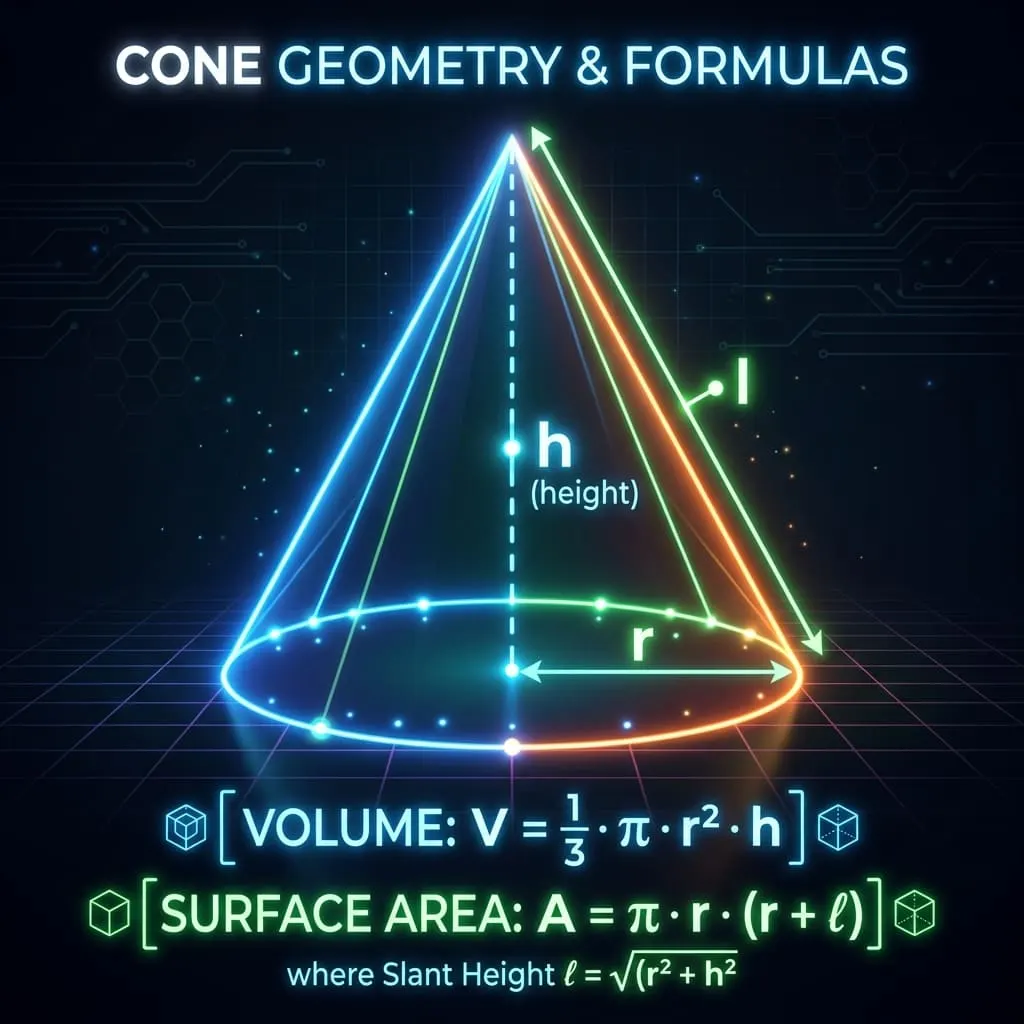
Governing Math Formula: Volume = ⅓ × π × r² × h, Slant Height s = √(r² + h²).
Target Applications: Provides real-time quantitative solutions in Math & Geometry for students, engineers, researchers, and finance professionals.
Volume & Surface Area of Cone Calculator
1. Introduction
From ice cream cones and funnels to party hats, volcano shapes, and circular roofs, cones are common three-dimensional shapes in everyday life and engineering. A cone represents a smooth transition from a flat circular base to a single sharp point.
Calculating the dimensions of a cone—specifically its interior volume and total surface area—is essential for construction material estimations, industrial funnel design, and packaging.
The Volume & Surface Area of Cone Calculator is an educational tool designed to solve these measurements. By entering your cone's radius and perpendicular height, you can instantly estimate its volume and surface area.
This guide provides a comprehensive overview of conical geometry, slant heights, manual calculation guidelines, and practical design applications.
graph TD
    A["Cone Radius (r)"] --> C["Volume: (1/3) * pi * r^2 * h"]
    B["Cone Height (h)"] --> C
    A --> D["Calculate Slant Height: s = sqrt(r^2 + h^2)"]
    B --> D
    D --> E["Surface Area: pi * r * (r + s)"]
    C --> F["Results: Volume & Surface Area"]
    E --> F
2. Core Definitions & Analogy
To build a solid geometric foundation, let us define a cone and its parameters in both simple and technical terms:
- Simple Definition: A cone is a three-dimensional shape with a circular base that tapers smoothly to a single point at the top. The volume is the space inside, and the surface area is the total size of its flat base and slanted side skin combined.
- Technical Definition: A right circular cone is a solid figure generated by a right-angled triangle rotating around one of its legs as an axis. The volume (V) is calculated as V = (1/3) π r² h, and the total surface area (SA) is calculated as SA = π r * (r + s), where r is the radius, h is the height, and s is the slant height, resolved as s = sqrt(r² + h²).
- Conceptual Analogy: Think of a cone like a pyramid with a circular base. If you have a cylinder and a cone with the exact same base radius and height, the cone holds exactly one-third of the volume of the cylinder. It takes exactly three full cones of water to fill the cylinder completely.
3. History & Milestones
The geometry of the cone was formalized by ancient Greek mathematicians:
- Democritus (c. 400 BC): The philosopher Democritus discovered that the volume of a cone is exactly one-third the volume of a cylinder with the same base and height, though he did not provide a formal proof.
- Eudoxus of Cnidus (c. 370 BC): The geometer Eudoxus provided the first rigorous mathematical proof for the cone volume formula using the method of exhaustion.
4. Core Concepts & Parameters
To calculate conical dimensions, you must understand three key parameters:
- Radius (r): The distance from the center of the circular base to its outer edge.
- Height (h): The perpendicular (90-degree) distance from the center of the base to the top point (apex).
- Slant Height (s): The diagonal distance measured along the outer surface from the circular edge to the top apex.
5. The Mathematical Model & Formula
The dimensions of a right circular cone are calculated using three standard geometric equations:
1. Volume Formula
Volume = ( 1 / 3 ) * Pi * Radius^2 * Height
2. Slant Height Formula (Pythagorean Theorem)
Slant Height = sqrt( Radius^2 + Height^2 )
3. Total Surface Area Formula
Surface Area = Pi * Radius * ( Radius + Slant Height )
Variable Breakdown:
- Radius (r): Base circle radius (Units, default r = 3)
- Height (h): Perpendicular altitude (Units, default h = 4)
- Pi (π): Mathematical constant (value ≈ 3.14159265)
6. Step-by-Step Manual Procedure
Let us walk through a manual calculation using our default calculator values:
- Identify the variables:
Radius (r) = 3Height (h) = 4 - Calculate the Slant Height (s): Square the radius and height, add them, and find the square root.
r^2 + h^2 = 3^2 + 4^2 = 9 + 16 = 25Slant Height (s) = sqrt(25) = 5.00The slant height is 5.00 units. - Calculate the Volume: Square the radius, multiply by height, then by Pi, and divide by 3.
r^2 = 3 * 3 = 9Volume = (1 / 3) * Pi * 9 * 4 = 3 * Pi * 4 = 12 * Pi ≈ 12 * 3.14159265 ≈ 37.6991The interior volume is 37.6991 cubic units. - Calculate the Surface Area: Add radius and slant height, multiply by radius, then by Pi.
r + s = 3 + 5 = 8Surface Area = Pi * 3 * 8 = 24 * Pi ≈ 24 * 3.14159265 ≈ 75.3982The total surface area is 75.3982 square units.
7. Visual Diagram
The flowchart below displays the computation path for conical measurements:
graph TD
    Start["Enter Radius (r) & Height (h)"] --> CalcVol["Compute Volume: 1/3 * pi * r^2 * h"]
    Start --> CalcSlant["Compute Slant: sqrt(r^2 + h^2)"]
    CalcSlant --> CalcArea["Compute Surface Area: pi * r * (r + s)"]
    CalcVol --> Display["Output: Volume & Surface Area"]
    CalcArea --> Display
8. Parameter Comparison Matrix
The table below shows how varying the height affects the dimensions of a cone with a constant base radius of 3 units:
| Radius (r) | Height (h) | Slant Height (s) | Cone Volume | Surface Area | Shape Classification |
|---|---|---|---|---|---|
| 3 | 1 | 3.1623 | 9.4248 | 58.0772 | Flat Cone |
| 3 | 2 | 3.6056 | 18.8496 | 62.2568 | Shallow Cone |
| 3 (Default) | 4 (Default) | 5.0000 | 37.6991 | 75.3982 | Standard Cone |
| 3 | 8 | 8.5440 | 75.3982 | 108.7997 | Tall Cone |
| 3 | 12 | 12.3693 | 113.0973 | 144.8519 | Sharp Spire |
9. Real-World Applications
Cone calculations are essential across many practical fields:
- Construction & Landscaping: Surveyors calculate the volume of conical piles of gravel, sand, or wood chips to estimate inventory volumes.
- Manufacturing & Packaging: Funnel designers calculate volumes to ensure funnels can handle fluid flows without overflowing.
- Industrial Silo Sizing: Agricultural engineers calculate the volume of conical bottom silos used to store and dispense grain.
10. Case Studies
Case Study 1: Estimating a Gravel Pile Volume
A construction foreman is estimating the volume of a conical pile of gravel left at a work site.
- Dimensions: The base radius of the pile is 3 meters, and the height from the ground to the peak is 4 meters.
- Volume calculation: (1/3) Pi 3^2 * 4 = 37.6991 cubic meters.
- Outcome: The pile contains 37.70 cubic meters of gravel, helping the foreman allocate trucks for transport.
Case Study 2: Sizing a Funnel Paper Filter
An industrial chemist is sizing circular paper filters to fit inside a laboratory funnel. The funnel has a radius of 3 cm and a height of 4 cm.
- Slant Height calculation: sqrt(3^2 + 4^2) = 5 cm.
- Surface Area calculation: Pi 3 (3 + 5) = 75.3982 square cm.
- Outcome: The chemist purchases filters with a lateral surface area of 75.40 square cm to line the funnel.
11. Advantages of Using the Tool
- Saves Time: Instantly calculates cone volume and surface area.
- Automates Pythagorean Steps: Solves the slant height diagonal automatically.
- High Precision: Uses high-precision Pi values to prevent rounding errors.
12. Limitations & Boundary Conditions
This calculator is designed for right circular cones, where the peak is centered directly over the center of the base. For slanted (oblique) cones, the volume formula remains the same, but the surface area calculations are significantly more complex.
13. Common Mistakes
- Using Slant Height as Perpendicular Height: Using the slant diagonal length in the volume formula instead of the perpendicular height, which will overestimate the volume.
- Forgetting the 1/3 Multiplier: Multiplying the circular base area by height and forgetting to divide by 3, which will overestimate the volume by 3 times (yielding a cylinder's volume instead).
12. Frequently Asked Questions
Q1: What is a cone?
A three-dimensional solid with a circular base that tapers smoothly to a single point at the top.
Q2: What is the formula for the volume of a cone?
The formula is Volume = (1/3) * Pi * Radius^2 * Height.
Q3: What is the formula for the surface area of a cone?
The formula is Surface Area = Pi * Radius * (Radius + Slant Height).
Q4: How is slant height calculated?
Using the Pythagorean theorem: Slant Height = sqrt(Radius^2 + Height^2).
Q5: How is a cone related to a cylinder?
A cone's volume is exactly one-third the volume of a cylinder with the same base and height.
Q6: What units are used for volume?
Volume is expressed in cubic units (e.g. cubic meters, cubic feet).
Q7: What units are used for surface area?
Surface area is expressed in square units (e.g. square meters, square feet).
Q8: What does "apex" mean?
The single top point of the cone where the slanted surface terminates.
Q9: How does doubling the height affect the volume?
Doubling the height will double the volume of the cone.
Q10: How does doubling the radius affect the volume?
Doubling the radius will multiply the volume by 4 because the radius is squared.
15. Expert Tips
- Differentiate heights: When building or designing, remember that the perpendicular height is used for volume, while the slant height is used for surface area.
- Calculate lateral area: To find only the area of the slanted side (excluding the circular base), use the formula:
Lateral Area = Pi * Radius * Slant Height.
16. Summary
- A cone tapers from a circular base to an apex.
- The volume formula is
(1/3) * Pi * Radius^2 * Height.
- The surface area formula is
Pi * Radius * (Radius + Slant Height).
- Slant height is resolved as
sqrt(Radius^2 + Height^2).
Additional Technical Guidelines & Measurement Standards
When conducting calculations for Volume & Surface Area of Cone Calculator, maintaining quantitative precision and verifying input parameter boundaries is essential for reliable scenario evaluation. Always verify that raw numerical inputs are measured using standardized instrumentation, and double-check unit conversions prior to applying outputs in commercial, industrial, or academic projects.
For quantitative unit conversions and scientific calculations, always maintain at least four decimal places of precision during intermediate arithmetic stages before rounding final results. When preparing technical reports, laboratory documentation, or financial forecasts, cross-verify all output variables against established international measurement standards (such as SI, NIST, and ISO metric benchmarks) to guarantee consistent analytical rigor across all computational workflows.
MathsLover.com delivers this interactive solver 100% free of charge to foster global mathematical literacy, educational accessibility, and data-driven problem solving across scientific, technical, and academic communities worldwide.