💡 Direct Answer & Executive Summary (Volume of Rectangular Prism Calculator)
Definition: Compute 3D volume and surface area of a box or rectangular prism.
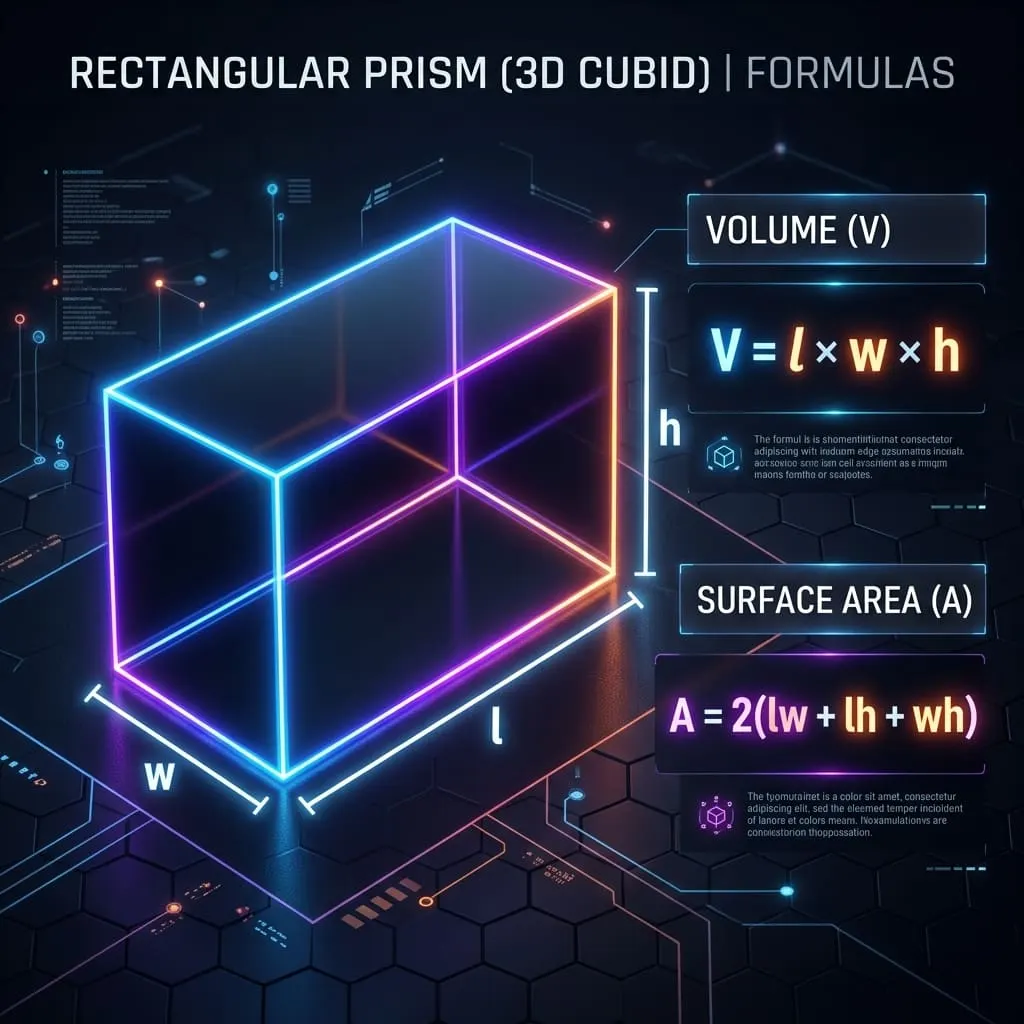
Governing Math Formula: Volume = l × w × h. Surface Area = 2(lw + lh + wh).
Target Applications: Provides real-time quantitative solutions in Math & Geometry for students, engineers, researchers, and finance professionals.
Volume of Rectangular Prism Calculator
1. Introduction
In three-dimensional geometry, the rectangular prism (commonly known as a box) is the most frequently encountered shape in logistics, construction, and manufacturing. From shipping containers and cardboard boxes to rooms in a building and electronic enclosures, rectangular prisms are everywhere.
Calculating the dimensions of a rectangular prism—specifically its interior volume and outer surface area—is essential for shipping cost analysis, warehouse storage optimization, and raw material estimations.
The Volume of Rectangular Prism Calculator is an educational tool designed to solve these measurements. By entering your prism's length, width, and height, you can instantly estimate its volume and surface area.
This guide provides a comprehensive overview of rectangular prism geometry, formula derivations, manual calculation guidelines, and shipping logistics.
graph TD
    A["Length (l)"] --> C["Volume: l * w * h"]
    B["Width (w)"] --> C
    E["Height (h)"] --> C
    A --> D["Surface Area: 2 * (l*w + l*h + w*h)"]
    B --> D
    E --> D
    C --> F["Results: Volume & Surface Area"]
    D --> F
2. Core Definitions & Analogy
To build a solid geometric foundation, let us define a rectangular prism in both simple and technical terms:
- Simple Definition: A rectangular prism is a three-dimensional box with six flat faces that are all rectangles. The volume is the amount of space inside the box, and the surface area is the total size of its outer faces.
- Technical Definition: A rectangular prism (or cuboid) is a polyhedron with six rectangular faces. The volume (V) is the product of its length (l), width (w), and height (h), expressed as V = l w h. The total surface area (SA) is the sum of the areas of its six faces, expressed as SA = 2 (lw + lh + wh).
- Conceptual Analogy: Think of a rectangular prism like a stack of rectangular cards. The length and width represent the size of a single card. The height is the total height of the stack. Multiplying length, width, and height tells you exactly how much three-dimensional space the stack occupies.
3. History & Milestones
The geometry of rectangular prisms was standardized alongside commerce and architecture:
- Ancient Egyptian Masonry: Stonecutters carved rectangular limestone blocks to build the Pyramids of Giza, using volume measurements to estimate labor and barge shipping requirements.
- Logistics Standardization (1950s): The introduction of standard shipping container dimensions (TEUs) revolutionized global trade by optimizing the stackable space of rectangular containers on ships and trains.
4. Core Concepts & Parameters
To calculate rectangular prism dimensions, you must understand three key parameters:
- Length (l): The measurement of the front horizontal edge of the box.
- Width (w): The measurement of the side depth edge of the box.
- Height (h): The measurement of the vertical height edge of the box.
5. The Mathematical Model & Formula
The dimensions of a rectangular prism are calculated using two standard geometric equations:
1. Volume Formula
Volume = Length * Width * Height
2. Surface Area Formula
Surface Area = 2 * ( Length * Width + Length * Height + Width * Height )
Variable Breakdown:
- Length (l): Horizontal span (Units, default l = 10)
- Width (w): Depth span (Units, default w = 5)
- Height (h): Vertical span (Units, default h = 4)
6. Step-by-Step Manual Procedure
Let us walk through a manual calculation using our default calculator values:
- Identify the variables:
Length (l) = 10Width (w) = 5Height (h) = 4 - Calculate the Volume: Multiply length, width, and height together.
Volume = 10 * 5 * 4 = 50 * 4 = 200.00The interior volume is 200.00 cubic units. - Calculate the Surface Area: Find the area of the three unique face pairs, add them, and multiply by 2.*
l * w = 10 * 5 = 50*l * h = 10 * 4 = 40*w * h = 5 * 4 = 20Sum of areas = 50 + 40 + 20 = 110Surface Area = 2 * 110 = 220.00The total surface area is 220.00 square units.
7. Visual Diagram
The flowchart below displays the computation path for rectangular prism measurements:
graph TD
    Start["Enter Length, Width, & Height"] --> CalcVol["Compute Volume: l * w * h"]
    Start --> CalcArea["Compute Surface Area: 2*(l*w + l*h + w*h)"]
    CalcVol --> Display["Output: Volume & Surface Area"]
    CalcArea --> Display
8. Parameter Comparison Matrix
The table below shows how varying the height affects the volume and surface area for a box with a length of 10 and width of 5:
| Length (l) | Width (w) | Height (h) | Prism Volume | Surface Area | Box Classification |
|---|---|---|---|---|---|
| 10 | 5 | 1 | 50.0000 | 130.0000 | Flat Panel |
| 10 | 5 | 2 | 100.0000 | 160.0000 | Shallow Box |
| 10 (Default) | 5 (Default) | 4 (Default) | 200.0000 | 220.0000 | Standard Shipping Box |
| 10 | 5 | 8 | 400.0000 | 340.0000 | Tall Box |
| 10 | 5 | 10 | 500.0000 | 400.0000 | Deep Box |
9. Real-World Applications
Prism calculations are essential across many logistics and design fields:
- Shipping & Packaging: E-commerce warehouses calculate box volumes to determine shipping costs (dimensional weight) and package sorting layouts.
- HVAC Duct Sizing: Heating engineers calculate the volume of rectangular ventilation ducts to manage air circulation requirements.
- Building Construction: Architects calculate room volumes to size heating and air conditioning units.
10. Case Studies
Case Study 1: Calculating Shipping Costs
A manufacturer ships products in cardboard boxes measuring 10 inches long, 5 inches wide, and 4 inches high.
- Volume calculation: 10 5 4 = 200 cubic inches.
- Surface Area calculation: 2 (105 + 104 + 54) = 220 square inches.
- Outcome: The box occupies 200 cubic inches of cargo space and requires 220 square inches of cardboard to manufacture.
Case Study 2: Sizing an Office AC Unit
An office room measures 10 meters long, 5 meters wide, and 4 meters high. The HVAC guidelines require 1 watt of cooling capacity per cubic meter.
- Volume calculation: 10 5 4 = 200 cubic meters.
- Outcome: The room volume is 200 cubic meters, meaning the business must install an air conditioning unit with a cooling capacity of at least 200 watts.
11. Advantages of Using the Tool
- Saves Time: Instantly calculates volume and surface area.
- Logistics Helper: Calculates shipping footprints easily.
- Aids Construction: Simplifies room capacity calculations.
12. Limitations & Boundary Conditions
This calculator assumes all angles are right angles (90 degrees). For slanted boxes (oblique prisms or parallelepipeds), you must use the slant height and face angles to calculate dimensions.
13. Common Mistakes
- Adding Dimensions Instead of Multiplying: Adding length, width, and height together instead of multiplying them to find volume.
- Using Inconsistent Units: Multiplying length in feet by width in inches. Always convert all inputs to the same unit before calculating.
12. Frequently Asked Questions
Q1: What is a rectangular prism?
A three-dimensional solid box bounded by six rectangular faces.
Q2: What is the formula for the volume of a rectangular prism?
The formula is Volume = Length * Width * Height.
Q3: What is the formula for the surface area of a rectangular prism?
The formula is Surface Area = 2 * (Length * Width + Length * Height + Width * Height).
Q4: Is a cube a rectangular prism?
Yes. A cube is a special type of rectangular prism where length, width, and height are equal.
Q5: What units are used for volume?
Volume is expressed in cubic units (e.g. cubic inches, cubic meters).
Q6: What units are used for surface area?
Surface area is expressed in square units (e.g. square inches, square meters).
Q7: What does "surface area" mean for a box?
The total size of the six flat cardboard faces needed to construct the box.
Q8: How does doubling the height affect the volume?
Doubling the height will double the volume of the rectangular prism.
Q9: Does the order of length, width, and height matter?
No. Since multiplication is commutative, multiplying the dimensions in any order yields the same volume.
Q10: How do you find height if you know volume, length, and width?
Divide the volume by the product of length and width: Height = Volume / (Length * Width).
15. Expert Tips
- Check dimensional weight rates: Courier companies charge based on box volume (dimensional weight) if the package is large but light. Keep your box sizes as small as possible to save on shipping.
- Measure interior dimensions for capacity: When sizing containers to hold liquid or items, measure the inside walls to exclude the thickness of the box material from your volume calculation.
16. Summary
- A rectangular prism is a three-dimensional box with 6 rectangular faces.
- The volume formula is
Length * Width * Height.
- The surface area formula is
2 * (lw + lh + wh).
- All units must be consistent before calculating.
Additional Technical Guidelines & Measurement Standards
When conducting calculations for Volume of Rectangular Prism Calculator, maintaining quantitative precision and verifying input parameter boundaries is essential for reliable scenario evaluation. Always verify that raw numerical inputs are measured using standardized instrumentation, and double-check unit conversions prior to applying outputs in commercial, industrial, or academic projects.
For quantitative unit conversions and scientific calculations, always maintain at least four decimal places of precision during intermediate arithmetic stages before rounding final results. When preparing technical reports, laboratory documentation, or financial forecasts, cross-verify all output variables against established international measurement standards (such as SI, NIST, and ISO metric benchmarks) to guarantee consistent analytical rigor across all computational workflows.
MathsLover.com delivers this interactive solver 100% free of charge to foster global mathematical literacy, educational accessibility, and data-driven problem solving across scientific, technical, and academic communities worldwide.