💡 Direct Answer & Executive Summary (Volume & Surface Area of Sphere Calculator)
Definition: Compute 3D volume and outer surface area of a sphere given radius r.
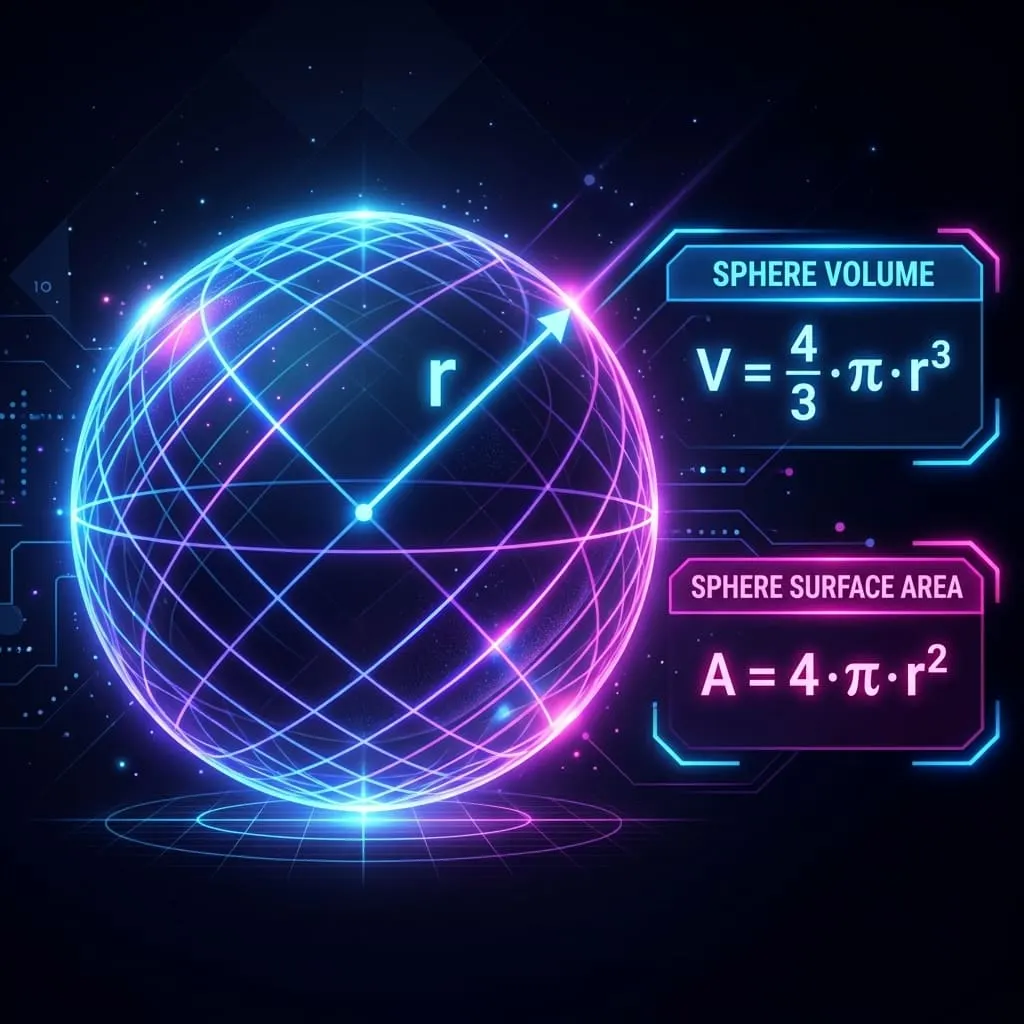
Governing Math Formula: Volume = ⁴/₃ × π × r³, Surface Area = 4 × π × r².
Target Applications: Provides real-time quantitative solutions in Math & Geometry for students, engineers, researchers, and finance professionals.
Volume & Surface Area of Sphere Calculator
1. Introduction
From planets and soap bubbles to marbles, bearings, and spherical storage tanks, spheres are fundamental shapes in nature and engineering. A sphere represents the most efficient shape in physics, enclosing the maximum volume with the minimum possible surface area.
Calculating the dimensions of a sphere—specifically its interior volume and outer surface area—is essential for sizing industrial storage tanks, estimating planetary masses, and designing sports equipment. Because a sphere is perfectly symmetrical, you can solve all these dimensions using only a single parameter: the radius.
The Volume & Surface Area of Sphere Calculator is an educational tool designed to solve these measurements. By entering your sphere's radius, you can instantly estimate its volume and surface area.
This guide provides a comprehensive overview of spherical geometry, Archimedes' derivations, manual calculation guidelines, and industrial applications.
graph TD
    A["Sphere Radius (r)"] --> C["Volume: (4/3) * pi * r^3"]
    A --> D["Surface Area: 4 * pi * r^2"]
    C --> E["Results: Volume & Surface Area"]
    D --> E
2. Core Definitions & Analogy
To build a solid geometric foundation, let us define a sphere and its parameters in both simple and technical terms:
- Simple Definition: A sphere is a perfectly round three-dimensional ball. The volume is the amount of space inside the ball, and the surface area is the total size of its outer round skin.
- Technical Definition: A sphere is the set of all points in three-dimensional Euclidean space that are at a fixed distance (radius) from a given point (the center). The volume (V) is calculated as V = (4/3) π r³, and the surface area (SA) is calculated as SA = 4 π r², where r is the radius.
- Conceptual Analogy: Think of a sphere like a round balloon. The radius is the distance from the center of the balloon to its rubber skin. The surface area represents the total square inches of rubber material needed to make the balloon. The volume is the total amount of air blown inside to fill it.
3. History & Milestones
The geometry of the sphere was one of the greatest discoveries of ancient mathematics:
- Archimedes of Syracuse (c. 225 BC): Archimedes considered his proof of the volume and surface area of a sphere to be his greatest achievement. He proved that a sphere has exactly two-thirds the volume and surface area of a cylinder that encloses it (having the same height and diameter), requesting that this geometric diagram be carved onto his tombstone.
- Planetary Mapping: Early astronomers and navigators applied spherical geometry to map the coordinates of the Earth and track stellar movements.
4. Core Concepts & Parameters
To calculate spherical dimensions, you must understand two key parameters:
- Radius (r): The distance from the center of the sphere to any point on its outer boundary.
- Pi (π): The mathematical constant approximately equal to 3.14159.
5. The Mathematical Model & Formula
The dimensions of a sphere are calculated using two standard geometric equations:
1. Volume Formula
Volume = ( 4 / 3 ) * Pi * Radius^3
2. Surface Area Formula
Surface Area = 4 * Pi * Radius^2
Variable Breakdown:
- Radius (r): Distance from center to edge (Units, default r = 3)
- Pi (π): Mathematical constant (value ≈ 3.14159265)
6. Step-by-Step Manual Procedure
Let us walk through a manual calculation using our default calculator values:
- Identify the variables:
Radius (r) = 3 - Calculate the Volume: Cube the radius, multiply by Pi, and then by 4/3.
r^3 = 3 * 3 * 3 = 27Volume = (4 / 3) * Pi * 27 = 4 * Pi * 9 = 36 * Pi ≈ 36 * 3.14159265 ≈ 113.0973The interior volume is 113.0973 cubic units. - Calculate the Surface Area: Square the radius, multiply by Pi, and then by 4.
r^2 = 3 * 3 = 9Surface Area = 4 * Pi * 9 = 36 * Pi ≈ 36 * 3.14159265 ≈ 113.0973The total surface area is 113.0973 square units.For a radius of 3 units, the numerical values for volume and surface area are equal, which is a unique property of this dimension.
7. Visual Diagram
The flowchart below displays the computation path for spherical measurements:
graph TD
    Start["Enter Sphere Radius (r)"] --> CalcVol["Compute Volume: 4/3 * pi * r^3"]
    Start --> CalcArea["Compute Surface Area: 4 * pi * r^2"]
    CalcVol --> Display["Output: Volume & Surface Area"]
    CalcArea --> Display
8. Parameter Comparison Matrix
The table below shows how the radius affects the volume and surface area of a sphere:
| Radius (r) | Sphere Volume | Surface Area | Scale Multiplier |
|---|---|---|---|
| 1 | 4.1888 | 12.5664 | Unit Sphere |
| 2 | 33.5103 | 50.2655 | 2x Scale |
| 3 (Default) | 113.0973 | 113.0973 | 3x Scale |
| 6 | 904.7787 | 452.3893 | 6x Scale (Volume grows 8x from default) |
| 10 | 4,188.7902 | 1,256.6371 | 10x Scale |
9. Real-World Applications
Spherical calculations are essential across many engineering and science fields:
- Industrial Tank Sizing: Natural gas and chemical companies build spherical storage tanks (Horton spheres) because they distribute high internal pressure evenly and minimize material requirements.
- Ball Bearing Manufacturing: Mechanical engineers calculate the volume and surface area of steel ball bearings to verify weight tolerances and lubrication needs.
- Geographical Modeling: Earth scientists model the Earth as a sphere (or oblate spheroid) to calculate surface distances and atmosphere volumes.
10. Case Studies
Case Study 1: Sizing a Spherical Gas Tank
A chemical plant installs a spherical tank to store natural gas. The design requires a radius of 3 meters.
- Volume calculation: (4/3) Pi 3^3 = 113.0973 cubic meters.
- Surface Area calculation: 4 Pi 3^2 = 113.0973 square meters.
- Outcome: The tank holds 113.10 cubic meters of gas and requires 113.10 square meters of steel plating to construct.
Case Study 2: Designing a Sports Ball
A sports company manufactures leather soccer balls. The ball design requires a radius of 3 decimeters.
- Surface Area calculation: 4 Pi 3^2 = 113.0973 square decimeters.
- Outcome: The company purchases 113.10 square decimeters of leather material per ball, using calculations to check production cost margins.
11. Advantages of Using the Tool
- Single Parameter Simplicity: Solves both volume and surface area using only the radius.
- Saves Time: Instantly calculates complex cubic conversions.
- High Precision: Uses high-precision values of Pi to prevent rounding errors.
12. Limitations & Boundary Conditions
This calculator is designed for perfect spheres. For flattened spheres (ellipsoids or oblate spheroids like the Earth), you must use more complex equations that factor in different polar and equatorial radii.
13. Common Mistakes
- Using Diameter Instead of Radius: Entering the total width (diameter) of the ball into the radius field, which will overestimate the volume by 8 times and the surface area by 4 times. Always divide diameter by 2 first.
- Multiplying by 3 Instead of Cubing: Multiplying the radius by 3 (e.g. 3 3 = 9) instead of cubing it (3 3 * 3 = 27) when calculating volume.
12. Frequently Asked Questions
Q1: What is the formula for the volume of a sphere?
The formula is Volume = (4/3) * Pi * Radius^3.
Q2: What is the formula for the surface area of a sphere?
The formula is Surface Area = 4 * Pi * Radius^2.
Q3: What is the relation between radius and diameter?
The diameter is exactly twice the radius: Diameter = 2 * Radius.
Q4: Why does a sphere have the minimum surface area for a given volume?
Because of surface tension and physics. A spherical boundary distributes forces evenly in all directions, creating a highly efficient shape.
Q5: What is the value of Pi?
Pi (π) is approximately equal to 3.14159.
Q6: What units are used for volume?
Volume is expressed in cubic units (e.g. cubic meters, cubic feet).
Q7: What units are used for surface area?
Surface area is expressed in square units (e.g. square meters, square feet).
Q8: How does doubling the radius affect the volume?
Doubling the radius multiplies the volume by 8.
Q9: How does doubling the radius affect the surface area?
Doubling the radius multiplies the surface area by 4.
Q10: How do you find the radius if you know the surface area?
Use the equation: Radius = sqrt(Surface Area / (4 * Pi)).
15. Expert Tips
- Divide diameters first: If you measure a sports ball end-to-end, divide that value by 2 to find the radius before typing it into the calculator.
- Understand pressure distribution: If you are building pressurized containers, select spherical designs over rectangular ones to prevent weak corner joints.
16. Summary
- A sphere is a perfectly round three-dimensional ball.
- The volume formula is
(4/3) * Pi * Radius^3.
- The surface area formula is
4 * Pi * Radius^2.
- Doubling the radius multiplies the volume by 8.
Additional Technical Guidelines & Measurement Standards
When conducting calculations for Volume & Surface Area of Sphere Calculator, maintaining quantitative precision and verifying input parameter boundaries is essential for reliable scenario evaluation. Always verify that raw numerical inputs are measured using standardized instrumentation, and double-check unit conversions prior to applying outputs in commercial, industrial, or academic projects.
For quantitative unit conversions and scientific calculations, always maintain at least four decimal places of precision during intermediate arithmetic stages before rounding final results. When preparing technical reports, laboratory documentation, or financial forecasts, cross-verify all output variables against established international measurement standards (such as SI, NIST, and ISO metric benchmarks) to guarantee consistent analytical rigor across all computational workflows.
MathsLover.com delivers this interactive solver 100% free of charge to foster global mathematical literacy, educational accessibility, and data-driven problem solving across scientific, technical, and academic communities worldwide.