💡 Direct Answer & Executive Summary (Density from Mass & Volume Solver)
Definition: Compute values for Density from Mass & Volume Solver in standard SI units physics.
Governing Math Formula: Physical equation system model for Density from Mass & Volume Solver.
Target Applications: Provides real-time quantitative solutions in Physics & Engineering for students, engineers, researchers, and finance professionals.
Density from Mass & Volume Solver ()
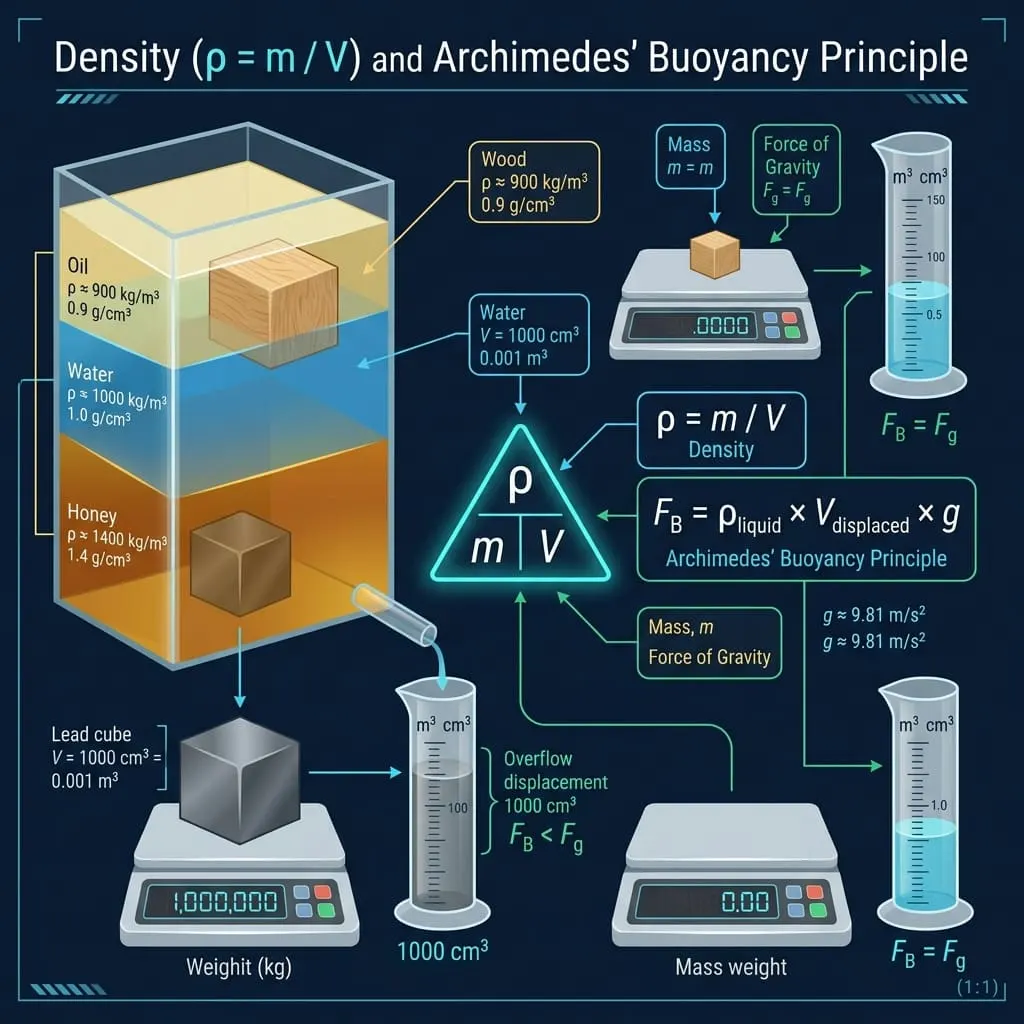
1. Introduction
Why does a colossal steel aircraft carrier float serenely on the surface of the Atlantic Ocean, while a tiny solid steel marble sinks instantly to the seabed? Why does hot air rise into the upper atmosphere to create weather patterns, while cold air sinks into valleys? Why can geologists instantly distinguish a genuine pure gold nugget from a piece of pyrite ("fool's gold") without damaging the sample?
At the core of all fluid mechanics, material science, metallurgy, geology, astrophysics, and aerospace engineering lies a fundamental intensive property of matter: Density ().
Density measures the compactness of matter—how much mass is packed into a given unit of three-dimensional volume.
graph LR
    M["⚖️ Total Mass (m)
Kilograms (kg) or Grams (g)"] --> DIV["➗ Divided By"]
    V["📦 Occupied Volume (V)
Cubic Meters (m³) or cm³ / mL"] --> DIV
    DIV --> RHO["🧱 Density (ρ)
ρ = m / V in kg/m³ or g/cm³"]
    RHO --> SG["💧 Specific Gravity (SG)
SG = ρ_substance / ρ_water"]
    RHO --> FB["🚢 Archimedes Buoyancy Force
F_B = ρ_fluid · V_sub · g"]
Mastering density calculations allows scientists and engineers to:
- Design marine vessels, submarines, scuba buoyancy compensators, and offshore oil platforms.
- Formulate lightweight aerospace composites (carbon fiber, titanium alloys, aerogels) that maximize structural strength while minimizing weight.
- Quality-control pharmaceutical liquid drug formulations, chemical distillation purity, and brewing wort sugar concentration (Brix / Plato).
- Model geological magma convection, mantle plume plate tectonics, and planetary core stratification.
- Calculate fuel mass payloads for commercial airliners and orbital space rockets where volume and temperature directly alter liquid propellant density.
2. Definitions & Analogies
2.1 The Simple Definition
In simple everyday terms:
- Mass () is "how much stuff or matter is inside an object" (measured on a balance scale in kilograms, or grams, ).
- Volume () is "how much 3D physical space the object occupies" (measured in cubic meters, , liters, , or cubic centimeters, ).
- Density ($\rho$) is "how heavy the object is for its size" ().
- A giant bag of feathers and a small solid gold coin might both have a mass of , but the feathers take up an enormous volume (low density), while the gold coin takes up a tiny volume (high density).
2.2 The Formal Technical Definition
Mathematical Formulation of Density
For a homogeneous substance or average continuum body:
Where:
- $\rho$ (Greek lowercase rho) is the mass density ( or ).
- is the total mass ().
- is the total three-dimensional volume ().
SI and Metric Conversion Constants
- SI Standard Unit: Kilogram per cubic meter ().
- CGS Laboratory Unit: Gram per cubic centimeter ( or ).
- Fundamental Conversion Equivalence:
Specific Gravity () / Relative Density
The dimensionless ratio of the density of a substance to the standard density of pure deionized water at ():
- If : The object is less dense than water and floats.
- If : The object is denser than water and sinks.
- If : The object exhibits neutral buoyancy and neither sinks nor rises.
2.3 The Crowded Elevator Analogy
To visualize density intuitively, compare material volume to a standard passenger elevator cabin:
graph TD
    subgraph Elevator_Air ["🎈 Low Density (Air / Gas)"]
        Room1["Huge Elevator Space (10 m³)"]
        People1["1 Toddler (Mass = 10 kg)"]
        Density1["Density: 1 kg/m³
(Light, spacious, particles far apart)"]
        Room1 & People1 --> Density1
    end
    subgraph Elevator_Lead ["🧱 High Density (Solid Metal)"]
        Room2["Same Elevator Space (10 m³)"]
        People2["50 Heavy Weightlifters Packed Wall-to-Wall (5,000 kg)"]
        Density2["Density: 500 kg/m³
(Extremely dense, atoms tightly packed)"]
        Room2 & People2 --> Density2
end- Low Density (Gas / Foam): A few small atoms rattling around in a huge empty space. The elevator feels virtually empty.
- High Density (Lead / Gold / Platinum): Heavy, massive atomic nuclei packed tightly together in a rigid, dense crystal lattice with almost zero empty space.
3. History & Milestones in Density & Buoyancy
timeline
    title Milestones in Density, Buoyancy & Material Physics
    250 BCE : Archimedes discovers water displacement and buoyancy in Syracuse ('Eureka!')
    1687 : Isaac Newton defines mass and density in the 'Philosophiae Naturalis Principia Mathematica'
    1795 : French Republic establishes the Metric System, defining the Gram via 1 cm³ of pure water
    1798 : Henry Cavendish measures the mean density of Earth (5.45 g/cm³) in the Cavendish Experiment
1934 : Walter Baade and Fritz Zwicky predict Neutron Stars with atomic nucleus densities (>10¹⁷ kg/m³)- Archimedes of Syracuse (250 BCE): King Hiero II suspected a goldsmith had adulterated a royal golden crown with cheap silver. While stepping into a public bath, Archimedes noticed the water overflow, realizing that an object's irregular volume equals the volume of displaced liquid. By comparing the crown's weight-to-displacement ratio against pure gold ( vs. ), he proved the fraud, shouting the famous exclamation "Eureka!" ("I have found it!").
- Metric System Origin (1795): The French Academy of Sciences defined the metric unit of mass—the Gram—as the exact mass of one cubic centimeter () of pure distilled water at its maximum density temperature of .
- Henry Cavendish Weighs the Earth (1798): Using a precision torsion balance, British scientist Henry Cavendish measured Newton's gravitational constant () and determined the average density of planet Earth to be (), proving Earth has a dense iron-nickel core rather than a hollow or purely rocky interior.
4. Comprehensive Density Benchmark Spectrum
Densities across the universe span over 30 orders of magnitude—from the near-vacuum of interstellar space to the ultra-dense degeneracy of neutron stars:
| Material / Entity | Physical State | Density () | Density () | Notable Physical Characteristic |
|---|---|---|---|---|
| Interstellar Medium | Gas / Plasma | Few hydrogen atoms per cubic meter | ||
| Air (Sea Level, ) | Gas | $0.001204$ | $1.204$ | Standard atmospheric baseline |
| Helium Gas () | Gas | $0.000178$ | $0.178$ | lighter than air (Lifting gas) |
| Silica Aerogel | Solid | Lightest solid on Earth (99.8% air) | ||
| Balsa Wood | Solid | Ultra-lightweight model aircraft wood | ||
| Ethanol (Pure Alcohol) | Liquid | $0.789$ | $789.0$ | Floats on water |
| Olive Oil | Liquid | $0.918$ | $918.0$ | Floats on water |
| Solid Water Ice () | Solid | $0.9167$ | $916.7$ | Expands upon freezing (Floats on water!) |
| Pure Fresh Water () | Liquid | $1.0000$ | $1,000.0$ | Metric standard reference () |
| Seawater () | Liquid | $1.0250$ | $1,025.0$ | Higher buoyancy than fresh water |
| Human Body (Average) | Biological | Near-neutral buoyancy with lungs full | ||
| Magnesium Metal | Solid | $1.738$ | $1,738.0$ | Lightest structural engineering metal |
| Concrete (Reinforced) | Solid | $2.400$ | $2,400.0$ | Standard civil construction aggregate |
| Solid Granite Rock | Solid | $2,700.0$ | Continental crust baseline | |
| Aluminum Alloy (6061-T6) | Solid | $2.700$ | $2,700.0$ | Lightweight aerospace structural alloy |
| Titanium Alloy (Ti-6Al-4V) | Solid | $4.430$ | $4,430.0$ | High strength-to-weight ratio metal |
| Structural Carbon Steel | Solid | $7.850$ | $7,850.0$ | Standard automotive & building frame metal |
| Pure Copper () | Solid | $8.960$ | $8,960.0$ | Dense electrical conductor |
| Solid Silver () | Solid | $10.490$ | $10,490.0$ | Precious metal |
| Solid Lead () | Solid | $11.340$ | $11,340.0$ | Radiation shielding & battery ballast |
| Liquid Mercury () | Liquid | $13.534$ | $13,534.0$ | Densest room-temperature liquid |
| Pure Gold () | Solid | $19.320$ | $19,320.0$ | denser than steel |
| Pure Platinum () | Solid | $21.450$ | $21,450.0$ | Heavy catalytic precious metal |
| Pure Osmium () | Solid | $22.587$ | $22,587.0$ | Densest natural element on Earth |
| Sun's Core | Plasma | Extreme gravitational compression | ||
| White Dwarf Star | Degenerate | |||
| Neutron Star Core | Nuclear |
5. Archimedes' Buoyancy Principle & Floatation
graph TD
    ARCH["🚢 Archimedes' Principle"] --> COND["⚖️ Net Vertical Force Balance"]

    COND --> F_GRAV["Downward Weight: F_g = m_object · g = ρ_obj · V_obj · g"]
    COND --> F_BUOY["Upward Buoyant Force: F_B = m_displaced · g = ρ_fluid · V_sub · g"]

    COND --> RES1["• If ρ_obj < ρ_fluid: F_B > F_g → FLOATS (Positive Buoyancy)"]
    COND --> RES2["• If ρ_obj = ρ_fluid: F_B = F_g → NEUTRAL BUOYANCY (Hovering)"]
    COND --> RES3["• If ρ_obj > ρ_fluid: F_B < F_g → SINKS (Negative Buoyancy)"]
5.1 The Buoyancy Equation
The upward buoyant force () exerted on a body immersed in a fluid is equal to the gravitational weight of the fluid displaced by the body:
5.2 Fraction of Submerged Volume for Floating Bodies
For any object floating in equilibrium ():
- Iceberg in Seawater: Pure ice has density ; seawater has .(Almost 90% of an iceberg's volume is submerged underwater, leaving only 10% visible above the surface!).
6. Master Formula Matrix & Problem Solver
| Unknown Variable | Primary Formula | Formula Given Specific Gravity () | Formula Given Archimedes Displacement |
|---|---|---|---|
| Density ($\rho$) | |||
| Total Mass () | |||
| Total Volume () | |||
| Specific Gravity () | — | ||
| Buoyant Force () |
7. Practical Real-World Calculation Examples
Example 1: Determining Density of a Machined Metal Cylinder
- Scenario: A machine shop produces an alloy cylinder of diameter () and length (). On a digital precision balance, the mass is measured as .
- Step 1: Calculate Cylinder Volume ():
- Step 2: Calculate Density ($\rho$):
- Identification: Comparing against metallurgical standard tables confirms the cylinder is fabricated from Structural Carbon Steel ().
Example 2: Verifying a Gold Bar Authenticity via Archimedes Method
- Scenario: An investor purchases a stamped () "Pure Gold" bullion bar. To verify it is not counterfeit tungsten coated in gold, it is submerged in a graduated cylinder of pure water, displacing exactly of water.
- Calculated Density:
- Conclusion: The measured density matches pure solid Gold () perfectly, confirming the bullion bar is 100% genuine 24-karat gold.
Example 3: Hot Air Balloon Envelope Lift Sizing
- Scenario: A hot air balloon operates in ambient atmospheric air (). Propane burners heat the air inside the envelope () to .
- Step 1: Calculate Mass of Cold Air Displaced:
- Step 2: Calculate Mass of Hot Air Inside Envelope:
- Step 3: Calculate Net Aerostatic Payload Lift Capacity:(Sufficient to safely lift the wicker basket, burners, fuel tanks, pilot, and 4 passengers!).
Example 4: Calculating Commercial Jet Aviation Fuel Mass from Volume
- Scenario: A Boeing 787 Dreamliner refuels with of Jet A-1 aviation kerosene at a cold winter ground temperature (fuel density ).
- Calculated Fuel Mass ():
- Operational Impact: If the same volume of fuel were pumped at in summer (), the total mass would be only ( less energy!). Aircraft flight management computers always compute range based on fuel mass, never volume.
Example 5: Submerged Submarine Ballast Tank Buoyancy
- Scenario: A research submarine of hull volume and dry structural mass operates in seawater ().
- Total Buoyant Upward Force When Fully Submerged:
- Required Total Mass for Neutral Buoyancy ():
- Required Water Ballast to Flood into Tanks:
8. Real-World Engineering Case Studies
Case Study 1: Why Steel Cargo Ships Float (Apparent Hull Density)
- Engineering Paradox: Structural carbon steel has a density of —almost denser than seawater (). Why doesn't a massive ultra-large container ship sink like a stone?
- Physics of Composite / Apparent Density:A ship is not a solid block of steel; it is a hollow structural shell enclosing vast interior compartments filled with low-density air ().
- Calculations for a Triple-E Ultra Container Ship:- Total Steel Hull & Cargo Deadweight Mass: ().- Total Enclosed Exterior Hull Volume Below Deck: .- Average Effective Apparent Density ():
graph TD
    subgraph Solid_Steel ["🧱 Solid Steel Block"]
        MassS["Mass = 7,850 kg"]
        VolS["Volume = 1.0 m³"]
        DensS["Density = 7,850 kg/m³ > 1,025 kg/m³
Result: SINKS RAPIDLY TO BOTTOM"]
        MassS & VolS --> DensS
    end
    subgraph Hollow_Ship ["🚢 Hollow Steel Ship Hull"]
        MassH["Steel Shell = 7,850 kg"]
        VolH["Air Pocket Volume = 15.0 m³"]
        DensH["Average Density = 523 kg/m³ < 1,025 kg/m³
Result: FLOATS WITH 50% FREEBOARD RESERVE"]
        MassH & VolH --> DensH
end- Outcome: Because the ship's average composite density () is half that of seawater (), it floats safely with 50% of its hull riding high above the waterline.
Case Study 2: Oceanic Thermohaline Circulation (The Global Ocean Conveyor Belt)
- Geophysical Context: Global ocean currents—such as the North Atlantic Gulf Stream—regulate planetary climate by transporting tropical heat to northern Europe. The driving engine of this circulation is not wind, but Density Differences triggered by temperature and salinity (Thermohaline Circulation).
- Physical Dynamics:1. Thermal Effect: In polar regions (Greenland & Antarctica), cold arctic air chills surface seawater to . Cold water contracts, increasing density ($\rho \uparrow$).2. Salinity Effect (Brine Rejection): When sea ice freezes, salt cannot enter the ice crystal lattice and is rejected into the surrounding liquid water, spiking salinity to ($\rho \uparrow$).
- Deep Ocean Sinking:The ultra-cold, high-saline surface water reaches a peak density of . Being denser than the underlying ocean water (), it plunges down to the abyssal ocean floor in giant underwater waterfalls (North Atlantic Deep Water), driving the global conveyor belt that circulates every drop of ocean water once every 1,000 years.
9. Common Mistakes & How to Avoid Them
Mistake 1: Confusing Weight () with Mass ()
Entering force in Newtons instead of mass in kilograms into . If an object weighs , its mass is .
Mistake 2: Mixing and Unit Conversions
Forgetting that ! Because volume is cubic:
Dividing mass by instead of $1,000,000$ introduces a catastrophic error of four orders of magnitude ().
Mistake 3: Neglecting Temperature Effects on Liquid and Gas Density
Measuring volume without recording temperature. Water expands significantly as it heats ( at at ). Gases expand even more dramatically following the Ideal Gas Law ().
10. Frequently Asked Questions (FAQ)
Q1: Why does ice float on liquid water when most solid substances sink in their liquid phase?
A: Unlike almost all other materials (which contract and become denser upon solidifying), water possesses unique hydrogen bonding geometry. As liquid water cools below , the hydrogen bonds lock into an open hexagonal crystalline lattice with empty interior channels, causing solid ice to expand by . Consequently, ice density () is lower than liquid water (), allowing ice to float and insulate aquatic ecosystems beneath frozen lakes.
Q2: What is the difference between Bulk Density and True (Skeleton) Density?
A: - True (Skeleton) Density: The mass divided strictly by the solid atomic volume of the particles, excluding all internal pores and voids.
- Bulk Density: The mass of a granular or porous material (like soil, gravel, powder, or coffee beans) divided by the total package volume, including the air pockets between grains.
Q3: What is the difference between Density and Specific Weight?
A: - Density ($\rho$): Mass per unit volume (), an intensive property independent of gravity.
- Specific Weight (): Gravitational weight force per unit volume (, measured in ). An object has the exact same density on the Moon as on Earth, but its specific weight on the Moon is as large.
Q4: How does temperature and pressure affect gas density?
A: By the Ideal Gas Law ():
- Increasing pressure ($P \uparrow$) compresses gas molecules closer together, increasing density ($\rho \uparrow$).
- Increasing temperature ($T \uparrow$) accelerates molecular thermal kinetic speeds, causing expansion and decreasing density ($\rho \downarrow$).
Q5: What is a Hydrometer and how does it measure liquid density?
A: A hydrometer is a calibrated weighted glass tube with a graduated stem. When placed in a liquid, it sinks until the buoyant force equals its own weight. In dense liquids (like sugar syrup or battery acid), it floats high on the stem; in low-density liquids (like pure alcohol), it sinks deep.
Q6: Can a solid piece of iron or steel float on liquid mercury?
A: Yes, effortlessly! Solid steel has a density of , while liquid mercury has an immense density of . A solid steel anvil dropped into a pool of mercury will float on top with nearly half of its body sticking out above the liquid!
Q7: What is the most dense natural element in the universe?
A: Osmium (, atomic number 76) is the densest naturally occurring stable element on Earth, with a room-temperature density of (), edging out Iridium () and Platinum (). A standard soccer ball made of pure solid Osmium would weigh over ()!
Q8: What is a Pycnometer?
A: A pycnometer is a precision laboratory glass flask with an exact, calibrated internal volume sealed with a ground glass capillary stopper. By weighing the empty pycnometer, filling it with a sample liquid, and re-weighing it on an analytical balance, chemists determine liquid density to four or five decimal places of accuracy.
11. Expert Tips & Best Practices
- Remember the $1,000$ Factor Rule: Always convert by multiplying by $1,000$ ().
- Use Archimedes Water Displacement for Irregular Solids: For odd-shaped stones, engine gears, or jewelry, measure displaced water volume in a graduated cylinder rather than attempting tedious geometric measurements.
- Normalize to Reference Temperature: In quality control and laboratory testing, always record fluid temperature and report density normalized to standard reference conditions ( or ).
12. Summary & Key Takeaways
- Universal Density Formula: , , and .
- Metric Water Benchmark: Pure water at has .
- Specific Gravity (): Dimensionless density ratio relative to water ().
- Archimedes Floatation Principle: Objects float if their average composite density is less than the fluid (), sink if denser, and achieve neutral buoyancy if equal.
- Vast Cosmological Span: Ranges from interstellar hydrogen () and aerogels () to Osmium () and collapsed neutron stars ().
Additional Technical Guidelines & Measurement Standards
When conducting calculations for Density from Mass & Volume Solver, maintaining quantitative precision and verifying input parameter boundaries is essential for reliable scenario evaluation. Always verify that raw numerical inputs are measured using standardized instrumentation, and double-check unit conversions prior to applying outputs in commercial, industrial, or academic projects.
For quantitative unit conversions and scientific calculations, always maintain at least four decimal places of precision during intermediate arithmetic stages before rounding final results. When preparing technical reports, laboratory documentation, or financial forecasts, cross-verify all output variables against established international measurement standards (such as SI, NIST, and ISO metric benchmarks) to guarantee consistent analytical rigor across all computational workflows.
MathsLover.com delivers this interactive solver 100% free of charge to foster global mathematical literacy, educational accessibility, and data-driven problem solving across scientific, technical, and academic communities worldwide.