💡 Direct Answer & Executive Summary (Escape Velocity Planetary Surface Solver)
Definition: Compute values for Escape Velocity Planetary Surface Solver in standard SI units physics.
Governing Math Formula: Physical equation system model for Escape Velocity Planetary Surface Solver.
Target Applications: Provides real-time quantitative solutions in Physics & Engineering for students, engineers, researchers, and finance professionals.
Escape Velocity Planetary Surface Solver ()
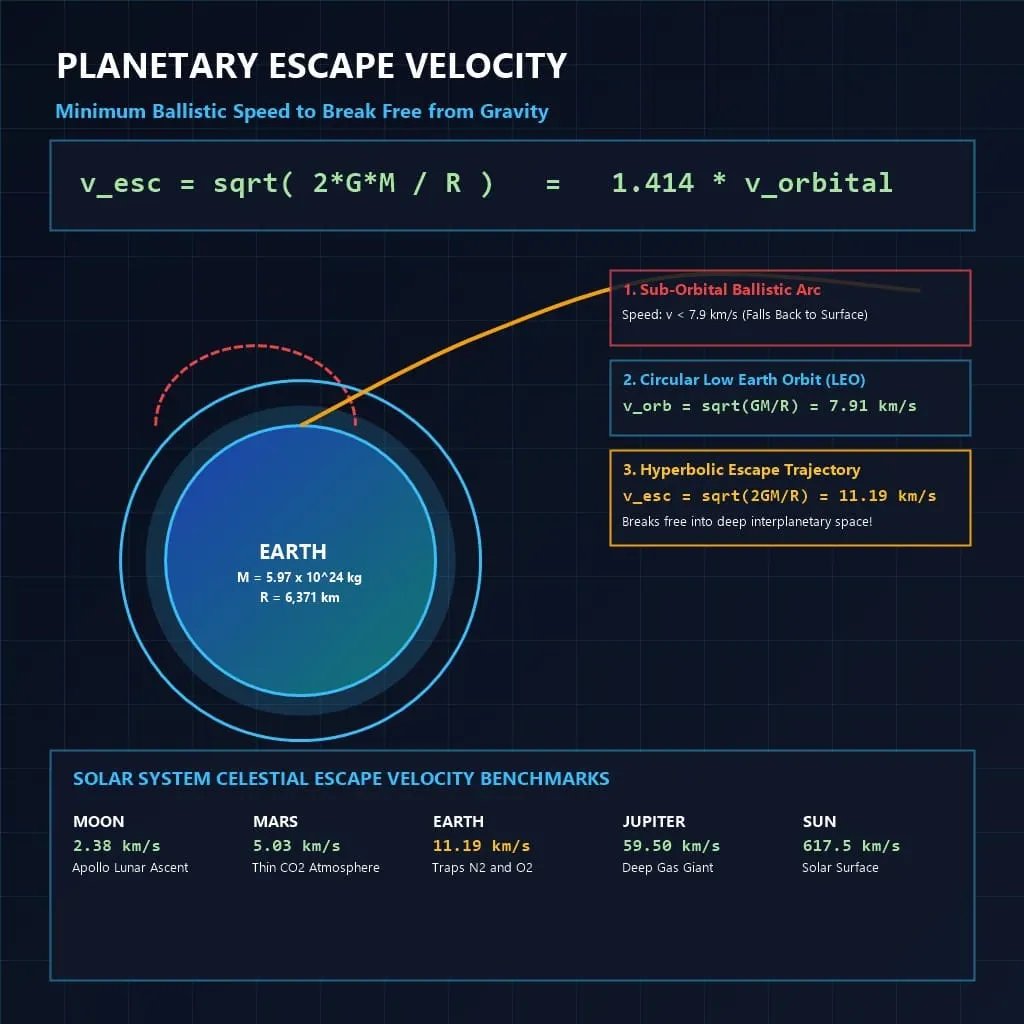
1. Introduction
Why must the Apollo Saturn V and NASA Artemis Space Launch System (SLS) moon rockets accelerate to over () to leave Earth's orbit and reach the Moon? Why is Mars unable to retain a dense nitrogen-oxygen atmosphere like Earth, while the Moon and Mercury have virtually zero atmospheric gases? Why cannot even light itself—the fastest entity in the cosmos—escape from the interior of a black hole?
At the foundational crossroads of orbital mechanics, planetary science, celestial navigation, and astrophysics lies a fundamental cosmic speed limit: Escape Velocity ().
Escape velocity is the minimum initial ballistic speed an unpropelled object must attain at the surface of a celestial body to completely break free from its gravitational field and travel infinitely far away without ever falling back.
graph LR
    M["🪐 Celestial Mass (M)
Planet Mass in kg"] --> MULT["✖️ 2 · G · M"]
    G["🌌 Gravitational Constant (G)
6.6743 × 10⁻¹¹ N·m²/kg²"] --> MULT
    R["📏 Surface Radius (R)
Planet Radius in meters"] --> DIV["➗ Divided By Radius R"]
    MULT --> DIV
    DIV --> SQRT["√ Square Root"]
    SQRT --> V_ESC["🚀 Escape Velocity (v_esc)
v_esc = √(2GM / R) in m/s or km/s"]
    V_ESC --> V_ORB["🛰️ Orbital Velocity Link
v_esc = √2 · v_orbital (≈ 1.414 × v_orb)"]
Mastering escape velocity and gravitational potential calculations enables aerospace engineers and planetary scientists to:
- Design interplanetary trajectory injection burns for deep space exploration probes (Voyager, New Horizons, James Webb Space Telescope).
- Calculate atmospheric gas retention lifespans for exoplanets orbiting distant stars based on molecular Maxwell-Boltzmann thermal velocity distributions.
- Size orbital rocket launch vehicles, solid rocket booster staging, and lunar/Martian ascent stages.
- Model the gravitational collapse of massive stars into white dwarfs, neutron stars, and stellar-mass black holes.
- Calculate the Schwarzschild radius () and event horizons of supermassive black holes.
2. Definitions & Analogies
2.1 The Simple Definition
In simple everyday terms:
- If you throw a stone straight up into the air at a normal speed, Earth's gravity slows it down until it stops and falls back down.
- If you throw it faster, it reaches a higher altitude before falling back.
- Escape Velocity () is the "magic speed" where you launch an object so blindingly fast that gravity gets weaker and weaker as the object travels farther away, and gravity never manages to pull it back.
- On Earth's surface, that magic speed is approximately ( or ).
2.2 The Formal Technical Definition
Energy Conservation Derivation
Escape velocity is derived directly from the Conservation of Mechanical Energy ().
For an object of mass () launched from the surface of a spherical planet of mass () and radius () to reach infinite distance () with zero residual kinetic energy ( and ):
Where:
- is the escape velocity in meters per second () or kilometers per second ().
- is Newton's Universal Gravitational Constant ().
- is the mass of the celestial body in kilograms ().
- is the radial distance from the center of mass to the launch point in meters ().
- Notice that the mass of the projectile () cancels out completely—an apple, a bowling ball, and a rocket all have the exact same escape velocity!
Relative Planetary Ratio Formula (Relative to Earth)
When comparing other planets to Earth (, , ):
Where and .
Escape Velocity vs. Circular Orbital Velocity ()
The velocity required to maintain a low circular orbit at radius is . Therefore:
- The Rule: Any satellite in circular orbit needs to increase its speed by only 41.4% to break completely free from the planet's gravitational grip into an interplanetary hyperbolic escape trajectory!
2.3 The Steep Gravitational Funnel Bowl Analogy
To visualize escape velocity intuitively, imagine a deep, smooth, funnel-shaped gravitational skate bowl:
graph TD
    subgraph Gravitational_Bowl ["🛹 Gravitational Potential Well Analogy"]
        GentleRoll["Low Push (v < v_orb)
Skater rolls up the slope, stops, and rolls back down"]
        RimOrbit["Precise Horizontal Push (v = v_orb)
Skater carves a permanent level circle around the rim (Circular Orbit)"]
        EscapeLeap["Explosive Rocket Push (v ≥ v_esc)
Skater flies over the outer rim entirely into the flat parking lot!"]
        GentleRoll --> RimOrbit --> EscapeLeap
end- Sub-Orbital Ballistic (Too Slow): A gentle push rolls the skateboard partway up the curved wall, but gravity pulls it back down to the center.
- Circular Orbit (): A precise sideways push balances inward gravitational pull against outward centrifugal acceleration, carving a permanent horizontal circle around the bowl.
- Hyperbolic Escape (): An explosive push launches the skateboarder so fast that they fly completely over the outer rim of the bowl and coast onto the infinitely flat parking lot outside.
3. History & Milestones in Orbital Mechanics & Escape Speed
timeline
    title Milestones in Celestial Mechanics & Escape Velocity
    1687 : Isaac Newton proposes the 'Newton's Cannonball' thought experiment in the Principia
    1783 : John Michell conceives 'Dark Stars' where escape velocity equals speed of light
    1916 : Karl Schwarzschild derives the exact Black Hole Event Horizon radius from Einstein's General Relativity
    1959 : Soviet Luna 1 becomes the first human-made object to achieve Earth escape velocity (11.2 km/s)
1977 : NASA launches Voyager 1 & 2 on interstellar hyperbolic escape trajectories from the Solar System- Newton's Cannonball Thought Experiment (1687): In his Principia, Isaac Newton imagined mounting a massive cannon atop a high mountain peak above Earth's atmosphere. Firing with increasing gunpowder charges produces sub-orbital ballistic arcs, then a closed circular orbit (), an eccentric ellipse, and finally a parabolic/hyperbolic trajectory () that never returns.
- John Michell & "Dark Stars" (1783): English natural philosopher John Michell realized that if a star were massive and compact enough, its escape velocity would exceed the speed of light (), preventing light particles from leaving—the earliest conceptual prediction of Black Holes.
- Luna 1 Milestone (1959): The Soviet probe Luna 1 became the first artificial spacecraft to accelerate beyond Earth's escape velocity (), entering a permanent heliocentric solar orbit.
- Voyager 1 Interstellar Escape (1977): Using gravitational gravity-assist slingshots around Jupiter and Saturn, Voyager 1 achieved solar escape velocity ( relative to the Sun), becoming the first human spacecraft to cross the heliopause into interstellar space.
4. Solar System Celestial Bodies Escape Velocity Spectrum
Escape velocity depends directly on planetary mass () and inversely on radius (). Below is the standard benchmark spectrum across the Solar System:
| Celestial Body | Mass Ratio () | Mean Radius ( in ) | Surface Gravity ( in ) | Escape Velocity () | Atmospheric Retention State |
|---|---|---|---|---|---|
| Asteroid Bennu | $0.00006$ | () | Zero (Human can jump into orbit!) | ||
| Ceres (Dwarf Planet) | $0.00015$ | $0.28$ | () | Exosphere only | |
| Earth's Moon | $0.01230$ | $1.62$ | () | Vacuum (Gases boiled away by solar wind) | |
| Mercury | $0.05530$ | $3.70$ | () | Trace exosphere | |
| Mars | $0.10700$ | $3.72$ | () | Thin () | |
| Venus | $0.81500$ | $8.87$ | () | Dense atmosphere () | |
| Earth (Standard Base) | $1.00000$ | $9.81$ | () | Stable biosphere | |
| Uranus | $14.5400$ | $8.87$ | () | Retains | |
| Neptune | $17.1500$ | $11.15$ | () | Retains | |
| Saturn | $95.1600$ | $10.44$ | () | Deep gas giant | |
| Jupiter | $317.8000$ | $24.79$ | () | Massive gas giant | |
| Sun (Solar Surface) | $333,000.0$ | $274.00$ | () | Stellar gravitational well | |
| White Dwarf Star | () | Extreme degenerate matter | |||
| Neutron Star | () | Relativistic spacetime curvature | |||
| Black Hole (Event Horizon) | Any Mass | Nothing can escape (Event Horizon) |
5. Planetary Atmospheric Gas Retention (Jeans Escape)
Why does Earth hold onto oxygen () and nitrogen () while letting helium and hydrogen escape into space?
According to the Maxwell-Boltzmann distribution of molecular thermal speeds, the root-mean-square thermal velocity of gas molecules of molar mass () at absolute temperature () is:
graph TD
    JEANS["🌡️ Planetary Atmospheric Retention Rule"] --> COND1["• Rule of Thumb: If v_esc > 6 × v_thermal
Atmosphere is retained stably for >4.5 Billion Years"]
    JEANS --> COND2["• If v_esc < 6 × v_thermal
High-energy tail of distribution escapes into space (Jeans Escape)"]

    COND1 --> EX1["🌍 Earth: v_esc = 11.2 km/s > 6 × v_O2 (2.9 km/s) → Nitrogen & Oxygen Trapped Forever"]
COND2 --> EX2["🌕 Moon: v_esc = 2.38 km/s < 6 × v_gas → All atmospheric gases leaked away"]- Hydrogen () on Earth (): . Because (), free hydrogen gas slowly leaks into space from the upper exosphere over millions of years.
- Oxygen () on Earth: . Here , meaning oxygen remains permanently trapped in Earth's gravitational grasp.
6. Master Formula Matrix & Problem Solver
| Unknown Variable | Primary Formula | Formula in Terms of Surface Gravity () | Formula Relative to Earth () |
|---|---|---|---|
| Escape Velocity () | |||
| Circular Orbit Speed () | |||
| Planet Mass () | |||
| Planet Radius () | |||
| Schwarzschild Radius () | — |
7. Practical Real-World Calculation Examples
Example 1: Calculating Mars Surface Escape Velocity
- Scenario: Planet Mars has a mass () and mean equatorial radius .
- Step 1: Calculate :
- Step 2: Divide by Radius and Take Square Root:
- Ratio Check:
Example 2: Moon Escape Velocity and Apollo Lunar Module Ascent
- Scenario: The Moon has mass and radius .
- Escape Velocity Calculation:
- Apollo LM Ascent Stage Delta-V: Because the Moon's escape velocity is only (and orbital velocity is only ) with zero air drag, the Apollo Lunar Module required only a small hypergolic rocket engine ( thrust) to launch the astronauts back into lunar orbit!
Example 3: Super-Earth Exoplanet Escape Velocity
- Scenario: Astronomers discover a rocky Super-Earth exoplanet orbiting a nearby red dwarf star. Spectroscopic measurements confirm the planet has twice Earth's radius () and eight times Earth's mass ().
- Calculated Escape Velocity:
- Astrophysical Impact: With an escape velocity of over , this super-Earth will retain dense blankets of hydrogen and helium, likely evolving into a "Mini-Neptune" with crushing surface pressures.
Example 4: Escape Velocity of the Sun from Earth's Orbit
- Scenario: What speed must an interstellar probe (like Voyager or New Horizons) attain to escape the Sun's gravitational well starting from Earth's orbital radius (, Solar Mass )?
- Calculated Solar Escape Speed from 1 AU:
- Earth's Orbital Velocity Boost: Because Earth is already revolving around the Sun at , launching in the direction of Earth's orbital motion reduces the required additional delta-v to only:
Example 5: Calculating the Schwarzschild Radius of Earth as a Black Hole
- Scenario: If planet Earth () were compressed until its escape velocity equaled the speed of light (), what would its radius be?
- Schwarzschild Radius Equation:(If the entire mass of planet Earth were compressed into a marble smaller than a dime, it would collapse into a black hole!).
8. Real-World Engineering Case Studies
Case Study 1: Why Rockets Don't Launch at Escape Velocity (Powered Ascent vs. Ballistic Guns)
- Popular Misconception: Non-physicists often assume a rocket must leave the launchpad traveling at ().
- Aerospace Reality:- If a rocket attempted to travel at at sea level, atmospheric aerodynamic drag resistance () and thermal friction would incinerate the vehicle within 2 seconds.- A chemical rocket is continuously propelled. It ascends slowly through the dense lower atmosphere (), clears the atmosphere ( Karman line), accelerates horizontally into Low Earth Orbit (LEO) at , and then performs a Trans-Lunar Injection (TLI) or Trans-Mars Injection (TMI) burn in the vacuum of space, boosting velocity from with zero atmospheric drag.
graph TD
    subgraph Launch_Profile ["🚀 Space Mission Launch Profile"]
        LiftOff["1. Lift-Off from Earth
Slow ascent through dense air (v < 1.5 km/s)"]
        LEO["2. Low Earth Orbit Insertion (h = 200 km)
Circular orbital speed: v_orb = 7.8 km/s"]
        TLI["3. Trans-Lunar / Interplanetary Injection Burn
Vacuum burn boosts: 7.8 km/s + 3.2 km/s = 11.0 km/s"]
        Escape["4. Hyperbolic Escape Trajectory
Spacecraft departs Earth gravitational well for Mars/Jupiter"]
        LiftOff --> LEO --> TLI --> Escape
    end
Case Study 2: Gravitational Slingshot Maneuvers (Voyager 1 & 2 Interstellar Escape)
- Deep Space Dilemma: In 1977, chemical rocket propulsion technology could not provide enough propellant mass to directly accelerate the Voyager 1 spacecraft to the Sun's escape velocity ().
- Gravitational Slingshot Physics (Gravity Assist):- Voyager flew behind the giant planet Jupiter in its orbital path around the Sun.- In Jupiter's frame of reference, Voyager approached at speed and departed at the exact same speed (conservation of energy in planet frame).- In the Sun's heliocentric reference frame, Voyager gained a massive boost equal to twice Jupiter's orbital velocity vector ():
- Interplanetary Outcome: The Jupiter gravity assist boosted Voyager's heliocentric speed by over without burning a single drop of fuel, catapulting the spacecraft past Saturn and out of the solar system on an irreversible interstellar voyage.
9. Common Mistakes & How to Avoid Them
Mistake 1: Confusing Escape Velocity with Orbital Velocity
Forgetting the factor. Circular orbital velocity is ( for Earth). Escape velocity is higher: .
Mistake 2: Assuming Projectile Mass Matters
Believing that a heavier rocket needs a higher escape velocity than a small satellite. In , the projectile mass cancels out completely.
Mistake 3: Kilometer vs. Meter Conversion Errors
Substituting radius in kilometers (e.g., ) into formulas with . This introduces an error by a factor of . Always convert kilometers to base meters ().
10. Frequently Asked Questions (FAQ)
Q1: What is the escape velocity from Earth's surface?
A: Earth's surface escape velocity is (), which equals approximately or .
Q2: Does escape velocity depend on launch angle?
A: In the absence of atmospheric drag and obstacles, escape velocity is completely independent of launch angle! Because energy is a scalar quantity (), launching at vertically, at , or horizontally over the horizon provides enough total kinetic energy to escape to infinity (as long as the path does not collide with the planet's surface).
Q3: What is the escape velocity at higher altitudes above Earth?
A: Because escape velocity decreases with the square root of radial distance from the planet's center (), it drops at higher altitudes:
- Earth Surface (): .
- Low Earth Orbit (, ISS altitude): .
- Geostationary Orbit (): .
Q4: Why can a person jump off small asteroids into orbit?
A: Small asteroids (like Bennu or Ryugu, diameter ) have minuscule mass (), producing an escape velocity of only (). A human jumping at a modest speed () would easily exceed escape velocity and drift away into interplanetary space!
Q5: Can an object escape a planet without ever reaching escape velocity?
A: Yes, if it has continuous active propulsion. If you had a rocket with infinite fuel burning continuously at a steady (), you could ascend indefinitely to infinity without ever exceeding . Escape velocity is strictly the speed required for unpropelled, ballistic coasting.
Q6: What is the difference between Solar System Escape Velocity and Earth Escape Velocity?
A: - Earth Escape Velocity (): Speed needed to escape Earth's gravity and enter orbit around the Sun.
- Solar Escape Velocity from Earth's Orbit (): Speed needed to escape the Sun's gravity and enter interstellar space.
Q7: What is the Event Horizon of a Black Hole?
A: The event horizon is the boundary radius () around a collapsed singularity where the gravitational escape velocity equals the speed of light (). Because nothing in the universe can travel faster than , no matter or radiation can ever cross back outward.
Q8: What is the Tsiolkovsky rocket equation?
A: The fundamental equation governing orbital propulsion delta-v:
Where is the rocket engine specific impulse in seconds, , and is the propellant mass ratio.
11. Expert Tips & Best Practices
- Use the Ratio Method for Exoplanet Calculations: When calculating escape velocities for exoplanets, use to avoid cumbersome multi-digit scientific notation constants.
- Remember the Multiplier: To find circular orbital speed from escape speed, simply divide by ().
- Always Convert Distance to Meters: Ensure planetary radii are in meters before evaluating to prevent square-root magnitude errors.
12. Summary & Key Takeaways
- Universal Escape Velocity Formula: (measured in or ).
- Earth Benchmark: Earth's surface escape velocity is ().
- Mass Independence: Escape speed depends solely on the celestial body's mass and radius; the projectile's mass cancels out completely.
- Orbital Relationship: Escape velocity is exactly the circular orbital speed ().
- Atmospheric & Cosmological Significance: Governs planetary gas retention (Jeans escape), deep-space interplanetary trajectories, asteroid gravity-assist slingshots, and black hole event horizons.
Additional Technical Guidelines & Measurement Standards
When conducting calculations for Escape Velocity Planetary Surface Solver, maintaining quantitative precision and verifying input parameter boundaries is essential for reliable scenario evaluation. Always verify that raw numerical inputs are measured using standardized instrumentation, and double-check unit conversions prior to applying outputs in commercial, industrial, or academic projects.
For quantitative unit conversions and scientific calculations, always maintain at least four decimal places of precision during intermediate arithmetic stages before rounding final results. When preparing technical reports, laboratory documentation, or financial forecasts, cross-verify all output variables against established international measurement standards (such as SI, NIST, and ISO metric benchmarks) to guarantee consistent analytical rigor across all computational workflows.
MathsLover.com delivers this interactive solver 100% free of charge to foster global mathematical literacy, educational accessibility, and data-driven problem solving across scientific, technical, and academic communities worldwide.