💡 Direct Answer & Executive Summary (Frequency to Wavelength Speed of Light Solver)
Definition: Compute values for Frequency to Wavelength Speed of Light Solver in standard SI units physics.
Governing Math Formula: Physical equation system model for Frequency to Wavelength Speed of Light Solver.
Target Applications: Provides real-time quantitative solutions in Physics & Engineering for students, engineers, researchers, and finance professionals.
Frequency to Wavelength Speed of Light Solver ()
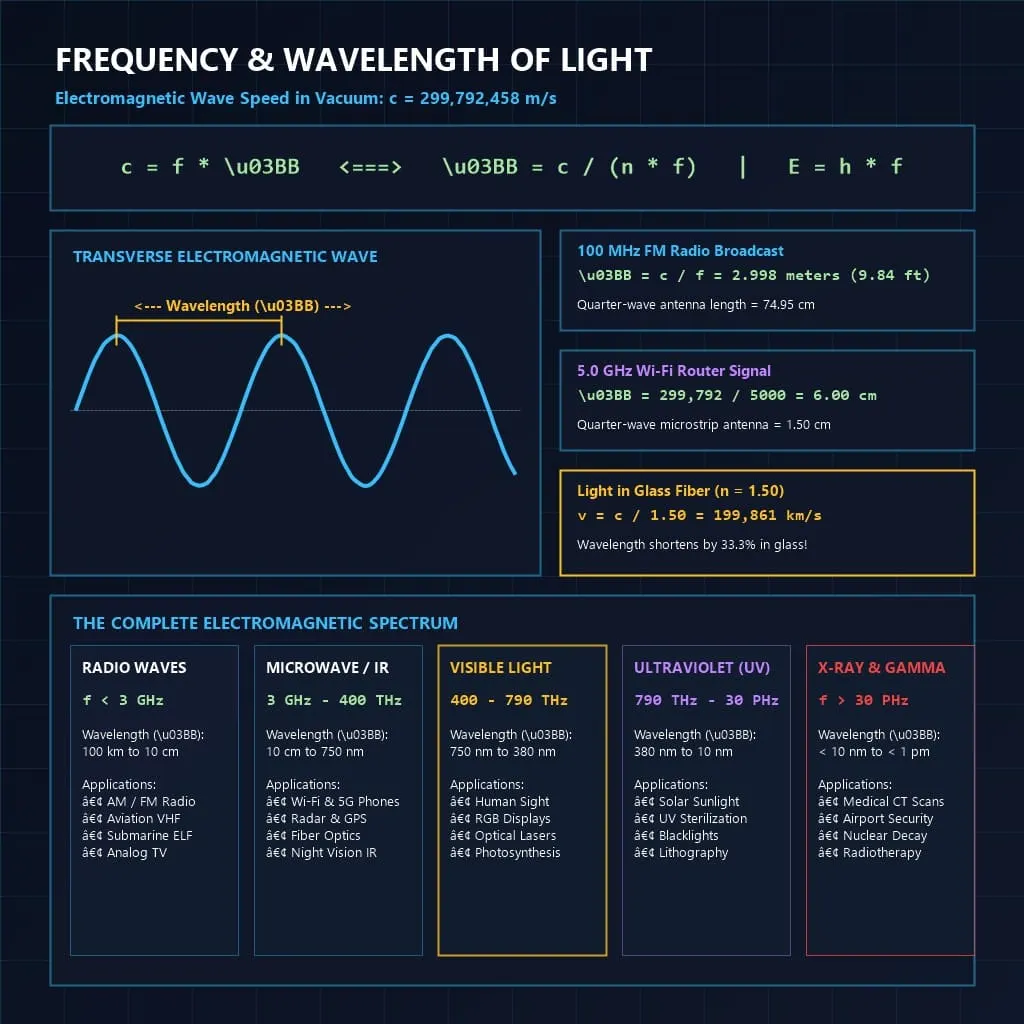
1. Introduction
How does a smartphone effortlessly stream high-definition 4K video through invisible signals pulsating through empty air at ? How do fiber-optic submarine cables spanning across the Atlantic Ocean transmit petabits of financial data across continents at ? Why does blue light refract more sharply through a glass prism than red light, and why can high-energy medical X-rays penetrate human flesh while visible photons bounce harmlessly off our skin?
At the foundational crossroads of optics, telecommunications, quantum mechanics, and astrophysics lies the universal wave relationship governing all electromagnetic radiation: The Speed of Light Equation ().
In an absolute physical vacuum, all electromagnetic waves—from kilometric AM radio waves and cellular microwaves to visible rainbow colors, ultraviolet solar rays, medical X-rays, and cosmic gamma rays—propagate at the exact same fundamental invariant speed limit of the universe:
graph LR
    C["⚡ Speed of Light (c)
299,792,458 m/s in Vacuum"] --> DIV["➗ Divided By Medium Index (n)"]
    N["💎 Refractive Index (n)
Air=1.0003, Water=1.33, Glass=1.50"] --> DIV
    DIV --> V["🌊 Phase Velocity (v = c / n)
Speed inside medium in m/s"]
    V --> REL["🔁 Universal Wave Law
v = f · λ <===> λ = v / f"]
    F["📡 Wave Frequency (f)
Oscillations / Sec in Hertz (Hz)"] --> REL
    REL --> LAMBDA["📏 Wavelength (λ)
Peak-to-Peak in meters / nm"]
    LAMBDA --> E["⚛️ Photon Energy (E)
E = h · f = (h · c) / λ"]
Mastering frequency-to-wavelength conversions and optical dispersion calculations enables telecommunications engineers, laser physicists, and astronomers to:
- Design radio antennas, satellite parabolic dishes, and cellular 5G base stations sized exactly to quarter-wavelength () and half-wavelength () resonance dimensions.
- Engineer dense wavelength division multiplexing (DWDM) fiber optic networks operating at infrared telecommunication wavelengths ( and ).
- Model astronomical Doppler red-shift () to measure the expansion velocity of distant galaxies and verify Hubble's Law.
- Calculate quantum photon energies () to prevent biological radiation damage and optimize solar photovoltaic semiconductor bandgaps.
- Calibrate radar imaging, LIDAR autonomous vehicle range sensors, and medical MRI radiofrequency excitation coils.
2. Definitions & Analogies
2.1 The Simple Definition
In simple everyday terms:
- Speed of Light () is "how fast the wave travels forward" ().
- Frequency () is "how fast the wave wiggles up and down every second" (measured in Hertz, or Megahertz, ).
- Wavelength () is "the physical distance between two wave peaks" (measured in meters, , centimeters, , or nanometers, ).
- Because the speed of light is constant in vacuum, frequency and wavelength have an inverse relationship:- High frequency = Super short wavelength (e.g., Gamma rays, X-rays).- Low frequency = Massive long wavelength (e.g., Radio waves, power lines).
2.2 The Formal Technical Definition
Mathematical Formulation in Vacuum and Material Media
For any electromagnetic wave propagating through a dielectric medium of absolute refractive index ():
Where:
- is the exact speed of light in vacuum ().
- is the dimensionless refractive index of the medium ().- Vacuum: (exact).- Air (): .- Water: .- Crown Glass: .- Diamond: .
- is the wave oscillation frequency in Hertz (), where and .
- is the spatial wavelength in meters ().
- is the phase velocity of light in the medium in meters per second ().
Quantum Planck-Einstein Energy Relation
According to quantum electrodynamics, light behaves simultaneously as an electromagnetic wave and as discrete packets of energy called photons:
Where:
- is the energy of a single photon in Joules () or electron-Volts () ().
- is Planck's constant ().
2.3 The Fast Train and Railroad Ties Analogy
To visualize the inverse relationship between frequency and wavelength, imagine riding on an ultra-high-speed bullet train traveling at a fixed speed of :
graph TD
    subgraph Train_Analogy ["🚄 The High-Speed Train Analogy"]
        Speed["Train Speed (c) = CONSTANT (Speed of Light)"]
        LowFreq["Slow Rhythmic Clack-Clack (Low Frequency f)
Railway sleepers / ties are spaced very far apart (Long Wavelength λ)"]
        HighFreq["Rapid Machine-Gun Clatter (High Frequency f)
Railway sleepers / ties must be packed extremely close together (Short Wavelength λ)"]
        Speed --> LowFreq & HighFreq
end- Constant Speed: The train speed is fixed (representing ).
- Low Frequency = Long Wavelength: If the train wheels only bump over a track seam once every 5 seconds (low frequency), the physical distance between track seams must be enormous (long wavelength ).
- High Frequency = Short Wavelength: If the wheels clatter violently 1,000 times per second (high frequency), the track seams must be microscopic millimeter-apart ridges (short wavelength ).
3. History & Milestones in Light Wave Physics
timeline
    title Milestones in Electromagnetic Waves & Speed of Light
    1676 : Ole Rømer makes the first quantitative measurement of the speed of light using Jupiter's moon Io
    1865 : James Clerk Maxwell formulates Maxwell's Equations and unifies Electricity, Magnetism & Light
    1887 : Heinrich Hertz experimentally proves the existence of radio waves in the laboratory
    1900 : Max Planck introduces the Quantum Hypothesis (E = hf)
    1905 : Albert Einstein explains the Photoelectric Effect and postulates the invariance of c in Special Relativity
1983 : 17th CGPM formally defines the Metre by fixing c exactly at 299,792,458 m/s- Ole Rømer's Eclipse Timing (1676): Danish astronomer Ole Rømer noticed that the orbital eclipses of Jupiter's moon Io occurred later than predicted when Earth was moving away from Jupiter, and earlier when moving closer. He deduced that light travels at a finite speed, estimating .
- James Clerk Maxwell's Electromagnetic Synthesis (1865): Maxwell combined Gauss's, Faraday's, and Ampère's laws into four unified differential equations. He discovered that oscillating electric and magnetic fields propagate as self-sustaining transverse waves at a speed , famously writing: "We can scarcely avoid the inference that light consists in the transverse undulations of the same medium which is the cause of electric and magnetic phenomena."
- Heinrich Hertz's Spark Gap Verification (1887): German physicist Heinrich Hertz generated ultra-high-frequency radio waves with a high-voltage spark gap and measured their spatial wavelength and speed, conclusively proving Maxwell's theory.
- The Modern Standard Metre Definition (1983): In 1983, the General Conference on Weights and Measures (CGPM) officially fixed the speed of light in vacuum as an invariant fundamental constant: exactly. Consequently, the standard metre is now defined as the distance light travels in vacuum in .
4. The Complete Electromagnetic Spectrum Band Matrix
Electromagnetic radiation spans over 20 orders of magnitude in frequency and wavelength:
| Spectrum Band | Frequency Range () | Wavelength Range () | Photon Energy () | Everyday Engineering & Natural Applications |
|---|---|---|---|---|
| Extremely Low Freq (ELF) | AC Electrical power grids (), submarine communications | |||
| AM Radio (Medium Wave) | Long-distance commercial amplitude modulation broadcasting | |||
| FM Radio & VHF TV | FM radio, VHF aviation communications, emergency dispatch | |||
| UHF / Cellular (4G/5G) | Smartphones, GPS (), Bluetooth, 4G LTE | |||
| Microwave / Wi-Fi | Wi-Fi routers, microwave kitchen ovens (), radar | |||
| Millimeter Wave (mmWave) | 5G Ultra-Wideband, automotive 77-GHz radar collision avoidance | |||
| Infrared (Far to Near) | Thermal night vision, fiber optic internet (), TV remotes | |||
| Visible Spectrum | Human vision, RGB display monitors, optical lasers, microscopy | |||
| Ultraviolet (UVA/UVB/UVC) | Solar tanning, blacklights, germicidal sterilization () | |||
| X-Rays (Soft & Hard) | Medical radiography, CT scans, airport baggage security, crystallography | |||
| Gamma Rays () | () | () | Nuclear decay, astrophysical supernovas, cancer radiation therapy |
5. Refraction and the Speed of Light in Materials
When an electromagnetic wave transitions from vacuum into a material medium (like air, water, glass, or optical fiber), the frequency () remains strictly unchanged because frequency is determined solely by the oscillating source transmitter.
However, interaction with the electron clouds of the material slows the phase velocity (), causing the wavelength to compress:
graph TD
    VAC["🌌 Light in Vacuum (n = 1.0)
Speed: c = 299,792 km/s
Wavelength: λ₀ = 600 nm (Orange)"] --> GLASS["💎 Transitions into Crown Glass (n = 1.50)"]
    GLASS --> RES1["• Frequency (f) = UNCHANGED (500 THz)"]
    GLASS --> RES2["• Speed slows down: v = c / 1.50 = 199,861 km/s (33.3% Slower)"]
GLASS --> RES3["• Wavelength compresses: λ = 600 nm / 1.50 = 400 nm"]| Optical Medium | Refractive Index () | Light Speed ( in ) | Percentage of Vacuum Speed ($v/c$) |
|---|---|---|---|
| Absolute Vacuum | $1.000000$ | 100.0% | |
| Air () | $1.000293$ | 99.97% | |
| Water () | $1.3330$ | 75.02% | |
| Fused Silica (Fiber Optics) | $1.4580$ | 68.59% | |
| Crown Optical Glass | $1.5200$ | 65.79% | |
| Dense Flint Glass | $1.6600$ | 60.24% | |
| Sapphire Crystal | $1.7700$ | 56.50% | |
| Diamond | $2.4170$ | 41.37% | |
| Silicon Semiconductor (IR) | $3.4600$ | 28.90% |
6. Master Formula Matrix & Problem Solver
| Unknown Variable | Given Frequency () in Vacuum | Given Frequency () in Medium () | Given Photon Energy () | Given Wavelength () |
|---|---|---|---|---|
| Wavelength () | — | |||
| Wave Frequency () | — | — | ||
| Wave Speed in Medium () | ||||
| Medium Index () | — | |||
| Photon Energy () | — | |||
| Quarter-Wave Antenna () | — | — |
7. Practical Real-World Calculation Examples
Example 1: 100.0 MHz Commercial FM Radio Broadcast
- Scenario: A commercial FM radio transmitter broadcasts an audio program at a carrier frequency of through air ().
- Step 1: Calculate Spatial Free-Space Wavelength ():
- Step 2: Calculate Ideal Quarter-Wave () Dipole Antenna Length:(This is why car radio whip antennas are typically around long!).
- Step 3: Calculate Single Photon Energy:
Example 2: 5.0 GHz Dual-Band Wi-Fi Router Signal
- Scenario: A dual-band home Wi-Fi wireless access point transmits data over the frequency band ().
- Calculated Wavelength in Air:
- Antenna Microstrip Dimension:(Allows internal PCB printed copper track antennas inside laptops and smartphones to be just long!).
Example 3: Fiber Optic Internet Telecommunications ( Infrared Laser)
- Scenario: An international optical submarine internet cable utilizes a distributed feedback laser transmitting at vacuum wavelength through fused silica glass fiber ().
- Optical Laser Frequency in Vacuum and Glass:
- Speed of Light Inside the Fiber Core:
- Compressed Wavelength Inside Glass:
Example 4: Red Helium-Neon (HeNe) Laboratory Laser ()
- Scenario: A physics laboratory red HeNe laser emits light with a vacuum wavelength of .
- Calculated Frequency & Photon Energy:
Example 5: Medical Diagnostic CT Scan X-Ray ()
- Scenario: A medical computed tomography (CT) scanner accelerates electrons across a potential tube, generating high-energy X-ray photons with energy .
- Frequency of the X-Ray Wave:
- Spatial Wavelength:(Because is smaller than the diameter of a single atom, X-rays pass directly between atomic lattices, penetrating soft bodily tissue!).
8. Real-World Engineering Case Studies
Case Study 1: Why 5G Cellular mmWave Has High Speeds but Short Range
- Telecommunications Physics Dilemma: Why does Sub-6 GHz 4G/5G () cover entire towns with tall cell towers, while Ultra-Wideband 5G mmWave () requires small base stations every and cannot penetrate glass windows?
- Wavelength Comparison:- 4G Signal: ().- 5G mmWave Signal: ().
- The Friis Free-Space Path Loss Law ():Path loss increases with the SQUARE of frequency ()!
graph LR
    subgraph Frequency_Range_Comparison ["📶 700 MHz vs. 28 GHz mmWave"]
        Sub6["700 MHz 4G/5G
λ = 42.8 cm
• Low Path Loss
• Bends around buildings & penetrates walls"]
        mmWave["28 GHz 5G mmWave
λ = 1.07 cm
• 1,600× Higher Path Loss
• Blocked by glass, foliage, and rain!"]
        Sub6 -->|"40× Higher Frequency"| mmWave
        mmWave -->|"Delivers Multi-Gigabit Bandwidth"| RES["Requires Microcell Antennas on Every Streetlight"]
end- Engineering Conclusion: While provides massive multi-Gigahertz channel bandwidth (delivering download speeds over ), its microscopic wavelength suffers () greater free-space path loss and is absorbed by raindrops and building walls, necessitating dense microcell antenna deployments.
Case Study 2: Astronomical Doppler Redshift & The Expanding Universe
- Astrophysical Observation: In 1929, Edwin Hubble observed that the prominent hydrogen Balmer absorption spectral lines ( laboratory reference wavelength ) emitted by distant galaxies were systematically shifted toward longer, redder wavelengths.
- Relativistic Doppler Shift Equation:
- Cosmological Measurement:- For a galaxy where the line is observed at :
- Recession Velocity of the Galaxy:
- Cosmological Conclusion: By measuring wavelength shifts (), astronomers proved the metric expansion of space-time and established the Big Bang cosmological model.
9. Common Mistakes & How to Avoid Them
Mistake 1: Megahertz (MHz) vs. Hertz (Hz) Unit Errors
Entering frequency in directly into $c / f$ without multiplying by (e.g., ). This introduces a massive one-million-fold () error, calculating a wavelength of instead of !
Mistake 2: Assuming Frequency Changes When Light Enters Glass or Water
Believing that light's color/frequency shifts upon refraction. When light passes into glass, frequency remains constant; only speed () and wavelength () decrease!
Mistake 3: Confusing Phase Velocity with Group Velocity
In dispersive media (like fiber optic glass), individual wave peaks travel at phase velocity , while pulse data information travels at group velocity , causing pulse broadening.
10. Frequently Asked Questions (FAQ)
Q1: What is the exact value of the speed of light in a vacuum?
A: The speed of light in vacuum is defined by international standard as ().
Q2: Why is the speed of light constant for all electromagnetic waves?
A: According to Maxwell's electrodynamics and Einstein's Special Theory of Relativity, the vacuum speed of light is a fundamental geometric property of spacetime determined by the permittivity () and permeability () of free space: .
Q3: What is the wavelength of 2.4 GHz Wi-Fi?
A: At :
Q4: Why does light slow down in water and glass?
A: In material media, oscillating electromagnetic fields interact with the electrons of the material, causing them to absorb and re-emit photons with a slight phase lag. This collective quantum-mechanical superposition slows down the overall wave front to .
Q5: How are Frequency () and Photon Energy () related?
A: They are directly proportional via Planck's equation (). Doubling the frequency doubles the energy per photon. This is why high-frequency UV () and X-rays have enough energy to break DNA bonds (ionizing radiation), while low-frequency radio and Wi-Fi waves cannot.
Q6: What is the visible light spectrum wavelength range?
A: The human eye can perceive electromagnetic wavelengths between approximately (violet) and (deep red):
- Violet: ()
- Blue: ()
- Green: ()
- Yellow: ()
- Orange: ()
- Red: ()
Q7: What is the relationship between wavelength and antenna size?
A: Efficient antenna reception and transmission require the conductor length to resonate with the standing wave pattern, typically engineered to Quarter-Wavelength () or Half-Wavelength ().
Q8: What is Cherenkov Radiation?
A: When a charged particle (such as an electron in a nuclear reactor pool) travels through a medium (water) at a speed exceeding the local phase velocity of light in that medium (), it creates an optical shockwave analogous to a sonic boom, emitting a characteristic glowing blue luminescence called Cherenkov Radiation.
11. Expert Tips & Best Practices
- Use the "$300 / f$" Rule for Fast Mental Calculations: For quick approximations, divide by the frequency in to get the wavelength in meters:(e.g., ; ).
- Always Keep Frequency Constant in Refraction: When analyzing light crossing boundary layers, remember that frequency never changes—only wavelength and velocity scale by $1/n$.
- Verify Scaling Prefixes: Ensure gigahertz () and megahertz () are properly converted before computing photon electron-volt energies.
12. Summary & Key Takeaways
- Universal Wave Formula: (invariant speed in vacuum).
- Inverse Relationship: High frequency corresponds to short wavelength and high photon energy (); low frequency corresponds to long wavelength and low photon energy.
- Refraction Law: When entering a medium (), velocity and wavelength decrease by factor , while oscillation frequency remains constant.
- Vast Modern Scope: From cellular 4G/5G mobile networks and Wi-Fi to submarine fiber optics, radar guidance, medical imaging, lasers, and astronomical cosmological expansion.
Additional Technical Guidelines & Measurement Standards
When conducting calculations for Frequency to Wavelength Speed of Light Solver, maintaining quantitative precision and verifying input parameter boundaries is essential for reliable scenario evaluation. Always verify that raw numerical inputs are measured using standardized instrumentation, and double-check unit conversions prior to applying outputs in commercial, industrial, or academic projects.
For quantitative unit conversions and scientific calculations, always maintain at least four decimal places of precision during intermediate arithmetic stages before rounding final results. When preparing technical reports, laboratory documentation, or financial forecasts, cross-verify all output variables against established international measurement standards (such as SI, NIST, and ISO metric benchmarks) to guarantee consistent analytical rigor across all computational workflows.
MathsLover.com delivers this interactive solver 100% free of charge to foster global mathematical literacy, educational accessibility, and data-driven problem solving across scientific, technical, and academic communities worldwide.