💡 Direct Answer & Executive Summary (Kinetic Energy & Momentum Calculator)
Definition: Calculate mechanical kinetic energy (KE) and linear momentum of a moving object given mass and velocity.
Governing Math Formula: KE = ½ × m × v², Momentum p = m × v.
Target Applications: Provides real-time quantitative solutions in Physics & Engineering for students, engineers, researchers, and finance professionals.
Kinetic Energy & Linear Momentum: Comprehensive Engineering Guide
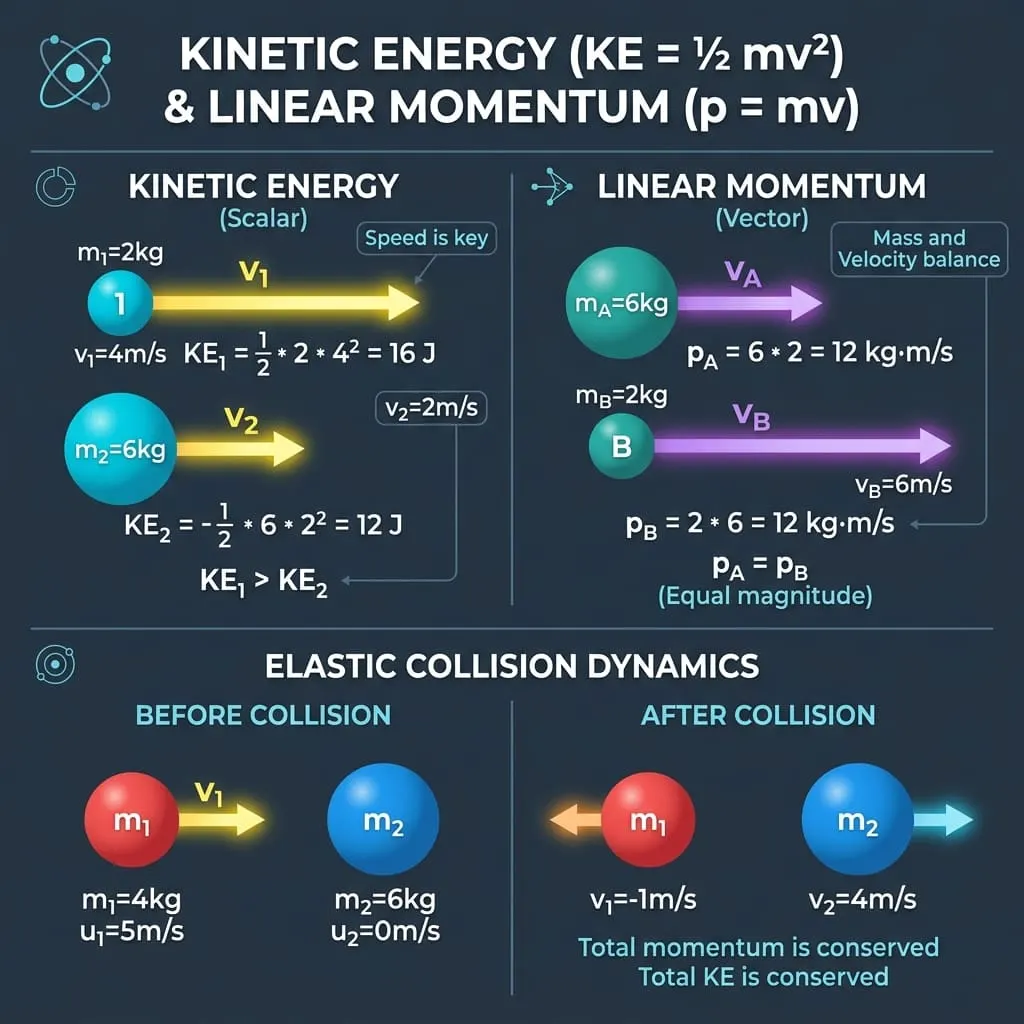
1. Introduction
Everything in our physical universe in a state of motion carries two fundamental quantities that dictate how it interacts with the world: Kinetic Energy () and Linear Momentum ().
Whether analyzing the safety design of automotive crash crumple zones, predicting the orbital velocity of communication satellites, calculating wind turbine blade aerodynamics, or evaluating ballistic impacts in materials science, understanding how mass () and velocity () govern these twin pillars of classical mechanics is essential.
graph TD
    M["⚖️ Mass (m)
Inertial Measure (kg)"] --> COMB["🚀 Object in Motion"]
    V["⚡ Velocity (v)
Speed with Direction (m/s)"] --> COMB
    COMB -->|"Scalar Work Capacity (½mv²)"| KE["💥 Kinetic Energy (KE)
Measured in Joules (J)"]
    COMB -->|"Vector Motion Quantity (mv)"| P["🎯 Linear Momentum (p)
Measured in kg·m/s"]
    KE -.->|"Relates via p² / (2m)"| P
While both quantities depend entirely on an object's mass and speed, they represent fundamentally distinct physical properties:
- Kinetic Energy () is a scalar quantity measuring an object's capacity to perform mechanical work. Because it scales quadratically with velocity (), doubling an object's speed quadruples its kinetic energy.
- Linear Momentum () is a vector quantity measuring the quantity of motion and directional inertia. It scales linearly with velocity () and is strictly conserved in all isolated physical systems.
In this comprehensive guide, we explore the mathematical derivations, comparative dynamics, real-world engineering case studies, step-by-step calculation protocols, and key problem-solving techniques for kinetic energy and momentum.
2. Definitions & Physical Meaning
2.1 The Simple Definition
In simple terms:
- Momentum is "how hard it is to stop a moving object." A slow heavy freight train and a fast light bullet can both have immense momentum because momentum equals mass multiplied by speed.
- Kinetic Energy is "the destruction or work potential stored in that motion." Because speed is squared when computing kinetic energy, the fast light bullet carries far more destructive work energy than a slow object of equal momentum.
2.2 Formal Technical Definitions
Kinetic Energy ( or )
The mechanical work () required to accelerate a body of given mass () from rest () to its stated velocity ():
- SI Unit: Joule () .
- Vector Status: Scalar (magnitude only, always non-negative for classical speeds).
Linear Momentum ()
The product of a particle's inertial mass () and its instantaneous velocity vector ():
- SI Unit: or Newton-second ().
- Vector Status: Vector (possesses both magnitude and spatial direction identical to ).
2.3 The Bullet vs. Bowling Ball Analogy
To grasp the distinction intuitively, compare a high-velocity bullet moving at with a bowling ball rolled at :
graph LR
    subgraph Bullet ["🔫 High-Speed Rifle Bullet"]
        B_M["Mass = 0.01 kg"]
        B_V["Velocity = 600 m/s"]
        B_P["Momentum: p = 6 kg·m/s"]
        B_KE["Kinetic Energy: KE = 1,800 Joules"]
        B_M & B_V --> B_P & B_KE
    end

    subgraph BowlingBall ["🎳 Slow Heavy Bowling Ball"]
        BB_M["Mass = 6.0 kg"]
        BB_V["Velocity = 1.0 m/s"]
        BB_P["Momentum: p = 6 kg·m/s"]
        BB_KE["Kinetic Energy: KE = 3 Joules"]
        BB_M & BB_V --> BB_P & BB_KE
end- Momentum Comparison: Both have the exact same momentum (). Stopping either object with a constant force of requires exactly of time ().
- Kinetic Energy Comparison: The bullet carries of kinetic energy, whereas the bowling ball carries only ( less!). The bullet will pierce deep into armor because it does more mechanical work over distance ().
3. Historical Milestones in Mechanics
timeline
    title Historical Evolution of Momentum & Kinetic Energy
    1644 : René Descartes proposes 'quantity of motion' as scalar product (mass × speed)
    1687 : Sir Isaac Newton publishes 'Principia', defining momentum and F = dp/dt
    1686-1695 : Gottfried Wilhelm Leibniz coins 'vis viva' (living force, mv²)
    1738 : Daniel Bernoulli applies vis viva conservation in fluid hydrodynamics
    1807 : Thomas Young first introduces the scientific term 'Energy'
    1829 : Gaspard-Gustave de Coriolis introduces the modern ½ coefficient in ½mv²
1905 : Albert Einstein unifies mass-energy equivalence in Special Relativity- Descartes vs. Leibniz: René Descartes initially believed that the universe conserved the scalar product . Gottfried Wilhelm Leibniz proved through falling bodies that drop heights scale with , introducing the concept of vis viva ().
- Newton's Second Law: Isaac Newton originally formulated his Second Law not as , but as the rate of change of momentum over time:
- Coriolis' Mathematical Rigor (1829): French mathematician Gaspard-Gustave de Coriolis formally integrated work () to establish the modern factor of , finalizing .
4. Fundamental Formulas & Relationships
4.1 The Direct Connection Between and
Since , substituting into the kinetic energy equation yields:
Conversely, linear momentum expressed in terms of kinetic energy:
This equation is critical in quantum mechanics (de Broglie wavelength ) and nuclear scattering experiments.
4.2 Master Formula Matrix
| Desired Variable | Given & | Given & | Given & | Given & | Given & |
|---|---|---|---|---|---|
| Kinetic Energy () | — | — | |||
| Linear Momentum () | — | — | |||
| Velocity () | — | — | — | ||
| Mass () | — | — |
5. Elastic vs. Inelastic Collision Dynamics
When bodies collide in an isolated system (no external net forces), Momentum is ALWAYS strictly conserved. However, Kinetic Energy may or may not be conserved.
graph TD
    COL["💥 Collision in Isolated System"] --> ELAS["🟢 Perfectly Elastic Collision"]
    COL --> INELAS["🟡 Inelastic Collision"]
    COL --> PINELAS["🔴 Perfectly Inelastic Collision"]

    ELAS -->|"Characteristics"| ELAS_D["• Momentum Conserved: Σp_initial = Σp_final
• Kinetic Energy Conserved: ΣKE_initial = ΣKE_final
• Coefficient of Restitution e = 1.0
• Examples: Subatomic particles, billiard balls"]

    INELAS -->|"Characteristics"| INELAS_D["• Momentum Conserved: Σp_initial = Σp_final
• Kinetic Energy Lost to heat/sound/deformation
• Coefficient of Restitution: 0 < e < 1
• Examples: Vehicle collisions, sports balls"]

    PINELAS -->|"Characteristics"| PINELAS_D["• Momentum Conserved: Σp_initial = Σp_final
• Objects stick together and move at identical velocity
• Maximum possible KE loss
• Coefficient of Restitution: e = 0
• Examples: Ballistic pendulum, clay ball hitting wall"]
6. Step-by-Step Problem Solving Protocol
flowchart TD
    A["Step 1: Parse Inputs & Target
(Identify mass m, velocity v, target KE or p)"] --> B["Step 2: Standardize Units to SI
(grams -> kg, km/h -> m/s, lbs -> kg, mph -> m/s)"]
    B --> C["Step 3: Select Working Equation
(KE = ½mv² or p = mv or p = √(2m·KE))"]
    C --> D["Step 4: Calculate & Verify Dimensions
(Confirm Joules [J] for energy, kg·m/s for momentum)"]
7. Practical Real-World Calculation Examples
Example 1: Passenger Vehicle on a Highway
- Scenario: A sedan with mass is traveling at .
- Step 1: Unit Conversion:
- Linear Momentum:
- Kinetic Energy:
Example 2: Impact of Doubling Vehicle Speed
- Scenario: The same car increases speed from () to ().
- At :
- At :
- Ratio:
- Safety Takeaway: Doubling your driving speed quadruples () braking distance and collision impact energy.
Example 3: Baseball Pitch Momentum & Energy
- Scenario: A major league baseball () is thrown at ().
- Momentum:
- Kinetic Energy:
Example 4: Commercial Aircraft at Cruising Altitude
- Scenario: A Boeing 737 with loaded mass cruises at ().
- Momentum:
- Kinetic Energy:
Example 5: Finding Velocity from Kinetic Energy
- Scenario: An arrow with mass (35 grams) is shot from a compound bow with .
- Calculation:
8. Real-World Engineering Case Studies
Case Study 1: Automotive Crash Safety & Crumple Zone Mechanics
- Engineering Challenge: In a high-speed vehicle impact, human organs can only tolerate decelerations up to without fatal trauma.
- Physical Analysis:- A vehicle at () has () and momentum .- By the Work-Energy Theorem:
- Rigid Chassis ( deformation):
- Engineered Crumple Zone ( controlled progressive crush):
- Conclusion: By extending crush distance , crumple zones absorb kinetic energy smoothly and extend impact duration $\Delta t$, dropping peak deceleration forces into survivable thresholds.
Case Study 2: Space Debris Orbital Velocity & Satellite Shielding
- Background: In Low Earth Orbit (LEO), space debris travels at orbital velocities around .
- Analysis:- Consider a tiny paint fleck of mass .- Momentum: .- Kinetic Energy:
- is equivalent to the energy of a person being dropped from the top of a 30-story building!
- Engineering Solution: Whipple shields use multiple sacrificial thin outer aluminum bumper layers spaced apart. When ultra-high velocity debris strikes the first sheet, its kinetic energy instantly shock-vaporizes the particle into an expanding cloud of harmless gas before reaching the pressurized crew hull.
9. Common Mistakes & How to Avoid Them
Mistake 1: Forgetting to Square the Velocity in Kinetic Energy
Beginners frequently calculate instead of . Always ensure velocity is multiplied by itself before multiplying by mass.
Mistake 2: Mixing km/h with SI Base Units
Entering velocity in directly into formulas without dividing by $3.6$ produces energy values off by a factor of . Always convert to first.
Mistake 3: Treating Momentum as a Scalar
Unlike kinetic energy (which is scalar and always adds), momentum is a vector. If two equal cars collide head-on at , total system momentum before impact is , while total kinetic energy is .
10. Comparison: Kinetic Energy vs. Linear Momentum
| Feature | Kinetic Energy () | Linear Momentum () |
|---|---|---|
| Mathematical Formula | ||
| Quantity Type | Scalar (Magnitude only) | Vector (Magnitude and Direction) |
| SI Unit | Joule () | or |
| Dependence on Velocity | Quadratic () | Linear ($p \propto v$) |
| Can it be Negative? | No ( in classical mechanics) | Yes (Depends on coordinate frame direction) |
| Conservation in Collisions | Only in perfectly elastic collisions | Conserved in ALL isolated collisions |
| Associated Physical Law | Work-Energy Theorem () | Newton's 2nd Law & Impulse () |
11. Frequently Asked Questions (FAQ)
Q1: What happens to kinetic energy in an inelastic car crash?
A: Kinetic energy is not destroyed; it transforms into other forms of energy according to the First Law of Thermodynamics—specifically mechanical plastic deformation work (bending steel frame), thermal heat generation, acoustic noise (the sound of the crash), and material fracture energy.
Q2: Can an object have large momentum but small kinetic energy?
A: Yes. An extremely massive object moving very slowly (such as a 100,000-ton cargo supertanker drifting at ) possesses massive linear momentum () but relatively modest kinetic energy ().
Q3: What is the relationship between Impulse and Momentum?
A: Impulse () is the integral of net force applied over an elapsed time interval $\Delta t$, and equals the exact change in momentum:
Q4: Does rotational motion have kinetic energy?
A: Yes. Rotating rigid bodies possess Rotational Kinetic Energy:
Where is the moment of inertia () and is angular velocity (). A rolling wheel carries both translational () and rotational kinetic energy.
Q5: When does relativistic kinetic energy need to be used?
A: Classical formulas () fail when velocities exceed roughly 10% the speed of light (). At relativistic speeds, Einstein's relativistic equation must be used:
Q6: Can kinetic energy be negative?
A: In classical Newtonian mechanics, mass is positive () and , so kinetic energy is strictly non-negative (). In contrast, potential energy can be negative depending on the arbitrary reference zero-point.
Q7: Why do ballistic pendulums measure both momentum and energy in separate phases?
A: In a ballistic pendulum (used to measure bullet speed): 1. Phase 1 (Impact): The collision between bullet and block is perfectly inelastic. Momentum is conserved (), but KE is lost. 2. Phase 2 (Swing): As the block swings upward to height , mechanical energy is conserved ().
Q8: What is the Center of Mass frame in momentum analysis?
A: The Center of Mass (CoM) frame is the reference coordinate system moving at the velocity of the system's center of mass. In this special frame, total momentum is identically zero (), which greatly simplifies collision calculations.
12. Summary & Key Takeaways
- Kinetic Energy: (Scalar, measured in Joules ).
- Linear Momentum: (Vector, measured in or ).
- Direct Bridge: and .
- Velocity Sensitivity: Speed is squared in kinetic energy calculations, making velocity the dominant factor in high-speed impact physics.
- Universal Conservation: Total linear momentum is always conserved in isolated collisions, while kinetic energy is only conserved in perfectly elastic interactions.
Additional Technical Guidelines & Measurement Standards
When conducting calculations for Kinetic Energy & Momentum Calculator, maintaining quantitative precision and verifying input parameter boundaries is essential for reliable scenario evaluation. Always verify that raw numerical inputs are measured using standardized instrumentation, and double-check unit conversions prior to applying outputs in commercial, industrial, or academic projects.
For quantitative unit conversions and scientific calculations, always maintain at least four decimal places of precision during intermediate arithmetic stages before rounding final results. When preparing technical reports, laboratory documentation, or financial forecasts, cross-verify all output variables against established international measurement standards (such as SI, NIST, and ISO metric benchmarks) to guarantee consistent analytical rigor across all computational workflows.
MathsLover.com delivers this interactive solver 100% free of charge to foster global mathematical literacy, educational accessibility, and data-driven problem solving across scientific, technical, and academic communities worldwide.