💡 Direct Answer & Executive Summary (Momentum p = mv Solver)
Definition: Compute values for Momentum p = mv Solver in standard SI units physics.
Governing Math Formula: Physical equation system model for Momentum p = mv Solver.
Target Applications: Provides real-time quantitative solutions in Physics & Engineering for students, engineers, researchers, and finance professionals.
Momentum () & Impulse Solver
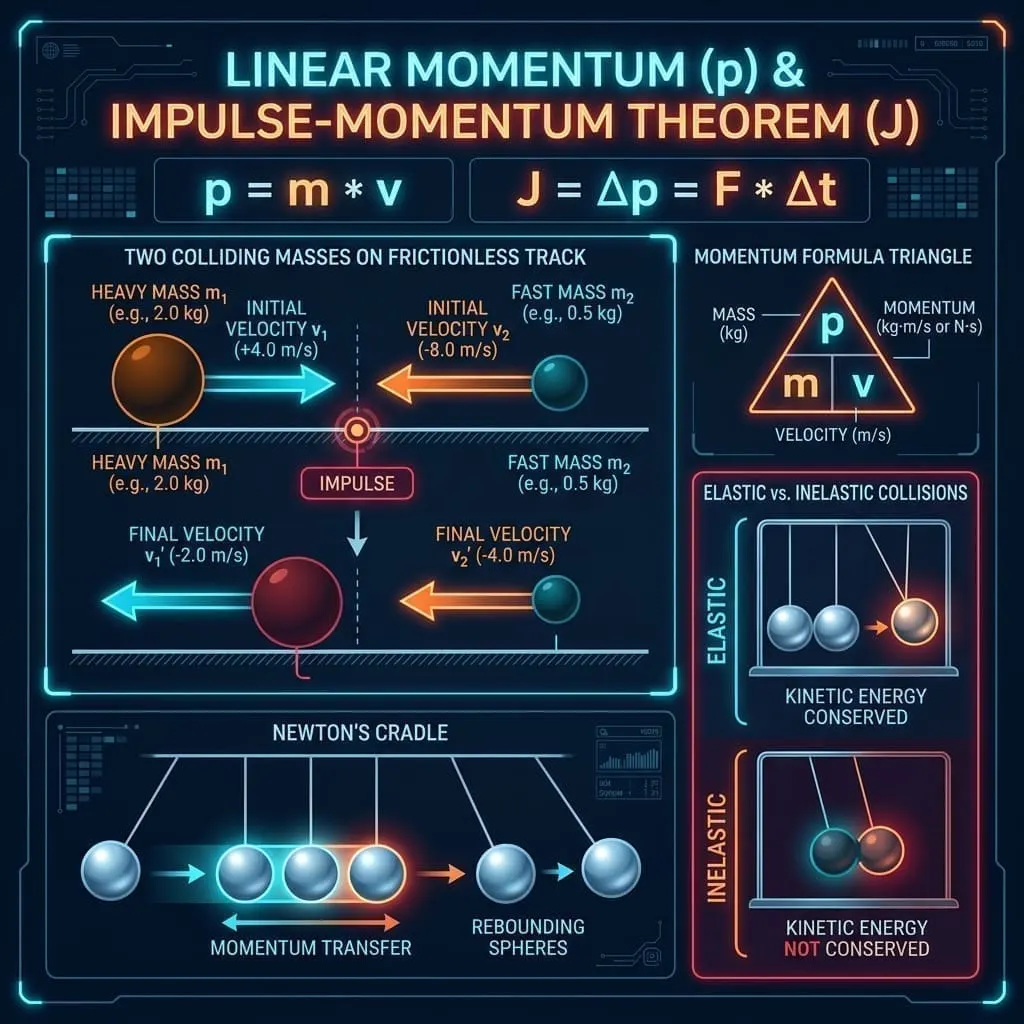
1. Introduction
Why is it virtually impossible for a lone person to stop a slowly rolling railroad boxcar moving at a sluggish (), even though they could effortlessly catch a baseball flying at ()? Why do modern automobile crumple zones and deploying airbags save human lives during high-speed crashes by extending the impact duration by just a few tens of milliseconds? Why does an orbital rocket accelerate forward into space by expelling hot combustion exhaust gases backward out of its nozzle?
At the foundational bedrock of classical mechanics, vehicular collision safety, astrophysics, and quantum particle physics lies one of the most inviolable conservation laws in the universe: the Law of Conservation of Linear Momentum ().
First codified by Sir Isaac Newton in 1687 as the "Quantity of Motion" (quantitas motus), momentum measures the reluctance of a moving mass to be brought to a halt.
graph LR
    M["⚖️ Moving Mass (m)
Kilograms (kg)"] --> MULT["✖️ Multiplied By"]
    V["🚀 Velocity Vector (v)
Meters / Second (m/s)"] --> MULT
    MULT --> P["💥 Linear Momentum (p)
p = m · v in kg·m/s or N·s"]
    P --> J["⏱️ Impulse-Momentum Theorem
J = F · Δt = Δp"]
    P --> COLL["🎱 Momentum Conservation
Σ p_initial = Σ p_final"]
Mastering momentum and impulse calculations enables engineers and scientists to:
- Design automotive crash protection systems (airbags, crumple zones, seatbelt pretensioners) that minimize peak deceleration forces on passengers.
- Calculate rocket propulsion staging, exhaust gas exit velocities, and orbital delta-v ($\Delta v$) trajectories using the Tsiolkovsky rocket equation.
- Analyze ballistics, planetary meteorite crater impacts, and asteroid planetary defense deflection missions (e.g., NASA's DART mission).
- Model subatomic particle scattering and nuclear fission dynamics inside high-energy particle accelerators.
- Optimize athletic sports performance, from golf club impact dynamics and baseball bat sweet spots to martial arts strikes.
2. Definitions & Analogies
2.1 The Simple Definition
In simple everyday terms:
- Mass () is "how heavy an object is" (measured in kilograms, ).
- Velocity () is "how fast it is moving and in what direction" (measured in ).
- Linear Momentum () is "how hard it is to stop the moving object" ().
- An object with high momentum requires either a huge stopping force or a very long time to bring to rest.
2.2 The Formal Technical Definition
Mathematical Formulation of Linear Momentum
For a point mass or rigid body translating in three-dimensional space:
Where:
- is the linear momentum vector in kilogram-meters per second () or Newton-seconds ().
- is the invariant rest mass in kilograms ().
- is the instantaneous velocity vector in meters per second ().
- Because velocity is a vector possessing magnitude and direction, momentum is strictly a vector quantity pointing in the identical direction as velocity.
Newton's Second Law: The True Momentum Formulation
While high school physics often summarizes Newton's Second Law as , Newton originally formulated his second law in terms of the time rate of change of momentum:
- If mass is constant (), this simplifies to .
- If mass changes dynamically (such as a burning rocket shedding propellant mass), the full momentum derivative must be used.
The Impulse-Momentum Theorem
Multiplying force by the duration of time over which it acts yields Impulse (), which equals the total change in momentum ():
- SI Unit: Newton-second () .
2.3 The Freight Train vs. High-Speed Bullet Analogy
To visualize the interplay between mass and velocity in linear momentum, compare two dramatically different moving objects:
graph TD
    subgraph Heavy_Train ["🚂 Heavy Slow Freight Train"]
        M1["Mass = 100,000 kg (100 tons)"]
        V1["Velocity = 0.2 m/s (0.72 km/h)"]
        P1["Momentum: p = 20,000 kg·m/s
(Colossal Mass dominates momentum)"]
        M1 & V1 --> P1
    end
    subgraph Fast_Bullet ["🔫 Light High-Speed Bullet"]
        M2["Mass = 0.020 kg (20 grams)"]
        V2["Velocity = 1,000 m/s (Mach 2.9)"]
        P2["Momentum: p = 20 kg·m/s
(High Velocity creates high KE, but low momentum)"]
        M2 & V2 --> P2
end- The Freight Train at : Has a massive momentum of . Even though it moves slower than walking speed, standing in front of it is fatal because stopping it in would require a crushing force of .
- The Rifle Bullet at : Has a momentum of ( less momentum than the train!). A bullet is dangerous because its kinetic energy is concentrated into a sharp tip (), but its actual linear momentum is tiny compared to a slow freight car.
3. History & Milestones in Momentum & Collision Mechanics
timeline
    title Milestones in Momentum & Collision Theory
    1644 : René Descartes proposes 'Quantity of Motion' as a conserved scalar property
    1668 : John Wallis, Christopher Wren, and Christiaan Huygens prove momentum conservation
    1687 : Isaac Newton publishes Principia, defining p = mv and F = dp/dt
    1738 : Daniel Bernoulli links gas pressure to molecular momentum impacts (Kinetic Theory)
    1903 : Konstantin Tsiolkovsky derives the Ideal Rocket Equation based on momentum
1905 : Albert Einstein reformulates Relativistic Momentum (p = γmv)- Descartes' Early Concept (1644): French philosopher René Descartes correctly surmised that the total "quantity of motion" in the universe is conserved, but erroneously treated it as a scalar magnitude without accounting for direction.
- Huygens & The Royal Society (1668): In response to a prize contest by the Royal Society of London, Dutch polymath Christiaan Huygens, alongside John Wallis and Christopher Wren, experimentally demonstrated with pendulum collisions that momentum is a directional vector quantity and that total momentum is perfectly conserved in all isolated collisions.
- Isaac Newton's Principia (1687): Newton synthesized these findings into his Second and Third Laws, showing that because every action has an equal and opposite reaction (), internal forces within a closed system can never alter the total system momentum.
- Konstantin Tsiolkovsky's Rocket Equation (1903): Russian visionary Konstantin Tsiolkovsky applied momentum conservation to variable-mass systems, proving that space travel is possible by expelling propellant reaction mass.
4. Elastic vs. Inelastic Collisions
When two or more bodies collide in an isolated system (where external net force ), Total Momentum is ALWAYS 100% Conserved. However, Kinetic Energy may or may not be conserved depending on the collision elasticity:
graph TD
    COLLS["💥 Collision Classification Types"] --> ELAST["🟢 Perfectly Elastic Collision"]
    COLLS --> INELAST["🟡 Inelastic Collision"]
    COLLS --> PERF_INELAST["🔴 Perfectly Inelastic Collision"]

    ELAST -->|"Properties"| E_PROP["• Total Momentum: CONSERVED (Σ p_i = Σ p_f)
• Kinetic Energy: CONSERVED (Σ KE_i = Σ KE_f)
• Coefficient of Restitution: e = 1.0
• Examples: Subatomic particle collisions, Newton's Cradle, billiard balls (approx)"]

    INELAST -->|"Properties"| I_PROP["• Total Momentum: CONSERVED (Σ p_i = Σ p_f)
• Kinetic Energy: NOT Conserved (Converted to heat/sound/deformation)
• Coefficient of Restitution: 0 < e < 1.0
• Examples: Tennis ball bounce, basketball on hardwood"]

    PERF_INELAST -->|"Properties"| PI_PROP["• Total Momentum: CONSERVED (Σ p_i = Σ p_f)
• Kinetic Energy: MAXIMUM LOSS (Objects stick together: v₁' = v₂' = v_f)
• Coefficient of Restitution: e = 0.0
• Examples: Car crashes, ballistic pendulums, clay dropped on floor"]| Collision Characteristic | Perfectly Elastic () | Inelastic () | Perfectly Inelastic () |
|---|---|---|---|
| Total Linear Momentum () | 100% CONSERVED | 100% CONSERVED | 100% CONSERVED |
| Total Kinetic Energy ($\Sigma KE$) | 100% CONSERVED | Partially Lost to Heat/Sound | Maximum Kinetic Energy Lost |
| Post-Collision Geometry | Objects bounce apart cleanly | Objects rebound with reduced speed | Objects lock/stick together () |
| Coefficient of Restitution () |
5. Master Formula Matrix & Step-by-Step Problem Solver
| Unknown Variable | Primary Formula | Formula Given Impulse () | Formula Given Kinetic Energy () |
|---|---|---|---|
| Linear Momentum () | |||
| Moving Mass () | |||
| Velocity Speed () | |||
| Impulse () | — | ||
| Average Impact Force () | — | ||
| Kinetic Energy () | — |
6. Step-by-Step Computational Procedure
flowchart TD
    S1["Step 1: Identify Mass, Velocity, and Direction
(Extract m in kg, v in m/s, and assign positive/negative direction signs)"] --> S2["Step 2: Calculate Initial Momentum
(Compute p_initial = m · v in kg·m/s)"]
    S2 --> S3["Step 3: Evaluate Collisions or External Impulses
(Apply Σ p_i = Σ p_f or Impulse-Momentum Theorem J = F · Δt = Δp)"]
    S3 --> S4["Step 4: Solve for Unknown Target Variable
(Determine final velocity v_f, impact force F_avg, or required mass m)"]
    S4 --> S5["Step 5: Verify Vector Sanity & Energy Loss
(Confirm momentum vector direction and ensure KE_final ≤ KE_initial)"]
7. Practical Real-World Calculation Examples
Example 1: Commercial Passenger Jet Momentum at Cruise
- Scenario: A fully loaded Boeing 777-300ER commercial airliner has a gross takeoff mass () cruising at true airspeed ().
- Calculated Linear Momentum ():
- Stored Kinetic Energy ():
Example 2: Automobile Crash Crumple Zone Impact Force
- Scenario: A sedan traveling at () collides head-on into a solid concrete bridge abutment and comes to a dead stop ().
- Initial Momentum ():
- Case A: Rigid Car (No Crumple Zone, stops in ):
- Case B: Engineered Crumple Zone + Airbag (Extends crash duration to ):(Extending the impact time by reduced the peak impact crushing force by !).
Example 3: Baseball Batter Sweet-Spot Strike Impulse
- Scenario: A professional baseball thrown at (toward home plate) is struck by a wooden bat and launched in the opposite direction at (). The bat-ball contact duration is ().
- Step 1: Calculate Total Momentum Change ():
- Step 2: Calculate Average Strike Force ():
Example 4: Perfectly Inelastic Head-On Vehicle Collision
- Scenario: A pickup truck traveling North at collides head-on with a compact car traveling South at . The two vehicles crumple and lock together as a single entangled mass ().
- Conservation of Momentum Equation:(The heavier truck overcomes the faster compact car, shoving the wreckage northward).
Example 5: Rifle Recoil Velocity
- Scenario: A sniper rifle of mass fires a lead bullet of mass at a muzzle velocity .
- Recoil Velocity of the Rifle ():
8. Real-World Engineering Case Studies
Case Study 1: NASA DART Mission (Asteroid Kinetic Impactor Deflection)
- Mission Challenge: In September 2022, NASA executed the Double Asteroid Redirection Test (DART) mission to demonstrate planetary asteroid defense by smashing a spacecraft into the moonlet asteroid Dimorphos () orbiting the larger asteroid Didymos.
- Kinetic Impactor Dynamics:- DART Spacecraft Mass at Impact: .- Relative Impact Velocity: ().- Raw Impactor Momentum:
- Momentum Enhancement Factor ():Because the hypervelocity impact blasted thousands of tons of rock and dust debris backward as ejecta plume, this backward momentum transfer imparted a reaction kick to the asteroid, multiplying the effective momentum transfer by a factor :
- Resulting Asteroid Velocity Change ($\Delta V$):
- Planetary Defense Success: Although a velocity change of under sounds small, over orbital distances this shortened Dimorphos's 12-hour orbital period by a massive 33 minutes, proving humanity can deflect earth-bound asteroids given sufficient warning.
Case Study 2: SpaceX Falcon 9 Rocket Staging & The Tsiolkovsky Equation
- Rocket Propulsion Physics: A rocket in the vacuum of space has no atmosphere to push against; it accelerates forward strictly by the Law of Conservation of Momentum by expelling high-velocity hot gas molecules backward:
- Falcon 9 Second Stage Parameter Analysis:- Merlin Vacuum (MVac) Effective Exhaust Velocity: ().- Fully Fueled Second Stage Mass: (including of RP-1/LOX propellant and a satellite).- Burnout Mass (Propellant Depleted): .
- Stage Delta-V Velocity Insertion Calculation:
- Outcome: The second stage gains of orbital velocity purely through continuous backward momentum expulsion, successfully injecting the payload into Geostationary Transfer Orbit (GTO).
9. Common Mistakes & How to Avoid Them
Mistake 1: Forgetting Velocity Vector Signs in 1D/2D Collisions
Treating all velocities as positive numbers. If Object 1 moves Right () and Object 2 moves Left (), entering both as $+10$ makes the total momentum appear as instead of the true value of ! Always set a coordinate axis ($+$ Right, $-$ Left).
Mistake 2: Confusing Linear Momentum () with Kinetic Energy ()
Assuming kinetic energy is conserved in all collisions. While total momentum () is always 100% conserved in all isolated collisions, kinetic energy is conserved ONLY in perfectly elastic collisions. In car crashes and real impacts, kinetic energy is converted into plastic metal deformation, heat, and sound.
Mistake 3: Neglecting External Forces in Non-Isolated Systems
Applying momentum conservation when strong external forces are present (such as ground friction over long distances or gravity during extended free-fall). Momentum is strictly conserved only during the brief instant of collision () where internal collision forces dwarf external friction.
10. Frequently Asked Questions (FAQ)
Q1: What is the difference between Momentum () and Inertia?
A: - Inertia is an intrinsic resistance to acceleration that depends solely on Mass (), regardless of whether the object is moving or at rest.
- Momentum () is "inertia in motion"—it depends on both mass and velocity. A motionless stationary boulder has immense inertia, but zero momentum.
Q2: What is the relationship between Momentum and Kinetic Energy?
A: Momentum scales linearly with velocity ($p \propto v$), whereas Kinetic Energy scales quadratically (). They are mathematically interconnected by:
Q3: How does Newton's Cradle work?
A: When one steel sphere is lifted and dropped, it strikes the stationary row with momentum and kinetic energy . Because the hard steel spheres undergo virtually perfect elastic collisions (), both momentum and kinetic energy must be conserved simultaneously. The only mathematical solution that satisfies both $\Sigma p$ and $\Sigma KE$ conservation is for exactly one sphere to pop out the opposite end at the exact same velocity!
Q4: What is Relativistic Momentum in Einstein's Special Relativity?
A: As an object's speed approaches the speed of light (), classical mechanics breaks down. Einstein showed that momentum approaches infinity as velocity nears , governed by the Lorentz factor ():
Q5: What is Angular Momentum ()?
A: Angular momentum is the rotational analogue of linear momentum, defined for a rotating mass around an axis:
Where is the Moment of Inertia () and is angular velocity (). Like linear momentum, total angular momentum is strictly conserved in the absence of external net torque.
Q6: What is a Ballistic Pendulum and how is it used to measure bullet speed?
A: A ballistic pendulum consists of a heavy wooden block suspended by strings. When a high-speed bullet embeds itself into the block (perfectly inelastic collision), momentum conservation determines the block's initial recoil velocity (). By measuring the vertical height () the pendulum swings upward (), the bullet's muzzle velocity can be calculated with extreme precision.
Q7: What is the Coefficient of Restitution ()?
A: The coefficient of restitution measures the elasticity of a collision, defined as the ratio of relative separation speed after impact to relative approach speed before impact:
- : Perfectly elastic.
- : Perfectly inelastic (objects stick together).
Q8: Do photons of light have momentum even though they have zero rest mass?
A: Yes! In quantum mechanics, photons carry momentum inversely proportional to their wavelength, despite having zero invariant rest mass:
This photon momentum creates Radiation Pressure, which enables solar sail spacecraft (like The Planetary Society's LightSail 2) to navigate across the solar system propelled by sunlight alone.
11. Expert Tips & Best Practices
- Always Establish Direction Signs Before Writing Equations: Explicitly designate forward/right as positive ($+$) and backward/left as negative ($-$) to prevent directional sign errors.
- Use the Impulse-Momentum Theorem for Impact Force Calculations: When calculating shock forces in machinery or structural drops, use directly.
- Incorporate Soft Deceleration Cushions to Lengthen $\Delta t$: In robotics and packaging design, doubling the deceleration stopping distance or time cuts peak structural impact forces in half.
12. Summary & Key Takeaways
- Fundamental Linear Momentum Formula: (measured in or ).
- Universal Conservation Law: Total momentum before any isolated collision or explosion equals total momentum after ().
- Newton's True Force Law: Force equals the time rate of momentum change: .
- Impulse-Momentum Equivalence: Impulse ; extending impact duration ($\Delta t$) drastically reduces destructive peak crushing forces.
- Ubiquitous Science: Powers automotive crash safety engineering, orbital rocket staging, asteroid deflection missions, and quantum subatomic particle dynamics.
Additional Technical Guidelines & Measurement Standards
When conducting calculations for Momentum p = mv Solver, maintaining quantitative precision and verifying input parameter boundaries is essential for reliable scenario evaluation. Always verify that raw numerical inputs are measured using standardized instrumentation, and double-check unit conversions prior to applying outputs in commercial, industrial, or academic projects.
For quantitative unit conversions and scientific calculations, always maintain at least four decimal places of precision during intermediate arithmetic stages before rounding final results. When preparing technical reports, laboratory documentation, or financial forecasts, cross-verify all output variables against established international measurement standards (such as SI, NIST, and ISO metric benchmarks) to guarantee consistent analytical rigor across all computational workflows.
MathsLover.com delivers this interactive solver 100% free of charge to foster global mathematical literacy, educational accessibility, and data-driven problem solving across scientific, technical, and academic communities worldwide.