💡 Direct Answer & Executive Summary (Potential Energy Gravitational Solver)
Definition: Compute values for Potential Energy Gravitational Solver in standard SI units physics.
Governing Math Formula: Physical equation system model for Potential Energy Gravitational Solver.
Target Applications: Provides real-time quantitative solutions in Physics & Engineering for students, engineers, researchers, and finance professionals.
Gravitational Potential Energy ()
1. Introduction
Why does water held high behind the colossal concrete wall of a hydroelectric dam possess the dormant capacity to spin multi-megawatt electrical turbine generators and power entire cities? Why does a roller coaster train require a motorized mechanical chain lift only on the initial ascent, effortlessly coasting through loops, camelbacks, and corkscrews for the remainder of the ride? How do pumped-storage hydro facilities serve as the world's most powerful grid-scale clean energy batteries?
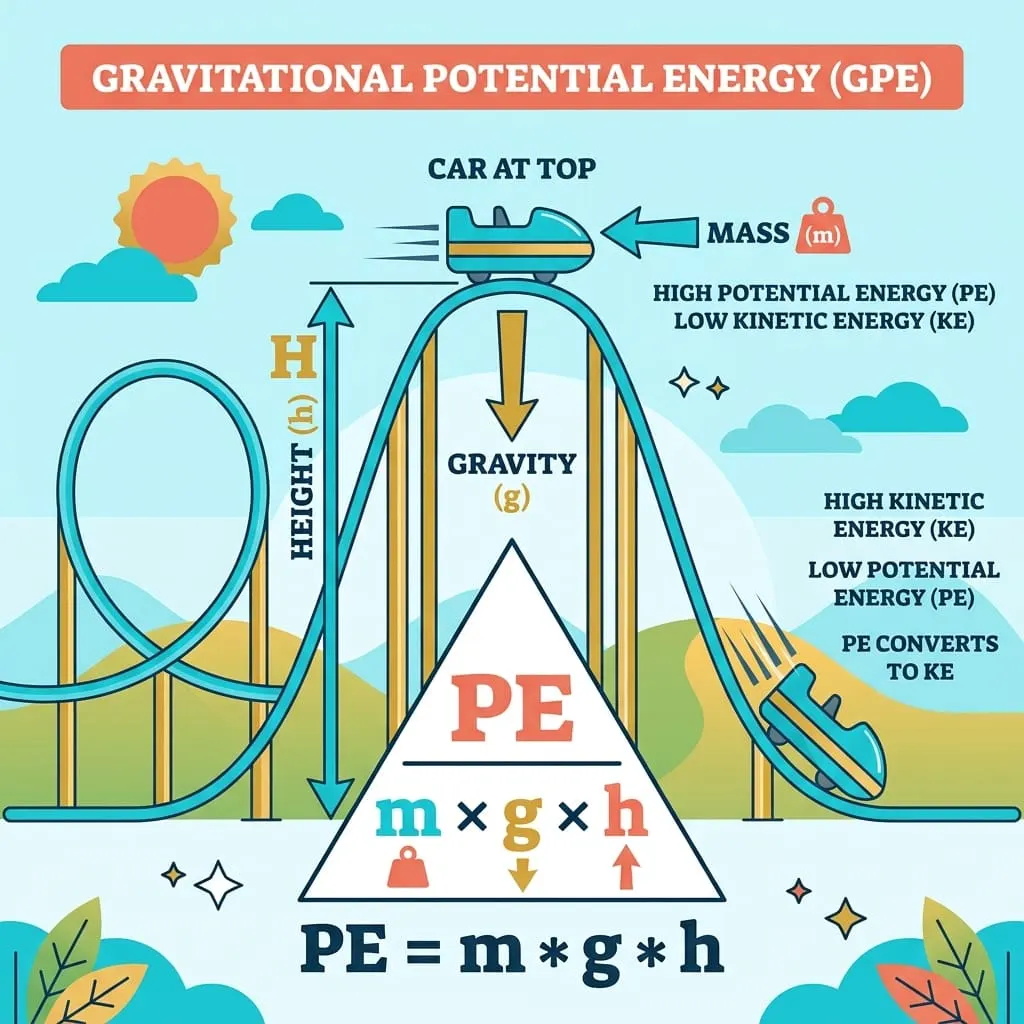
These mechanical systems are governed by Gravitational Potential Energy ()—the mechanical energy stored within an object as a consequence of its vertical position within a gravitational field.
graph LR
    M["⚖️ Object Mass (m)
Inertial Mass in kg"] --> MULT["✖️ Multiplied By"]
    G["🌍 Gravitational Field (g)
9.80665 m/s² (Earth Surface)"] --> MULT
    H["📐 Elevation Height (h)
Vertical Distance in Meters"] --> MULT
    MULT --> PE["⚡ Gravitational PE
PE = m · g · h (Joules J)"]
    PE --> CONV["🔄 Kinetic Energy Conversion
KE = ½ · m · v² (Free Fall / Descent)"]
Whenever an external force does work against gravity to elevate an object to a higher datum elevation, that mechanical work is not lost; it is stored as gravitational potential energy. When released, gravity accelerates the mass downward, converting that stored potential energy into active Kinetic Energy () in strict adherence to the Law of Conservation of Energy.
Mastering gravitational potential energy enables engineers, architects, and scientists to:
- Design thrill rides and roller coasters that maximize G-force thrills while maintaining safe deceleration envelopes.
- Plan pumped-hydroelectric energy storage (PHES) reservoirs for renewable solar and wind grid stabilization.
- Calculate pile driver hammer drop impact forces in geotechnical civil foundation engineering.
- Model orbital mechanics, ballistic trajectories, and spacecraft gravitational slingshot maneuvers.
- Engineer safety elevator counterweights, cranes, and industrial rigging hoisting limits.
2. Definitions & Analogies
2.1 The Simple Definition
In simple everyday terms:
- Potential Energy is "stored energy waiting to be released."
- Gravitational Potential Energy is the energy an object gets simply because it has been lifted up high against gravity.
- If you lift a heavy rock above your head, you have done work against Earth's gravitational pull. That rock now holds gravitational potential energy. The moment you let go, gravity pulls it back down, converting that stored energy into speed and impact work.
2.2 The Formal Technical Definition
Near-Earth Uniform Field Approximation ()
In classical Newtonian mechanics, when vertical elevation changes () are small compared to the radius of the Earth (), the gravitational acceleration vector is treated as uniform and constant. The gravitational potential energy ( or ) of a point mass () at height () relative to an arbitrary reference datum () is defined as:
- SI Unit: Joule () .
- Imperial Unit: Foot-pound () ().
Universal Gravitation General Form ()
Over astronomical distances (satellites, planetary orbits, lunar trajectories), gravity weakens with distance according to Newton's Law of Universal Gravitation (). Taking the reference zero-point of potential energy at infinite separation ():
Where:
- is the Newtonian Gravitational Constant (),
- is the central attracting celestial mass (e.g., Earth, ),
- is the orbiting mass (),
- is the radial center-to-center distance ().
2.3 The Compressed Spring / Bank Account Analogy
To visualize potential energy intuitively, consider a compressed mechanical coil spring or a savings bank account:
graph TD
    subgraph Financial_Analogy ["💰 Financial Bank Account Model"]
        Deposit["Deposit Labor Income
(Lifting Mass = Performing Work W)"]
        Vault["Bank Vault Balance
(Stored Potential Energy PE = mgh)"]
        Withdrawal["Cash Withdrawal / Spending
(Falling Object = Kinetic Energy KE)"]
        Deposit -->|"Stores Capital"| Vault
        Vault -->|"Converts to Goods"| Withdrawal
    end
    subgraph Physics_Model ["⚡ Mechanical Potential Energy Model"]
        LiftWork["External Lift Work: W = F · h
(Overcoming Gravitational Field)"]
        StoredPE["Stored Energy: PE = mgh
(Elevated Mass at Height h)"]
        ReleaseKE["Free-Fall Kinetic Energy: KE = ½mv²
(Rapid Mechanical Work Capacity)"]
        LiftWork -->|"Charges Field"| StoredPE
        StoredPE -->|"Discharges on Drop"| ReleaseKE
end- Lifting the Mass Depositing Money: You perform work against the gravitational field, "depositing" Joules of energy into the gravitational system.
- Elevated State Account Balance: While resting quietly on the shelf, the mass expends zero energy, but its high balance () remains ready for instant withdrawal.
- Dropping the Mass Spending the Cash: Releasing the mass converts the stored Joules into kinetic speed and thermodynamic impact energy.
3. History & Milestones in Potential Energy
timeline
    title Milestones in Potential Energy & Energy Conservation
    1638 : Galileo Galilei analyzes falling bodies and inclined planes (Discourses)
    1687 : Sir Isaac Newton publishes 'Principia Mathematica' (Universal Gravitation)
    1738 : Daniel Bernoulli establishes Bernoulli's Principle in fluid dynamics
    1853 : William John Macquorn Rankine formally coins the term 'Potential Energy'
    1847 : Hermann von Helmholtz formulates the universal Law of Conservation of Energy
1915 : Albert Einstein reformulates gravity as spacetime curvature (General Relativity)- Galileo Galilei (1638): Galileo proved that in a vacuum, all falling masses accelerate at identical rates regardless of weight, and discovered that the speed acquired descending a frictionless ramp depends solely on the vertical height drop, not the ramp's incline angle.
- William Rankine Coining 'Potential Energy' (1853): Scottish engineer and thermodynamicist William John Macquorn Rankine formally introduced the term Potential Energy in his paper On the General Law of the Transformation of Energy, distinguishing stored structural configuration energy from active Actual (Kinetic) Energy.
- Helmholtz & The Conservation Law (1847): German physicist Hermann von Helmholtz published Über die Erhaltung der Kraft (On the Conservation of Force), providing the mathematical foundation proving that mechanical potential energy converts losslessly into kinetic energy in conservative systems ().
4. Core Concepts & Parameters Explained
4.1 Mass ()
- Definition: The fundamental measure of an object's inertia and amount of matter.
- SI Unit: Kilogram ().
- Physical Role: Potential energy scales strictly linearly with mass ($PE \propto m$). Doubling the mass doubles the stored energy at the same altitude.
4.2 Local Gravitational Acceleration ()
- Definition: The acceleration experienced by a free-falling body in a vacuum due to gravitational attraction.
- Standard Earth Value (): Exactly ().
- Planetary Variation Across the Solar System:
| Celestial Body | Surface Gravity ( in ) | Relative to Earth () | of at |
|---|---|---|---|
| Earth (Standard) | |||
| Moon | |||
| Mars | |||
| Jupiter (Cloud Top) | |||
| Sun (Surface) | |||
| International Space Station Orbit |
4.3 Elevation Height () & Reference Datum Selection
- Definition: The perpendicular vertical displacement from a designated reference plane (the datum).
- SI Unit: Meter ().
- Arbitrary Nature of Datum (): Because physical forces depend only on the gradient (change) of potential energy (), the choice of where is completely arbitrary (e.g., sea level, ground floor, or table surface). Only the difference in potential energy () produces observable physical work.
graph TD
    subgraph Datum_Levels ["📐 Arbitrary Reference Planes"]
        Top["Roof Level: h = +20 m (PE = +19,620 J relative to Ground)"]
        Ground["Ground Floor: h = 0 m (Reference Datum)"]
        Basement["Basement Floor: h = -5 m (PE = -4,905 J relative to Ground)"]
        Top -->|"Drop Δh = 25 m"| Basement
    end
4.4 The Work-Energy & Conservation Principle
In any conservative gravitational field without non-conservative dissipative forces (such as friction or aerodynamic drag):
When an object falls from rest () from height to ground level ():
Notice that the mass () cancels out entirely! A bowling ball and a small marble dropped from the same height in a vacuum strike the ground with the exact same final velocity ().
5. Master Formula Matrix & Problem Solver
| Desired Unknown | Given , , | Given , , | Given , , | Given , , |
|---|---|---|---|---|
| Potential Energy () | — | — | — | |
| Object Mass () | — | — | — | |
| Elevation Height () | — | — | — | |
| Gravitational Field () | — | — | — | |
| Impact Velocity () | — | — |
6. Step-by-Step Computational Procedure
Follow this 5-step engineering protocol to solve any gravitational potential energy or motion conservation problem:
flowchart TD
    S1["Step 1: Establish Reference Datum (h = 0)
(Select lowest point of interest, ground level, or basin bottom)"] --> S2["Step 2: Identify Knowns & Normalize Units to SI
(Mass in kg, Height in meters, Gravity in m/s²)"]
    S2 --> S3["Step 3: Calculate Stored Potential Energy
(Apply PE = m · g · h to determine energy in Joules)"]
    S3 --> S4["Step 4: Formulate Energy Conservation Balance
(Set PE_initial + KE_initial = PE_final + KE_final + Work_friction)"]
    S4 --> S5["Step 5: Compute Velocity, Force, or Power Output
(Solve for target speed v = √(2gh) or turbine power P = η·ρ·Q·g·h)"]
7. Comparison: Potential Energy vs. Kinetic Energy
| Feature | Gravitational Potential Energy () | Kinetic Energy () |
|---|---|---|
| Fundamental Governing Formula | ||
| State of the Physical System | Energy of Position / Elevation | Energy of Active Motion / Speed |
| Primary Dependency | Vertical height () and field strength () | Velocity squared () |
| Velocity Requirement | Can be stored in completely stationary objects | Requires non-zero velocity () |
| Can Value Be Negative? | Yes (when positioned below chosen datum ) | No ( in classical mechanics) |
| Dominant Industrial Use | Hydroelectric dams, counterweights, clock weights | Flywheels, vehicle brakes, wind turbines |
8. Practical Real-World Calculation Examples
Example 1: High-Rise Construction Crane Hoisting a Steel I-Beam
- Scenario: A tower crane lifts a structural steel beam of mass to the 30th floor of a skyscraper at height .
- Stored Gravitational Potential Energy:
- Equivalent Power for a 60-Second Lift:
Example 2: Roller Coaster Free-Fall Velocity Drop
- Scenario: A roller coaster train with loaded mass crests a lift hill at with a slow initial speed of . It descends into a ground-level valley ().
- Initial Total Mechanical Energy ():
- Velocity at Bottom of Valley ():
Example 3: Geotechnical Pile Driver Impact Work
- Scenario: A heavy foundation pile driver drops a solid steel ram of mass from a drop height of onto a concrete piling. The pile drives () into the earth per blow.
- Potential Energy at Apex:
- Average Ground Penetration Resistance Force ():
Example 4: Skydiver in High-Altitude Free Fall
- Scenario: An skydiver leaps from an airplane at an altitude of ().
- Gravitational Potential Energy Stored at Jump Point:
- Energy Dissipation: Because terminal velocity with an open body profile limits falling speed to (), over 96% of the skydiver's initial potential energy is converted into aerodynamic friction heat warming the ambient atmospheric air column!
Example 5: Grandfather Clock Weight Drive
- Scenario: A brass clock drive weight () falls vertically through a height of over a span of 7 days ().
- Total Available Potential Energy:
- Continuous Mechanical Power Delivered to Pendulum:
9. Real-World Engineering Case Studies
Case Study 1: Pumped-Storage Hydroelectricity (The World's Grid Battery)
- Background: The Bath County Pumped Storage Station in Virginia (often called the world's largest battery) operates two massive water reservoirs with a vertical hydraulic head differential of .
- Technical Operation:- During off-peak night hours (low electricity demand), cheap surplus nuclear and wind energy powers reversible pump-turbines, pumping water from the lower reservoir to the upper reservoir.- During peak midday hours (high electrical demand and expensive wholesale rates), water is released back down through penstocks to generate electricity.
- Physical Calculations:- Active Upper Reservoir Usable Water Volume: ().- Water Mass (): ().- Total Stored Gravitational Potential Energy:
- Conversion to Electrical Energy Units:
- Round-Trip Cycle Efficiency (): Delivers over of reliable clean electricity with instant response times ().
Case Study 2: Counterweight Elevator Efficiency in Tall Buildings
- Engineering Dilemma: An elevator cab with loaded passenger mass must travel vertically in a high-rise office tower.
- Comparison:- Direct Hoist Without Counterweight:- Work required per ascent: .- Requires an enormous motor and heavy braking systems to dissipate of kinetic energy on every descent.- Counterweighted Design ():- Net unbalanced mass: .- Net Work required per ascent: ().
- Result: As the cab climbs, the heavy counterweight falls, releasing its gravitational potential energy to hoist the cab, allowing a compact motor to operate the lift safely and efficiently.
10. Common Mistakes & How to Avoid Them
Mistake 1: Confusing Slope Travel Distance with Vertical Height
When an object rolls down an inclined hill or ramp, is strictly the perpendicular vertical elevation drop, NOT the diagonal distance () traveled along the ramp surface! Always compute .
Mistake 2: Mixing Mass with Weight Force
Entering imperial weight in pounds () directly as mass without converting to slugs or kilograms, or multiplying weight by twice (, so , not ). In SI units: Mass is in , Weight Force is in .
Mistake 3: Forgetting the Arbitrary Datum Reference
Potential energy values only have physical meaning relative to a specified reference plane. Never compare values calculated from two different coordinate datums without adjusting for baseline offsets.
11. Frequently Asked Questions (FAQ)
Q1: Can gravitational potential energy be negative?
A: Yes! In near-Earth problems (), if you choose the ground floor as your zero-datum (), an object placed in a basement below ground has negative potential energy (). In celestial mechanics (), potential energy is universally negative everywhere because the zero reference is set at infinite separation ().
Q2: Does an object's path affect its potential energy change?
A: No. Gravity is a conservative vector field. The potential energy difference $\Delta PE$ between point A and point B depends solely on the initial and final vertical coordinates (), regardless of whether the path taken was straight down, a zigzag, a spiral, or a loop.
Q3: How does potential energy relate to escape velocity?
A: Escape velocity () is the launch speed where an object's initial kinetic energy exactly balances its negative gravitational binding potential energy:
For Earth (), ().
Q4: What is the difference between gravitational potential and gravitational potential energy?
A: Gravitational Potential () is the potential energy per unit mass (, measured in ). It describes the gravitational field independent of any specific object placed within it. Gravitational Potential Energy () is the total energy of a specific mass () placed in that field (, measured in Joules).
Q5: Why is standard gravity and how does it vary on Earth?
A: Earth is an oblate spheroid (flattened at poles, bulging at equator) and rotates on its axis. Consequently, surface gravity varies from at the Equator to at the North and South Poles. The value was standardized by the 3rd CGPM in 1901 as the international benchmark at latitude.
Q6: Can gravitational potential energy be directly converted into electrical energy?
A: Yes, through hydroelectric power generation. Falling water directed through high-pressure penstocks impacts water turbines (Pelton, Francis, or Kaplan turbines), converting potential energy into rotational kinetic energy that drives electromagnetic alternators.
Q7: What is elastic potential energy compared to gravitational potential energy?
A: Gravitational PE stores energy in the external gravitational field via vertical separation (). Elastic PE stores energy internally within distorted chemical bonds of a deformed material (such as a compressed spring or drawn bow) according to Hooke's Law: .
Q8: What happens to potential energy when a satellite falls from orbit?
A: As atmospheric drag lowers the satellite's orbital altitude ($h \downarrow$), its gravitational potential energy decreases ($PE \downarrow$). Roughly half of this lost potential energy converts into faster orbital velocity ($KE \uparrow$), while the other half converts into intense friction heat shock-heating the satellite to thousands of degrees until disintegration.
12. Expert Tips & Best Practices
- Always Establish at the Lowest Geometric Point: Setting your coordinate datum at the lowest point of travel ensures all potential energy terms remain positive (), eliminating sign errors during kinetic energy conversions.
- Account for Turbine and Generator Efficiency ($\eta$): In real-world hydroelectric projects, total electrical power generated is , where accounts for hydraulic friction and generator copper losses.
- Decompose Incline Slopes with Trigonometry: When analyzing slopes, ramps, or ski jumps, always draw a right triangle and solve for vertical height () before substituting into .
13. Summary & Key Takeaways
- Core Formula: (Scalar energy measured in Joules ).
- Direct Linear Scaling: Gravitational potential energy scales directly with object mass (), local field acceleration (), and vertical elevation ().
- Conservative Nature: The work done by gravity is path-independent; only the net vertical elevation change ($\Delta h$) matters.
- Mechanical Energy Conservation: In frictionless systems, transforms completely into kinetic energy (), yielding free-fall impact speeds of .
- Grid-Scale Importance: Powers global hydroelectric infrastructure and pumped-storage clean energy storage networks stabilizing the worldwide electrical grid.
Additional Technical Guidelines & Measurement Standards
When conducting calculations for Potential Energy Gravitational Solver, maintaining quantitative precision and verifying input parameter boundaries is essential for reliable scenario evaluation. Always verify that raw numerical inputs are measured using standardized instrumentation, and double-check unit conversions prior to applying outputs in commercial, industrial, or academic projects.
For quantitative unit conversions and scientific calculations, always maintain at least four decimal places of precision during intermediate arithmetic stages before rounding final results. When preparing technical reports, laboratory documentation, or financial forecasts, cross-verify all output variables against established international measurement standards (such as SI, NIST, and ISO metric benchmarks) to guarantee consistent analytical rigor across all computational workflows.
MathsLover.com delivers this interactive solver 100% free of charge to foster global mathematical literacy, educational accessibility, and data-driven problem solving across scientific, technical, and academic communities worldwide.