💡 Direct Answer & Executive Summary (Power from Work & Time Solver)
Definition: Compute values for Power from Work & Time Solver in standard SI units physics.
Governing Math Formula: Physical equation system model for Power from Work & Time Solver.
Target Applications: Provides real-time quantitative solutions in Physics & Engineering for students, engineers, researchers, and finance professionals.
Power from Work & Time Solver ()
1. Introduction
Why can an Olympic 100-meter sprinter deliver explosive speed bursts while a marathon runner sustains energy for hours? Why is a Formula 1 race car engine capable of launching from 0 to 100 km/h in under , while a small lawnmower engine doing the exact same total mechanical work requires several minutes?
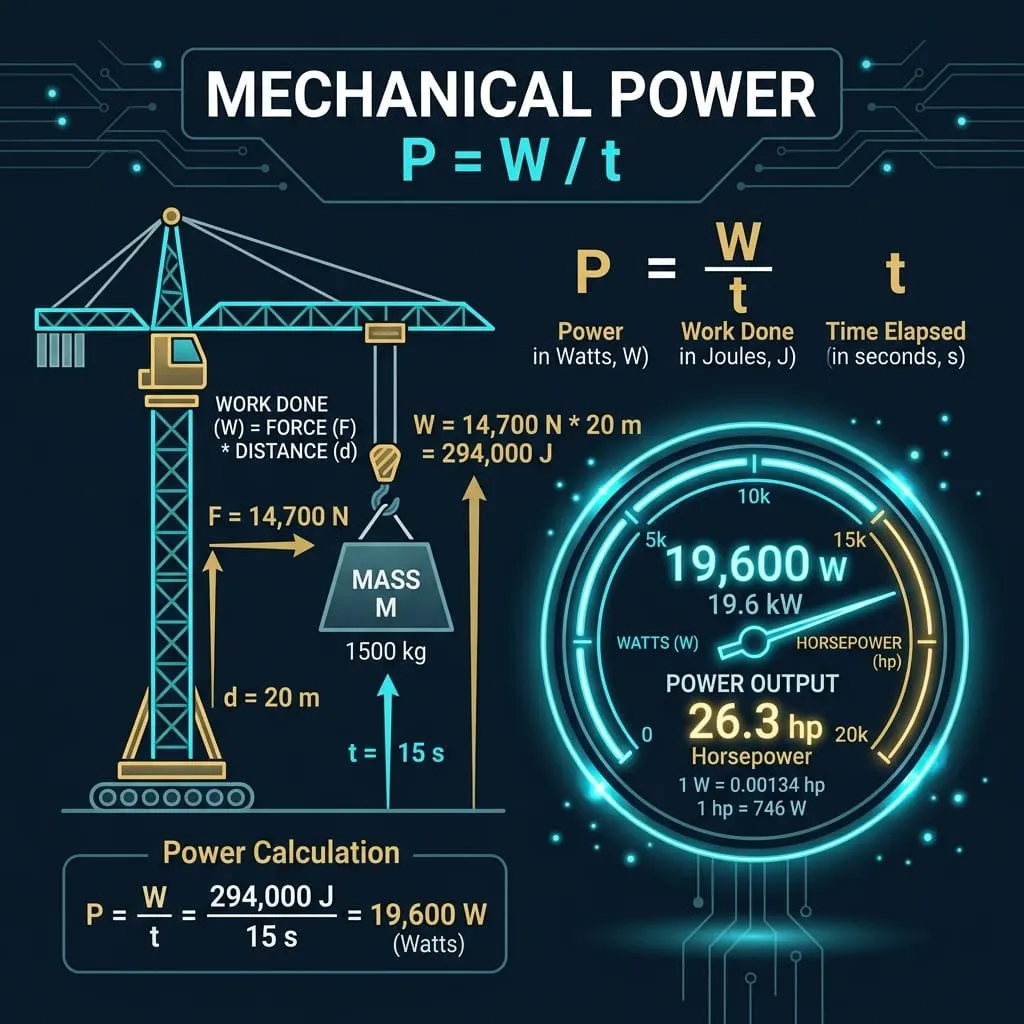
While Mechanical Work () and Energy () measure the total quantity of physical transformation performed, Power () measures the time rate at which work is performed or energy is converted.
Formally codified during the Industrial Revolution by Scottish inventor James Watt, power is the universal bridge connecting mechanical force, electrical energy conversion, thermodynamics, and engine performance.
graph LR
    W["⚙️ Mechanical Work (W)
Energy Converted in Joules (J)"] --> DIV["➗ Divided By"]
    T["⏱️ Time Elapsed (t)
Duration in Seconds (s)"] --> DIV
    DIV --> P["⚡ Power Output (P)
P = W / t in Watts (W)"]
    P --> HP["🐎 Mechanical Horsepower
1 hp = 745.7 Watts"]
    P --> ELEC["🔌 Electrical Power
P = V · I = I² · R"]
Mastering power calculations allows mechanical engineers, automotive designers, and electrical utility operators to:
- Size internal combustion engines, electric vehicle traction motors, and industrial gearboxes.
- Design high-speed passenger elevators, mining hoists, and industrial construction cranes.
- Calculate electrical utility grid generation capacities (Megawatts, Gigawatts) and consumer energy consumption bills ().
- Model aerodynamic power drag () to optimize high-speed train and aircraft fuel economy.
- Optimize human athletic conditioning, cycling functional threshold power (FTP), and rowing ergonomics.
2. Definitions & Analogies
2.1 The Simple Definition
In simple everyday terms:
- Work () is "what you got done" (e.g., carrying 100 heavy bricks up three flights of stairs).
- Time () is "how long it took you to do it."
- Power () is "how fast you did the work" ().
- If you carry the bricks up the stairs over an entire 8-hour workday, you produce a gentle low power output. If you sprint up the stairs carrying all 100 bricks in 30 seconds, you perform the exact same total work, but your power output is colossal!
2.2 The Formal Technical Definition
Average vs. Instantaneous Power
For any mechanical or thermodynamic process transferring energy:
Where:
- is the power output in Watts ().
- is the mechanical work done or energy transformed in Joules ().
- is the time elapsed in seconds ().
- is the applied force vector ().
- is the instantaneous velocity vector ().
SI and Engineering Units of Power
- SI Base Unit: Watt () .
- Kilowatt (): .
- Megawatt (): .
- Gigawatt (): .
- Imperial Mechanical Horsepower ():
- Metric Horsepower ( or ):
2.3 The Crane Lift vs. Human Laborer Analogy
To visualize power intuitively, consider lifting a pallet of steel building beams to the 5th floor ():
graph TD
    subgraph Human_Pusher ["👷 Manual Human Winch"]
        M1["Mass = 1,500 kg, Height = 20 m"]
        W1["Work: W = 294,000 Joules"]
        T1["Time Elapsed: t = 2,940 s (49 minutes)"]
        P1["Power: P = 100 Watts (0.134 hp)
(Slow, steady, low power)"]
        M1 & W1 & T1 --> P1
    end
    subgraph Tower_Crane ["🏗️ Industrial Electric Crane"]
        M2["Mass = 1,500 kg, Height = 20 m"]
        W2["Work: W = 294,000 Joules"]
        T2["Time Elapsed: t = 15.0 s"]
        P2["Power: P = 19,600 Watts (26.3 hp)
(Fast, explosive, high power!)"]
        M2 & W2 & T2 --> P2
end- The Mechanical Work is Identical:
- The Power Output Determines the Speed:- The human laborer takes (), outputting a modest ().- The industrial electric crane hoists the entire pallet in just , outputting ( more power!).
3. History & Milestones in Power Engineering
timeline
    title Milestones in Power, Engines & Energy Conversion
    1712 : Thomas Newcomen builds the first commercial Atmospheric Steam Engine
    1769 : James Watt invents the separate condenser steam engine and coins 'Horsepower'
    1824 : Sadi Carnot publishes 'Reflections on the Motive Power of Fire', founding Thermodynamics
    1882 : Thomas Edison opens Pearl Street Station, the world's first commercial electric power grid
    1889 : International Electrical Congress formally adopts the 'Watt' as the SI unit of Power
1954 : First Nuclear Power Plant (Obninsk AM-1, 5 MW) connects to the electrical grid- James Watt & The Origin of "Horsepower" (1769–1782): When Scottish engineer James Watt improved the steam engine with his separate condenser, coal mine operators wanted to know how many draft pit ponies a single steam engine could replace. Watt measured that a heavy brewery draft horse could turn a mill wheel of radius against a pulling force of at , calculating that a strong horse could do of work per minute (), defining the Horsepower ().
- Sadi Carnot & Carnot Efficiency (1824): French military engineer Nicolas Léonard Sadi Carnot proved that heat engine power output is fundamentally limited by temperature differences (), founding thermodynamics.
- The SI Unit "Watt" (1889): The International Electrical Congress officially named the metric unit of power the Watt () in honor of James Watt.
4. Mechanical vs. Electrical vs. Rotational Power
Power appears across diverse physical domains governed by equivalent mathematical formulations:
graph TD
    POWER["⚡ Power Output Formulations"] --> MECH["⚙️ Linear Mechanical Power"]
    POWER --> ROT["🔄 Rotational Engine Power"]
    POWER --> ELEC["🔌 Electrical Circuit Power"]
    POWER --> FLUID["🌊 Fluid Hydraulic Power"]

    MECH -->|"P = W / t = F · v"| M_DESC["• Force (N) × Linear Velocity (m/s)
• Elevators, vehicles, trains, aircraft"]
    ROT -->|"P = τ · ω = (2π · N · τ) / 60"| R_DESC["• Torque (N·m) × Angular Speed (rad/s)
• Car engines, turbines, electric motors, propellers"]
    ELEC -->|"P = V · I = I² · R = V² / R"| E_DESC["• Voltage (V) × Current (A)
• Batteries, power grids, electronics, heaters"]
    FLUID -->|"P = Q · ΔP"| F_DESC["• Flow Rate (m³/s) × Pressure Drop (Pa)
• Hydraulic excavators, hydroelectric dams, pumps"]| Physical Domain | Governing Formula | Key Variables & Units | Common Industrial Benchmark |
|---|---|---|---|
| Linear Mechanical | (Force in ), (Velocity in ) | Crane lifting, towing winches | |
| Rotational Engine | $\tau$ (Torque in ), () | Internal combustion engines, dynamometers | |
| Electrical Circuit | (Volts), (Amperes), () | CPU chips, home appliances, power lines | |
| Fluid / Hydraulic | (Flow in ), $\Delta P$ (Pressure in ) | Hydroelectric dams, hydraulic excavators |
5. Master Formula Matrix & Problem Solver
| Unknown Variable | Primary Formula | Formula Given Force & Velocity | Formula Given Mass & Height () | Given Torque & RPM |
|---|---|---|---|---|
| Power () | ||||
| Mechanical Work () | ||||
| Time Elapsed () | — | |||
| Required Force () | — | — | ||
| Horsepower () | — |
6. Step-by-Step Computational Procedure
flowchart TD
    S1["Step 1: Identify Given Physical Parameters
(Extract Work W in Joules, Force F in N, Distance d in m, or Time t in seconds)"] --> S2["Step 2: Calculate Mechanical Work (W)
(Apply W = F · d or gravitational lift work W = m · g · h)"]
    S2 --> S3["Step 3: Evaluate Time Interval (t)
(Ensure time is in base SI seconds: minutes × 60, hours × 3600)"]
    S3 --> S4["Step 4: Compute Power Output (P = W / t)
(Calculate numerical power in standard Watts W)"]
    S4 --> S5["Step 5: Convert Units for Engineering Domain
(Convert Watts -> Kilowatts kW, Megawatts MW, or Horsepower hp / 745.7)"]
7. Practical Real-World Calculation Examples
Example 1: High-Speed Passenger Skyscraper Elevator Motor
- Scenario: A luxury high-rise passenger elevator cabin (total loaded mass ) travels upward from the ground lobby to the observation deck () in ().
- Step 1: Calculate Total Gravitational Work Done ():
- Step 2: Calculate Mechanical Power Output ():
- Step 3: Convert to Horsepower ():
Example 2: Electric Vehicle Supercar High-Speed Highway Cruising Power
- Scenario: An electric vehicle cruises along a highway at constant speed (). Total aerodynamic air drag and tire rolling resistance force opposes the motion with .
- Calculated Motor Traction Power ():
- Energy Consumed Over a 2-Hour Trip ():
Example 3: Industrial Pump Hydroelectric Storage
- Scenario: A pumped-storage hydroelectric facility pumps of water (mass ) to an upper mountain reservoir () over .
- Work Performed on Water ():
- Average Pump Power Rating ():
Example 4: Automotive Engine Dynamometer Horsepower from Torque
- Scenario: A V8 performance engine on an engine dynamometer produces a torque of at an engine speed of .
- Angular Velocity ():
- Power Output in Watts & Horsepower:
Example 5: Professional Cyclist Sprint vs. Sustained Power Output
- Scenario: A professional Tour de France cyclist of mass ascends a steep mountain pass () in .
- Mechanical Gravitational Power Output:(While an elite human can sustain for an hour, during a 10-second sprint finish they can burst over !).
8. Real-World Engineering Case Studies
Case Study 1: Aerodynamic Velocity-Cubed Power Drag Law ()
- Automotive Physics Dilemma: Why does an electric car's battery range drop so drastically when speed increases from to on the German Autobahn?
- Aerodynamic Drag Force Formula:
- Aerodynamic Power Requirement ():Power required to overcome air resistance scales with the CUBE of velocity ()!
graph LR
    subgraph Speed_Comparison ["🏎️ Velocity-Cubed Aerodynamic Power Drag"]
        V100["Speed: 100 km/h (27.8 m/s)
Power: 10.7 kW (14.3 hp)"]
        V160["Speed: 160 km/h (44.4 m/s)
Power: 43.8 kW (58.7 hp)"]
        V100 -->|"60% Increase in Speed"| V160
        V160 -->|"Demands 4.1× (410%) MORE Power!"| RES["Battery Range Collapses by >60%"]
end- Numerical Comparison for a Typical Sedan (, ):- At :
- At ( faster):
- Engineering Conclusion: Increasing speed by just 60% demands () more engine power, quadrupling aerodynamic battery consumption per hour.
Case Study 2: Electrical Grid Base-Load Sizing (Megawatts & Gigawatts)
- Utility Engineering Challenge: A metropolitan region with $2,000,000$ households experiences a sweltering summer heatwave where every home operates a central air conditioning unit simultaneously during peak afternoon hours ().
- Peak AC Power Demand:
- Total Energy Consumed During 4-Hour Peak:
- Grid Balancing: Utility dispatchers fire up fast-reacting Natural Gas Peaker plants ( each) and grid-scale lithium-ion battery storage installations to deliver the required Gigawatts of instantaneous power, preventing brownouts and transmission line thermal collapse.
9. Common Mistakes & How to Avoid Them
Mistake 1: Confusing Power (Watts) with Energy (Joules or Kilowatt-Hours)
Treating Watts as a quantity of energy. Watts () measure instantaneous rate (like speed in ), whereas Joules () and Kilowatt-hours () measure total energy consumed (like total distance driven). A lightbulb running for consumes of energy.
Mistake 2: Forgetting Time Unit Conversions (Minutes/Hours to Seconds)
Dividing work in Joules by time in minutes (e.g., ) instead of converting to seconds (). This introduces a massive calculation error.
Mistake 3: Overlooking Aerodynamic Velocity Cubing ()
Assuming engine power required to drive a vehicle scales linearly with speed. As speed increases, aerodynamic drag power scales with , making high-speed travel exponentially more power-intensive.
10. Frequently Asked Questions (FAQ)
Q1: What is the exact mathematical definition of 1 Watt?
A: One Watt () is defined as the rate of energy transfer or work performed at the rate of one Joule per second ().
Q2: Why is 1 Horsepower equal to 745.7 Watts?
A: James Watt defined one mechanical horsepower as the ability to lift by in (). Converting standard pounds-force and feet to SI units yields:
Q3: What is the difference between Mechanical Horsepower () and Metric Horsepower ()?
A: - Imperial Horsepower (): .
- **Metric Horsepower (, Pferdestärke):** ( smaller than imperial hp).
Q4: How is Power related to Force and Velocity ()?
A: Because work is , dividing by time gives . When pushing an object against friction or aerodynamic drag at constant velocity, the engine power required equals the resisting force multiplied by the travel speed.
Q5: What is the difference between Brake Horsepower (BHP) and Wheel Horsepower (WHP)?
A: - Brake Horsepower (BHP): The raw power generated at the engine flywheel before transmission and drivetrain friction losses.
- Wheel Horsepower (WHP): The actual power delivered to the tires in contact with the road (typically lower due to gearbox, differential, and axle frictional parasitic drag).
Q6: What is a Kilowatt-Hour ()?
A: A Kilowatt-hour is a commercial unit of energy (not power), representing the total work done by a power of operating continuously for :
Q7: What is Human Power Output capacity?
A: A healthy human adult can comfortably sustain of physical power during prolonged daily work. Elite endurance athletes (cyclists/rowers) can sustain for an hour, and world-class track sprinters can peak at () for brief 5-to-10 second bursts.
Q8: What is Power Factor in AC electrical circuits?
A: In Alternating Current (AC) circuits containing inductive coils or capacitors, voltage and current waveforms shift out of phase. The Real Power (, in Watts) that performs actual work is related to the Apparent Power (, in Volt-Amperes) by the Power Factor ():
11. Expert Tips & Best Practices
- Convert Minutes and Hours to Seconds First: Always ensure time is expressed in seconds before calculating to obtain standard Watts.
- Apply the Rule for Fast Horsepower Conversions: To convert Kilowatts to Horsepower quickly in your head, divide by $0.75$ ().
- Account for Drivetrain and Mechanical Efficiency ($\eta$): In real machines, input power exceeds useful output power due to heat and friction: (e.g., a 90% efficient motor lifting a load requires ).
12. Summary & Key Takeaways
- Fundamental Power Equation: (measured in Watts ).
- Watt Definition: .
- Horsepower Benchmark: .
- Velocity-Cubed Aerodynamic Drag: High-speed aerodynamic power demands scale with , quadrupling fuel consumption at elevated highway speeds.
- Vast Technical Scope: Governs everything from human metabolic athletics and building elevator hoist motors to electric vehicle powertrains, hydroelectric dams, and continental electrical utility grids.
Additional Technical Guidelines & Measurement Standards
When conducting calculations for Power from Work & Time Solver, maintaining quantitative precision and verifying input parameter boundaries is essential for reliable scenario evaluation. Always verify that raw numerical inputs are measured using standardized instrumentation, and double-check unit conversions prior to applying outputs in commercial, industrial, or academic projects.
For quantitative unit conversions and scientific calculations, always maintain at least four decimal places of precision during intermediate arithmetic stages before rounding final results. When preparing technical reports, laboratory documentation, or financial forecasts, cross-verify all output variables against established international measurement standards (such as SI, NIST, and ISO metric benchmarks) to guarantee consistent analytical rigor across all computational workflows.
MathsLover.com delivers this interactive solver 100% free of charge to foster global mathematical literacy, educational accessibility, and data-driven problem solving across scientific, technical, and academic communities worldwide.