💡 Direct Answer & Executive Summary (Pressure (P = F/A) Calculator)
Definition: Compute values for Pressure (P = F/A) Calculator in standard SI units physics.
Governing Math Formula: Physical equation system model for Pressure (P = F/A) Calculator.
Target Applications: Provides real-time quantitative solutions in Physics & Engineering for students, engineers, researchers, and finance professionals.
Pressure (): Comprehensive Engineering Guide
1. Introduction
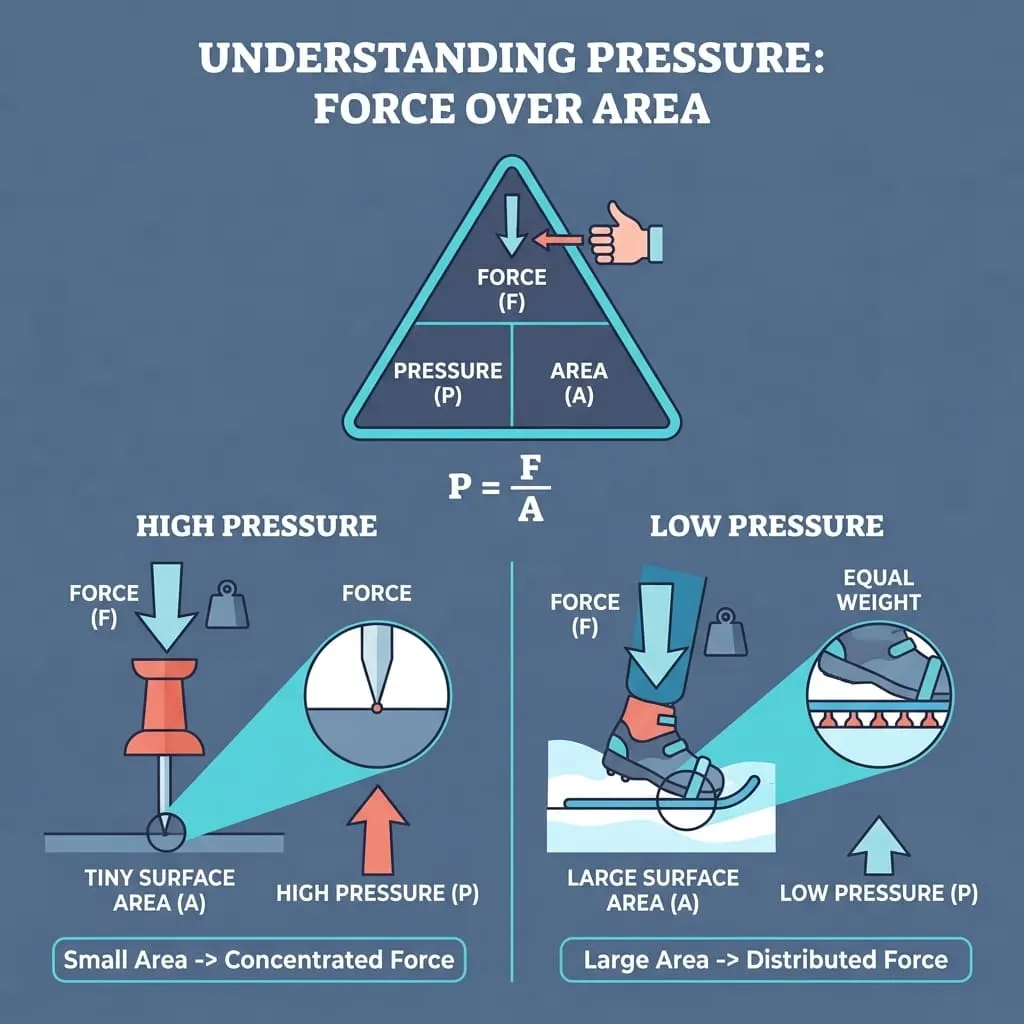
Why can a woman in high-heeled stiletto shoes crack or puncture a delicate hardwood floor, while a 5-ton African elephant walking on broad padded feet leaves no dent at all? Why does a dull kitchen knife struggle to slice through a tomato while a razor-sharp blade cuts effortlessly with minimal effort? How do deep-sea exploration submersibles withstand the crushing hydrostatic forces of the Mariana Trench?
All these phenomena illustrate the fundamental physics of Pressure ().
graph LR
    F["💥 Perpendicular Force (F_⊥)
Normal Force in Newtons (N)"] --> DIV["➗ Divided By"]
    A["📐 Surface Contact Area (A)
Area in Square Meters (m²)"] --> DIV
    DIV --> P["💨 Pressure (P)
P = F / A in Pascals (N/m²)"]
Pressure measures how concentrated a force is across a given surface area. While total force may be identical, concentrating that force onto a microscopic point creates astronomical pressure capable of cutting steel or piercing armor, whereas distributing the same force over a large area drops the pressure to benign levels.
Mastering pressure calculations enables engineers to:
- Design high-pressure hydraulic actuators, heavy construction excavators, and aircraft brake systems.
- Size safety relief valves and pressure vessels in chemical processing plants.
- Calculate aerodynamic lift across airplane wings and drag across high-speed trains.
- Measure cardiovascular blood pressure and respiratory lung mechanics in biomedical engineering.
2. Definitions & Physical Meaning
2.1 The Simple Definition
In simple terms:
- Force () is the total push applied to an object.
- Area () is the surface size over which the push is spread out.
- Pressure () is the force per unit area.
If you push with of force over a broad snowshoe (), the pressure is only (you stay on top of the snow). If you push with the exact same onto the tip of a pushpin (), the pressure skyrockets to (), effortlessly puncturing solid wood!
2.2 Formal Technical Definition
Formally, for a force acting uniformly and perpendicularly across a flat planar surface of area :
In differential vector mechanics, pressure is the scalar normal component of the stress tensor :
Where:
- is the fluid/contact pressure ().
- is the perpendicular (normal) force vector ().
- is the projected surface area ().
2.3 Atmospheric, Absolute, and Gauge Pressure
In engineering systems (such as tire pressure, boilers, and scuba diving), pressure is categorized into three interrelated reference frameworks:
graph TD
    ABS["🎯 Absolute Pressure (P_abs)
Measured relative to absolute vacuum (0 Pa)"]
    ATM["🌍 Atmospheric Pressure (P_atm)
Standard sea-level barometric air pressure (101.325 kPa)"]
    GAUGE["🎛️ Gauge Pressure (P_gauge)
Pressure reading relative to local atmosphere"]

    GAUGE -->|"P_gauge = P_abs - P_atm"| ABS
ABS -->|"P_abs = P_gauge + P_atm"| GAUGE- Absolute Zero (): Complete molecular vacuum.
- Atmospheric Pressure (): The weight of Earth's atmospheric air column pressing down on surface objects.
- Gauge Pressure: What tire gauges read. If your car tire reads gauge, its absolute pressure is .
3. Historical Evolution & Foundations
timeline
    title Milestones in Pressure & Fluid Mechanics
    1643 : Evangelista Torricelli invents the Mercury Barometer ('We live at the bottom of an ocean of air')
    1648 : Blaise Pascal proves atmospheric pressure decreases with altitude on Puy de Dôme
    1653 : Pascal formulates Pascal's Principle (Hydraulic pressure transmission)
    1654 : Otto von Guericke demonstrates the vacuum force with Magdeburg Hemispheres
1971 : General Conference on Weights & Measures officially designates the 'Pascal' (Pa) as SI unit- Torricelli's Vacuum (1643): Italian physicist Evangelista Torricelli filled a 1-meter glass tube with dense mercury and inverted it into a dish. The mercury dropped to a height of , leaving a vacuum at the top and proving that atmospheric pressure supports the column weight.
- Pascal's Hydraulic Principle (1653): French polymath Blaise Pascal proved that pressure applied to an enclosed, incompressible fluid is transmitted undiminished in all directions throughout the fluid:
4. Master Formula Matrix & Pressure Units
4.1 Master Formula Matrix
| Desired Variable | Given Force & Area | Given Hydrostatic Depth | Given Ideal Gas $n, T, V$ | Given Work & Volume Change $\Delta V$ | Hydraulic Output |
|---|---|---|---|---|---|
| Pressure () | |||||
| Force () | |||||
| Area () |
4.2 Universal Pressure Unit Conversion Table
| Unit | Symbol | Exact Value in Pascals () | Typical Application Domain |
|---|---|---|---|
| Pascal (SI Base) | Scientific baseline (very small unit) | ||
| Kilopascal | Meteorology & HVAC air ducts | ||
| Megapascal | Material tensile strength & structural concrete | ||
| Bar | Industrial fluid hydraulics & scuba diving | ||
| Standard Atmosphere | Chemical equilibria & atmospheric science | ||
| Pounds per Square Inch | US automotive tires & compressed air tools | ||
| Torr / Millimeters of Mercury | Medical blood pressure () |
5. Practical Real-World Calculation Examples
Example 1: Stiletto Heel vs. Elephant Foot Pressure
- Scenario A (Stiletto Heel): A person momentarily shifts their entire weight onto a single stiletto heel with tip area .
- Scenario B (Elephant): A African elephant stands on four circular feet, each of radius ().
- Takeaway: The stiletto heel exerts higher pressure than the elephant!
Example 2: Force Multiplication in a Hydraulic Car Lift
- Scenario: A service station hydraulic lift has an input piston of radius () and an output lift ram of radius (). A mechanic applies an input force to the small piston.
- Hydraulic Lift Force ():
- Lifting Capacity: (effortlessly hoists a heavy SUV).
Example 3: Hydrostatic Pressure at Oceanic Depth
- Scenario: A research submarine dives to a depth in seawater ().
- Hydrostatic Gauge Pressure:
6. Real-World Engineering Case Studies
Case Study 1: Commercial Aircraft Cabin Pressurization & Explosive Decompression
- Background: A Boeing 787 cruises at altitude (), where ambient outdoor air pressure drops to ().
- Cabin Regulation: The aircraft environmental control system maintains cabin pressure at (, equivalent to an altitude of ).
- Structural Analysis:- Differential Pressure: ().- A passenger cabin emergency door has dimensions ().- Outward Force on Door:
- Safety Engineering Design: Cabin doors are designed as plug doors (larger than the doorframe opening, opening inward before swiveling out). The outward pressure forces the door firmly into its structural frame seal, making it physically impossible for a human to open in flight.
Case Study 2: Deep-Sea Titanium Pressure Hull Buckling
- Background: The manned submersible Titan imploded under deep-sea hydrostatic pressure at depth ().
- Failure Mechanics:- Unlike internal pressure (which places cylindrical vessel walls in uniform tension), external pressure places hull walls in compressive hoop stress:
- Under severe external compression, materials are prone to catastrophic elastic buckling and micro-delamination along carbon-fiber matrix boundaries, leading to instantaneous implosion in .
- Result: Deep-submergence exploration vehicles (e.g., Alvin, Limiting Factor) mandate spherical forged Grade 5 Titanium alloys with safety factors yield pressure.
7. Common Mistakes & How to Avoid Them
Mistake 1: Confusing Gauge Pressure with Absolute Pressure
Forgetting to add atmospheric pressure () when solving thermodynamic gas law problems () produces massive calculation errors. Thermodynamic formulas strictly require Absolute Pressure ().
Mistake 2: Area Unit Conversion Errors ( to )
Converting square centimeters to square meters requires dividing by $10,000$ (), NOT ! Entering as instead of creates a error.
Mistake 3: Non-Perpendicular Force Angles
If a force is applied at an inclined angle relative to the surface normal, only the perpendicular component creates pressure: . The tangential component () generates shear stress.
8. Frequently Asked Questions (FAQ)
Q1: What is the difference between Pressure and Stress?
A: Both share the identical unit of Pascals (). However, Pressure is a scalar quantity exerted uniformly by fluids perpendicular to boundaries, while Stress is a second-order tensor within solid materials having both normal (compressive/tensile) and shear components.
Q2: Why do deep-sea fish not get crushed by water pressure?
A: Deep-sea marine organisms have internal cellular fluid pressures that are completely equalized with the surrounding hydrostatic pressure, possessing no compressible gas-filled cavities (like human lungs or swim bladders).
Q3: How does hydraulic fluid transmit force?
A: Liquids are virtually incompressible. When force is applied to a confined fluid, molecules cannot pack closer together, so the applied pressure transmits instantaneously throughout the fluid medium according to Pascal's Principle.
Q4: What is vapor pressure in cavitation?
A: When fluid flow velocity increases dramatically (such as around spinning boat propellers), local static pressure drops by Bernoulli's Principle. If pressure falls below the fluid's vapor pressure, water spontaneously boils at room temperature, forming vapor bubbles that violently collapse and pit steel surfaces (cavitation erosion).
9. Summary & Key Takeaways
- Fundamental Formula: , where is in Pascals (), is in Newtons (), and is in square meters ().
- Pressure Concentration: Reducing contact surface area exponentially amplifies pressure for the same applied force.
- Hydrostatic Law: Fluid pressure increases linearly with depth: .
- Hydraulic Multiplication: In closed hydraulic systems, force multiplies proportionally to piston area ratio: .
Additional Technical Guidelines & Measurement Standards
When conducting calculations for Pressure (P = F/A) Calculator, maintaining quantitative precision and verifying input parameter boundaries is essential for reliable scenario evaluation. Always verify that raw numerical inputs are measured using standardized instrumentation, and double-check unit conversions prior to applying outputs in commercial, industrial, or academic projects.
For quantitative unit conversions and scientific calculations, always maintain at least four decimal places of precision during intermediate arithmetic stages before rounding final results. When preparing technical reports, laboratory documentation, or financial forecasts, cross-verify all output variables against established international measurement standards (such as SI, NIST, and ISO metric benchmarks) to guarantee consistent analytical rigor across all computational workflows.
MathsLover.com delivers this interactive solver 100% free of charge to foster global mathematical literacy, educational accessibility, and data-driven problem solving across scientific, technical, and academic communities worldwide.