💡 Direct Answer & Executive Summary (Wave Speed & Frequency Solver)
Definition: Compute values for Wave Speed & Frequency Solver in standard SI units physics.
Governing Math Formula: Physical equation system model for Wave Speed & Frequency Solver.
Target Applications: Provides real-time quantitative solutions in Physics & Engineering for students, engineers, researchers, and finance professionals.
Wave Speed & Frequency ()
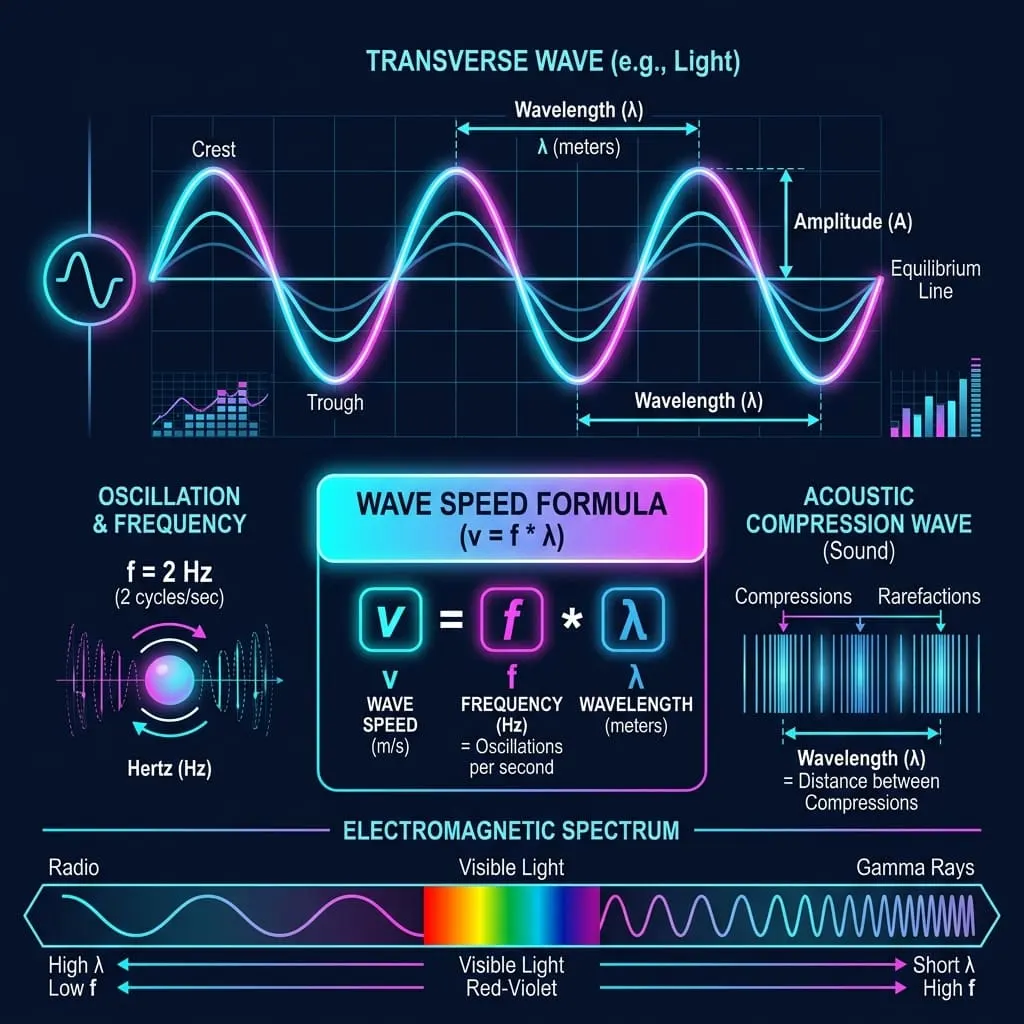
1. Introduction
From the audible acoustic vibrations of a violin string resonating through air to the high-frequency electromagnetic microwave carrier signals transmitting 5G data into smartphones, and the deep seismic P-waves and S-waves radiating through the Earth's molten mantle, waves are nature's primary mechanism for transporting energy and information across space without transporting matter.
At the core of all physical wave mechanics—spanning classical acoustics, optics, hydrodynamics, radio telecommunications, and quantum mechanics—lies a single, universal relationship: the Universal Wave Equation ().
graph LR
    L["🌊 Wavelength (λ)
Spatial Length of 1 Cycle (m)"] --> MULT["✖️ Multiplied By"]
    F["📻 Frequency (f)
Oscillation Cycles / Sec (Hz)"] --> MULT
    MULT --> V["⚡ Wave Speed (v)
Propagation Velocity: v = f · λ (m/s)"]
    V --> T["⏱️ Linked via Wave Period:
T = 1 / f (Seconds)"]
Mastering wave speed, frequency, and wavelength calculations allows engineers, geophysicists, acoustic designers, and medical specialists to:
- Engineer fiber-optic telecommunications networks transmitting petabytes of optical data via wavelength division multiplexing (WDM).
- Design medical diagnostic ultrasound transducers and non-destructive industrial ultrasonic testing probes.
- Model seismic shockwave arrival times to pinpoint earthquake epicenters and issue tsunami early warnings.
- Tune wireless radio antennas, radar tracking systems, satellite uplinks, and Wi-Fi channels to resonant wavelengths.
- Analyze optical phenomena such as atmospheric dispersion, rainbows, laser cavity modes, and gravitational waves.
2. Definitions & Analogies
2.1 The Simple Definition
In simple everyday terms:
- Wavelength () is "how long one wave is" (the physical distance from the crest of one wave to the crest of the next).
- Frequency () is "how many waves pass you each second," measured in Hertz ().
- Wave Speed () is "how fast the wave energy travels forward" across space ().
- If ocean waves with a wavelength of roll past a pier at a frequency of (), the wave speed is ().
2.2 The Formal Technical Definition
The Universal Wave Equation
For any periodic harmonic wave propagating through a continuous homogeneous medium:
Where:
- is the wave phase velocity ().
- is the temporal frequency in Hertz ().
- (Greek lambda) is the spatial wavelength in meters ().
- is the wave period (the duration in seconds for one complete cycle to elapse).
Angular Frequency () and Wave Number ()
In advanced wave mechanics, optics, and quantum physics, the wave equation is expressed in radians:
Where:
- is the angular frequency in radians per second ().
- is the angular wave number in radians per meter ().
2.3 The Freight Train Analogy
To visualize why wave speed equals frequency multiplied by wavelength, imagine standing beside a railroad track watching a passing freight train with identical railroad cars:
graph LR
    subgraph Train_Analogy ["🚂 Freight Train Analogy"]
        CarLength["Car Length = 20 meters
(Wavelength λ)"]
        Rate["Passage Rate = 3 cars per second
(Frequency f = 3 Hz)"]
        Speed["Train Velocity: 3 × 20 = 60 m/s
(Wave Speed v = f · λ)"]
        CarLength & Rate --> Speed
end- Wavelength () Length of Each Train Car: If each boxcar is long.
- Frequency () Boxcars Passing Per Second: If rumble past your viewpoint every second ().
- Wave Speed () Train Forward Velocity: The entire train must be moving forward at a velocity of:
3. History & Milestones in Wave Mechanics
timeline
    title Milestones in Wave Theory & Electromagnetism
    1678 : Christiaan Huygens proposes the Wave Theory of Light (Huygens' Principle)
    1801 : Thomas Young's Double-Slit Experiment proves light interference and wavelength
    1865 : James Clerk Maxwell formulates Maxwell's Equations, predicting electromagnetic waves
    1887 : Heinrich Hertz experimentally generates and detects radio waves, proving v = c
    1924 : Louis de Broglie introduces Matter Waves in quantum mechanics (λ = h / p)
2015 : LIGO detects Gravitational Waves from colliding black holes, confirming Einstein- Huygens & Wave Optics (1678): Dutch polymath Christiaan Huygens proposed that light consists of waves spreading out as spherical wavelets from every point on a wavefront, explaining reflection and refraction.
- Thomas Young's Double-Slit Experiment (1801): English physician Thomas Young shone light through two narrow slits, projecting alternating dark and bright interference fringes onto a screen, mathematically measuring the minuscule wavelengths of visible light () for the first time.
- James Clerk Maxwell (1865): Scottish physicist James Clerk Maxwell unified electricity and magnetism into four partial differential equations. He discovered that electromagnetic waves propagate at a speed , famously concluding: "Light is an electromagnetic disturbance in the form of waves."
- Heinrich Hertz (1887): German physicist Heinrich Hertz generated ultra-high-frequency spark-gap radio waves in his laboratory. By measuring their spatial standing wave nodes () and spark frequency (), he confirmed that radio waves travel at the speed of light (), leading to the SI unit of frequency being named the Hertz () in his honor.
- Louis de Broglie's Matter Waves (1924): French physicist Louis de Broglie established wave-particle duality, proving that material particles with momentum () also possess quantum mechanical wavelengths: .
4. Wave Classification: Transverse vs. Longitudinal
Waves are classified by the geometric relationship between the direction of particle oscillation and the direction of wave energy propagation:
graph TD
    WAVES["🌊 Wave Propagation Types"] --> TRANS["🔴 Transverse Waves"]
    WAVES --> LONG["🔵 Longitudinal (Compression) Waves"]

    TRANS -->|"Characteristics"| T_DESC["• Oscillations PERPENDICULAR (90°) to wave travel
• Consists of Crests and Troughs
• Can be Polarized
• Examples: Light, Radio, Microwave, X-rays, Guitar Strings, Seismic S-waves"]

    LONG -->|"Characteristics"| L_DESC["• Oscillations PARALLEL (0°) to wave travel
• Consists of Compressions and Rarefactions
• Cannot be Polarized
• Examples: Sound in air/water, Ultrasound, Slinky springs, Seismic P-waves"]| Feature | Transverse Waves | Longitudinal Waves |
|---|---|---|
| Oscillation Direction | Perpendicular () to propagation | Parallel () collinear with propagation |
| Geometric Features | Crests (peaks) and Troughs (valleys) | Compressions (high density) and Rarefactions (low density) |
| Medium Requirement | Can propagate in a vacuum (EM waves) or solids | Requires a material elastic medium (solid, liquid, or gas) |
| Polarization | Yes (linear, circular, elliptical) | No (direction of vibration is fixed along travel axis) |
| Primary Examples | Light, Radio, X-rays, S-waves | Sound waves, Ultrasonic medical imaging, P-waves |
5. Wave Speed Across Different Physical Media
A Fundamental Rule of Wave Physics:
The speed of a wave () is determined strictly by the properties of the transmitting medium (its elasticity, density, temperature, and refractive index), NOT by the frequency or wavelength. If you increase the frequency of a sound source, the wavelength automatically shrinks in exact proportion to keep the wave speed constant ().
5.1 Speed of Sound in Various Media
Where is the Bulk Modulus, is Young's Modulus of elasticity, and $\rho$ is density.
| Medium | State | Temperature / Condition | Speed of Sound () |
|---|---|---|---|
| Dry Air (Standard) | Gas | () | () |
| Dry Air (Room Temp) | Gas | () | () |
| Helium Gas | Gas | () | |
| Pure Fresh Water | Liquid | () | |
| Seawater () | Liquid | () | |
| Human Soft Tissue (Ultrasound) | Biological | (Ultrasound benchmark) | |
| Solid Granite Rock | Solid | Ambient | () |
| Solid Structural Steel | Solid | Ambient | () |
| Solid Diamond Crystal | Solid | Ambient | () |
5.2 The Electromagnetic Spectrum & Speed of Light ()
In a vacuum, all electromagnetic waves (from kilometers-long radio waves to sub-picometer gamma rays) propagate at exactly:
When light enters a transparent dielectric medium (such as glass, water, or diamond), it slows down according to the material's Refractive Index ():
| Spectral Region | Typical Frequency () | Typical Wavelength () | Primary Real-World Application |
|---|---|---|---|
| AM Radio | Long-range groundwave broadcast | ||
| FM Radio / VHF TV | High-fidelity terrestrial audio | ||
| Wi-Fi () | Wireless local area data networks | ||
| 5G Millimeter Wave | Ultra-fast cellular mobile data | ||
| Infrared Thermal | Thermal imaging, fiber optics () | ||
| Visible Light (Red Violet) | Human visual perception, microscopy | ||
| Ultraviolet (UV) | Water sterilization, lithography | ||
| Diagnostic Medical X-Rays | Medical bone radiography, CT scanners | ||
| Gamma Rays () | () | Nuclear radiotherapy, astrophysics |
6. Step-by-Step Computational Procedure
flowchart TD
    S1["Step 1: Identify Known Parameters & Medium Type
(Extract Frequency f in Hz, Wavelength λ in m, or Wave Speed v)"] --> S2["Step 2: Normalize Metric Prefixes to Standard SI
(kHz -> 10³, MHz -> 10⁶, GHz -> 10⁹, nm -> 10⁻⁹, cm -> 10⁻²)"]
    S2 --> S3["Step 3: Select Working Wave Equation
(Apply v = f·λ, f = v/λ, or λ = v/f)"]
    S3 --> S4["Step 4: Compute Target Variable & Period
(Calculate numerical output and compute wave period T = 1/f)"]
    S4 --> S5["Step 5: Validate Physical Reality
(Confirm EM waves ≤ c, acoustic waves match medium density)"]
7. Practical Real-World Calculation Examples
Example 1: 5G Mobile Telecommunications Wavelength
- Scenario: A commercial 5G cellular base station transmits on the high-band millimeter wave spectrum at . Electromagnetic signals travel in air at .
- Wavelength Calculation:
- Engineering Insight: Because the wavelength is only , engineers can pack a phased array of to micro-antennas into a smartphone case for beamforming.
Example 2: Musical Note Concert A (440 Hz) in Air
- Scenario: A tuning fork vibrates at standard Concert Pitch () in a room at where the speed of sound is .
- Wavelength in Air:
- Wave Period ():
Example 3: Medical Diagnostic Ultrasound Imaging
- Scenario: An obstetrics medical ultrasound probe generates high-frequency acoustic waves at . Acoustic wave velocity in human soft tissue is standardized at .
- Wavelength in Biological Tissue:
- Imaging Resolution: Because ultrasound cannot resolve anatomical structures smaller than approximately its wavelength (), a probe achieves sub-millimeter axial image resolution ().
Example 4: Marine Sonar Echo-Ranging
- Scenario: A naval submarine emits an active sonar acoustic ping at into seawater ().
- Wavelength of the Sonar Pulse:
- Target Distance via Echo Time-of-Flight: If the echo returns after , the round-trip distance is . One-way target distance to the seabed is:
Example 5: Fiber-Optic Infrared Laser Telecom
- Scenario: An infrared telecommunications laser emits at a standardized vacuum wavelength . In silica glass fiber, the refractive index is .
- Speed of Light in Optical Fiber:
- Optical Laser Frequency:
- Compressed Wavelength Inside the Glass Core:
8. Real-World Engineering Case Studies
Case Study 1: Earthquake Epicenter Triangulation (Seismic P-Waves vs. S-Waves)
- Geophysical Background: When an earthquake ruptures along an underground fault, it releases two distinct wave modes through the Earth's lithosphere:- Primary (P) Waves (Longitudinal): Fast compressional waves traveling through rock at .- Secondary (S) Waves (Transverse): Slower shear waves traveling through rock at .
- Mathematical Analysis: A seismograph station records the arrival of the initial P-wave pulse, followed later by the destructive S-wave pulse.
- Formulation:
- Outcome: The seismologist instantly knows the earthquake occurred precisely away. By combining distance circles from 3 seismic stations, emergency responders triangulate the epicenter in under .
Case Study 2: Automotive Wi-Fi Antenna Quarter-Wave Resonator Design
- Engineering Dilemma: An automotive electronics manufacturer needs to integrate an internal monopole Wi-Fi antenna tuned for ().
- Resonance Physics: For optimal impedance matching and zero reactive reflections, a quarter-wave () whip antenna length is required.
- Calculations:- Full Free-Space Wavelength:
- Quarter-Wave Antenna Length ():
- Velocity Factor on FR4 PCB Substrate ():
- Result: RF engineers etch a compact copper trace directly onto the circuit board, providing maximum wireless transmission efficiency and range without external protruding rods.
9. Common Mistakes & How to Avoid Them
Mistake 1: Assuming Wave Speed Changes When Frequency Changes
In a fixed medium (like air at ), sound speed is constant (). If you double the frequency of a musical pitch from to , the speed does NOT double—the wavelength is cut exactly in half () while remains constant!
Mistake 2: Mixing Megahertz () and Gigahertz () with Base Hertz
Entering as into formulas instead of (). This introduces an error by a factor of one million (). Always convert metric prefixes to base SI units.
Mistake 3: Confusing Wave Propagation Speed with Particle Speed
In a sound wave or water wave, the wave energy propagates forward at high speed (), but individual air molecules merely oscillate back and forth a few micrometers around their equilibrium position with very small local particle velocities.
10. Frequently Asked Questions (FAQ)
Q1: What is the difference between wave speed () and wave frequency ()?
A: Wave speed () is the linear distance the wave crest moves forward through space per unit time (). Frequency () is the number of complete vibrational cycles completed per unit time ().
Q2: Why does sound travel faster in water and steel than in air?
A: Sound is a mechanical compression wave governed by elasticity () and density ($\rho$) via . Although water and steel are denser than air, their molecular elastic bonds are immensely stiffer (higher bulk modulus), transmitting intermolecular collisions far faster ( in water and in steel vs. in air).
Q3: What is the Doppler Effect and how does it relate to ?
A: When a wave source moves relative to an observer at velocity , the physical wavelengths in front of the source are compressed (), causing the observer to hear or measure a higher frequency (), while waves behind are stretched:
Q4: Does light change frequency or wavelength when entering glass or water?
A: Frequency () remains strictly constant because the number of wave cycles entering the surface per second must equal the number of cycles exiting the boundary. However, because light slows down in dense media (), the wavelength must compress according to .
Q5: What are Gravitational Waves and at what speed do they travel?
A: Gravitational waves are ripples in the fabric of spacetime predicted by Einstein's General Relativity and detected by LIGO. They are transverse quadrupole waves that propagate through the vacuum of space at exactly the speed of light ().
Q6: What is wave dispersion?
A: Dispersion is the physical phenomenon where wave speed depends on frequency ($v(f)$). In dispersive media (like white light passing through a glass prism), higher frequency violet light travels slower than red light, causing the colors to separate into a visible rainbow spectrum.
Q7: What is the relationship between wave amplitude and wave energy?
A: In all mechanical and electromagnetic waves, the energy carried by the wave is proportional to the square of its amplitude (). Doubling a wave's wave height quadruples its transported energy.
Q8: What is de Broglie wavelength in quantum physics?
A: Louis de Broglie showed that all matter exhibits wave properties. An electron of mass moving at velocity has a quantum wavelength of:
Where is Planck's constant.
11. Expert Tips & Best Practices
- Convert Frequency to Base Hertz First: Always convert , , and before evaluating equations.
- Remember the Medium Controls Wave Speed: Never try to increase wave speed by turning up the frequency; to change wave speed, you must change the medium properties (such as heating the air, changing string tension, or switching from copper wire to optical fiber).
- Use the Wave Period as an Easy Bridge: If frequency is given as a time duration , use directly.
12. Summary & Key Takeaways
- Universal Wave Equation: .
- Constant Medium Velocity: Wave speed is an intrinsic property of the medium; frequency and wavelength are inversely proportional ().
- Wave Period Relation: Period measures seconds per cycle; frequency measures cycles per second (Hertz).
- Two Major Classes: Transverse waves (oscillate perpendicular to motion, e.g., light) and Longitudinal waves (oscillate parallel to motion, e.g., sound).
- Broad Technological Applications: Governs everything from medical ultrasound imaging and fiber-optic internet cables to seismic earthquake triangulation and Wi-Fi antenna design.
Additional Technical Guidelines & Measurement Standards
When conducting calculations for Wave Speed & Frequency Solver, maintaining quantitative precision and verifying input parameter boundaries is essential for reliable scenario evaluation. Always verify that raw numerical inputs are measured using standardized instrumentation, and double-check unit conversions prior to applying outputs in commercial, industrial, or academic projects.
For quantitative unit conversions and scientific calculations, always maintain at least four decimal places of precision during intermediate arithmetic stages before rounding final results. When preparing technical reports, laboratory documentation, or financial forecasts, cross-verify all output variables against established international measurement standards (such as SI, NIST, and ISO metric benchmarks) to guarantee consistent analytical rigor across all computational workflows.
MathsLover.com delivers this interactive solver 100% free of charge to foster global mathematical literacy, educational accessibility, and data-driven problem solving across scientific, technical, and academic communities worldwide.