💡 Direct Answer & Executive Summary (Mechanical Work (W = Fd) Calculator)
Definition: Compute values for Mechanical Work (W = Fd) Calculator in standard SI units physics.
Governing Math Formula: Physical equation system model for Mechanical Work (W = Fd) Calculator.
Target Applications: Provides real-time quantitative solutions in Physics & Engineering for students, engineers, researchers, and finance professionals.
Mechanical Work (): Comprehensive Engineering Guide
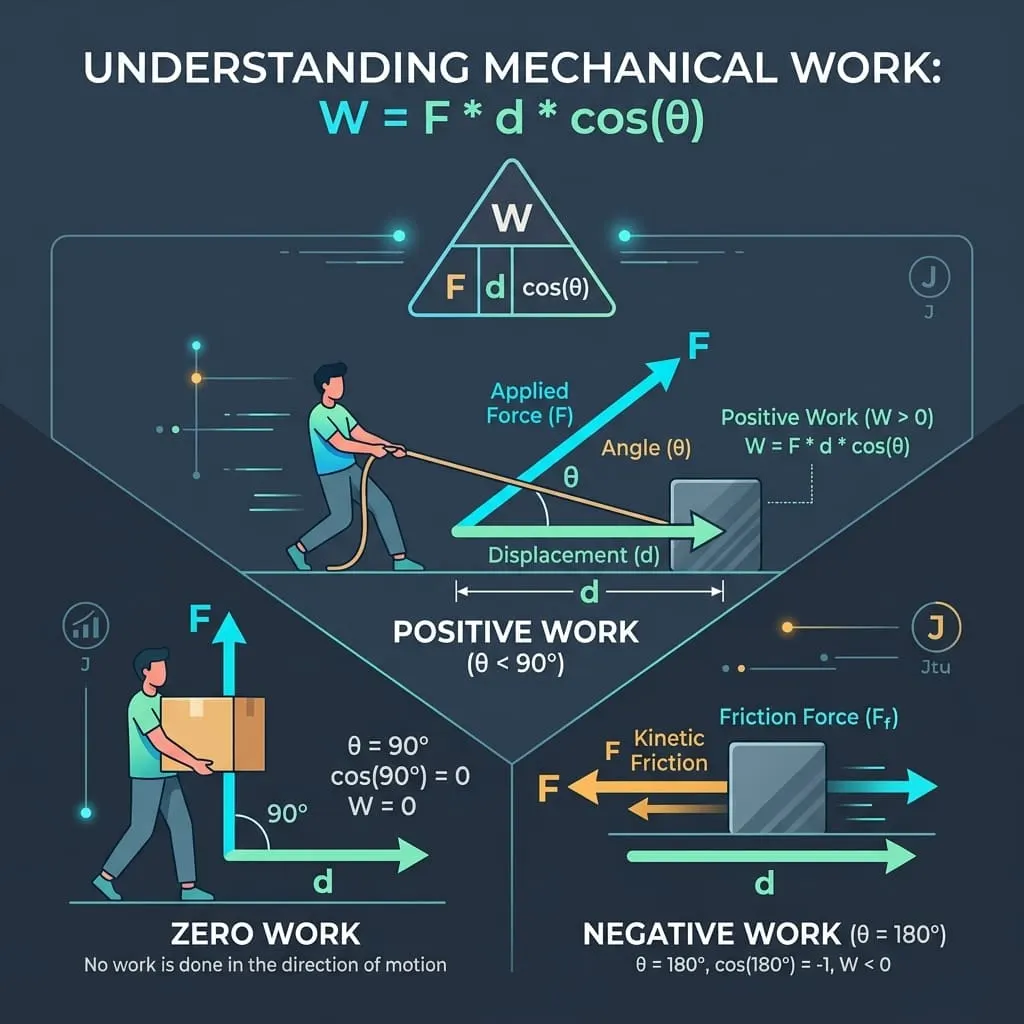
1. Introduction
Whenever an industrial crane hoists a multi-ton steel beam upward, a steam locomotive pulls freight wagons across a mountain pass, or an electric vehicle motor propels wheels forward against rolling resistance, mechanical energy is actively transferred from one physical system to another.
In physics and engineering, this energy transfer is quantitatively defined as Mechanical Work ().
graph LR
    F["💥 Applied Force (F)
Vector Magnitude in Newtons (N)"] -->|"Acts Along"| TH["📐 Angle (θ)
Between Force & Path"]
    D["📏 Displacement (d)
Distance Traversed (m)"] -->|"Multiplies with"| TH
    TH -->|"Calculates"| W["⚡ Mechanical Work (W)
W = F · d · cos(θ) in Joules (J)"]
While everyday colloquial language often equates "work" with exertion or effort (such as holding a heavy suitcase steady), the rigorous physical definition requires a force to act parallel to an actual displacement distance. If there is no displacement, or if the force is applied perpendicular to motion (), strictly zero mechanical work is performed.
Mastering mechanical work enables engineers to:
- Design high-efficiency gearboxes, pulleys, and mechanical advantages in industrial machinery.
- Determine thermal braking heat loads and hydraulic braking capacity.
- Calculate energy requirements for electric transit, elevators, conveyor systems, and fluid pumping stations.
- Apply the Work-Energy Theorem () to analyze complex ballistic impacts and structural deformation.
2. Definitions & Physical Meaning
2.1 The Simple Definition
In simple terms:
- Work () is the amount of energy transferred when a force moves an object across a distance.
- If you push a shopping cart with of force across , you perform of work.
- If you push against a solid brick wall with of force but the wall doesn't move (), you perform of mechanical work, despite burning biochemical calories.
2.2 Formal Technical Definition
Formally, for a constant force vector acting on a body undergoing a linear displacement vector :
For a variable force acting along a curved path from position to in three-dimensional space:
Where:
- is the mechanical work ().
- is the applied force vector ().
- (or ) is the displacement vector ().
- is the interior angle between the direction of the force vector and the direction of the displacement vector.
2.3 The Sign of Work: Positive, Zero, and Negative
graph TD
    W_TYPES["⚡ Classification of Mechanical Work"] --> POS["🟢 Positive Work (0° ≤ θ < 90°)"]
    W_TYPES --> ZERO["⚪ Zero Work (θ = 90° or d = 0)"]
    W_TYPES --> NEG["🔴 Negative Work (90° < θ ≤ 180°)"]

    POS -->|"Effect"| POS_D["• cos θ > 0
• Force adds energy to object
• Object speeds up (KE increases)
• Example: Engine pushing car forward"]
    ZERO -->|"Effect"| ZERO_D["• cos 90° = 0 or displacement d = 0
• No energy transfer along path
• Speed remains constant
• Example: Carrying briefcase while walking horizontally"]
    NEG -->|"Effect"| NEG_D["• cos θ < 0 (cos 180° = -1)
• Force removes energy from object
• Object slows down (KE decreases)
• Example: Kinetic friction & brake pads"]
3. Historical Evolution & Foundations
timeline
    title Milestones in Mechanical Work & Energy
    1687 : Sir Isaac Newton establishes classical dynamics (Principia)
    1753 : Daniel Bernoulli investigates work in hydraulic pumping mechanisms
    1826 : Gaspard-Gustave de Coriolis coins 'quantité de travail' (Quantity of Work)
    1829 : Jean-Victor Poncelet introduces dynamic work in mechanical engineering
    1843 : James Prescott Joule proves Mechanical Equivalent of Heat (1 cal = 4.184 J)
1850 : William Rankine and Lord Kelvin formalize Energy Conservation Laws- Origin of the Term (1826): French mathematician and engineer Gaspard-Gustave de Coriolis formally introduced the term "travail mécanique" (mechanical work) as the integral of force multiplied by displacement ().
- Poncelet's Industrial Standard (1829): Jean-Victor Poncelet popularized work units across French industrial mining and waterwheel design, defining work as the effort required to elevate mass against gravity.
- Joule's Paddle-Wheel Experiment (1843): English physicist James Prescott Joule connected falling weights to rotating paddle wheels in water, measuring the exact temperature rise and proving that mechanical work converts directly into thermal energy ().
4. Master Formula Matrix & Unit Conversions
4.1 Master Formula Matrix
| Desired Variable | Given , () | Given , , | Given Power & Time | Given Change in Kinetic Energy | Given Spring Constant & |
|---|---|---|---|---|---|
| Work () | |||||
| Force () | |||||
| Distance () | |||||
| Power () | — |
4.2 Work & Energy Unit Conversions
| Unit | Symbol | Equivalence in Joules () | Common Domain of Use |
|---|---|---|---|
| Joule (SI Base) | Scientific & engineering baseline | ||
| Kilojoule | Human metabolism & mechanical equipment | ||
| Foot-pound | Imperial mechanical engineering & torque work | ||
| Watt-hour | Battery capacity & energy storage | ||
| Kilowatt-hour | Electrical utility billing | ||
| Calorie (thermochemical) | Thermal thermodynamics | ||
| Electron-volt | Atomic physics & semiconductor energy bands |
5. The Work-Energy Theorem
The Work-Energy Theorem
The net work () performed on a rigid particle by all combined external forces equals the exact change in that particle's kinetic energy ($\Delta KE$):
This theorem is one of the most powerful analytical tools in physics because it allows solving complex speed and distance problems without needing to integrate time-dependent accelerations!
6. Practical Real-World Calculation Examples
Example 1: Pulling a Sled with an Angled Tow Rope
- Scenario: A person pulls a cargo sled across snow by applying a tension force to a tow rope inclined at an angle above the horizontal. The sled travels a distance .
- Calculation:
Example 2: Lifting Construction Materials with a Crane
- Scenario: A construction tower crane lifts a pallet of concrete blocks of mass vertically upward through a height at constant velocity. Take .
- Gravitational Weight ():
- Work Done by Crane:
- Work Done by Gravity:
Example 3: Braking Work and Thermal Dissipation in an Automobile
- Scenario: A sedan () decelerates from highway speed () to a complete stop () over a braking distance .
- Change in Kinetic Energy ($\Delta KE$):
- Work Done by Brake Pads ():
- Average Retarding Friction Force:
Example 4: Compressing an Automotive Suspension Spring
- Scenario: An industrial shock absorber spring with stiffness constant is compressed by a distance ().
- Elastic Work Done:
7. Real-World Engineering Case Studies
Case Study 1: Hydroelectric Pumped-Storage Power Plant
- Background: The Bath County Pumped Storage Station in Virginia (the "world's biggest battery") pumps water from a lower reservoir to an upper reservoir situated at an average elevation head during off-peak nighttime hours.
- Engineering Calculation:- Volumetric pumping capacity: of water pumped per cycle.- Density of water ().- Gravitational Mechanical Work:
- Electrical Energy Conversion:
- System Takeaway: During peak daytime grid demand, releasing this stored water back down through hydraulic Francis turbines recovers of this mechanical work () as electricity.
Case Study 2: Aircraft Carrier Steam & Electromagnetic Catapults
- Engineering Challenge: An F/A-18 Super Hornet fighter jet with full combat payload () must accelerate from to a takeoff airspeed () along an aircraft carrier flight deck stroke distance .
- Analysis:- Takeoff Kinetic Energy:
- Minimum Net Work Required from Catapult + Jet Afterburners:
- Average Tractive Launch Force over the stroke:
- Launch Duration ():
- Result: EMALS (Electromagnetic Aircraft Launch System) linear induction motors deliver pulse power of to supply the required mechanical work within .
8. Common Mistakes & How to Avoid Them
Mistake 1: Ignoring the Directional Angle ()
Multiplying force directly by distance () when force is applied at an angle will overestimate work. Always multiply by . If the force is perpendicular (), .
Mistake 2: Confusing Mechanical Work with Biological Effort
Pushing against a heavy stationary object causes muscle fatigue because sarcomeres inside muscle fibers constantly hydrolyze ATP to maintain tension. However, in physics, without spatial displacement (), mechanical work is strictly .
Mistake 3: Confusing Work and Torque Units
Both mechanical work and torque have units of . However:
- Work () is a scalar quantity measured in Joules ().
- Torque ($\tau$) is a vector (rotational cross product ) and is expressed strictly as , never in Joules!
9. Frequently Asked Questions (FAQ)
Q1: Can work be negative?
A: Yes. Work is negative whenever the applied force opposes the direction of motion (). Friction forces, vehicle brakes, and air resistance almost always perform negative work on moving objects, extracting kinetic energy and dissipating it as heat.
Q2: Is carrying a heavy backpack while walking horizontally doing work on the backpack?
A: No vertical mechanical work is done on the backpack by gravity or your upward supporting force because the supporting force is directed vertically upward ($\uparrow$) while displacement is directed horizontally (), meaning and . (Work is only done against horizontal air resistance and during initial forward acceleration).
Q3: What is the difference between Work and Power?
A: - Work (, in Joules): The total quantity of energy transferred, regardless of time.
- Power (, in Watts): The rate of doing work per unit time (). Lifting in requires ; lifting the same in requires only .
Q4: What is conservative vs. non-conservative work?
A: - Conservative Forces (Gravity, Ideal Springs, Electrostatic): Work done is path-independent and depends only on initial and final positions. Total mechanical energy is conserved.
- Non-Conservative Forces (Friction, Air Drag, Viscous Dampers): Work done depends on the actual path length traveled and dissipates mechanical energy into non-recoverable thermal heat.
Q5: How is work calculated in thermodynamic gas expansion?
A: For a gas expanding inside a piston from volume to against pressure :
At constant pressure (isobaric process), .
Q6: Does a satellite orbiting Earth experience work done by gravity?
A: In a circular orbit, Earth's gravitational pull is directed toward Earth's center, which is always exactly perpendicular () to the satellite's tangential velocity vector. Therefore, , which is why the satellite maintains constant orbital speed indefinitely without engine thrust.
Q7: What is the relationship between work and potential energy?
A: For any conservative force field, the work done by the conservative force equals the negative change in potential energy:
Q8: How is work calculated in rotating mechanical systems?
A: In rotational mechanics, linear force is replaced by torque $\tau$, and linear displacement is replaced by angular displacement (in radians):
10. Summary & Key Takeaways
- Fundamental Formula: , where is in Joules (), is in Newtons (), and is in meters ().
- Angle Dependency: Work is maximized when force is parallel to motion (), zero when perpendicular (), and negative when opposing ().
- Work-Energy Connection: Net work directly equals the change in kinetic energy: .
- Scalar Quantity: Work is a scalar measure of energy transfer, with .
Additional Technical Guidelines & Measurement Standards
When conducting calculations for Mechanical Work (W = Fd) Calculator, maintaining quantitative precision and verifying input parameter boundaries is essential for reliable scenario evaluation. Always verify that raw numerical inputs are measured using standardized instrumentation, and double-check unit conversions prior to applying outputs in commercial, industrial, or academic projects.
For quantitative unit conversions and scientific calculations, always maintain at least four decimal places of precision during intermediate arithmetic stages before rounding final results. When preparing technical reports, laboratory documentation, or financial forecasts, cross-verify all output variables against established international measurement standards (such as SI, NIST, and ISO metric benchmarks) to guarantee consistent analytical rigor across all computational workflows.
MathsLover.com delivers this interactive solver 100% free of charge to foster global mathematical literacy, educational accessibility, and data-driven problem solving across scientific, technical, and academic communities worldwide.