💡 Direct Answer & Executive Summary (Golf Handicap Differential Index Calculator)
Definition: Calculate USGA score differentials based on adjusted gross score, course rating, and slope rating.
Governing Math Formula: Handicap Differential = (Adjusted Gross Score - Course Rating) * 113 / Course Slope.
Target Applications: Provides real-time quantitative solutions in Sports for students, engineers, researchers, and finance professionals.
Golf Handicap Differential Index Calculator: The Complete WHS & USGA Guide
1. Introduction
Golf is unique among competitive sports because it allows players of vastly different skill levels to compete on equitable terms. A scratch golfer (handicap $0.0$) and a high-handicap golfer (handicap $24.0$) can play an official match on any course in the world, and the Handicap System levels the playing field.
The Golf Handicap Differential Index Calculator utilizes the unified World Handicap System (WHS) and USGA mathematical formulas to calculate your exact Score Differential for any round. By factoring in your Adjusted Gross Score (), the Course Rating (), and the Course Slope Rating (), this tool measures your demonstrated potential ability.
flowchart TD
    SCORE["⛳ Record Round Adjusted Gross Score (AGS) using Net Double Bogey Caps"] --> RATING["📋 Input USGA Course Rating (CR) and Course Slope Rating (SR)"]
    RATING --> DIFF["⚖️ Compute Score Differential = (AGS minus CR) × 113 / SR"]
    DIFF --> WHS["📊 Average Lowest 8 Differentials out of 20 Most Recent Rounds"]
    WHS --> INDEX["🏆 Output Official World Handicap System (WHS) Handicap Index"]
2. Core Definitions & Analogy
Simple Definition
A Golf Score Differential measures how well you played a specific round of golf compared to the difficulty of that specific golf course. Your Handicap Index is the average of your best 8 score differentials out of your last 20 rounds.
Technical Definition
Technically, a Score Differential quantifies the relative performance of a golfer relative to a Scratch Golfer (course rating benchmark) adjusted for relative difficulty for a Bogey Golfer (slope rating benchmark). Course Rating represents expected score for a $0.0$ scratch player, while Slope Rating measures relative difficulty for a bogey player relative to standard difficulty ().
The Level Playing Field Equalizer Analogy
Think of a golf course like a running track with custom hurdles. A flat, wide fairway course is like a track with hurdles (Slope ). A tight, oceanfront championship course with deep bunkers and thick rough is like a track with hurdles (Slope ). Shooting an over hurdles is far more impressive than shooting an over hurdles. The handicap differential acts as the obstacle equalizer, scaling your raw score based on hurdle height.
3. History & Milestones
timeline
    title History of Golf Handicap Indexing Systems
    1911 : USGA introduces the first national handicap system in the United States.
    1987 : USGA introduces Slope Rating System to account for relative course difficulty.
    1993 : CONGU system standardized across the United Kingdom and Ireland.
    2020 : World Handicap System (WHS) unifies 6 global systems into a single global standard.
    2024 : WHS updates short course rating rules and unrated hole stroke allocation adjustments.
4. Core Concepts & Player Skill Handicap Tier Matrix
Under the World Handicap System, golfers are classified into skill tiers based on demonstrated Handicap Index range:
| Skill Tier Category | Handicap Index Range | Average 18-Hole Score (Par 72) | Score Differential Target Range | Course Handicap Allowance (Slope 120) | Player Potential Profile |
|---|---|---|---|---|---|
| Tour Pro / Plus Handicap | strokes | Consistently scores under par on difficult championship courses | |||
| Scratch Golfer | strokes | Plays to par; high greens in regulation (GIR) percentage | |||
| Single-Digit Low Handicap | strokes | Advanced amateur; solid short game, occasional bogey | |||
| Mid-Handicap Golfer | strokes | Most active club golfers; solid drives, variable putting | |||
| High-Handicap / Novice | strokes | Developing golfer; frequent penalty areas or three-putts |
5. The Mathematical Model & Formulas
1. WHS / USGA Score Differential Equation:
Where:
- = Total score capped at Net Double Bogey per hole
- = USGA expected score for a scratch golfer ($0.0$)
- = Relative difficulty rating ranging from (easiest) to (hardest)
- = Standard benchmark slope rating of a course of average difficulty
- = Playing Conditions Calculation (weather/setup adjustment, typically $0.0$)
2. Official Handicap Index Calculation:
(Calculated from the lowest 8 differentials among the player's 20 most recent scores).
3. Course Handicap Formula:
6. Step-by-Step Computational Procedure
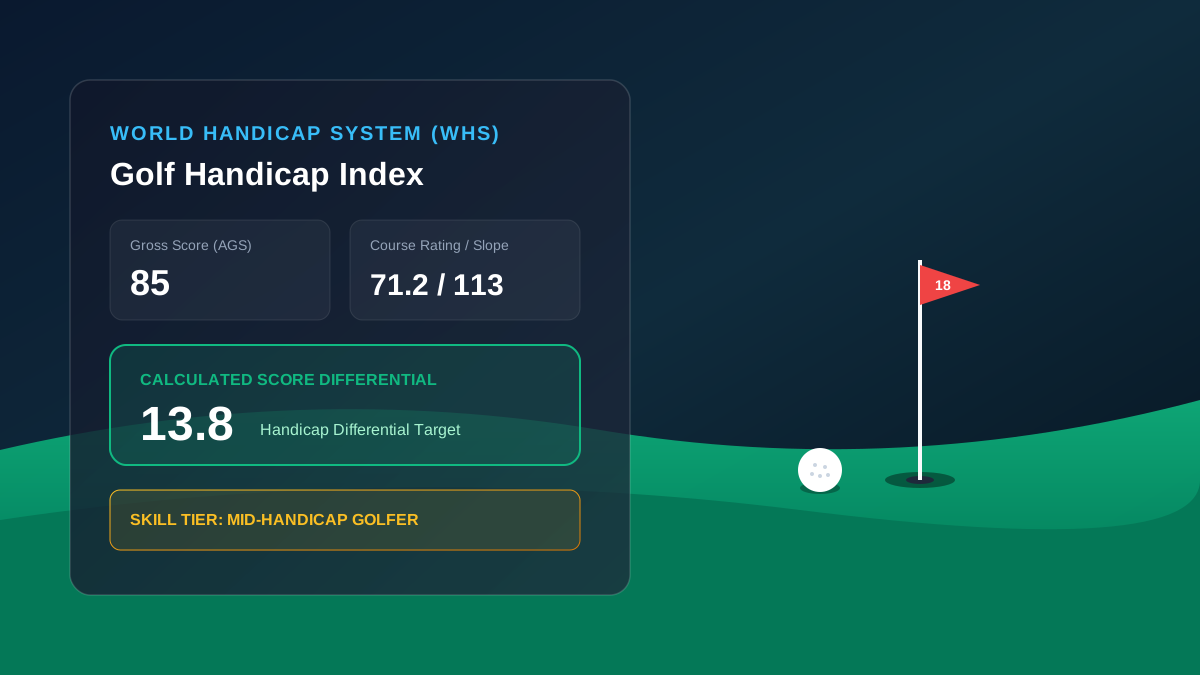
Consider a golfer who shoots an Adjusted Gross Score of 85 on a course with a Course Rating of 71.2 and a Slope Rating of 113 (standard benchmark difficulty):
- Identify Inputs:***
- Compute Score Above Rating:
- Apply Slope Adjustment Ratio ():
- Example 2 (Difficult Course): Suppose the same score of 85 was achieved on a challenging championship course with and :Insight:* Shooting an on the tough course yields a $9.3$ differential (single-digit skill), compared to a $13.8$ differential on the standard course!
7. Visual Explanations
Average Stroke Breakdown for a Mid-Handicap Golfer
pie title Stroke Contribution Breakdown in a 20-Handicap Golfer Round
    "Short Game Pitching & Chipping (35%)" : 35
    "Putting Strokes (32%)" : 32
    "Tee Shot Driving Distance & Accuracy (20%)" : 20
    "Long Iron & Hybrid Approach Shots (13%)" : 13
8. Parameter Comparison Matrix
| Gross Score | Course Rating (CR) | Slope Rating (SR) | Calculated Differential | Player Skill Tier | Key Handicap Takeaway |
|---|---|---|---|---|---|
| 72 (Even Par) | $72.0$ | (Standard) | $0.0$ | Scratch Golfer | Perfect baseline score |
| 78 | $71.5$ | (Championship) | $5.65$ | Single-Digit Low | Strong performance under pressure |
| 85 | $71.2$ | (Standard) | $13.8$ | Mid-Handicap | Solid recreational round |
| 92 | $70.8$ | (Moderate) | $19.16$ | Mid-Handicap | Potential lowest 8 differential score |
| 105 | $68.5$ | (Executive) | $37.5$ | High-Handicap | Developing golfer baseline |
9. Real-World Applications & Case Studies
- Equitable Tournament Scoring: In a corporate charity tournament, Player A (Handicap Index $5.0$) plays against Player B (Handicap Index $20.0$). On a course with Slope , Player A gets strokes while Player B gets strokes. Net scoring allows both players to compete on equal terms for the trophy.
- Case Study (Net Double Bogey Adjustment): A 15-handicap golfer suffered a disaster hole, taking 9 strokes on a Par 4 (quintuple bogey). Under WHS rules, the maximum score allowed for handicap posting is Net Double Bogey (Par + strokes + handicap stroke = ). The score of was reduced to before calculating the round differential, preventing one catastrophic hole from inflating their true potential index.
10. Advantages & Limitations
Advantages
- Portability: Converts scores from courses anywhere in the world into a standardized index.
- Rewards Potential: By averaging only the best 8 of 20 rounds, bad weather days or experimental rounds do not ruin your official handicap index.
- Prevents Sandbagging: Net Double Bogey caps stop golfers from intentionally inflating their scores.
Limitations
- Small Sample Volatility: Golfers with fewer than 20 total posted scores use temporary scaling tables ( lowest score for 3 rounds, lowest for 6 rounds), which can cause temporary index swings.
11. Common Pitfalls
Pitfall 1: Forgetting to Apply Net Double Bogey Caps Before Posting
Never post your unadjusted raw gross score if you had an 8 or 9 on a hole. Always apply Net Double Bogey maximums () to individual holes prior to differential calculation.
12. Frequently Asked Questions (FAQ)
Q: What is a good Golf Handicap Index?
A: The average male golfer has a Handicap Index of approximately $14.0$, while the average female golfer has an index of $27.0$. An index under $10.0$ represents the top 25% of active golfers.
Q: What is the difference between Course Rating and Slope Rating?
A: Course Rating is the expected score for a scratch golfer ( handicap) on a normal day. Slope Rating (ranging from to ) measures how much harder the course is for a bogey golfer relative to a scratch golfer.
Q: How many scores do I need to get an official WHS Handicap Index?
A: You need to post a minimum of 54 holes (either three 18-hole rounds or six 9-hole rounds).
13. Expert Tips & Summary
- Post Every Eligible Score: Always post your score on the day played so the WHS engine can apply the daily Playing Conditions Calculation () if weather was severe.
- Focus on Short Game Improvement: Over 65% of all wasted strokes in mid-to-high handicap golfers occur within 100 yards of the green.
- Summary: Calculating score differentials () establishes an accurate, portable benchmark of demonstrated athletic potential in golf.
Additional Technical Guidelines & Measurement Standards
When conducting calculations for Golf Handicap Differential Index Calculator, maintaining quantitative precision and verifying input parameter boundaries is essential for reliable scenario evaluation. Always verify that raw numerical inputs are measured using standardized instrumentation, and double-check unit conversions prior to applying outputs in commercial, industrial, or academic projects.
For quantitative unit conversions and scientific calculations, always maintain at least four decimal places of precision during intermediate arithmetic stages before rounding final results. When preparing technical reports, laboratory documentation, or financial forecasts, cross-verify all output variables against established international measurement standards (such as SI, NIST, and ISO metric benchmarks) to guarantee consistent analytical rigor across all computational workflows.
MathsLover.com delivers this interactive solver 100% free of charge to foster global mathematical literacy, educational accessibility, and data-driven problem solving across scientific, technical, and academic communities worldwide.