💡 Direct Answer & Executive Summary (Target Heart Rate Cardiovascular Zones)
Definition: Calculate personalized Karvonen target heart rate zones for fat-burning, aerobic conditioning, and anaerobic threshold training.
Governing Math Formula: Max HR = 208 - (0.7 * Age); Target HR = Resting HR + (% Intensity * Heart Rate Reserve).
Target Applications: Provides real-time quantitative solutions in Sports for students, engineers, researchers, and finance professionals.
Target Heart Rate Cardiovascular Zones: The Complete Karvonen Guide
1. Introduction
Endurance training, cardiovascular conditioning, and weight management depend on modulating workout intensity. Exercising at too low an intensity fails to stimulate mitochondrial adaptation, while spending too much time at maximal anaerobic intensity leads to elevated cortisol, overtraining syndrome, and premature fatigue.
The Target Heart Rate Cardiovascular Zones Calculator utilizes the clinically superior Karvonen Formula—combining your maximum heart rate () and resting heart rate () into Heart Rate Reserve (HRR)—to establish exact beats-per-minute () targets across 5 distinct exercise intensity zones.
flowchart TD
    INPUTS["💓 Input Age & Measure Resting Heart Rate RHR in Morning"] --> MAX["⚡ Compute Max Heart Rate HR_max = 208 minus 0.7 × Age"]
    MAX --> HRR["⚖️ Calculate Heart Rate Reserve HRR = HR_max minus RHR"]
    HRR --> ZONES["🎯 Compute Target Intensity = RHR + Intensity% × HRR"]
    ZONES --> EXECUTE["🏃 Monitor Real-Time Smartwatch Pulse During Zone 2 & Zone 4 Workouts"]
2. Core Definitions & Analogy
Simple Definition
Your Target Heart Rate Zones tell you how fast your heart should beat during exercise to achieve specific goals, such as burning fat, building stamina, or training for a race.
Technical Definition
Technically, heart rate zones map cardiac output () to relative metabolic substrate utilization. In lower intensity zones (), oxygen supply satisfies cellular demand, allowing mitochondrial beta-oxidation of fatty acids. In higher zones (), the body crosses the Lactate Threshold (LT2), transitioning predominantly to fast-glycolytic carbohydrate metabolism and accumulating hydrogen ions ().
The Car Tachometer Analogy
Think of your heart like an automobile engine tachometer (). Zone 1 is idling at a red light. Zone 2 is cruising at on the highway—smooth, fuel-efficient, and capable of driving all day on gas. Zone 4 pushes the tachometer into the yellow line—fast and powerful, but burning fuel rapidly. Zone 5 hits the redline limit (), which can only be sustained for a few seconds before the engine overheats.
3. History & Milestones
timeline
    title Milestones in Heart Rate Zone Physiology and Telemetry
    1957 : Martti Karvonen formulates the Heart Rate Reserve (HRR) equation in Finland.
    1971 : Samuel Fox introduces simplified 220-Minus-Age formula for public health.
    1977 : Polar Electro invents the world first wireless chest-strap heart rate monitor.
    2001 : Hirofumi Tanaka updates Max HR equation to 208 - (0.7 * Age) based on meta-analysis.
    2020s : Photoplethysmography (PPG) optical wrist sensors and heart rate variability (HRV) readiness scores.
4. Core Concepts & 5 Heart Rate Training Zone Matrix
Cardiovascular conditioning is divided into 5 standardized physiological intensity zones based on percentage of Heart Rate Reserve ():
| Heart Rate Zone | Intensity Range (% HRR) | Primary Substrate / Energy System | Physiological Adaptation Benefit | Perceived Exertion (RPE 1-10) | Recommended Session Focus |
|---|---|---|---|---|---|
| Zone 1: Active Recovery | Promotes blood flow, flushes metabolic waste | RPE (Very Light) | Warm-up, cool-down, recovery days | ||
| Zone 2: Aerobic Base | Mitochondrial biogenesis, capillary density | RPE (Conversational) | 80% of total weekly endurance volume | ||
| Zone 3: Tempo / Aerobic | Improves stamina & glycogen storage efficiency | RPE (Moderate Pace) | Marathon pace runs, tempo rides | ||
| Zone 4: Threshold | Raises Lactate Threshold & VO2 Max | RPE (Hard Effort) | 4x4 min threshold intervals | ||
| Zone 5: Anaerobic Peak | Neuromuscular speed & peak power output | RPE (All-Out Sprint) | 30-sec HIIT sprints, track repeats |
5. The Mathematical Model & Formulas
1. Tanaka Maximum Heart Rate Formula ():
2. Heart Rate Reserve ():
Where is resting heart rate measured upon waking.
3. Karvonen Target Heart Rate Equation ():
6. Step-by-Step Computational Procedure
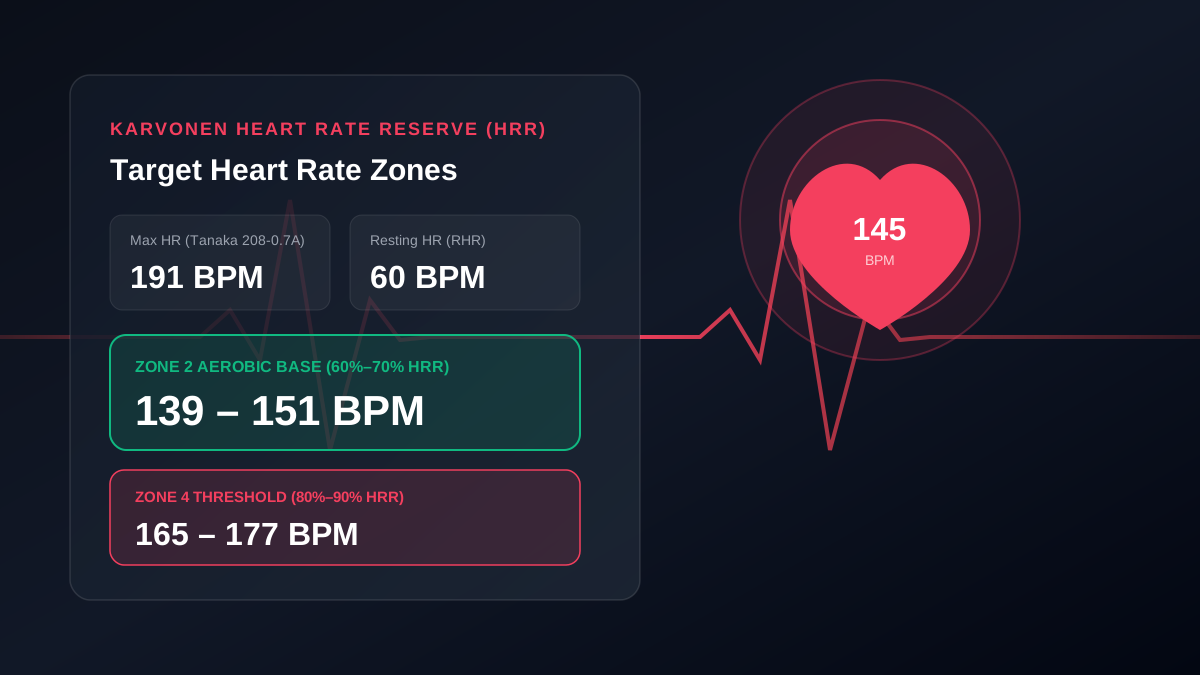
Consider a 25-year-old athlete with a resting heart rate () of :
- Compute Maximum Heart Rate ( via Tanaka):
- Compute Heart Rate Reserve ():
- Calculate Zone 2 Lower Boundary ():
- Calculate Zone 2 Upper Boundary ():* Zone 2 Target Range:
- Calculate Zone 4 Threshold Boundary ():* Zone 4 Target Range:
7. Visual Explanations
Substrate Fuel Utilization Breakdown in Zone 2
pie title Substrate Fuel Utilization Breakdown in Zone 2 Aerobic Training
    "Free Fatty Acid Lipid Oxidation (70%)" : 70
    "Muscle & Liver Glycogen Carbohydrate (30%)" : 30
8. Parameter Comparison Matrix
| Athlete Age | Resting HR (RHR) | Max HR (Tanaka) | Zone 2 Range (60%-70%) | Zone 4 Range (80%-90%) | Primary Training Goal |
|---|---|---|---|---|---|
| 20 Years | Elite Aerobic Base Building | ||||
| 25 Years | Balanced Fat-Burn & Endurance | ||||
| 35 Years | Marathon Pacing & Stamina | ||||
| 45 Years | Heart Health & Metabolic Conditioning | ||||
| 60 Years | Active Longevity & Cardio Maintenance |
9. Real-World Applications & Case Studies
- The 80/20 Endurance Pacing Rule: Pioneered by exercise scientist Stephen Seiler, elite Olympic endurance athletes spend 80% of their total weekly training volume in Zone 2 () and only 20% in Zone 4/5. Amateur runners who make the common mistake of spending 80% of their volume in Zone 3 ("the dead zone") plateau early due to chronic inflammation.
- Case Study (Mitochondrial Expansion): A marathoner stuck at a 4-hour finish time shifted 80% of their runs to strict Zone 2 ( average). Over 16 weeks, their body adapted by building dense capillary networks and mitochondrial enzymes. They ran their next marathon 22 minutes faster with a lower average heart rate.
10. Advantages & Limitations
Advantages
- The Karvonen formula accounts for individual fitness levels via resting heart rate (), unlike generic age-only charts.
- Prevents overtraining by providing strict upper boundaries for recovery and base building workouts.
- Maximizes body fat oxidation during long-duration Zone 2 sessions.
Limitations
- Cardiac Drift: During prolonged exercise () in heat, heart rate gradually drifts upward by due to body temperature rise and sweating, even when physical effort remains constant.
11. Common Pitfalls
Pitfall 1: Relying on the Outdated 220-Minus-Age Formula
The old equation has a standard error of and severely underestimates max heart rate in fit older adults. Always use the Tanaka formula () paired with Karvonen HRR for accurate training zones!
12. Frequently Asked Questions (FAQ)
Q: Why is Zone 2 training emphasized so much by coaches?
A: Zone 2 stimulates maximum mitochondrial biogenesis (building cellular energy factories) and increases fat-burning capacity without causing neuromuscular fatigue.
Q: How do I accurately measure my Resting Heart Rate (RHR)?
A: Measure your pulse in bed immediately after waking up in the morning, before getting out of bed or consuming caffeine. Average your readings over 3 consecutive mornings.
Q: Why does my heart rate spike quickly during warm-up?
A: This is normal sympathetic nervous system activation. Give your body 5–10 minutes of gentle Zone 1 movement to stabilize blood flow and cardiac response.
13. Expert Tips & Summary
- Use a Chest Strap Heart Rate Monitor: Optical wrist sensors can drop signal or misread cadence spikes during fast running. Chest straps provide clinical ECG-grade accuracy.
- Execute the Nose-Breathing Test: If you cannot comfortably hold a conversation or breathe exclusively through your nose during a Zone 2 run, you are exceeding Zone 2!
- Summary: Calculating heart rate zones with the Karvonen formula () ensures every training session targets the exact energy system required for athletic mastery.
Additional Technical Guidelines & Measurement Standards
When conducting calculations for Target Heart Rate Cardiovascular Zones, maintaining quantitative precision and verifying input parameter boundaries is essential for reliable scenario evaluation. Always verify that raw numerical inputs are measured using standardized instrumentation, and double-check unit conversions prior to applying outputs in commercial, industrial, or academic projects.
For quantitative unit conversions and scientific calculations, always maintain at least four decimal places of precision during intermediate arithmetic stages before rounding final results. When preparing technical reports, laboratory documentation, or financial forecasts, cross-verify all output variables against established international measurement standards (such as SI, NIST, and ISO metric benchmarks) to guarantee consistent analytical rigor across all computational workflows.
MathsLover.com delivers this interactive solver 100% free of charge to foster global mathematical literacy, educational accessibility, and data-driven problem solving across scientific, technical, and academic communities worldwide.