How to Calculate Area of Square and Rectangle: Complete Formulas, Diagonals & Real-Life Examples
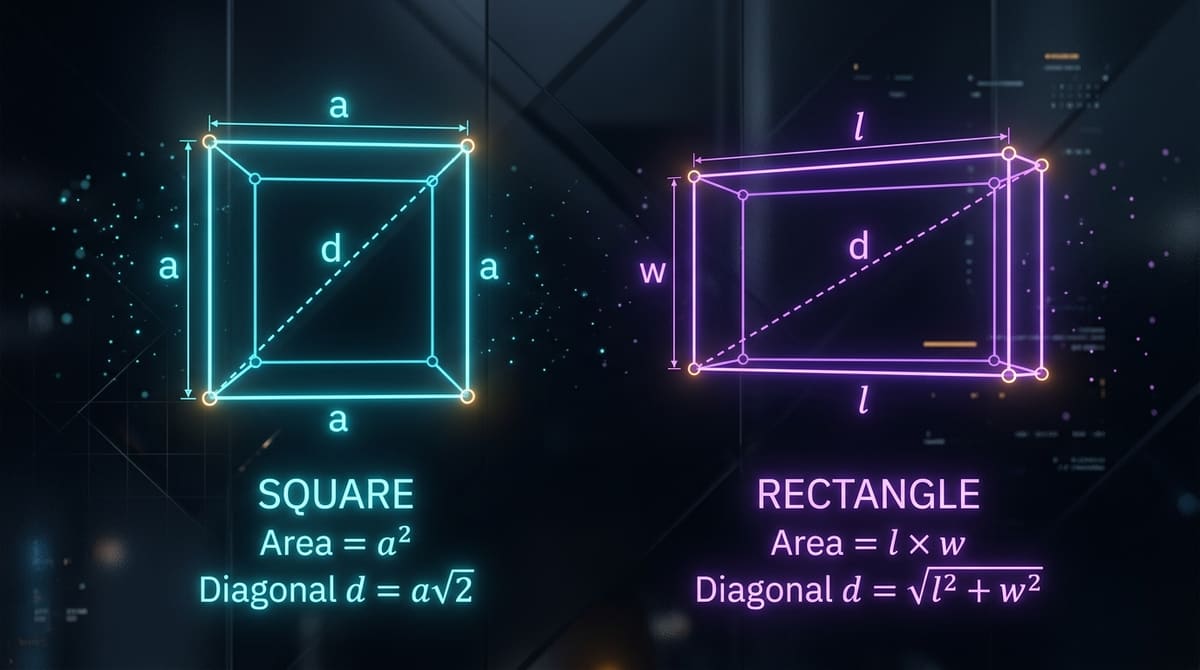
Table of Contents
14 CHAPTERS & WORKED PROOFS
- 1. Direct Reference: Master Formulas for Square & Rectangle Area
- 2. Geometric Anatomy: Squares, Rectangles & Quadrilateral Hierarchy
- 3. How to Calculate Area of a Square (3 Methods: Side, Diagonal, Perimeter)
- 4. How to Calculate Area of a Rectangle (3 Methods: Length/Width, Diagonal, Perimeter)
- 5. The Diagonal Connection: Pythagorean Theorem & Coordinate Geometry
- 6. The Isoperimetric Theorem: Why Squares Enclose More Area Than Rectangles
- 7. Calculating Area of L-Shaped & Composite Rectilinear Rooms
- 8. Real-World Applications: Flooring Tiles, Solar Panels & Screen Aspect Ratios
- 9. Master Practice Questions with Step-by-Step Solutions
- 10. Common Cognitive Pitfalls & Mistakes to Avoid
- 11. Unit Conversion Matrix for Square & Rectangular Areas
- 12. Formula Selection Decision Flowchart
- 13. Frequently Asked Questions (FAQ)
- 14. Summary & Interactive Geometric Solvers
1. Direct Reference: Master Formulas for Square & Rectangle Area
To calculate the area of a square, square the side length (): , or divide the squared diagonal by 2: . To calculate the area of a rectangle, multiply length () by width (): , or use a known diagonal () and width: . Always express your answer in square units ().
Squares and rectangles are the foundational building blocks of Euclidean geometry, architectural floor planning, computer graphics rasterization, and physical land surveying. Below is your quick reference formula comparison:
Standard Square
Multiply the side length by itself ().
Square Diagonal
Square the corner-to-corner diagonal, then divide by 2.
Standard Rectangle
Multiply horizontal length by vertical width.
Pythagorean Rectangle
Find length via , then multiply by .
Area of Square & Rectangle Solvers
Calculate area, perimeter, and diagonals instantly with step-by-step unit conversions.
2. Geometric Anatomy: Squares, Rectangles & Quadrilateral Hierarchy
In mathematics, every square is a rectangle, but not every rectangle is a square! Understanding this geometric relationship clarifies why area formulas share identical algebraic roots.
Visual Anatomy: Square vs. Rectangle
Figure 1: Core dimensions of squares and rectangles. Both shapes feature four interior right angles.
Axiomatic Geometric Properties
- Rectangle: An equiangular quadrilateral where all four interior angles equal . Opposite sides are parallel and of equal length ( and ).
- Square: A regular quadrilateral that is simultaneously a rectangle (four angles) and a rhombus (four equal side lengths ). Hence, a square is the special equilateral case of a rectangle where length equals width ().
- Perimeter Formulas:
- Square Perimeter: (or side )
- Rectangle Perimeter:
3. How to Calculate Area of a Square (3 Master Methods)
Depending on which measurement you have, there are three distinct algebraic methods to calculate the area of a square:
Method 3.1: Given Side Length ()
Multiply the side length by itself:
Worked Example: Square Garden Plot
Problem: A raised garden bed has a side length of . What is the planting surface area?
Solution:
- Write formula:
- Substitute :
- Compute:
Method 3.2: Given Diagonal Length ()
By the Pythagorean theorem, the diagonal of a square satisfies . Dividing both sides by 2 gives . Because area is :
Worked Example: Square Diamond Pitch
Problem: A square baseball diamond has a corner-to-corner diagonal distance of . What is the infield area?
Solution:
- Apply formula:
- Square the diagonal:
- Divide by 2: (equivalent to ).
Method 3.3: Given Perimeter ()
Since all 4 sides are equal (), the side length is . Substituting into the area formula:
4. How to Calculate Area of a Rectangle (3 Master Methods)
The area of a rectangle measures the grid of unit squares that fit inside its boundary.
Method 4.1: Given Length () and Width ()
Multiply the base length by the perpendicular height/width:
Worked Example: Rectangular Living Room
Problem: A room measures in length and in width. What is the floor area?
Solution:
- Formula:
- Calculate:
Method 4.2: Given Diagonal () and One Side ()
Using the Pythagorean theorem (), the missing length is . Therefore:
Worked Example: 65-Inch Television Screen Area
Problem: A 65-inch television has a diagonal of and a screen height (width) of . What is the screen display area?
Solution:
- Find horizontal length:
- Calculate area: ().
Method 4.3: Given Perimeter () and One Side ()
Because , the missing width is . Then:
5. The Diagonal Connection: Pythagorean Theorem & Coordinate Geometry
In any rectangle or square, the corner-to-corner diagonal bisects the shape into two congruent right-angled triangles. By Euclid's Proposition 47 (the Pythagorean Theorem):
Coordinate Geometry Formula
In a 2D Cartesian coordinate plane, if the four vertices of a rectangle are given by :
6. The Isoperimetric Theorem: Why Squares Enclose More Area Than Rectangles
One of the most powerful optimization principles in mathematics is the Isoperimetric Inequality. Suppose you have a fixed perimeter of fencing—say, . How should you shape your rectangle to maximize the enclosed area?
| Dimensions () | Perimeter $2(l+w)$ | Enclosed Area () | Efficiency vs. Square |
|---|---|---|---|
| (Very narrow) | 19% of maximum | ||
| 75% of maximum | |||
| 96% of maximum | |||
| (Perfect Square 🏆) | 100% (OPTIMAL MAXIMUM) |
Mathematical Proof via AM-GM Inequality: By the Arithmetic Mean - Geometric Mean inequality, for any two positive real numbers and :
Equality holds if and only if (a square). Thus, among all rectangles with equal perimeter, the square always encloses the maximum possible area.
7. Calculating Area of L-Shaped & Composite Rectilinear Rooms
Real-world architectural floor plans are rarely simple single rectangles. Most modern apartments feature L-shaped living-dining spaces or hallways.
The Decomposition Strategy (Add or Subtract)
- Method A (Additive Splitting): Slice the irregular L-shape into two separate rectangles ( and ), compute each area (, ), and add them together: .
- Method B (Subtractive Bounding Box): Calculate the overall bounding rectangle area () and subtract the missing corner rectangle cutout (): .
8. Real-World Applications: Flooring Tiles, Solar Panels & Aspect Ratios
Case Study 1: Real Estate Hardwood Flooring & Wastage
Estimating tile counts and material costs for a master bedroomA homeowner plans to install laminate wood flooring in a rectangular bedroom measuring . Flooring planks are sold in boxes covering each at $\$55.00$ per box. Standard construction practices require adding a 10% wastage buffer for corner cuts.
- Net room area: .
- Area with 10% wastage: .
- Boxes needed: (rounded up to nearest whole box).
- Total material cost: $13 \times \$55.00 = \mathbf{\$715.00}$.
Case Study 2: Rooftop Solar Panel Power Density
Calculating kilowatt output from rectangular photovoltaic surface areaA residential solar panel has rectangular dimensions of (area ). At peak solar irradiance of and 21.5% panel efficiency:
9. Master Practice Questions with Step-by-Step Solutions
The Square Courtyard
A square outdoor courtyard requires a perimeter fence of . What is the total paved surface area inside the courtyard?
Show Step-by-Step Solution ▾
Step 1: Find the side length:
Step 2: Calculate the area:
The Rectangular Storage Container
A shipping crate floor has a width of and a diagonal corner distance of . What is the floor area of the container?
Show Step-by-Step Solution ▾
Step 1: Calculate missing length using Pythagorean Theorem:
Step 2: Calculate rectangular area:
The L-Shaped Office Hallway
An L-shaped corporate lobby has an outer bounding dimension of by , but has a missing corner cutout measuring by . What is the total usable floor area?
Show Step-by-Step Solution ▾
Step 1: Compute total bounding rectangle area:
Step 2: Compute cutout area:
Step 3: Subtract cutout from total:
10. Common Cognitive Pitfalls & Mistakes to Avoid
❌ Pitfall 1: Confusing Perimeter and Area
Perimeter measures 1D outer boundary ($2l + 2w$) in linear meters (). Area measures 2D enclosed surface () in square meters ().
❌ Pitfall 2: Unit Mismatches
Multiplying a length in feet by a width in inches yields invalid units! Always convert all dimensions to the same unit before multiplying.
❌ Pitfall 3: Diagonal Squared Misconception
For a square, area is , NOT . Forgetting to divide by 2 doubles your answer erroneously.
❌ Pitfall 4: Non-Linear Scaling
Doubling both sides of a rectangle ( and ) quadruples its area (), not doubles it!
11. Unit Conversion Matrix for Square & Rectangular Areas
| From Area Unit | To Area Unit | Multiply By | Mathematical Conversion |
|---|---|---|---|
| Square Feet () | Square Inches () | ||
| Square Yards () | Square Feet () | ||
| Square Meters () | Square Centimeters () | ||
| Acres | Square Feet () | ||
| Square Meters () | Square Feet () |
12. Formula Selection Decision Flowchart
Square & Rectangle Decision Tree
Select your known shape parameters:
13. Frequently Asked Questions (FAQ)
How do you calculate the area of a square without side length?
If you do not have the side length, you can calculate the area of a square from its diagonal using , or from its perimeter using .
How do you calculate the area of a rectangle with diagonal and width?
Use the Pythagorean Theorem to find the missing length: . Then multiply length by width: .
Is a square always a rectangle?
Yes. A rectangle is defined as a quadrilateral with four right angles. Because every square has four right angles, every square satisfies the geometric definition of a rectangle where .
What happens to the area of a rectangle if length and width are doubled?
Because , doubling both linear dimensions increases the enclosed area by a factor of 4 (400%).
How do you find the side length of a square if only the area is known?
Take the principal square root of the area: . For example, if a square has an area of , each side is .
Why is a square more efficient than a rectangle for fencing?
By the Isoperimetric Theorem and AM-GM inequality, for any fixed perimeter length, a square encloses the strictly maximum possible 2D area. Long, narrow rectangles waste fencing perimeter on excessive perimeter-to-area ratios.
14. Summary & Interactive Geometric Solvers
Mastering how to calculate area of a square and rectangle provides essential mathematical leverage across construction, interior design, packaging optimization, and physics. Key formulas to remember:
- Square Area: or
- Rectangle Area: or
- Square Diagonal:
- Rectangle Diagonal:
Explore our live computational tools: Area of Square Calculator, Area of Rectangle Calculator, Area of Circle Calculator, and Area of Triangle Calculator on MathsLover.