How to Calculate Area of a Circle: Formulas, Proofs & Real-Life Examples
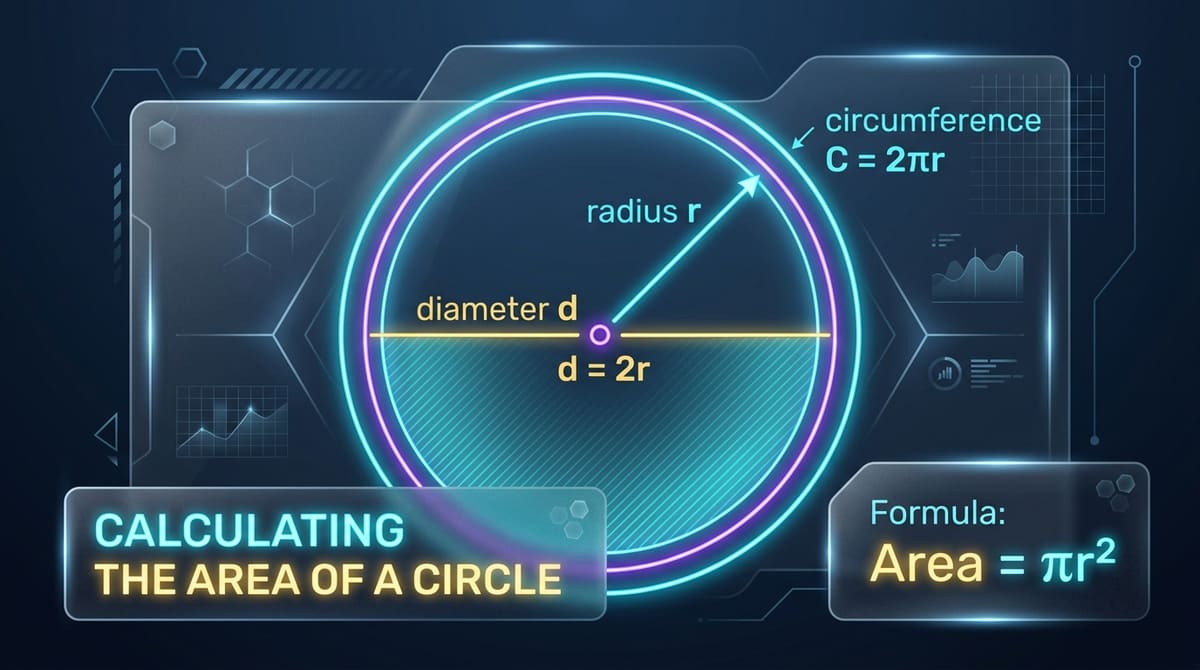
Table of Contents
14 CHAPTERS & INTERACTIVE PROOFS
- 1. Quick Reference: The 4 Core Circle Area Formulas
- 2. Anatomical Foundations: Radius, Diameter, Circumference &
- 3. Method 1: Calculating Area from Radius ()
- 4. Method 2: Calculating Area from Diameter ()
- 5. Method 3: Calculating Area from Circumference ()
- 6. Advanced Sub-Geometries: Sectors, Segments & Annulus Rings
- 7. Mathematical Derivations & Proofs: From Archimedes to Calculus
- 8. Real-World Applications: The Pizza Paradox, Hydraulic Pipes & Irrigation
- 9. Master Practice Questions with Step-by-Step Solutions
- 10. Common Cognitive Pitfalls & Mistakes to Avoid
- 11. Unit Conversion Matrix for Area Calculations
- 12. Formula Selection Decision Flowchart
- 13. Frequently Asked Questions (FAQ)
- 14. Summary & Interactive Tools
1. Quick Reference: The 4 Core Circle Area Formulas
To calculate the area of a circle, multiply () by the square of its radius (): . If you know the diameter (), use . If you know the circumference (), use . Always express circular surface area in square units (such as ).
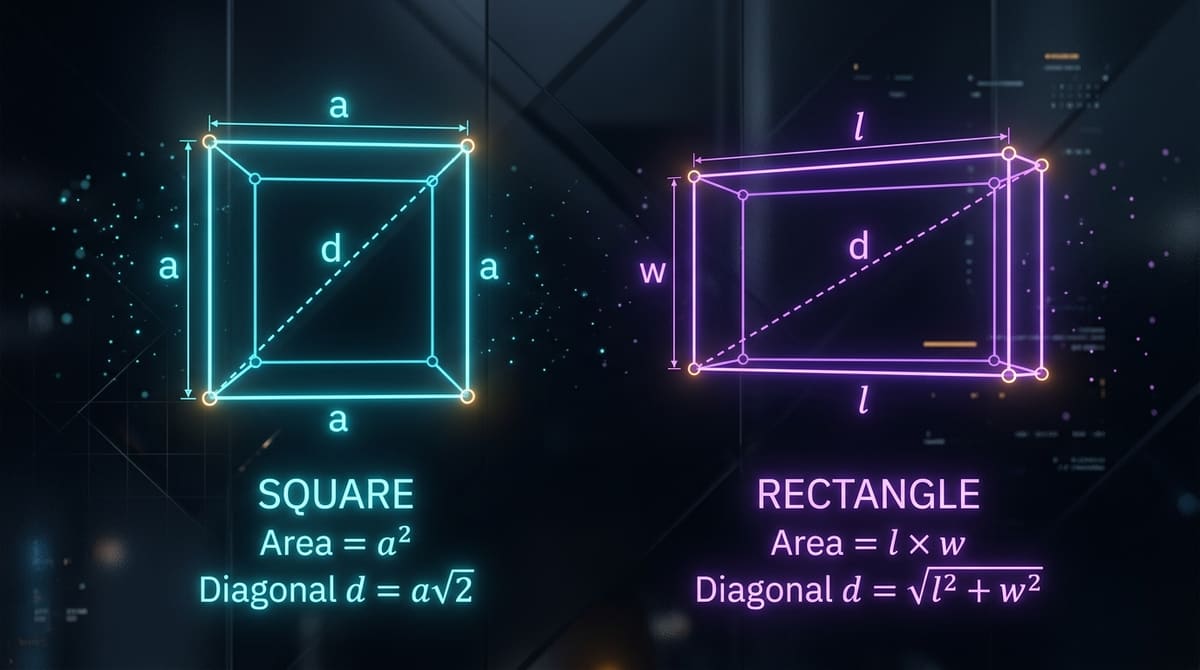
Learning how to calculate area of a circle is one of the most fundamental skills in geometry, physics, engineering, and everyday life. The area of a circle is the total two-dimensional space enclosed inside its circular perimeter boundary (the circumference). Related 2D shape calculations include the Area of Square, Area of Rectangle, Area of Triangle, and Area of Ellipse.
Depending on which geometric dimension you already know, you can immediately calculate the circle's area using one of the four standard master formulas:
Standard Formula
Square the radius, then multiply by ().
Diameter Formula
Square the diameter, multiply by , then divide by 4.
Perimeter Formula
Square the perimeter/circumference, then divide by ().
Annulus Formula
Subtract the inner radius squared from the outer radius squared, times .
Area of Circle Calculator
Instantly compute area, circumference, and diameter with live step-by-step conversions in metric and imperial units.
2. Anatomical Foundations: Radius, Diameter, Circumference &
To understand exactly how to calculate area of a circle, it is crucial to recognize how its core geometric dimensions connect to one another. A circle is mathematically defined as the set of all points in a two-dimensional plane that are equidistant from a fixed reference point known as the center.
Anatomy of a Circle: Core Geometric Relationships
Figure 1: Core elements of a circle. Radius is half the diameter (), while circumference is the outer perimeter ().
Key Terms & Definitions
- Radius (): The straight-line distance from the central origin of the circle to any point along its outer boundary edge.
- Diameter (): The longest straight-line segment passing directly through the center point, connecting two opposing perimeter points. By definition, , or conversely, .
- Circumference (): The linear perimeter distance around the outside edge of the circle. Calculated as .
- Pi (): The transcendent mathematical constant representing the invariant ratio between any circle's circumference and its diameter:
For mental calculations or homework, or the rational fraction is frequently used.
3. Method 1: Calculating Area from Radius ()
The most famous, widely taught formula for the area of a circle is derived directly from its radius:
Standard Radius Formula
Where is the circle area in square units (), is the radius length, and .
Step-by-Step Procedure:
- Step 1: Identify or measure the radius (). Ensure your measurement is in consistent units (e.g., centimeters, inches, or meters).
- Step 2: Square the radius (). Multiply the radius by itself (). Warning: Do not multiply by 2!
- Step 3: Multiply by . Multiply the squared radius by $3.14159$ (or use the key on your calculator for complete precision).
- Step 4: Attach square units. Label your final result with square units ().
Worked Example 1: Finding Area from a Radius of
Problem: A circular glass coaster has a radius of . What is its total surface area?
Solution:
- Write the formula:
- Substitute :
- Evaluate the square:
- Multiply by :
Using the fractional approximation : .
4. Method 2: Calculating Area from Diameter ()
In manufacturing, construction, carpentry, and astronomy, it is usually much easier to measure across the full width of an object (the diameter) rather than locating its exact invisible center point.
Because the radius is half of the diameter (), we can substitute into the standard radius formula:
Diameter Formula
Where is the total diameter length. The constant factor .
Worked Example 2: Finding Area of a 14-Inch Pizza Pan
Problem: A round baking pan has a measured outer diameter of . What is the cooking surface area?
Method A (Direct Diameter Formula):
Method B (Halving to Radius First):
- Find radius:
- Apply
Both methods produce the exact same result!
5. Method 3: Calculating Area from Circumference ()
What if you are measuring a solid tree trunk, a giant architectural pillar, or an inflated storage silo where you cannot cut through the middle to measure the diameter? You can wrap a flexible tape measure around the perimeter to find its circumference ().
Since , solving for gives . Substituting this into :
Circumference (Perimeter) Formula
Square the circumference , then divide the result by .
Worked Example 3: Cross-Sectional Area of a Giant Redwood Tree
Problem: A forester measures the circumference of a giant circular sequoia trunk to be . What is the cross-sectional area of the trunk?
Solution:
- Formula:
- Square the circumference:
- Calculate :
- Divide:
6. Advanced Sub-Geometries: Sectors, Segments & Annulus Rings
Real-world geometric problems frequently involve partial circular regions or hollow circular washers. Here is how to compute areas for circular sectors, segments, and concentric rings:
🍕 1. Circular Sector
Enclosed by two radii and an arc with central angle :
slice with : .
🍩 2. Circular Annulus
Flat ring region between outer radius and inner radius :
Factored: . Tangent chord : .
📐 3. Circular Segment
Region between chord line and arc ():
Degrees: .
🌓 4. Semicircle & Quadrant
Half () and quarter () sub-divisions of a circle:
Semicircle perimeter: . Quadrant perimeter: .
7. Mathematical Derivations & Proofs: From Archimedes to Calculus
Why is the area of a circle exactly ? For centuries, humans simply estimated circle areas by approximating them with squares or polygons. The rigorous proof that is one of the greatest triumphs of human thought.
Proof 1: Archimedes' Geometric Unrolling Dissection (250 BC)
In his treatise Measurement of a Circle, the Greek polymath Archimedes of Syracuse proved that the area of any circle is equal to the area of a right triangle whose base equals the circle's circumference () and whose height equals the radius ().
Archimedes' Concentric Ring Unrolling Proof
Figure 2: Cutting concentric nested rings along the radius and flattening them out forms a right-angled triangle with base and height .
Using the elementary formula for the area of a triangle ():
Proof 2: Calculus Integral (Concentric Onion Shell Integration)
In modern integral calculus, we view the interior area of a circle with total radius as the continuous sum of infinitely many ultra-thin concentric rings of radius and infinitesimal radial thickness .
Each thin ring has an unrolled rectangular strip area equal to . Integrating from to :
Proof 3: Double Integral in Polar Coordinates
In 2D polar coordinates where and , the differential area element is . Integrating over the full circle domain ( and ):
8. Real-World Applications: The Pizza Paradox, Hydraulic Pipes & Irrigation
Because the radius is squared (), circle area scales quad-ratically. Doubling the radius or diameter of a circle does not double its area—it makes the area four times (400%) larger! This non-linear scaling creates surprising and powerful real-world consequences:
Case Study 1: The Famous Pizza Sizing Paradox
Why one 18-inch pizza has MORE food than TWO 12-inch pizzas!Suppose a pizzeria sells an 8-inch personal pizza for $8, a 12-inch medium pizza for $14, and an 18-inch extra-large pizza for $22. Which option delivers the most pizza per dollar?
| Pizza Option | Radius () | Total Area () | Price | Cost per Sq Inch |
|---|---|---|---|---|
| Two 8-Inch Pizzas | each | $16.00 | ||
| One 12-Inch Medium | $14.00 | |||
| Two 12-Inch Mediums | each | $28.00 | ||
| One 18-Inch Extra Large 🏆 | $22.00 | (BEST VALUE) |
Key Takeaway: One 18-inch pizza provides of pizza, which is larger than two entire 12-inch pizzas (), while saving you $6.00! One single 12-inch pizza also gives 12.5% MORE pizza than two 8-inch pizzas.
Case Study 2: Civil Engineering & Hydraulic Pipe Capacity
Why doubling pipe diameter increases fluid carrying capacity by 4x!In plumbing and municipal civil engineering, fluid flow velocity () through a circular pipe is directly governed by its cross-sectional area: .
When an engineer replaces a diameter pipe () with a diameter pipe (), the cross-sectional area increases by a factor of 4. Under laminar flow according to the Hagen-Poiseuille law, volumetric flow rate actually scales with (a massive 16-fold increase for equal pressure gradients!).
Case Study 3: Agricultural Center-Pivot Crop Circles
Calculating farmland acreage from satellite-visible irrigation circlesWhen flying over agricultural regions like the American Midwest or Saudi Arabia, circular green fields are visible from airplanes. These are created by motorized center-pivot sprinklers of radius ().
Farmers use this exact area computation to calculate the precise quantities of fertilizer, seed bushels, and millions of liters of water required per harvesting season.
9. Master Practice Questions with Step-by-Step Solutions
Test your mastery of how to calculate area of a circle with these three progressive practice problems ranging from standard conversions to real-world composite geometry:
The Round Swimming Pool Cover
A circular above-ground swimming pool has an outer perimeter circumference of . What is the surface area of the pool cover needed to fit over the pool? (Use ).
Show Step-by-Step Solution ▾
Step 1: Choose the formula. Given circumference , we use .
Step 2: Square the circumference:
Step 3: Calculate the denominator ():
Step 4: Compute the area:
Alternative check: Find radius first . Then .
The Landscaping Flowerbed & Mulch Cost
A landscape gardener is designing a circular flowerbed with a total diameter of . The flowerbed requires a mulch layer that is () deep. If premium mulch costs per cubic meter (), what is the total cost of the mulch?
Show Step-by-Step Solution ▾
Step 1: Find the radius of the circular bed:
Step 2: Calculate the 2D surface area:
Step 3: Calculate the 3D volume of mulch needed:
Step 4: Calculate total material cost:
Paved Walkway Around a Fountain
A city park contains a circular water fountain of radius . The city builds a concentric circular paved walkway around the fountain with a uniform width of . What is the total paved area of the walkway in square meters?
Show Step-by-Step Solution ▾
Step 1: Identify the inner and outer radii:
- Inner radius (fountain):
- Outer radius (fountain + walkway):
Step 2: Apply the circular annulus formula:
Step 3: Simplify the difference of squares:
Step 4: Multiply by :
Conclusion: The contractor must purchase paving stones to cover exactly .
10. Common Cognitive Pitfalls & Mistakes to Avoid
Even advanced STEM students frequently make systematic mistakes when computing circular areas. Review these top four pitfalls before taking your exam or ordering materials:
❌ Pitfall 1: Confusing with
Squaring a number means multiplying it by itself (), NOT multiplying it by 2 (). Multiplying by 2 computes diameter, not area!
❌ Pitfall 2: Forgetting to Divide Diameter by 4
When given diameter , the formula is . If you compute without dividing by 4, your answer will be 400% too large.
❌ Pitfall 3: Unit Squaring Misconceptions
, but . Always convert linear dimensions before squaring to avoid 100x errors!
❌ Pitfall 4: Mixing Degrees and Radians in Sectors
When calculating sector area, requires angle in radians. If your angle is in degrees, you must use .
11. Unit Conversion Matrix for Area Calculations
When working on real-world engineering or international problems, converting between metric and imperial area units is essential:
| From Unit | To Unit | Multiply By | Exact Conversion Factor |
|---|---|---|---|
| Square Inches () | Square Centimeters () | ||
| Square Feet () | Square Meters () | ||
| Square Meters () | Square Feet () | ||
| Square Meters () | Acres | ||
| Square Meters () | Hectares () |
12. Formula Selection Decision Flowchart
Use this quick reference decision guide to select the fastest calculation path for any circle area problem:
Circle Area Decision Tree
What information do you currently have?
13. Frequently Asked Questions (FAQ)
How do you calculate the area of a circle with only the diameter?
To calculate the area of a circle with only the diameter, square the diameter (), multiply by , and divide the product by 4: . Alternatively, divide the diameter by 2 to find the radius () and calculate .
What is the formula for the area of a circle without radius?
If you do not have the radius, you can calculate the area from the diameter using or from the circumference using .
Why is the area of a circle instead of ?
is the 1D linear distance around the outer boundary (the circumference), measured in linear units like meters or inches. In contrast, measures the 2D surface space enclosed inside the perimeter in square units ().
What happens to the area of a circle if the radius is tripled?
Because area is proportional to the square of the radius (), tripling the radius () multiplies the area by (900%).
How do you find the radius of a circle if only the area is given?
To calculate the radius from the area, divide the given area by , then take the square root of the quotient: . For example, if a circle has an area of , its radius is .
How do you calculate the area of a semicircle and a quadrant?
A semicircle is half a circle (), so its area is . A quadrant is a quarter circle (), so its area is .
Should I use $3.14$, , or the button on my calculator?
For precision engineering, scientific modeling, or computer programming, always use the built-in constant ($3.1415926535...$). For fast mental estimates, $3.14$ or the fraction (which is accurate to 0.04%) is ideal.
14. Summary & Interactive Tools
Knowing how to calculate area of a circle unlocks fundamental mastery across algebra, geometry, physics, construction, and daily financial decision-making. Keep the three core formulas in mind:
- From Radius:
- From Diameter:
- From Circumference:
Need to run instant step-by-step calculations with custom dimensions and unit conversions? Try our free Area of Circle Calculator on MathsLover.