How Much Water to Drink a Day Calculator: Formulas, Weight Charts & Daily Hydration Guide
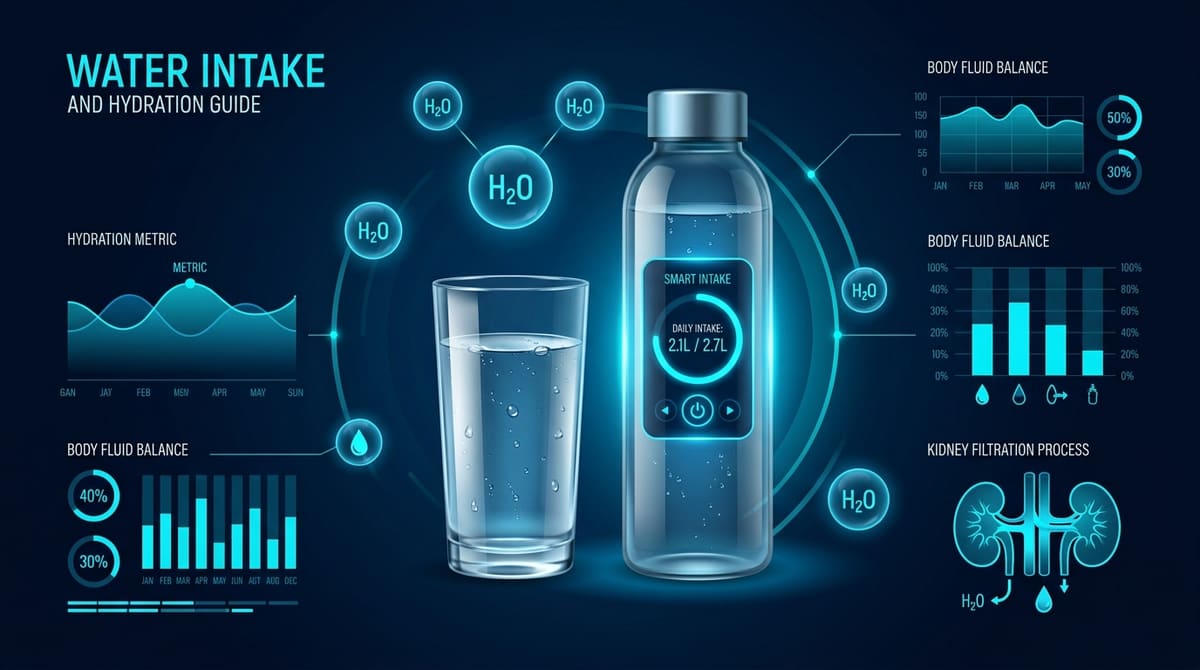
Table of Contents
14 CHAPTERS & CLINICAL MODELS
- 1. Quick Reference: Master Formulas for Daily Water Intake
- 2. Cellular Physiology: Why Water Is the Foundation of Human Biology
- 3. Debunking the "8 Glasses a Day" (8×8) Myth: Where Did It Come From?
- 4. Clinical Calculation Models: Weight, Calories & Holliday-Segar Methods
- 5. Dynamic Adjustments: Physical Exercise, Climate, Altitude & Heat Index
- 6. Demographic Variances: Men, Women, Pregnancy, Lactation & Older Adults
- 7. Dietary Hydration: Moisture in Food, Coffee, Tea & Metabolic Water
- 8. Self-Monitoring: The Armstrong Urine Color Index & Bio-Markers
- 9. Pathophysiology: Mild Dehydration vs. Life-Threatening Hyponatremia
- 10. The Electrolyte Equation: Sodium, Potassium & Osmotic Balance
- 11. Athlete Protocol: Calculating Exact Sweat Rate per Hour of Training
- 12. Practical 24-Hour Hydration Schedule for Peak Energy & Focus
- 13. Frequently Asked Questions (FAQ)
- 14. Summary & Interactive Hydration Calculators
1. Quick Reference: Master Formulas for Daily Water Intake
According to clinical guidelines from the National Academies of Sciences, Engineering, and Medicine (NASEM), average baseline daily total fluid intake for healthy sedentary adults in temperate climates is 3.7 Liters (125 fl oz / 15.5 cups) for men and 2.7 Liters (91 fl oz / 11.5 cups) for women. Individually, multiply body weight by 30 to 35 mL per kg (or 0.5 to 0.7 fl oz per pound), then add 350 to 500 mL per 30–60 minutes of exercise.
Calculating how much water to drink a day is critical for cognitive focus, cardiovascular stamina, metabolic rate, kidney function, and joint cushioning. Fluid needs vary depending on body weight, muscle mass, exercise sweat rates, and climate. Related health & fitness calculators on MathsLover include the BMR Mifflin-St Jeor Calculator, TDEE Daily Energy Calculator, Calorie Deficit Calculator, and BMI Category Calculator.
Adult Men Baseline
Equates to ~125 fl oz or ~15.5 cups of total daily fluid intake.
Adult Women Baseline
Equates to ~91 fl oz or ~11.5 cups of total daily fluid intake.
Body Weight Rule
Multiply weight in kilograms by 30 to 35 mL (or 0.5–0.7 oz/lb).
Exercise Sweat Factor
Add 350 to 500 mL per 30–60 min of active moderate training.
Daily Water Intake Hydration Calculator
Calculate your exact personalized water target in Liters and Cups based on body mass and exercise duration.
2. Cellular Physiology: Why Water Is the Foundation of Human Biology
Water () is the primary chemical constituent of the human body. In healthy adults, total body water (TBW) accounts for roughly 55% to 65% of total body mass. In neonates, this fraction reaches as high as 75%, gradually declining as adipose (fat) tissue increases and muscle mass decreases across the lifespan.
Every single metabolic pathway, biochemical enzymatic reaction, cellular transport cycle, and hemodynamic process relies directly on water as a universal polar solvent and hydrostatic medium:
Water possesses an extraordinary specific heat capacity () and latent heat of vaporization ( at body temperature). By diverting blood flow to dermal capillary beds and evaporating sweat from the epidermis, the body dissipates massive thermal energy generated during cellular respiration and physical exercise.
Blood plasma is approximately 92% water. Adequate vascular volume maintains optimal cardiac output, stroke volume, and arterial blood pressure. When plasma volume drops due to inadequate water intake, hematocrit levels rise (blood viscosity increases), forcing the myocardium to work significantly harder at any given workload.
The kidneys filter approximately 180 liters of blood plasma each day through nephron glomerular units. Sufficient hydration allows kidneys to excrete urea, creatinine, excess uric acid, and metabolic toxins with low urinary specific gravity, dramatically decreasing the risk of nephrolithiasis (kidney stones) and urinary tract infections (UTIs).
Articular cartilage consists of 70% to 80% water bound to proteoglycan matrices. Water gives synovial fluid its non-Newtonian lubricant properties, cushioning diarthrodial joints. Furthermore, the brain and spinal cord are suspended within the hydrostatic shock-absorbing protective barrier of cerebrospinal fluid (CSF).
Physiological Fluid Compartments: Total Body Water (TBW) Distribution
Figure 1: Internal physiological division of Total Body Water (TBW) between intracellular and extracellular compartments.
3. Debunking the "8 Glasses a Day" (8×8) Myth: Where Did It Come From?
Almost everyone has heard the pervasive health rule: "You must drink eight 8-ounce glasses of water every day" (the famous 8×8 rule, equaling 64 fluid ounces or ~1.9 liters). Despite its massive popularity across lifestyle magazines and fitness apps, the 8×8 rule has zero definitive scientific origin.
🔍 The Historical Origin of the 8×8 Misconception
Medical historians trace this rule back to a 1945 recommendation published by the US Food and Nutrition Board of the National Research Council, which stated:
"An ordinary standard for diverse persons is 1 milliliter for each calorie of food. Most of this quantity is contained in prepared foods."
Crucially, the public memorized the first sentence (2,000 to 2,500 kcal daily diet = 2,000 to 2,500 mL water = ~8 glasses) while completely discarding the vital second sentence: "Most of this quantity is contained in prepared foods."
The fundamental flaw of the 8×8 rule is that it treats a 45 kg (100 lb) sedentary office worker working in an air-conditioned room identically to a 95 kg (210 lb) construction worker or athlete training in high summer heat. Modern exercise physiology demonstrates that hydration needs are strictly dynamic, individual, and biometric.
4. Clinical Calculation Models: Weight, Calories & Holliday-Segar Methods
Clinical nutritionists, nephrologists, and sports dietitians use validated mathematical formulas rather than generic rules of thumb to determine baseline daily fluid requirements. Here are the three primary evidence-based methods utilized by medical institutions:
Method 1: Body Mass Allometric Scale (WHO & NASEM Standard)
Because metabolic active cell mass correlates directly with body weight, the most common clinical baseline relies on a weight-indexed coefficient:
Example: For a person weighing ():
(approx. ).
Method 2: Holliday-Segar Clinical Formula
Developed in 1957 and still the universal gold standard for maintenance fluid calculation in hospital clinical settings worldwide:
| Body Weight Tier | Daily Maintenance Fluid Allocation |
|---|---|
| First 10 kg (0 to 10 kg) | |
| Second 10 kg (11 to 20 kg) | |
| Each kg beyond 20 kg (> 20 kg) | (adults) |
Example for 80 kg adult:
.
Method 3: Caloric Turnover Energy Equivalence Ratio
For athletes and physically active individuals, hydration requirements scale directly with Total Daily Energy Expenditure (TDEE):
If your daily energy expenditure is (calculated via your BMR and TDEE activity scale), your baseline fluid target is .
Quick Reference Chart: Daily Water Intake by Body Weight
Use this comprehensive baseline chart to instantly find your daily water intake in metric (Liters, Milliliters) and imperial units (Fluid Ounces, 8 oz Cups):
| Weight (kg) | Weight (lbs) | Sedentary Baseline (Liters) | Fluid Ounces (fl oz) | Standard Cups (8 oz) | Active / Exercise Target |
|---|---|---|---|---|---|
| 45 kg | 100 lbs | 1.58 L (1,575 mL) | 53 fl oz | 6.6 Cups | 2.08 L (~8.8 Cups) |
| 55 kg | 120 lbs | 1.93 L (1,925 mL) | 65 fl oz | 8.1 Cups | 2.43 L (~10.2 Cups) |
| 65 kg | 143 lbs | 2.28 L (2,275 mL) | 77 fl oz | 9.6 Cups | 2.78 L (~11.7 Cups) |
| 75 kg | 165 lbs | 2.63 L (2,625 mL) | 89 fl oz | 11.1 Cups | 3.13 L (~13.2 Cups) |
| 85 kg | 187 lbs | 2.98 L (2,975 mL) | 101 fl oz | 12.6 Cups | 3.48 L (~14.7 Cups) |
| 95 kg | 210 lbs | 3.33 L (3,325 mL) | 113 fl oz | 14.1 Cups | 3.83 L (~16.2 Cups) |
| 105 kg | 230 lbs | 3.68 L (3,675 mL) | 124 fl oz | 15.5 Cups | 4.18 L (~17.6 Cups) |
5. Dynamic Adjustments: Physical Exercise, Climate, Altitude & Heat Index
Your baseline water intake is only the foundational starting point. Environmental stresses and kinetic work create immediate sweat loss and increased respiratory water vapor dissipation. When calculating using a how much water to drink a day calculator, apply these validated adjustment coefficients:
| Lifestyle / Environmental Variable | Physiological Mechanism | Recommended Fluid Adjustment |
|---|---|---|
| Moderate Exercise (30–60 mins) | Eccrine sweat gland activation for core thermoregulation. | +350 to +500 mL (+12 to 17 fl oz) |
| Intense / Endurance Training (> 60 mins) | High sweat rates (up to 1.5–2.5 L/hr) plus glycogen bound water release. | +500 to +1,000 mL per active hour (with electrolytes) |
| Hot / Humid Climate (> 30°C / 86°F) | Impaired evaporative cooling efficiency forces higher profuse sweating. | +500 to +750 mL / day |
| High Altitude (> 2,500 m / 8,200 ft) | Hyperventilation in dry air increases respiratory vapor loss; altitude diuresis. | +750 to +1,200 mL / day |
| Dry Winter / Air-Conditioned Indoors | Low ambient relative humidity (< 30%) accelerates transepidermal water loss. | +250 to +400 mL / day |
6. Demographic Variances: Men, Women, Pregnancy, Lactation & Older Adults
Biological sex, hormonal phases, and physiological lifecycle stages profoundly alter cellular water retention and renal osmoregulation:
- Men vs. Women: Men typically possess a higher percentage of lean skeletal muscle mass (which is ~75% water) compared to adipose tissue (~10% water). Consequently, average baseline recommendations for men are higher (3.7 L vs. 2.7 L).
- Pregnancy: Maternal blood plasma volume expands by 40% to 50% to support fetal circulation and amniotic fluid volume. The American College of Obstetricians and Gynecologists (ACOG) recommends adding +300 mL/day (total ~3.0 L / 10 cups).
- Lactation (Breastfeeding): Breast milk consists of approximately 88% water. Producing 750 to 800 mL of milk daily requires an additional +700 to +1,000 mL/day of fluid intake (total ~3.8 L / 13–14 cups).
- Older Adults (Seniors 65+): The hypothalamic thirst mechanism (osmoreceptor sensitivity) blunts significantly with aging, while renal concentrating ability declines. Seniors must drink proactively on a schedule rather than waiting to feel thirsty.
7. Dietary Hydration: Moisture in Food, Coffee, Tea & Metabolic Water
One of the biggest misunderstandings in nutrition is assuming that "water intake" only counts pure tap or bottled water. In reality, human fluid balance is satisfied by three distinct inputs:
Cucumbers (96% water), Watermelon (92%), Strawberries (91%), Spinach (91%), and Oranges (88%) deliver cellular structured water rich in bioavailable potassium and magnesium electrolytes.
Contrary to old myths, clinical trials by Armstrong et al. confirm that moderate caffeine intake (< 400 mg/day, or 3–4 cups of coffee/tea) does not cause dehydration and contributes positively to net fluid balance.
When your mitochondria oxidize macronutrients for energy (), your body produces roughly 250 to 350 mL of pure metabolic water internally every single day!
8. Self-Monitoring: The Armstrong Urine Color Index & Bio-Markers
While online calculators provide the exact target volume, your body offers immediate visual bio-feedback through your urinary concentration. Developed by Dr. Lawrence E. Armstrong at the Human Performance Laboratory, the 8-level Urine Color Scale is the gold standard for daily self-assessment:
The Clinical Urine Color Spectrum Chart
9. Pathophysiology: Mild Dehydration vs. Life-Threatening Hyponatremia
Hydration is a Goldilocks metric: both too little and too much fluid carry severe physiological hazards. Understanding both ends of the spectrum ensures safe, high-performance daily hydration:
⚠️ Dehydration (Hypovolemia)
Losing just 1% to 2% of body mass in water impairs cognitive focus, slows executive working memory, increases fatigue, and triggers headaches.
- Elevated heart rate (+5 to 8 bpm per 1% fluid deficit)
- Impaired athletic power output (-10% to 15%)
- Reduced gastrointestinal motility & constipation
- Higher risk of heat exhaustion and kidney stones
💧 Hyponatremia (Water Intoxication)
Drinking excessive plain water (> 1 to 1.5 L/hr) faster than the kidneys can excrete () dilutes extracellular sodium below .
- Water moves osmotically into cells, causing cellular swelling
- Cerebral edema (brain swelling), confusion, and nausea
- Common in marathon runners who overdrink plain water
- Prevented by pacing fluid intake and adding sodium
10. The Electrolyte Equation: Sodium, Potassium & Osmotic Balance
Water cannot hydrate cells in isolation. The human body distributes water between the intracellular fluid (ICF) (two-thirds of TBW) and the extracellular fluid (ECF) (one-third of TBW) via sodium-potassium ATP pump gradient mechanics:
The 3 Essential Osmotic Electrolytes
- Sodium (): The primary extracellular cation (). Sodium holds water inside your blood vessels to maintain blood pressure and blood volume. When sweating heavily, consume 300 to 600 mg of sodium per liter of water.
- Potassium (): The primary intracellular cation (). Potassium pulls water inside your muscle and organ cells, preventing cramps and facilitating glycogen storage.
- Magnesium (): Regulates neuromuscular relaxation, enzymatic ATP phosphorylation, and electrolyte channel opening across cell membranes.
11. Athlete Protocol: Calculating Exact Sweat Rate per Hour of Training
For competitive runners, weightlifters, and endurance athletes, guessing fluid requirements during workouts is ineffective. The American College of Sports Medicine (ACSM) recommends performing a simple 1-hour sweat rate test:
ACSM Sweat Rate Formula
- Weigh yourself nude immediately before a 60-minute workout (e.g., ).
- Perform your workout at your typical intensity. Note exactly how much water you drink (e.g., ).
- Towel off all sweat completely and weigh yourself nude immediately after (e.g., ).
- .
Rehydration Rule: Consume 125% to 150% of your net weight lost within 2 to 4 hours post-exercise along with electrolytes to achieve complete rehydration.
12. Practical 24-Hour Hydration Schedule for Peak Energy & Focus
Gulping 2 liters of water all at once before bed leads to interrupted sleep and rapid urinary elimination without proper cellular absorption. Use this science-backed circadian hydration timeline:
Drink a large glass of room-temperature water with a pinch of sea salt or lemon immediately upon waking to replenish 8 hours of overnight respiratory moisture loss.
Sip water or green tea between work blocks. Maintaining hydration prevents the mid-morning cognitive slump and keeps prefrontal cortex executive focus sharp.
Drink 20–30 minutes before or with lunch. Water aids gastric enzyme dissolution and peristaltic fiber movement without diluting stomach acid.
Sip 150–250 mL every 15–20 minutes during exercise. For high-intensity training lasting > 60 mins, use electrolyte-fortified water.
Taper fluid intake 1 to 2 hours before bedtime to avoid nocturnal awakenings (nocturia) while ensuring restorative sleep and cellular repair.
13. Frequently Asked Questions (FAQ)
How much water should I drink a day according to my weight?
Does coffee, tea, or soda count towards my daily water intake?
Can drinking water help you lose weight?
How much extra water should I drink during a workout?
What are the earliest signs of mild dehydration?
How much water should I drink to prevent kidney stones?
Does drinking water improve skin health and acne?
Is it bad to drink cold ice water vs. room-temperature water?
14. Summary & Interactive Hydration Calculators
Optimizing your daily water intake is one of the highest-leverage biological habits for physical energy, mental clarity, and metabolic longevity. Explore MathsLover's interactive hydration and health solvers below to get personalized numbers tailored to your lifestyle:
Daily Water Intake Hydration Calculator
Compute exact target liters based on weight (kg) and workout duration (minutes).
Daily Water Intake in Cups Solver
Converts pounds of body weight and active work hours into convenient 8 oz cups per day.
BMR Mifflin-St Jeor Calculator
Calculate your resting metabolic calorie burn and metabolic water generation rate.
BMI & Healthy Weight Category Calculator
Assess healthy body weight ranges and clinical body mass index according to WHO standards.
📖 Read More Articles & Mathematical Guides
View All Articles →
How to Calculate Area of a Circle: Formulas, Proofs & Real-Life Examples

How to Calculate Area of Square and Rectangle: Complete Formulas, Diagonals & Real-Life Examples